Sunday, 5 January 2020

A Tribute to the Tributaries:The Secret Rivers of London.

"What kind of city buries its rivers? And what kind of city digs them up?" - Platform, 2012.

"For they were young, and the Thames was old. And this is the tale that the river told" - Rudyard Kipling, 1911.

When a Londoner speaks of the river, they speak of the river Thames. But the Thames is merely the father, or mother, of all London's rivers. All, or nearly all (some canals and the New River, for example, can be exempted), of London's waterways eventually flow into the Thames and finally, via the estuary, into the North Sea.

Some are visible, some are hidden. Some are visible at times, hidden at others. There are 27 tributaries of the Thames in London alone and many of them have several tributaries of their own which, in turn, have their own tributaries and so on and so on until you find out that that ditch which flows through your back garden flows into a brook which flows into a stream which flows into a river with flows into a creek which flows into the Thames and, finally, the sea.

The Museum of London Docklands on West India Quay hosted, towards the end of last year, an exhibition named Secret Rivers and if the name was misleading, many of these rivers are very well known, that did not reflect negatively on how interesting an experience I had when I spent a morning taking it in.


The rivers the Museum of London Docklands had chosen for consideration were the Walbrook, the Fleet, the Neckinger, the Westbourne, the Tyburn, the Effra, the Wandle, the Lea, and the Thames itself and the story the exhibition's curators were trying to tell is one of how those rivers have not just shaped London itself but how Londoners have shaped, and responded to, those rivers. How the rivers have been revered, used, and abused. How they've been utilised for transport, industry, sustenance, and pleasure and how they have inspired authors, musicians, and artists over the years.

"Where a spring or river flows, there should we build altars and offer sacrifices" is a quote attributed to the Roman philosopher and statesman Seneca who lived from 4BC to AD65 and though it seems likely that Seneca had the Tiber in mind it's a quote that could apply equally to the Ganges, the Jordan, or, of course, the Thames (and its tributaries).

Our need for water influenced where we built our earliest settlements (even now it's unusual to find a large city not based near a river or sea) and the Romans founded Londinium on the north bank of the Thames with the Walbrook flowing through the middle of the city. They also constructed the first bridge over the Thames which connected the then Londinium to the marshy islands of Southwark to the south.

It was only a matter of time before people started seeing the river as holy and furnishing it with votive offerings and sacrifices. The word Thames comes from the Latin Tamesis and is believed to derive its name from the Sanskrit word for 'dark'. It flows from the Cotswold Hills in Gloucestershire to, as we've established, the North Sea and it was once, before Britain was separated from continental Europe in something far more dramatic than Brexit, a tributary of the Rhine.

I've even read that the force of the Thames as it emptied into the Rhine was the impetus that pushed Britain away from Europe. While the Thames runs for 215 miles, the Walbrook's length is less than two miles. Rising from springs in Angel Islington and Shoreditch it meets the Thames near where Cannon Street station now stands. It was buried during the 15th century but during building work at the Bank of England (in both 1732 and 1803) construction workers spotted it flowing.


Middle Bronze Age skull (1260-900BC)

You can travel back another three thousand years if you're fishing skulls out of the Thames. The majority (but certainly not all) are prehistoric and the majority (but, again, not all) are the result of simple water burials. It's the river movement that's probably caused any polishing, scraping, and frontal tooth loss, and resulted in stones wedging themselves into the ear canals.

It wasn't just dead bodies that were affected by the elemental power of the river. Those living by its banks would try to prevent unpredictable and threatening floods and tidal shifts while still harnessing the river for food and power by physically controlling them. It wasn't always a success so, perhaps inevitably, divine help was sought.

The Romans believed rivers acted as boundaries between physical and spiritual worlds and offered a direct means of communicating with the gods. Bridges and other crossing points became the focus of ritual activity and these patterns of behaviour continue to this day. Though, mostly, out of a sense of tradition than any great belief system.

The annual Blessing of the Thames takes places each Sunday after Epiphany (that's the Sunday coming up, 12th January) when the parishes of Southwark Cathedral (south bank) and St Magnus the Martyr (north bank) meet in the centre of London Bridge, bless the river and those who work on it, and cast a wooden cross into its water. I might go along and watch it. Might even write about it. You never know.

Near where the Walbrook now flows underground there is a temple dedicated to the Roman mystery god, Mithras. A Greek god many consider to be inspired by the Iranian religion of Zoroastrianism. It's free to visit and I can fully recommend you do so. It's another thing that, time permitting, one day I will write about.


Metal statuette of Vishnu (20th century)

In the Hindu faith there are seven sacred rivers (Ganges, Yamuna, Indus, Saraswati, Godavari, Narmada, and Kaveri). Or at least there were until 1970 when the Thames was blessed and became the eighth. This meant that it could, from thereon, be used for various religious rites and since then many small objects, like the above statuette of Vishnu (the preserver and protector of the universe), have been found on the foreshore. In a bizarrely circular story it is said that the Ganges flows from the toe of Vishnu.

Elsewhere, poppy-headed jars, flagons, and bronze feet found in the river are believed to have religious significance although experts are still undecided on what religion or what significance to that religion they actually had. As the river still flows its mysteries continue to both unfold and deepen simultaneously. The most plausible theory regarding the bronze foot is that it belonged to a statue of the Egyptian goddess Isis who was known for protecting ships at sea. Hence the location by the river.


Poppy-headed jar (c.AD130)


Bronze foot (2nd century AD)


Cow's skull

The skull of the cow shows that it has received a lethal blow to the forehead and is believed to have been sacrificed and thrown to the water and the jolly looking 'facepot' below was found in the Walbrook and is thought to be a votive offering. Another theory suggests that it, and the miniature jars and Roman styli found nearby, had simply fallen out of fashion or use and were ditched as rubbish.


Facepot (1st-2nd century AD)


Roman styli

"The Fleet is a secret ditch, the kingdom of typhoid, a conduit of bad air" - Aidan Andrew Dun, 1995.

Heading upstream, and along the north bank, the next river to flow into the Thames is the Fleet. Also known as the 'River of Wells' and the 'Fleet Ditch' it is, we're informed, a river of surprises as well as the most famous of London's 'lost' rivers, possibly due to the massive archaeological excavations that took place on it during the 1980s.

In Roman times, the Fleet, situated outside the city walls, was a useful dock and during the medieval period a prison and monasteries altered the landscape. As the city grew and houses and industry filled the Fleet valley, the river's banks narrowed and pollution decreased its flow. Attempts to cleanse it, and even a brief spell at turning it into a canal, both failed and, eventually, it was buried underground and used as a Victorian sewer.

The state in which, more or less, it has to this day. It's only four miles long and runs from springs on Hampstead Heath to just beneath Blackfriars Bridge and if you were to take a swim in the Hampstead ponds, as many Londoners still do often, you will be swimming in the Fleet water as the ponds are fed by the same springs as the water that reaches the Thames.


Entrance to the Fleet Canal - Follower of Samuel Scott (c.1750)

Away from the heath, it soon stopped looking as grand as it did in the above mid-eighteenth century oil painting. After 1666's Great Fire, the Fleet (on its way down from Holborn) looked more worthy of Venice than London yet the wharves proved unprofitable and Londoners, as they do to this day, chose to throw rubbish in their own beauty spots. To shit on their own doorsteps. The swine.

Dog collars have been found in the Fleet (it was a popular spot for disposing of expired hounds) and there was one on show in the exhibition as well as the butchered bones of cattle, sheep, and pigs from Smithfield market (where the Museum of London's main building will soon be moving). These all contributed to clogging up the river and making it unnavigable. They even led to a rumour that a herd of subterranean feral swine roamed, and continue to roam, the sewers that used to be, and in fact still are, the Fleet.
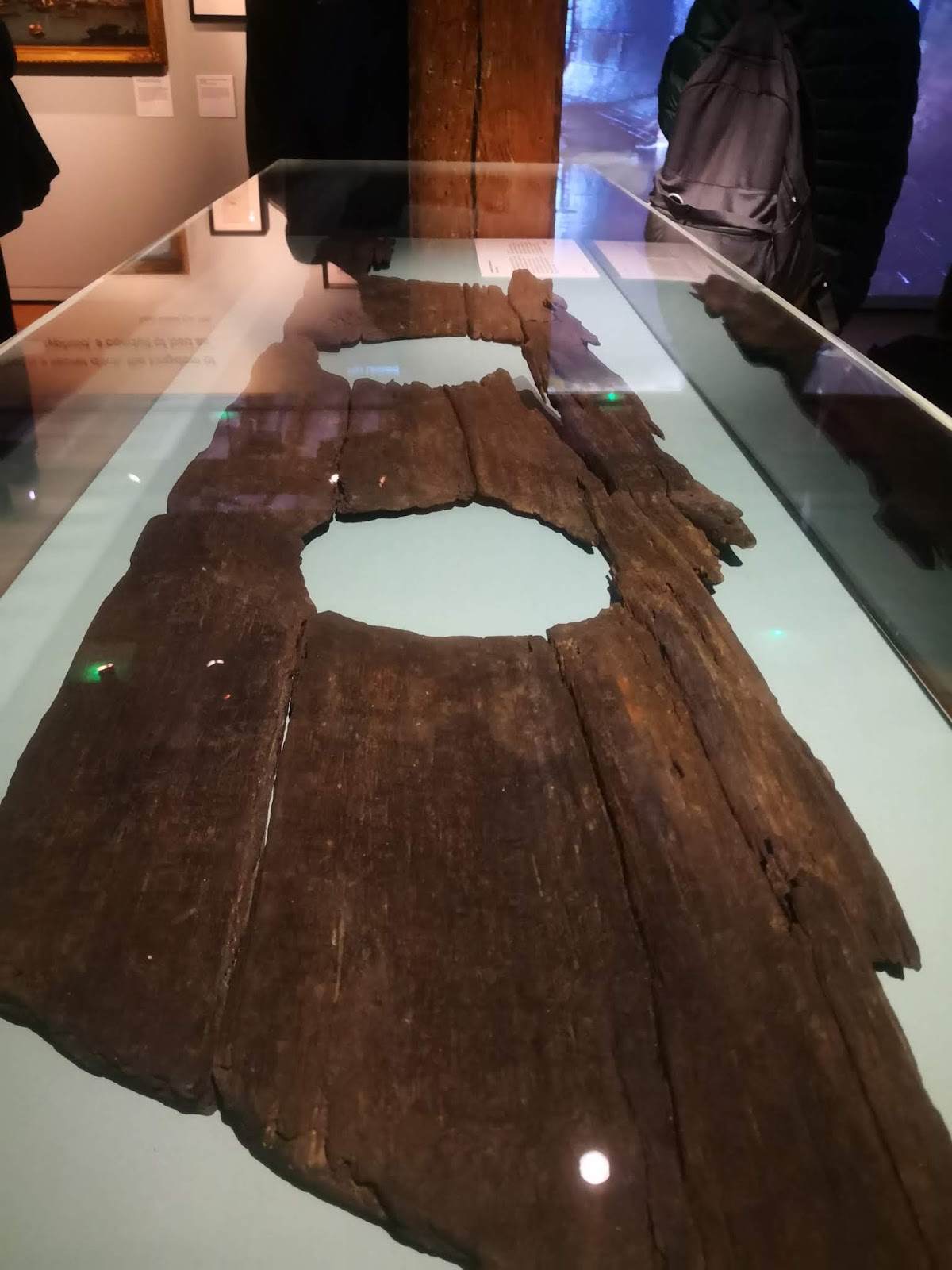

Medieval oak three-seater toilet seat (mid-12th century)

The humans who lived on the river's banks, judging by their propensity for fly tipping, were barely less primitive, it appears. Although at least they sat down to have a shit. Together. In groups of three, ideally. A toilet seat found lying over a cesspit in a yard near Ludgate Hill is evidence of how the family that sits together, shits together.

Three hundred years later, around 1612, the poet and playwright Ben Jonson wrote:-

'...How dare 
Your dainty nostrils (in so hot a season,
When every clerk eats artichokes, and peason,
Laxative lettuce, and such windy meat)
'Tempt such a passage? When each privy's seat
Is filled with buttock? And the walls do sweat
Urine, and plasters? When the noise doth beat
Upon your ears, of discords so unsweet?
And outcries of the damned in the Fleet?'

Not much had changed (though defecating directly into the river was banned in 1463) and the Secret Rivers exhibition didn't want us to miss out on the fun so they'd handily provided a mock up copy for us to try for size. If only I'd attended with two (very close) friends or family members. We learn that the person tasked with removing the excrement from the cesspit was given the job title 'gong farmer'! It's a dirty job but someone had to do it.


Far less renowned than the Fleet, the Neckinger flowed for three miles from the site of the current Imperial War Museum to St Saviour's Dock just east of Tower Bridge (near the old Design Museum) and was buried in the late nineteenth century. There's even some debate as to whether or not it's a tributary or simple part of a minor channel of the Thames.

The Neckinger was first exploited by the monks of Bermondsey Abbey for industrial use and, later, power mills and factories sprang up. By the time the river/channel had been covered up the area had become a notorious slum filled with both industrial and human waste.

It was quite a different story in the more affluent, and leafier, west London. The Westbourne (an eight mile river that runs, or ran, from Hampstead to Chelsea Bridge) was damned  in Hyde Park, on the orders of Queen Caroline in the 1730s, to create the Serpentine and was used to fill the ornamental canal of the Ranelagh Pleasure Gardens.

Much nicer. Though also evidence of how there have always been at least two different Londons. The London of the rich and the London of the poor. Only the wealthy could afford to attend Ranelagh and drink out of the opulent porcelain provided there. Opened to the public in 1742 not far from where the Saatchi Gallery now stands, Ranelagh was designed as a more upmarket rival to Vauxhall Gardens and had, as its centrepiece, the below rotunda. The rotunda was surrounded by the canal fed by the Westbourne. A river that now passes through one of the platforms of Sloane Square underground station in a pipe. How the mighty have fallen.


A Design for the Rotunda and Canal at Ranelagh Gardens - William Jones and Francois Morellon (1742)


Cup and saucer, Chelsea-Derby porcelain (1746-1780)


The Chinese House, the Rotunda, & the Company in Masquerade in Ranelagh Gardens - Thomas Bowles II (1751)


Skating on the Serpentine - Thomas Rowlandson (1786)

There are pots available for visitors, visiting children primarily one assumes, to sniff and to decide if they prefer the genteel aromas of the Westbourne to the fetid stench of the Neckinger. It's hardly the Pepsi challenge but it's a bit of fun in an exhibition which is intended as a family show but sometimes leans so heavily into history it risks losing a younger audience.

There's a toothbrush (a communal one - often one toothbrush was shared by a whole family), found near the Neckinger, and a story which suggests that people used to brush their teeth in water that had rubbish thrown in it and with bristles made from the hair of pigs, horses, or badgers and there's an a-z consisting of rubbish that artist Jane Porter fished out of the Wandle (the f is from a fish'n'chip shop, the J from a bicycle lock, and the u is made of false teeth) in which it's suggested that we might like to spell out our names. These are fun but, truth be told, it's not the most interactive of exhibitions and would be of interest to older, more curious, children but not distracting enough for the very young.


Wandle Alphabet - Jane Porter (2011)

For the most part, it's of interest to Londoners like myself who never seem to tire of digging into their city's history. There's stuff about Jacob's Island (the artificial island that became known as both 'the Venice of drains' and 'the very capital of cholera' and whose houses gave Charles Dickens the inspiration for Bill Sikes' home in Oliver Twist), and, on the same theme, there's Richard Dugard Grainger's Cholera Map of the Metropolis from 1849 where the darker the markings the more prevalent the disease.

There are ceramic mugs (but only 'FOR A GOOD GIRL' - not creepy at all), there are plastic dinosaur toys fished from the Wandle (along with knives, motor scooters, and number plates), and there are river sounds recorded by both Ian Rawes and Dale Garland as you walk round the museum. Rawes has plotted his on to a 'sound map' based on Harry Beck's iconic map of the London Underground whereas Garland has gone as far out as Windsor to get the essence of the Thames down on tape.


Oliver Reed as Bill Sikes in Oliver! (1968)


Folly's Ditch, Jacob's Island - James Lawson Stewart (1887)


Cholera Map of the Metropolis - Richard Dugard Grainger (1849)


Plastic toy (21st century)

As we listen to these ambient, at times barely audible, sounds we can read about the recent popularity of daylighting, or bringing back to the surface, these hidden rivers. Sections of the Moselle, the Quaggy, and the Wandle have all reappeared above ground in recent years where they have provided sustainable flood protection, havens for wildlife, and more urban green spaces.

It's not cheap to do but it seems an eminently worthwhile exercise if London is to continue to thrive. The latest proposals are to uncover sections of the Effra and the Tyburn and if neither of those projects seem, yet, entirely plausible they've both succeeded in drawing attention to important ecological questions about urbanisation and about how our shared water resources are managed.

The Effra runs 6.8 miles from Norwood to Vauxhall Bridge (and the last part was buried right back in 1880) and the Oval cricket ground is both shaped around a curve of the Effra and contains banks of seating made from soil excavated during the covering of that river. The Tyburn, a shorter river at 5.7 miles, flows from Hampstead to Westminster and Pimlico and did not, as you might think, give its name to the Tyburn Gallows. That comes from the Tyburn Brook. A separate water course, a tributary of the Westbourne in fact, altogether.


Newspaper poster (1992)


Tyburn Salmon - Simon Gudgeon (c.2000)

All these rivers do get a bit confusing! But don't lose heart. There are only two left to go in both this exhibition and this article. The Wandle and the Lea have been lumped together not due to geographical proximity but because they are both formerly industrialised and polluted rivers that have been cleaned up and invested in significantly in recent years.

Take a walk along either (my London by Foot walking group did the Lea last year and we're doing the Wandle in June) and you'll see just how true that is. By 1805 the Wandle (shallow, fast flowing, and ideal for powering water mills) had earned itself the title of "the hardest working river for its size in the world" but by the 1960s all that hard work had turned it, like so many before it, into an open sewer. The Lea provided the water for munitions, vehicle, electronic, and chemical manufacturing but as most of those industries declined the river came to be neglected.

The regeneration of the area around Stratford for the London Olympics in 2012 did wonders for the Lea while the Wandle's return to favour has been more gradual and less spectacular but equally welcome. While the Lea flows for forty-two miles, the Wandle manages just nine but, along the way, it passes some beautiful parkland and some of Croydon's more pleasant areas. You can even take a 'sound cup' and listen to Wandle enthusiast Andy talk about sticklebacks and canoeing down the river. When it comes to the Lea the curators have used the same Adele quote that I started off March 2019's walk with. Great minds and all that, eh?


Croydon Church, Surrey - James Bourne (1800-1848)


Croydon Minster - John Chase (2018)


View of Wandsworth, Surrey - John Burges Watson (1819)


Junction of the Lea and Pudding Mill river - Mike Seaborne (2006)


View of the New Bridge at Bow - Unknown artist (c.1834)


The Iron Bridge over the River Lea, near East India Docks, Poplar (1815-1825)

There's lots of nice paintings and photographs of the Lea and the Wandle proving how good they once looked and how good they now look again and from there we enter into a final section, a coda if you will, to the exhibition called Tracing The Rivers featuring contemporary art, photography, maps, and a section of books written about the rivers, lost or otherwise, of London

They look at history, they look at place, and they look at environment. Simon Dovar's has erased a pencil drawing of the course of the Fleet from a hand drawn street map as if to question our sense of loss and our sense of understanding of what the river once gave us while Loraine Ruff's Peckham Light Postcards has cast a confusing history, in porcelain, of the burial of the river Peck. Just one small rivulet in Peckham Rye remains today.


Lost River Fleet - Simon Dovar (2010)


Peckham Lights Postcards - Loraine Rutt (2015)


There are books by Ben Aaronovitch, Charles Dickens, Iain Sinclair, Neil Gaiman and others and there is Stephen Walter's photogravure etching that shows London stripped of its buildings and roads and given over to the water of its rivers, canals, brooks, and sewers. Finally there is Andy Sewell's recent pigment print of his five year project to document Hampstead Heath (the source of so many of London's rivers as you will have read) as well as the human urge, biophilia, to associate with nature.

The example here shows a man swimming in the Hampstead Brook and while it's far from the most impressive exhibit on show at the Museum of London Docklands it is, in some ways, one of the most instructive. Because no matter how interesting an exhibition on London's lost or secret rivers can be (and this one was very interesting, for sure) it can never compete with getting out there, in the city, exploring these rivers yourself by foot or by bike. I enjoyed the exhibition and I enjoyed writing about it but, truth be told, I can hardly wait to get out and walk along one of these bad boys again soon. When we start the Capital Ring (75 mile long) circular walk around London in less than three weeks we'll no doubt be reacquainted, or even acquainted for the first time, with these rivers. It'll be like catching up with old friends.


Rivers of London - Stephen Walter (2014)


The Heath - Andy Sewell (2006-2011)


Saturday, 4 January 2020

Down in the Subway:O' Magic Power Of Bleakness with Mark Leckey.

"To the centre of the city where all roads meet, waiting for you" - Shadowplay, Joy Division.

Towards the end of last year I spent a couple of hours underneath a flyover of the M53 motorway on the Wirral, between Ellesmere Port and Wallasey. Near Eastham Rake train station, Delamere Community Centre, and a branch of not just Bargain Booze, but Bargain Booze Plus!

Except I didn't. I wasn't, in fact, anywhere near the border of Cheshire and Merseyside. I was in London, at Tate Britain, and Birkenhead artist Mark Leckey, in his show O' Magic Power of Bleakness, had mocked up the motorway flyover as some kind of art installation and it was that which I was under. Or, more accurately, in.


Why had Leckey converted one of the Tate's most coveted exhibition spaces as if to appear it was a motorway flyover and why had he projected a series of films (his earlier works:- Fiorucci Made Me Hardcore (1999), Dream English Kid (1964-1999), and AD (2015)) on to the surrounding concrete walls that we could sit, or stand, and watch? Why had he included the below Henry Fuseli illustration?


At first I was utterly baffled and distinctly unimpressed but the longer I spent in the 'subway' the more the show grew on me. Leckey aims to "explore the links between youth, class, memory and nostalgia" and if the blurry footage of young people getting down at Northern Soul events, Joy Division performances, old sheds, and Cinzano adverts refused to make any narrative sense whatsoever it did, for those us of a certain age, induce a pang of nostalgia for those things, those experiences, that are now so lost to the sands of time we're starting to doubt our own recollections of them.


Was this all some kind of memento mori? Was Leckey saying that what we remember of our past, the feelings we felt so earnestly at the time, have now been co-opted and sold back to us as mere nostalgia? As befits an artist, and a conceptual one at that, he was asking a lot more questions than he was giving answers.

I no longer thought that O' Magic Power of Bleakness was crap. I was simply a bit confused while, at the same time, at least occasionally, bewildered and, even more rarely, enchanted. Where should I look? Video footage would appear in dim and dark corners, in crevices, and then revert, suddenly, to a series of larger screens on the walls.


This 'son et lumiere' obviously spoke more directly to Leckey and those who grew up with and like him on the Wirral (the flyover, the real one, is where he used to play with childhood friends and, he claims, the area still haunts him) but, more generally, these spaces remind us of a time in our childhood where we didn't need to visit art exhibitions, go to the theatre, or attend gigs to amuse ourselves.

We could find magic and mystery, for want of better words, wherever we went. It was in our heads and the world, or our own very small corner of it, was our playground. Before I was even a teenager, fun could be had hiding in hedges, hanging round the back of the garages, or getting lost in the nearby Pamber Forest. Teenage years would see hours wasted wandering the streets of my home town of Tadley, disappearing into the nearby commons and woods, and, on one occasion, spending an hour or so in a concrete pipe with two close friends singing Prefab Sprout's Faron Young.


It seemed boring at the time. Like a waste of time. There was a feeling that real life, genuine excitement and opportunity, was happening elsewhere and we, of course, wanted some of it. So when we got older we gravitated to pubs, relationships, gigs, festivals, and, eventually, our own houses and our own lives.

But did we lose something on the way? Did we strike the inevitable deal with life where our youth, innocence, and sense of wonder was exchanged for cold hard reality? Did we, in the words of Pink Floyd, "exchange a walk on part in the war for a lead role in a cage"?


Again, no answers. Just more food for thought. A wet shoe, an eighties haircut, a crude graphic of military aeroplanes flying over an archipelago, and child like drawings of lorries. What could it all mean? It made as much sense to me as an adult as life itself did to me as a child (though I wasn't aware of that at the time) and, in that - if nothing else, Mark Leckey had, in a very short time, taken me back to childhood and reminded me that though I view much of it through rose tinted spectacles now perhaps it wasn't quite as I remember it.

All the things of my youth that I recall were no doubt there at the time. But what they meant to me then and what I now think they meant to me are, it seems, very different things. This was both a memento mori and a genius loci but it was, intentionally, a highly unreliable one and, filtered through Leckey's vision (he's four years older than me), a partial one too. Appropriately enough it was a partial, rather than unqualified, success.


Friday, 3 January 2020

Theatre night:Ghost Quartet.

"There were two sisters who lived by the sea.
Oh, the wind and rain
And the youngest one loved a man in the trees.
Oh, the wind and rain" - The Wind & Rain, Dave Malloy for Ghost Quartet.

Three days into 2020 and the top subject trending on Twitter is World War III (just behind it:- Iran, Soleimani (Qasem, the Iranian general killed this morning in a US air strike) and Franz Ferdinand (not the band). We all know Twitter, and social media in general, likes to exaggerate threats and dangers wherever possible, acts as an amplifier for already horrible things, and creates binary divisions where once there was nuance but, even with that in mind, this is a predictably shitty start to the year.


It's not like the arbitrary change of dates was ever going to change the mindsets of the nationalists, populists, and religious fundamentalists that hold so much sway in the world right now but, ffs, let us at least get halfway through our first full week of work.

With this in mind, I was glad that my first night out of the year and my first theatrical experience of 2020 was of an escapist nature. There's going to be more than enough reality very soon and I'm feeling run down as it is (month long cold combined, most likely, with general festive unhealthiness has left me feeling each and every year of my age) so what I needed was something to make me smile and with Dave Malloy's Ghost Quartet at The Boulevard Theatre in Soho I was not to be disappointed.


Its billing as "an intoxicating musical about love, loss and spirits" was absolutely right. Performed in the round by four nattily dressed actors, singer and musicians it told a circular, and circuitous story, of a family torn apart by an infant's death, a thwarted love affair, a fatal crash in a tube station, and alcoholic dependence.

None of which sounds much fun, admittedly. But in the capable hands of Carly Bawden, Niccolo Curradi, Maimuna Memon, and Zubin Varla (under the direction of Bill Buckhurst), the music, lyrics, and story that Dave Malloy created was brought beautifully to magical realist life in the form of a double album. With a running length of ninety minutes it was the sort of album you'd buy in, or from, the seventies. One with a gatefold sleeve.

As with many of those progtastic albums, the sheer length ran the risk of venturing into periods of boredom but with the songs veering from woozy Tom Waits style bar room philosophising ("Bad Men") to Disneyesque musical numbers ("Starchild") and from ramalama bangers ("The Camera Shop") to songs dedicated to Thelonious Monk things were never allowed to stay the same for long and drifts of concentration were skillfully averted.


The Wikipedia page on Ghost Quartet claims influences from even farther afield. Japanese Noh theatre, Arabian Nights, David Bowie, James Joyce, The Twilight Zone, Stanley Kubrick, Stephen Sondheim, Stephen King, Edgar Allan Poe, Frozen, Neil Gaiman, and Carl Sagan. One thing you can say for sure is that Ghost Quartet was not lacking in ambition.

If it didn't quite manage to pull all these disparate influences into as powerful a narrative as I'd have hoped that was more than adequately compensated for by the sheer glee of the performance and the technical proficiency, both vocally and musically,  of all four performers. Whether playing a melodica, an erhu, a dulcimer, a harp, a cello, or the more traditional piano, guitar, and keyboard the sound they made was both haunting and many of the songs instantly catchy.

It's not long before we're clapping along like we're in one of those dreadful An Audience With programmes on ITV and further crowd participation only adds to the gaiety. Shakers are distributed to some previously unsuspecting percussionists and whiskey and bourbon passed out to those in the front row. It didn't reach me which is just as well as (a) I don't get on with the hard stuff and (b) I'm trying to be good at the moment - but it was a lovely gesture all the same. Extending the New Year's Eve party deep into the 2nd of January!

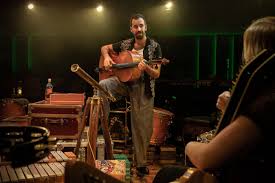
At one point, members of the audience were invited on stage to play the instruments and, while sometimes this can be a bit cringe inducing, it was all done in such a tasteful and understated way it had me beaming with joy. The few spaces on the stage (it was just a floor really) not given over to various musical instruments were covered in dusty old piles of books, a mountain of retro style suitcases in which our performers would ascend to sing, proper old globes, and an aesthetically pleasing golden, and occasionally rotating, telescope.


I must confess I was so distracted by the songs and telescope that I did not follow the story so well. But it wasn't an easy one to track in the first place. Characters shifting from lovers to family members and from daughters to mothers was discombobulating enough but "four interwoven narratives spanning seven centuries" was never going to be an easy follow.

Throw in an evil bear, the ghost of Thelonious Monk (who seemed to be living behind a large and highly resonant gong), and Scheherazade from One Thousand and Nights and things started to get really intricate. They became a little clearer as the story developed but still peculiar tales of fiddles fashioned from breastbones of great aunts, imaginary friends, and ghosts beckoning children to come and join them on the other side add further layers of mystery and mystique to the whole baroque concoction.

With repeated viewings one imagines it's likely that the story will make more sense and that further depth will be revealed but, thrown in at the deep end as I was, I felt it best just to hold on tight and enjoy the ride. If, often, I was unsure what was going on it didn't matter all that much. It wouldn't be long before another great song like The Astronomer, Any Kind of Dead Person, or Subway would come along and as the vast majority of the story was told in song it never felt forced.


By the end I was rapt by the skills of the performers. Varla, in his flat cap and crumpled just to the right degree suit, had me spellbound as he stood behind his piano like a barrelhouse professor, the vest wearing Curradi's hirsute features made his forays into the realms of the ursine as believable as his erhu playing was infectious, Bawden's dulcimer playing was eclipsed only by her powerful voice, and Memon acted as her perfect foil. Bawden in a beautiful black dress and Memon bequiffed and decked out in a fifties style trouser suit. These are people that looked as good as they sounded.

It all added up to a much needed, and thoroughly enjoyable and atmospheric, ninety minutes of music and storytelling and, as I walked home through the surprisingly mild London air, I reflected on my belief that as long as more of us choose to come together to tell stories, sing songs, and (if you must) drink whiskey together than want to start wars, waste their lives 'shouting' at strangers on Twitter, and, essentially, try to take control over other's lives we're probably not as close to World War III as the naysayers like to make us think we are. I really fucking hope so.


Thursday, 2 January 2020

Celia Paul:Pure/Mourning.

It's 2020! That sounds incredibly futuristic and modern and, in many ways, it is. Smart phones, broadband, climate change, and all the other things people have been banging on about for years are all here now, there's no doubt about it. But poverty, homelessness, sexism, and racism don't seem to have gone away, like they probably said they would on Tomorrow's World. In some countries - like the UK, they've got noticeably worse in recent years.

Just because Brexit is now a certainty it doesn't mean it won't continue to both dominate the news and divide families. So I thought I'd kick off another year (my fifth now) of blogging with a low-key, gentle dipping of the toes in the water, assessment of the artist Celia Paul's recent show at the Victoria Miro Gallery on Wharf Road between Shoreditch and Islington, as well as a few personal thoughts about my life, where it's been, and where it might be going.


My Sisters in Mourning (2015-2016)

Family is at the heart of Celia Paul's work. She was born, in 1959, in Thiruvananthapuram in Kerala, India (a city I visited, for one hour, eight years back. I saw a very busy train station and one of the grimmest bars I've ever witnessed, even I didn't stop for a drink) but, for the most part, she's worked in London. She studied at the Slade School of Fine Art, had a twenty year relationship, and a son, with Lucian Freud and has had work shown at such august institutions as the British Museum, the National Portrait Gallery, the Saatchi Gallery, and the V&A as well as the MoMA in New York and Copenhagen's Carlsberg Foundation.

It seems she's not allowed this impressive CV to go to her head. Her work is still thoughtful, unshowy, and understated. As the unnecessarily laminated sheet of A4 you can pick up on entering the Victoria Miro asserts, it is "familial, creative" as well as "self-assuredly quiet, contemplative and ultimately moving".

The vast bulk of this lovely show is given over to portraiture and landscape but in the muted tones of the paintings, in their stillness, and in their sombre colour schemes it's very clear that these aren't commissioned portraits. These are not made to boost the confidence or ego of the sitter. These are quite different portraits. They dwell, the landscapes as much as the portraits, on something we all do. Something we often wish we didn't dwell on. Mortality.


My Mother and God (1990)

As we get older, as the lucky ones among us all must do, death looms larger in our lives. We lose family members, we lose friends, and our bodies start to slowly fail us. Firstly, for most of us, in small ways (gout for me, a few years back) and then, surely but with absolute sureness, in larger, scarier, more obvious ways. Each minor ailment a signpost as we travel on the (hopefully) long road towards our certain death.

How does an artist contemplate this without depressing us, without filling us with morbidity? I'm not sure it's always possible but, equally, I'm not sure that's necessarily a bad thing. Life's not all jokes.  Last year I attended Tracey Emin's wonderful A Fortnight of Tears show at Bermondsey's White Cube and I wrote, at the time, about how "death is the end for the dead" but how "that's not the case for those that are left behind" before remarking of a painting of Emin carrying a box containing her mother's ashes that it was "an unbearably sad image to ponder".

If Celia Paul's depictions of grief, bereavement, and absence don't carry quite the same almost physical weight as Tracey Emin's scratchy, quite brutal, and often disquieting imagery, they do reflect on other aspects of death. Loneliness, solitude, and those little moments when you have a small thought you'd like to share with a loved one only to realise, yet again, they're gone and you can't. You never will be able to.


Lucian and Me (2019)

2015 saw the thirtieth anniversary of Celia Paul's mother's death and with her father having recently passed too, the artist set about the work that heads this blog up. My Sisters in Mourning. Celia and her three sisters are together, united in their grief but each sister's silent contemplation remains a mystery both to us and to each other. Bereavement can bring people together but it can tear them apart too. It's up to us as humans to respect that everybody handles it differently and to navigate a path through it where those left behind can emerge, after however long it takes, with as little permanent damage as possible.

Art, music, writing, and friendship can all help immeasurably. Celia Paul is an artist so, quite understandably, that's the route she's taken to try to come to terms with her losses. Even the pieces that are devoid of a human presence, Room and Tower (below) for example, have a powerful feeling of absence within them. In fact, Room and Tower is defined, haunted even, by that very absence. It reminds me of some of Edward Hopper's best work and that, of course, is no idle praise.   


Room and Tower (2019)


Self-Portrait, Standing (2019)


Santa Monica (2019)

The seascapes, too, are so simple as to border on abstraction. I was fortunate enough, in 2016, to visit Santa Monica and I must say my take on the place was that it was vibrant and fun (and that, if I had enough money, I'd quite like to live there) so it's fair to say that Celia Paul's meditation on the waters and skies there is quite separate to my personal experience.

It does, however, have that quality that water, and the seas and oceans most of all, always have. There's a duality about staring out to sea. The sound of the waves, the enormity of the ocean (and this is the Pacific so it's the biggest of them all), and the endless blue horizons have an ability to help our minds find rest at times of inner turmoil while at the same time remaining a dangerous primal force with the power to dwarf us and even destroy us. People often move to coastal towns as they get older as if in some kind of cruel reverse evolution. Fishes came on to the land and evolved into mammals and eventually us. When it's our time to go many of us, it seems, return to whence we came. 


In Front of the Museum (2008)


Breaking, Santa Monica (2019)


Hawthorn Blossom Tree (2019)

Elsewhere in the exhibition there are celebrations of love, architecture, and even new life in the blossom of a hawthorn tree. As if to suggest that this is all quite natural. People and flowers always die but new people and new flowers always appear in their wake. At fifty-one years old I now realise that to create and to nurture a new life is the most wonderful thing any human being can do and I am in awe of all of my friends who have taken on this challenge. I sometimes regret I was too selfish, too disorganised, to do the same.

When I was younger the idea of creating new life would have been horrific to me. I WAS new life! Time passed, things happened, I even got involved, briefly, in being a stepdad but, despite being better at it than I would have expected to be, it wasn't to last. Mostly down to my own failings but circumstantial also. The last decade, decade and a half even, has seen a slow dawning, a realisation, that life is not about the grand gesture, it's not about becoming rich or famous. Instead, the truly important things in life are the relationships we build, small moments of kindness, grace, and charity. Being there for people. Having time for them.


Self-Portrait, Early Summer (2018)


Charlotte (2019)


Emily (2019)


Lucy, Autumn (2018)

Once I was very selfish. Of late I have been much less so. It's not brought me any wealth or success but I do feel happier in my skin than I did when I was younger and, therefore, I endeavour to continue to try and learn, to try to listen more, and when given a choice between being kind and being right to try and always err on the side of kindness.

I won't always get it right and friends and family occasionally will need to tell me so but entering into my seventh decade on this accursed planet I don't want to be one of these people who thinks they know everything, thinks they can lecture younger people on how to behave, or thinks things were better in the olden days. 

Times change, sure, but we do too. Twenty to thirty years ago I'd have taken virtually no interest in 'quiet' art like that of Celia Paul but now it speaks to me deeply. Seascapes, country churchyards, trees, and the interior lives of those closest to me have become (not least in my ever growing passion for walking) the subjects that I find myself becoming ever more drawn to. Obviously, that's partly because I'm older and I'm closer to death but it's also because, I think, that in these quiet places of the world or of the mind there is space and time. Space and time to be with both our thoughts and each other.

I haven't entered 2020 with any new year's resolutions as such. Just an ongoing personal project to be the best version of myself I can be and to be present for others. Lives can seem incredibly long things while we're living them but they can reach their ends within what seems barely more than a blink of an eye. It's impossible to do, or achieve, everything we've ever wanted to but what we can do, or at least try to do, is to appreciate the things we do have and many others do not. I have food, I have friends, I have family, I have a roof over my head, and I have access to galleries and art exhibitions as well as a reasonable level of articulacy to write about it afterwards. My life ain't so bad right now.


Silvery Sun (2018)


The Bronte Parsonage (with Charlotte's Pine and Emily's Path to the Moors) (2017)


Kate in White, Spring (2018)