Saturday, 26 October 2024

I Am Society:Fucked Up @ the o2 Academy.

You don't expect a band with the name of Fucked Up to be a barbershop quartet, a doo-wop ensemble, or a gospel choir. And, spoiler alert, they are not any of those things. They are a hardcore punk band and as with most hardcore punk bands (though, sadly, not all) they have a empathetic beating heart that underpins every intense roar and shredding guitar riff that makes up their music.


Though their songs do, after a while, sound a bit samey. That's not actually a problem. Me and my mate Rob used to split bands up into sound bands (Jesus And Mary Chain, Pixies) and song bands (Blur, Primal Scream) and Fucked Up, it's no big deal to say, are very much a sound band. The sound, however, is both enormous and brutal and much of that is down to Damian 'Pink Eyes' Abraham and his larger than life vocals - and his larger than life presence - and his larger than life size too for that matter.

With his gut spilling out over his trousers and pants, and a bald head and bushy beard combo that splits the difference between Built To Spill's Doug Martsch and Grange Hill's Bullet Baxter, he is, along with bassist Sandy Miranda, very much the focal point of Fucked Up. Even when he's not singing, or informing the audience of his views on trans rights and ceasefires, you can't keep your eyes off him.

I didn't actually know many of the songs played last night at Oxford's o2 Academy (a great venue in many ways but £7.80 a pint and a strict no bags rule - what the fuck?) but that didn't deter my enjoyment of the gig one iota. Maybe I was just happy to be out on a Friday night following my second full week of work in over two years, maybe I was simply pleased to be hanging out with the lovely Colin and Patricia (and meeting their friends Steve and Nick), or perhaps I felt at home in a room full of superannuated punks and indie 'kids'.


Who knows? Sometimes you can just be happy - and for all the righteous anger in Fucked Up's music they come across, primarily, as a band that are very happy being a band. As were support act The Tubs. The Welsh indie rockers were formed from the remains of Joanna Gruesome (not a band that ever really troubled me) and proved for a great support act. They had elements of Pearl Jam (the singer certainly had Eddie Vedder's hair) but combined that with the likes of Husker Du and early REM to provide a supercharged, and very agreeable, take on what was once called 'college rock'.

Scottish drummer Matthew Green proved a bit of a character, offering members of the audience a fight and even slagging off his fellow band members between songs, while posh sounding vocalist Owen 'O' Williams made for a conciliatory character. Guitarist Steve Stonholt was rocking the foppish beatnik John Cale in the VU look, and bassist George Nicholls was brave enough to wear a Phantom of the Opera t-shirt on stage.


Mind you, he looked like the sort of man who could fill you in if you dared to question his fashion sense so why not. Fucked Up, Pink Eyes and Miranda apart, don't really go for image. Function rules with these Toronto veterans (they've been going for 21 years now so I guess that makes them veterans, The Beatles only lasted for ten). Roid rage thrash anthem followed roid rage thrash anthem as they blistered through Tell Yourself You Will, Being, and Another Day - the title track of their latest, eighth, album.

Stimming chucks in some (very brief) Beach Boys harmonies before heading off into the land of hardcore thrash, Does Your Dreams, quite remarkably, chucks in some baggy vibes and ends up sounding like The Stone Roses at their funkiest and most Madchester, and Normal People dares to flirt with trad rock, even heartland rock, even glam rock while Son the Father chucks in a soupcon of space rock while not forgetting to shred like fuck.

The highlight for me was, of course, a sped up and startlingly effective Queen of Hearts ("hello, my name is David, you must be Veronica" - a song that's very dear to my heart for all sorts of reasons) but with Fucked Up it's the cumulative effect of being punched in the head by their sonic assault while at the same time being gently caressed by their innate sense of kindness and empathy. A great gig - and one that was over way too soon (not long after half-nine).

Thanks to Colin, Patricia, Steve, and Nick for a great night (special thanks to Colin for joining me for post-gig drinks in both The Port Mahon and The Half Moon - and for making sure I got the Oxford Tube back to London okay - I finally got home at 4am) and thanks to Fucked Up (and The Tubs) for providing a soundtrack to another great night. Should probably go to Oxford more often

Friday, 25 October 2024

Fleapit revisited:The Apprentice.

Donald Trump is a cunt. That's just a fact. It's not up for debate. Forget all the crazy, distraction, stuff. All the bullshit about "the late, great Hannibal Lecter", Arnold Palmer's supposedly impressive penis, and the Haitian immigrants in Springfield, Ohio eating cats and dogs and, instead, focus on his admiration for Putin, his admiration for Hitler, his threat/promise to end American democracy and turn the military on his political opponents, and his policy of separating children from their parents and putting them in cages.

Yes, Donald Trump is a cunt and the only people who don't think it are either so dumb it's a wonder they manage to get dressed in the morning or, far more worryingly, hoping that his cuntishness will, somehow, bring them some kind of reward. Spoiler alert:- it won't. Among Republicans warning against the danger of a second Trump presidency are John Kelly (who served as secretary for Homeland Security under Trump), Mark Milley (former Joint Chief of Staff), James Mattis (Trump's first Defense secretary), and even Trump's former Vice President Mike Pence.

In Iranian-Danish filmmaker Ali Abbasi's new film The Apprentice, you're never in any doubt that Trump (played by Sebastian Stan) is anything other than a complete cunt but what comes as something of a surprise is he's not the biggest cunt in the film. That dubious honour goes to Roy Cohn (an excellent performance from Jeremy Strong), the lawyer and prosecutor who served as Joseph McCarthy's chief counsel and, at the time of the film, is still dining out on the fact that he played a leading role in the conviction and execution of Julius and Ethel Rosenberg in 1951.

Cohn is a nasty piece of work and when a young Trump comes happily into his orbit, he takes time out to teach the teetotal property developer the secret of his success. There are, he says, three rules. Firstly, you should never defend yourself, you should always attack. Secondly, there is no such thing as truth - you make your own truth up. Finally, you should always claim victory - even if it is obvious to everyone else you have failed.


Take for example, losing the 2020 American election. Don't admit defeat. Just say you won (and maybe make up some bullshit about the 'deep state' to back it up). As you'll have already gathered, The Apprentice has it that Trump remodelled himself in Cohn's image but that, to my mind, lets Trump off the hook a bit which, as the film goes on, is readdressed as Trump slowly morphs into the horrendous grotesque that we have all come to know and hate. Essentially, Cohn runs the danger of being out-Cohned by his prodigy.

Cohn manages to combine being a promiscuous homosexual with being a vicious homophobe (forever accusing people of being 'faggots' and blackmailing other closeted homosexuals) while not being adverse to a bit of racism and misogyny either. Trump is so enamoured of the man that he even gets drunk (for what we must assume is the only time in his life) on neat vodka.

As Trump's star rises, Cohn's wanes but Trump keeps him nearby just in case.We see Trump woo and marry Ivana Zelnickova, the Czech businesswoman and socialite (played by Maria Bakalova), we see him fall out of love with her, and we see him rape her in a fit of rage (hey, it's Trump, don't be surprised) while at the same time he's opening up Trump Tower and talking of how he'd never want to be a politician for any other reason than hopefully getting a blow-job on Air Force One.

There's lots of little digs in the film about Trump and his unfitness for any form of public office but that's totally understandable - Trump IS unfit for any form of public office. He's not fit for anything except prison. But, as we see in The Apprentice, the capitalist world we have made doesn't punish Trump, it celebrates him in all his wretched and craven malevolence.

What stops you from actually enjoying, or getting emotionally involved with, the film is the fact there is not a single major character you can either sympathise or empathise with. Trump's family are too lightly sketched. Supposedly domineering father Fred Trump Sr (Martin Donovan) remains very much in Cohn's shadow and seems a long way off the Old Man Trump that Woody Guthrie excoriated in song, mother Mary (Catherine McNally) seems protective - although has an angry side, and alcoholic brother Fred Trump Jr (Charlie Carrick) seems to serve primarily as an easily available punchbag for both his father and his orange turd of a brother.

Elsewhere, there are brief roles for Mark Rendall as the egregious Roger Stone, Tom Barnett as Rupert fucking Murdoch (who, of course, Trump and Cohn suck up to), and - I didn't see this coming although it makes perfect sense - this being New York in a certain era, Bruce Beaton as Andy Warhol who briefly talks to Trump about how making money is an art form in itself.

Trump, of course, likes the sound of that. As he does the sound of Ronald Reagan's plan to 'make America great again'. Reagan appears on screen a few times and so does Richard Nixon who once would have been almost everyone's choice for the worst ever President of the United States. Nobody even debates that point anymore. Trump likes winning and that is one title he has already won hands down and he is in danger of being far, far worse should he be elected a second time.

Many have commented on how this film errs close to being the origin story of a supervillain in the Marvel universe. But Donald Trump is not Magneto, Thanos, or Doctor Doom. He's a human being and he's a very very dangerous human being who could, in less than two weeks, be the most powerful person on the whole of the planet (though Putin, Xi Jinping, and Trump's atrocious friend and arselicker non pareil Elon Musk may dispute that). The Apprentice (named after the most morally bankrupt television show ever, one that gave Trump, as well as the vile Katie Hopkins, a huge public platform) does a good job of showing what a cunt Trump is and was. The trouble is, and this isn't the film's thought - but the thought of the fractured and divided world we live in, it doesn't show just how much of a cunt he plans to be in the future. If there's one take away from this film it is one you probably already knew. Donald Trump was, is, and will always remain a cunt.


Wednesday, 23 October 2024

Fleapit revisited:Woman of the Hour.

Cheryl Bradshaw (Anna Kendrick) is a struggling actress in 1978 Hollywood. When she's persuaded by her agent to appear on The Dating Game (Blind Date for UK readers) her choice of bachelors is predictably disappointing. Bachelor #1 (Matt Visser) can barely string a sentence together and Bachelor #2 (Jedidah Goodacre) is a common or garden sleazeball. But Bachelor #3 seems alright. He's the funniest and the most charming, he knows "what girls are for", and he's got all the right cultural references.

The problem is that Bachelor #3 is Rodney Alcala (Daniel Zovatto) and we, the viewers, know that he's already murdered at least two women. One unnamed young woman in Wyoming two years earlier (who opens up to him as he takes photos of her only for him, in return, to strangle her to death) and another, Charlie (Kathryn Gallagher), in New York in 1971 whom he murders after helping her move into her new flat.

Woman of the Hour (directed by Kendrick herself, written by Ian McDonald, and now available to watch on Netflix) tells the story of both Alcala and Bradhsaw and though it's a slighter film than I'd expected it packs quite a powerful punch as it excoriates the horrendous misogyny of the time and shows how that allowed for violent murderers like Alcala to escape the consequences of their actions for so long.

It's a era of heightened chauvinism. When Cheryl explains she won't do nude scenes she's told "I'm sure they're fine" - and nobody can doubt that 'they' is a reference to her boobs, and it's a time when women are told not to be too smart so as not to intimidate men. Advice that Cheryl, brilliantly, ignores.

Other women are simply ignored. Like Laura (Nicolette Robinson) who's in the audience for the Dating Game and recognises Alcala as the man she saw with a friend of hers just before she was murdered. The trouble is nobody, no men certainly, want to listen to Laura. Which puts Cheryl (who, of course, has chosen Alcala as her date) in imminent danger.

An imminent danger she soon begins to sense. But what will she do about it? And how will he react to whatever she does about it? And how will she react to his reaction? It's not just the (male) behaviour that's of its time. Woman of the Hour comes good with period detail. The cars, the clothes, and the hair all reek of the 70s but perhaps nothing does so more than Dating Game host Ed Burke - based on Jim Lange, the real life host (Tony Hale).

In most films, he'd be one of the creepiest characters in it but, obviously, Alcala owns that title here and Zovatto is great at showing how a supposed charmer can turn evil very quickly, Kendrick, also, is excellent as usual, and props should also go to Pete Holmes as Cheryl's friend Terry who appears to harbour an unrequited - or at least not fully requited - love for Cheryl and Autumn Best as Amy, another young lady who is unfortunate enough to fall into Rodney Alcala's toxic orbit.

I don't know if the real life Alcala was a fan of Roman Polanski or if that's simply the film maker's way of reminding us of another powerful man who pretty much got away with sexually abusing and raping women and girls but it's a handy reminder of how prevalent this kind of behaviour once was and, in some places, still is. Woman of the Hour is a creepy, tense, film but it's also a reminder to anyone who needs it that when women talk of dangerous men they should be listened to.


Monday, 21 October 2024

Homes For Heroes.

Some walks take a while to happen. Saturday's LbF walk, Homes for Heroes, was originally planned for 2021 but a combination of covid lockdowns, train strikes, weather, and sheer lack of interest resulted in it being postponed a number of times. But good things come to those who wait and yesterday Bee, Pam, and myself finally got out to the London Borough of Barking and Dagenham for an exploration of the Becontree estate (more on that later) and the parks, waterways, and architecture of the area.


It was fun too. Or at least I thought so. I'd got up early (an achievement in itself after my first full week back at work in umpteen months), wandered down to Honor Oak Park station (bumping into Bec and baby Etienne on the way - standard, but this time with added Gareth), and took the Overground to Whitechapel and the District line to Becontree where I wrestled with the Guardian crossword and quiz.

Arriving early, I thought I'd do a brief recce of the first part of the walk (so as not to go wrong) so headed into Parsloes Park. Once I'd taken in the soaking wet unsafe metal climbing frames that looked more like Sol LeWitt climbing frames, the sky opened up so I retreated quickly to the D&D Hill Cafe. The hill in question not being much of one, just a bridge over the railway lines.


Bee was first to arrive and Pam wasn't far behind. We each had a veggie breakfast (no tomatoes for me) which was delicious (except for the sausage which was of the vegetable rather than the Quorn or Linda McCartney kind) and was washed down with both a cup of tea and a can of pop. It was good to have my appetite back and back good.

We had a good gas and set off into Parsloes Park. The rain had now stopped but it was still pretty overcast. Parsloes Park was opened in 1935 by the Labour/Liberal MP Christopher Addison and is named after the Passelewe family who owned land round here in the 13th century. A stretch of the Gares Brook (a minor Thames tributary) runs through and there's a Bobby Moore Sports Hub. England's World Cup winning captain having been born in Barking in 1941.


From Parsloes Park, we took Keppel Road (Pam taking the chance to remind me of the time that Judith Keppel knocked me out of Eggheads - on sport, she can shove her Eleanor of Aquitane up her arse) into the Becontree estate itself, the area I'd hung the walk on. Though I wasn't foolish enough to imagine anyone wanted to spend five hours walking round a housing estate so I chucked some parks and pubs in to keep the punters happy. A people pleaser, that's me.

Once we'd crossed the centre of the estate, the circular Valence Circus, and taken in a sign that had been changed from NO BALL GAMES to BALL GAMES (this is a strong football area as you will come to appreciate but I wonder if the preponderance of NO BALL GAMES signs across the country in the past has been a factor in England not winning anything since 1966, I bet you don't see NO BALL GAMES signs in Brazil or Argentina), it was time for me to read out my longest piece of spiel of the day. Bee, as you can see, either listened intently or posed as if to give that impression. Either way, I'll take it.

Becontree was built as the largest public housing estate in the world between 1921 and 1935 (the original date I'd planned was intended to mark its centenary) and some say it still is. The Housing Act of 1919 permitted London County Council to build housing outside the then County of London and they were inspired by Raymond Unwin (1863-1940), a prominent engineer, architect, and town planner who had, himself, been inspired by William Morris and John Ruskin.

In 1912, Unwin had published a pamphlet called Nothing Gained By Overcrowding in which he recommended building short terraces, spaced twelve to the acre on 'cottage estate' principles. The end of World War I provided fresh impetus as working class, urban, soldiers returned home in poor health. Hence Becontree was built and it's pretty obvious why these became known as 'home for heroes'.

By the time of Becontree's completion in 1935, there were 26,000 homes housing 100,000 people across Ilford, Barking, and Dagenham but there were few services and little work until the chemical company May & Baker moved to the area from Wandsworth and, more famously, the Ford Dagenham plant opened up. When I was a kid, I remember my dad calling Ford Cortinas Dagenham dustbins.

The name Becontree comes from the ancient Becontree hundred (an administrative division) and, before that, from an Old English word meaning 'tree of a man named Beohha'. Notable residents have included Alf Ramsey, Terry Venables, Sandie Shaw, Max Bygraves, Dudley Moore, and former Archbishop of Canterbury George Carey. These days its a pleasant, if unremarkable, place with many of the homes altered to cater to the tastes of new inhabitants (I wrote some thoughts on vernacular architecture generally, and Becontree specifically, back in 2022 and you can read them here) but one feature we couldn't help noticing, and liking, were the double doors and the arches they were behind. It struck me as something from a friendlier, more neighbourly, time but I may be wrong.


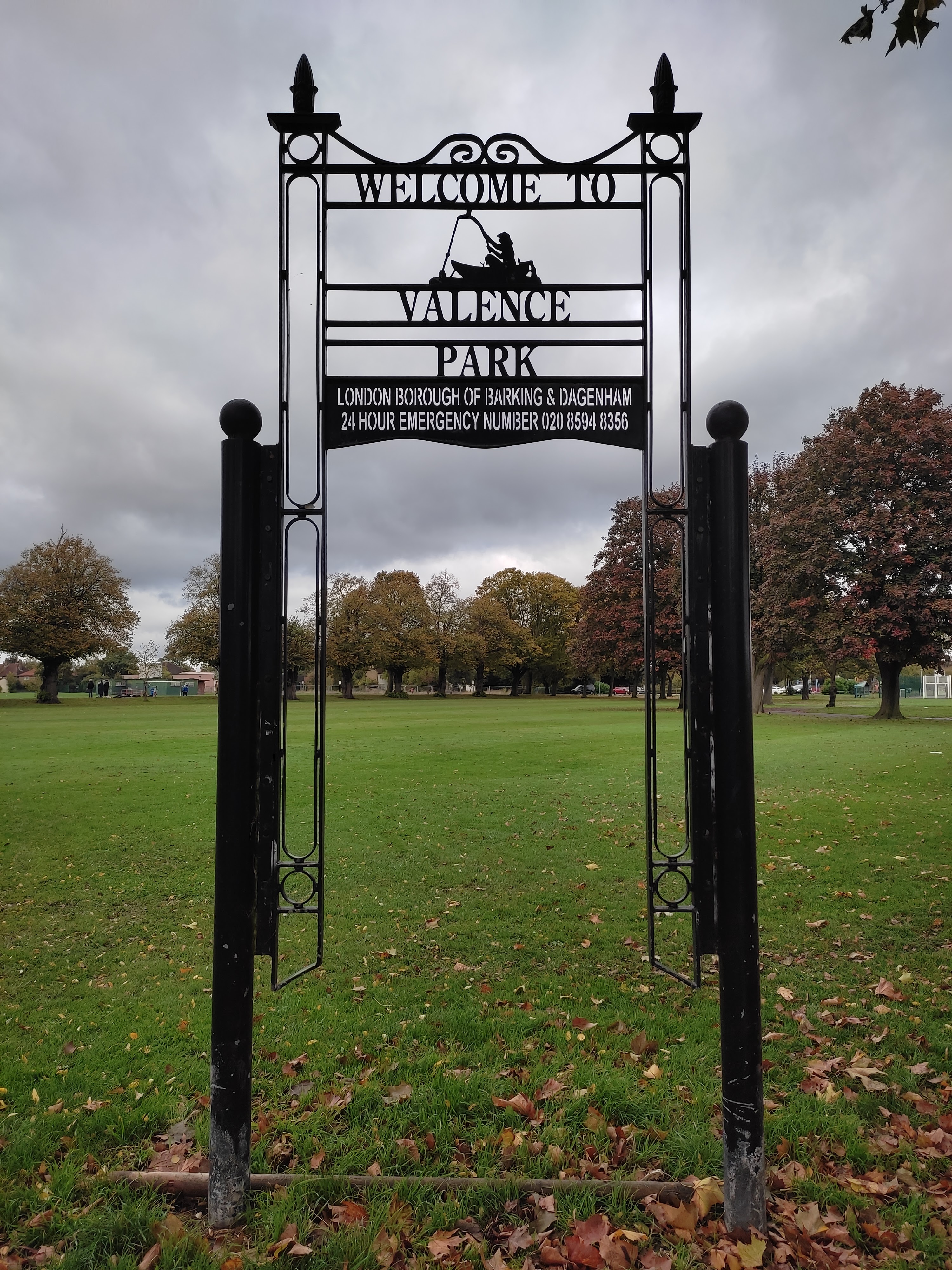
Soon we moved into Valence Park where stands one of the Great Trees of London (a holm oak by the lake that you wouldn't know was a great tree of London unless you'd done some research like me) which had Pam singing Great Trees of London to the tune of Warren Zevon's Werewolves of London (it'd been a week of werewolves for me).

It's also home to the Valence House Museum (in the last remaining of the five manor houses of Dagenham) which contains displays relating to the Becontree estate and an exhibition of restored items from the Ray and Diana Harryhausen Foundation. We didn't go in, time is of the essence on these walks, but we did take in a rusty mangle, a pretty and pungent herb garden, and a rusty Ford Capri made by the artist A.J.Baldwin in tribute to the Ford Dagenham plant. I liked it. I like rust and I like For Capris.


We left the park near an Art Deco adjacent library and took the A1083/Green Lane down to Becontree Heath past a wooden house with a brick roof (didn't anyone learn anything from the story of three little pigs?), the interestingly named FIDDLERS FOOD & WINE, and a house whose roof had been burnt clean off.

Most interesting of all, architecturally certainly, was the modernist Dagenham Civic Centre (now, seemingly, used, quite bizarrely, by Coventry University). The Art Deco looking building went up in 1936 and the architect responsible, Ernest Barry Webber, was also behind Hammersmith's Town Hall and Southampton's Civic Centre as well as rebuilding Portsmouth's Guildhall.


We loved it - you can tell by the amount of snaps. From there it wasn't long before we were in the heavily landscaped, almost like Teletubby land, Central Park and, from there, it wasn't long before we found ourselves in Eastbrook Park, Eastbrookend Country Park, and Beam Valley Country Park. Just as the sun was climbing high and bright into the sky.
 
This area was quite the discovery. Absolutely delightful. It felt quite wild and though we didn't see any adders,barred grass snakes, slow worms, or great crested newts we did see a cute bunny rabbit and a friendly chap sat on a bench with his dog drinking a can of Stella Artois - and why not!

There was a little sculpture park featuring hedgehogs, owls, and a picture frame from which some hideous monster appears to be emerging and there are lakes with fantastic names like Chase Waters, Bardag, Tom Thumb, Hook's Hall Pond, and The Slack. There was even a Slack Bird sanctuary and, yes, the jokes write themselves.

After crossing the railway line we followed the course of the Rom, or Beam, river (a small and slow Thames tributary that starts in, you guessed it, Romford) until we reached the A112/Dagenham Road. We followed that for a while and then cut through a housing estate to find our first pub stop, the Cross Keys.


It didn't, initially, look that inviting but the taped up windows were merely Hallowe'en decorations and the men daytime drinking were all harmless enough and I wasn't going to argue with £10.10 for three pints (my Doom Bar was £2.50 - London Pride the same price and I'd have had that it hadn't been off, I was feeling a sense of London pride).

The jukebox blasted out The Specials, Madness, The Beat, Bad Manners, The Funboy Three, Talk Talk, and some stadium era Simple Minds and we had a good old chinwag before heading off. I seem to be free of the acid reflux at the moment so I didn't even need to be sick. Either in the toilet, sink, or urinal.

We stopped outside to take a look at the Dagenham Parish Church (a local church for local people) and then headed off along Church Street, Church Elm Lane, and Dagenham Avenue coming off into and through Goresbrook Park before heading past Becontree where we'd started the walk and along Woodward Road and Lodge Avenue to the Roundhouse pub which I'd earmarked for our second stop.


But it was closed. Which was a pity. Because I had some bloody good spiel about it. It's a pub that should be on any rock pilgrim's to do list because it's got some serious history. Established as 1969 as the Village Blues Club and, until 1975, considered East London's premier rock music venue the list of acts who have played there is remarkable. Take a deep breath:-

Led Zeppelin, Fairport Convention, Caravan, Howlin' Wolf, Deep Purple, Soft Machine, Pentangle, Free, Tyrannousaurus Rex, Yes, Pink Floyd, Spooky Tooth, Procol Harum, Elton John, Fleetwood Mac, Osibisa, Funkadelic, Atomic Rooster, The Velvet Underground, Can, Uriah Heep, Wishbone Ash, Status Quo, ELO, Wizzard, Dr John, Genesis, Budgie, Thin Lizzy, the Average White Band, the Sensational Alex Harvey Band, Queen, Magma, Cockney Rebel, Gong, Lindisfarne, Dr Feelgood, Motorhead, Judas Priest, UFO, 10cc, Leo Sayer, and Sailor.

Worth a glass of champagne, eh? The pub was the work of specialist pub architect Alfred W Bloomfield (1879-1949) who was also responsible for The Bedford in Balham, the French House in Soho, and The Horns in Shoreditch which I think is now a strip bar. There's one last surprise too. The road that leads to the car park is named after one of Barking's all time greats. Bragg Close was opened by Billy himself on the 24th August 1999 and the Bard of Barking dedicated it to Ben Tillett, the founder of the dockworkers union.

Sadly it's none too fancy a road. Unable to grab a pint in this storied institution we cut through nearby Mayesbrook Park, where we saw a crow in a face off with two Egyptian geese, and out on to Upney Lane where Bee left us. Pam and I continued down Upney Lane and grabbed a couple of scoops in the pleasant Acorn pub. Bournemouth were beating Arsenal 2-0 on telly but we were too busy chatting to pay much attention.


By about 7.30pm it was time for food, so we walked down Longbridge Road to Barking proper and to the not for profit HumDum Pakistani restaurant where I meant to, but didn't, dish out some spiel about Barking. How the name comes from Berecingas ('the settlement of descendants of a man called Bereca), how Underworld released an album called Barking in 2010, and how Barking's notables include Tony Adams, Trevor Brooking, Billy Bragg (but of course), Captain Cook (who moved here in his 30s), 2009 Britain's Got Talent winners Diversity, John Farnham (of You're The Voice fame), Nick Frost, Phil Jupitus, Ross Kemp, Paul Konchesky (these footballers!), Vera Lynn, Bobby Moore, Sara Pascoe, Martin Peters, Stacey Solomon, John Terry, Bobby Zamora, Mary Wollstonecroft, and Brian Poole and the Tremoloes. Truly the place is a home for heroes.
 
The people who run HumDum are heroes too in my eyes. All the lights were on and they had no other customers but they let us, against their usual rules, bring our own beer in and made us a chaat and a saag paneer that cost us just over £11. Not each, in total. Ridiculously cheap and I thought a £2.50 pint of Doom Bar would be the bargain of the day.
 
HumDum was cheap and cheerful and everything we left was going to be used to feed the homeless so there is nothing but good things I can say about the place. We were out earlier than normal and hopped on the tube together. I jumped off at Whitechapel where there was some kind of incident going on and seven empty trains came through the station without stopping before one actually took me back to Honor Oak Park and, eventually, home. It had a been a really good day with really good company and I'm so happy that my walking, and walk arranging, mojo has returned. 
 
Thanks to Bee and Pam (two very lovely and very low maintenance friends) both for joining me on this walk and for providing some of the photos I've used in this here blog. There's only one LbF walk left this year and that's on 29th December. Here's Looking at Leslie Greene - The British Moderne will take us from Elephant & Castle to Chalk Farm and no doubt there'll be some festive shenanigans en route. Would be good to see you all.