Wednesday, 10 May 2023

Two Heads Are Better Than One?:A Journey Into The World Of Delusionary Thinking.

Once there was a man. The man had a wife. The wife was having an affair. With a doctor. One day, the doctor and the wife were involved in a car crash. It killed them both. That's not a very happy story but it gets worse and it gets weirder.

The man, now both cuckolded and widowed, grew a second head. Right next to his existing head. Or at least he believed he had done so. Nobody else could see it. There was no evidence whatsoever that he had two heads. But he firmly believed he did. What was, perhaps, worse was that the second head was that of the doctor who had had an affair with the man's wife and was now dead.

The two heads didn't get on. The doctor head tried to run things but the original head wasn't having that. Eventually the situation got so bad that the man got a gun and shot the doctor head clean off. From that moment on he no longer believed he had a second head. Which would have been at least something positive in this rather grim story if it wasn't for the fact that when shooting the second head off he managed to injure his own head and that those injuries would eventually kill him.

Thinking you have a second head would seem, quite clearly, a sign of serious delusion and it was just the sort of story I was hoping to hear when Dr Ema Sullivan-Bissett, a reader in philosophy at the University of Birmingham, spoke at Davy's Wine Vaults last night for Greenwich Skeptics in the Pub.

Her talk, Is it normal to be delusional?, didn't just involve telling weird and wonderful stories. Fun though those bits were. Her particular interest is in how we view, and treat, people with delusions. Ema's view is that they're not as odd as they might seem. Certainly not when you look at the beliefs we consider normal.

By normal, we don't mean rational, logical, or even sensible. Some examples were given and they ranged from the slightly cheeky to the downright disturbing. Take, for example, a fan of Tottenham Hotspur (an example used because Ema's partner is one) who, each season, truly believes his team will win the league. Spurs last won the league in 1961 and are currently in sixth place, twenty five points behind Manchester City. There are, quite clearly, much better teams in the league but that doesn't stop Spurs fans thinking that, somehow, they'll end up on top.

Wishful thinking! What about, to go all Richard Dawkins, somebody who believes in God. Or gods. There is no empirical evidence whatsoever for the existence of a god and there never has been. There is a shitload of empirical evidence of evolution. But when people believe in God, most of us don't say they're deluded (though, to be fair, I do). We say they have 'faith'.

What about when people believe in conspiracy theories, when they believe Covid is caused by 5G, when they believe the Earth is flat, or when they believe that Hillary Clinton runs a cannibal paedophile ring? These beliefs are outlandish, nonsensical, and, in most cases, very very dangerous. But they're not, statistically, considered abnormal.

Because a significant number of people believe them to be true. Not very many people believe they have a second head or that their child has been abducted by aliens and replaced by an imposter. Most of those who study delusion believe there are two factors in what causes delusion:-

 (1) A major event that may cause shock, trauma, or grief - like for instance your wife dying in a car crash along with a doctor she's having an affair with. 

(2) The way that the person involved processes that shock, trauma, and/or grief.

Take, for example, two women, Emma and Gemma. Emma's married to Barry, Gemma's married to Gary. One day Emma and Gemma have a car crash (car crashes cropped up a lot last night) and something happens to them which results in them having strange reactions when they next meet with Barry and Gary. They still recognise their husbands, they still look the same, but the affective feeling we all feel when we see someone we love (a partner, a child, a parent, a close friend) isn't working because of some injury caused by the accident.

Emma, being a rational and logical person who respects science, realises that the reason she feels weird about Barry is because something has happened to her. She seeks help and the situation is remedied. Gemma. who gets her news from social media and anti-vax websites and already believes in poltergeists and lucky horseshoes, jumps to quite a different conclusion. She believes aliens (which, in her mind, obviously exist among us) have kidnapped Gary and replaced him with some kind of android lookalike.

It was Ema Sullivan-Bissett's contention that that isn't really all that different to believing in a flat Earth or that birds aren't real (and have all been replaced by drones by the US government). It was her belief, quite an inclusive one I thought, that if we can extend what we consider as normal behaviour to those that believe in demonstrably untrue conspiracy theories we should extend it to include those that believe their partner has been kidnapped by aliens or those that have grown second heads.

I didn't agree entirely with her premise (though it certainly carried some weight) but she spoke knowledgeably, enthusiastically, and with a great deal of humour about the subject and even chucked in some (voluntary) audience participation which proved that when it comes to reasoning logically we are all incredibly fallible.

Following a pint in the Spanish Galleon Tavern, veggie pie and mash in Goddard's, it all made for a lovely evening. Thanks to Jade for keeping me company, thanks to Professor Chris French for hosting, and thanks to Dr Ema Sullivan-Bissett for giving us all something to think about. Next month it's Dr Anna Stone with 'The appeal of conspiracy theories and why people feel so passionate about them' which sounds like a highly suitable follow up.


Tuesday, 9 May 2023

A Still Life:Giorgio Morandi @ the Estorick Collection of Modern Italian Art.

"Nothing is more abstract than reality" - Giorgio Morandi


 Still Life (1953)

Giorgio Morandi led a still life. He was born in Bologna in 1890 and he died in Bologna in 1964. To look at a lot of his paintings, you'd almost be able to believe that, in that time, he hardly left his studio. He did but he almost didn't need to. Giorgio Morandi saw beauty in the most simple things. When Picasso looked at Cezanne's apples it inspired him to extrapolate wildly and, with Georges Braque, invent Cubism. When Morandi looked at them he seems to have come away with the conclusion that it was all a bit much, that it needed paring down.

Morandi was influenced by Cezanne and Picasso, even Derain, but in the Estorick Collection of Modern Italian Art's ongoing show, Giorgio Morandi:Masterpieces from the Magnani-Rocca Foundation (in Parma), you can get a real sense of how much Morandi managed to do with so little. There are a few outliers, which we'll come to, but, for the most part, there's a lot of vases, bottles, and fruit carefully arranged on tables. Usually painted in muted, muddy, colours.

It's not an art that screams for attention. Which sits well with Morandi's ascetic, or reclusive, reputation. Even if that wasn't quite true, Morandi was actively engaged in the Italian art scene at the time. He just preferred to paint the way he did and stay in Bologna as much as possible.

Metaphysical Still Life (1918)

As a younger man, Morandi had made some metaphysical paintings in the style of Giorgio de Chirico and Carlo Carra. But even those were quieter than the works of those contemporaries. They weren't as busy as Carra's more hectic style and they lacked the uncanny menace of de Chirico's mannequins, rubber gloves, speeding trains, and eerily vacant plazas.

But for Morandi, it seems, they were busy enough. Most of the rest of his career he stuck almost rigidly to the style is he now rightly famous for, the still life painting. There are so many on show as the Estorick that I've only included the best ones but it's a moot question how a viewer decides which ones are best. There's not a huge amount of difference.

Still Life (1963)

The Courtyard on Via Fondazza (1954)

Still Life (1948)

Landscape (1953)

Flowers (1942)

I've tried to mix them up with some of the outliers I mentioned earlier. There's a Bolognese courtyard, or half a courtyard - most of it is wall, that owes a debt to Cezanne, there's a hazy landscape, and there's a bowl of flowers. Morandi had always been keen on flowers but during World War II he took to painting them. Perhaps his message of peace. Who knows? Either way, it's about as close as Morandi ever got to making a political painting.

The meditative still life paintings kept coming though. The curators at the Estorick compare Morandi to a chess player who would contemplate every possible configuration before making a move and note how the surfaces that the collection of objects depicted on were painted so airily that an impression of floating was given.

Still Life (1942)

Still Life (1936)

Still Life with Fruit (1927)

Self Portrait (1925)

Along with a bowl of fruit (again, clearly inspired by Cezanne), there's even a very rare self-portrait of the man himself in his mid-thirties. Painted nearly four decades before his death, it is the last portrait (self or otherwise) Morandi would ever make. In fact, the last painting he'd make with any human figure in whatsoever.

Morandi seemed to see life happening in objects as much as he did in people. The Estorick show is pretty small. Just two rooms with the second room being dedicated to etchings and watercolours. It has to be said that room is of less interest, Morandi seemed to work better in oil, but there's still some good stuff in it.

The Bridge over the Savena in Bologna (1912)

Even some works that suggest that Morandi did, occasionally, leave the house. There's a lovely etching of a bridge in Bologna (of course), there's a haystack (!), and then there's a really rather blurry landscape. You could easily get the impression that Morandi was rushing that because he was in a hurry to get back to his studio and arrange some bottles and vases on a table.

It's a funny way to live a life. Devoting yourself so thoroughly to one subject entirely, it reminds me of medieval religious zealots, but it was clearly what Morandi wanted to do. To keep doing it until he got it right. He devoted so much time and attention to his art and yet he didn't demand our time or attention at all. He made the images. We look at them, admire them in my case, and then we move on. That seems like something Morandi would have been more than happy with. Nothing is more abstract than reality.

Haystack in Grizzana (1929)

Landscape (1958)


Monday, 8 May 2023

Beef:How Low Can You Go?

When Danny Cho (Steven Yeun) nearly backs into Amy Lau (Ali Wong) in the parking lot of a home improvements store in Los Angeles he doesn't do what most of us would do. Apologise, wave her through, or simply ignore the very minor incident. Instead, the red mist descends and not just for him. Horns are beeped, Amy flips Danny the bird, and, before you know it, they're involved in a fairly implausible road rage fuelled car chase which manages to ruin some of California's most finely manicured lawns.


This is the the start of the beef in Netflix's Beef (created by Lee Sung Jin and directed by him too as well as Hikari and Jake Schreier) and if it sounds like a very slim premise then don't worry. Stick with it. It's hugely watchable, good fun, and though the beef itself is never far from the heart of the drama it does a great job of drilling down into both Danny's and Amy's lives and backgrounds. 

As if to try and understand why they're both so angry. Their anger, and their Asian-American identities, it seems, at least at first, are all they share. They're very different. Danny is a struggling contractor (definitely not a handyman, a word he baulks at) living with his messy, crypto currency obsessed, brother Paul (Young Mazino). Their parents have lost the motel they used to run and have moved back to South Korea.


Amy is a stressed out, but very wealthy, owner of a successful small business, Koyohaus, that sells bespoke plants. She lives in a very nice house with a 'timeless kitchen' and she uses a gun to masturbate. Not that her husband, George (Joseph Lee), knows about that. George is a sculptor of vases and George is also a very modern, anxious, man who talks about mindfulness, meditation, focusing on the positives, and 'gratitude journals'.

Precious George believes "anger is just a transitory state of consciousness" which, to be fair, it probably is. But that's not much use for Amy and her short temper. Amy and George's daughter June (Remy Holt) is ridiculously sweet and, appropriately enough, she gets to deliver some of the sweetest lines of the entire show. June loves her parents and she also loves her grandmother, George's mum Fumi (Patti Yasutake).


All of them will eventually be caught up in Danny and Amy's ever spiralling beef. As will Isaac (David Choe), Danny and Paul's larger than life cousin who has recently been released from prison (for involvement in a racket concerning counterfeit baby formula) and seems likely to be back there again soon, and Jordan (Mario Bello) who runs the home improvement store, Forsters, and whom Amy is hoping to strike a deal with.

Jordan comes across as a fairly awful person. She talks as if she's deeply spiritual but her only god appears to be mammon. Everything has a price and Jordan can always afford it. She lives in a huge house that is bigger than most museums I've visited, hosts extravagantly pretentious mushroom dinners, considers shy children to be impolite, and is due to marry her brother's ex-wife Naomi (Ashley Park). Naomi is a woman with too much time on her hands which may become a problem for Amy.

Beef is styled as a dark comedy and it's certainly dark (and weird) in places (more so as the series progresses) but, despite some very good dialogue, it's not laugh out loud funny. Although you have to marvel at choice lines like "I don't fuck guns", "I know a handyman urinated in your bathroom", and "I almost set a baby on fire" and, equally, you have to admire the bizarre episode titles. I Am Inhabited By A Cry. Such Inward Secret Creatures. I Am A Cage. Or even The Birds Don't Sing, They Scream In Pain.


What with that, and chances to learn about the K-Town riots of the early nineties and the Dick Cheney crow experiment (as well as alternate lyrics to Pop Goes The Weasel) it may sound like Beef is trying too hard to be artsy and edgy but when you watch it it doesn't feel like that. It flows easily as the quarrel goes from threatening phone calls, pissing on bathroom floors, and Instagram catfishing to vandalised pick up trucks and, eventually, far more serious situations.

It helps that both Danny and Amy, despite their fatal flaws - that red mist will descend again - at one point literally, are both charming characters you can't help rooting for. Yeun and Wong really inhabit the roles and the rest of the cast are great too (honourable shout outs to Justin H.Min as church leaded Edwin, Alyssa Gihee Kim as Veronica, Edwin's wife (and Danny's ex), Mia Serafino as a woman who works for Amy and idolises both her and George, and Rek Lee and Andrew Santino (Mike from Dave, lots of the people involved with Beef also worked on Dave) as two of Isaac's morally dubious cronies.

The soundtrack's interesting. The incidental music comes courtesy of Bobby Krlic, the Yorkshire dark ambient artist who's put a couple of albums out under the name of The Haxan Cloak and found favour on Stuart Maconie's Freak Zone, but each episode ends with a song and it's hard to escape the fact that they, more or less, all seem to come from a certain time period.

About twenty years back. So you get to hear the likes of Bush, Keane, Bjork, Tori Amos, The Offspring, System Of A Down, Grant Lee Buffalo, Smashing Pumpkins' Mayonnaise, and Hoobastank's deathless The Reason. Some of the songs are great (Morphine's Cure For Pain particularly), some less so but they all work well in the context of Beef.

It may be far fetched and rely on an extraordinary amount of confected coincidences to propel the story forward, and even have a rather odd corvid subplot, but that doesn't really matter. All of that, and the fact that people often act very strangely, is what makes Beef such a success. It's not a docudrama, it's not social realism. If anything, it's a parable. A parable about anger, about revenge, and about how to address one's demons. Go with it. Enjoy the ride. Don't get mad, get even. 


Sunday, 7 May 2023

TADS #55:Ashurst to Brockenhurst (or Old Yet Ever New).

There are two ways in which TADS are very much like The Fall. One, and with due reference to Mark E Smith and a falsely humble apology, if it's me and your granny on bongos, it's the TADS. Two? In the words of John Peel, TADS, like The Fall, are always different but they're always the same.


We'd last visited the New Forest back in September 2017 and we'd been keen to go back. I'd scheduled the walk for May as it seemed likely we'd be able to enjoy clement weather and fully appreciate the beauty of the place. That was not exactly how it panned out.

The unpromising weather forecasts I'd been reading all week weren't lying. Yesterday was something of a wash out. I blame King Charles for angering the 'gods' by having a coronation. An event I was more than happy to neither watch on television or in person. I thought I'd be spending it in a sunny beer garden instead but that wasn't the case.

Despite the poor weather, however, I had a brilliant time and judging by what the others said, and how much laughter I heard throughout the day, so did everyone else involved. I've got a feeling this walk will be one of the ones we look back most fondly on as time passes by.

I'd woke early, 5am, got the train to Clapham Junction, met Pam, and then another train to Southampton where we met with Neil and Bee. By the time we arrived in a very rainy Ashurst we'd had a message from Teresa and her, Adam, Shep, and Laura were already in The Happy Cheese. It's a pub but nobody, in our group at least, was drinking booze. Coffees and lemonade all round.


The Happy Cheese, there used to be a rival pub across the road called The Angry Cheese but that's gone now, is a place some of us had visited many many years ago but that wouldn't have been for breakfast. Which is a pity because the veggie breakfast was one of the best I'd ever had. Beans on toast, fried eggs, huge mushrooms, one hash brown, and some fried tomato (which I donated to an eager Shep). The sausages looked pretty anaemic so I smothered them in ketchup. I didn't need to. They tasted delicious. Much better than they looked.

The coronation was on the television in the background. An old man, Charles Windsor, was sitting on an expensive chair while the Archibishop of Canterbury screwed a silly hat on to his and his wife's heads. Nobody was paying much attention but elsewhere in the New Forest we'd be confronted with Union Jack flags, bunting, cardboard cut outs of King Chuck, balloons, and a man playing God Save The King on a box piano.

Each to their own but I'd rather the mega rich paedophile adjacent royal family fucked off and we got rid of all this monarchy bollocks. The most important Royal news of the week for me was that Reading FC had been relegated earlier in the week.


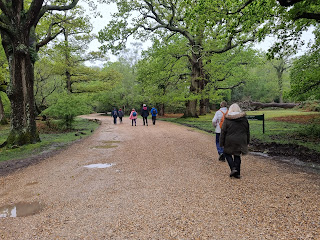
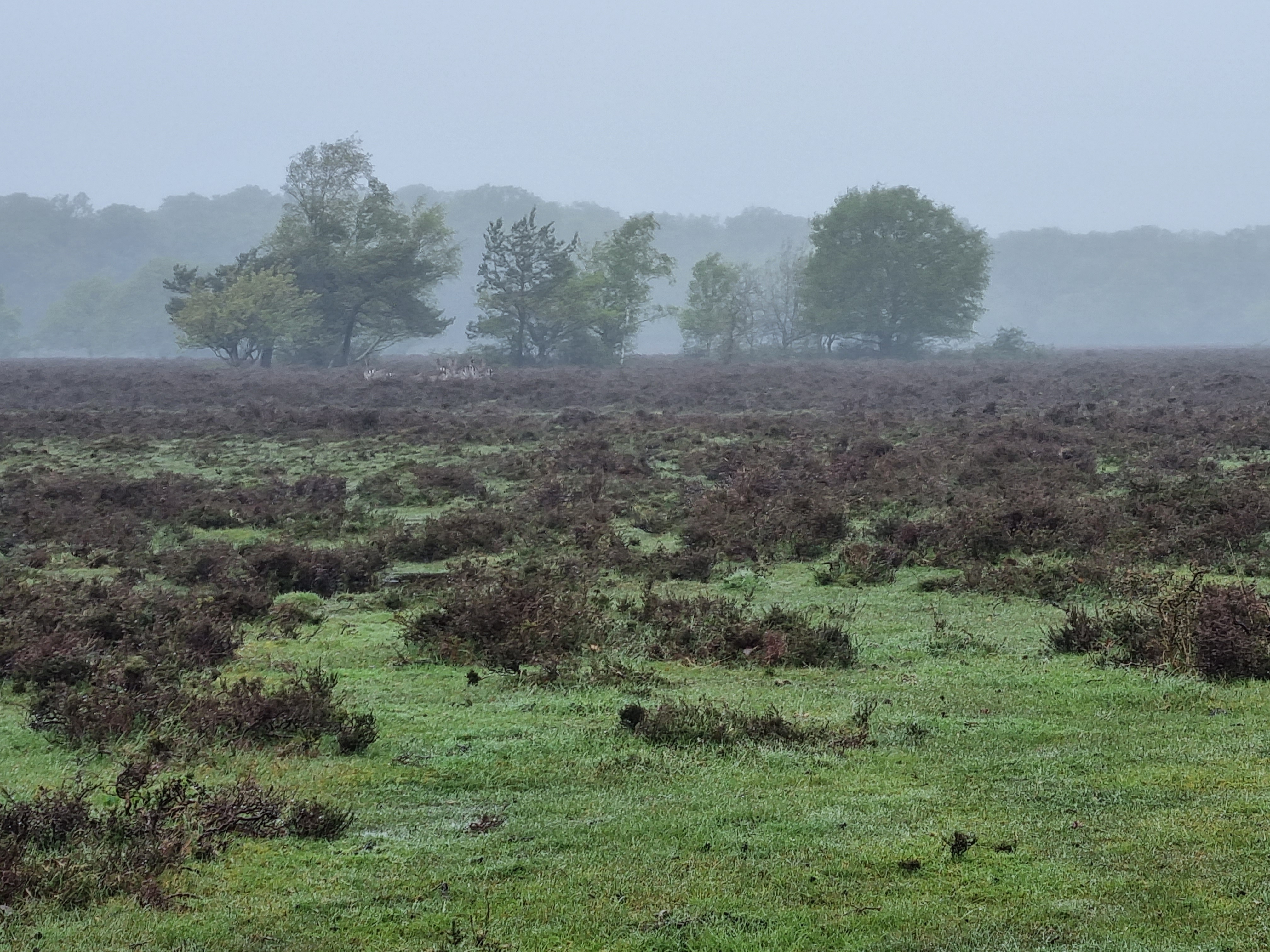
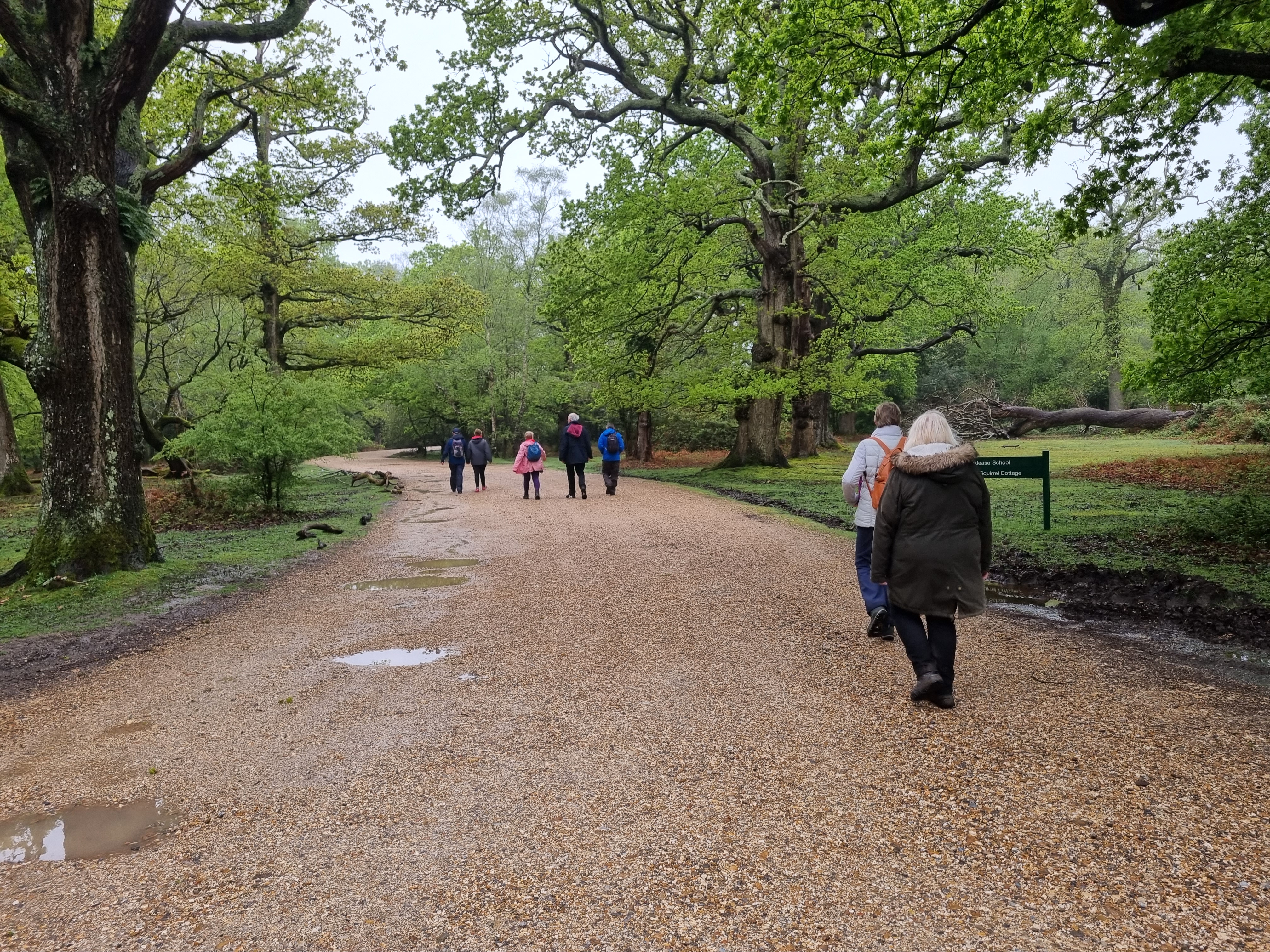
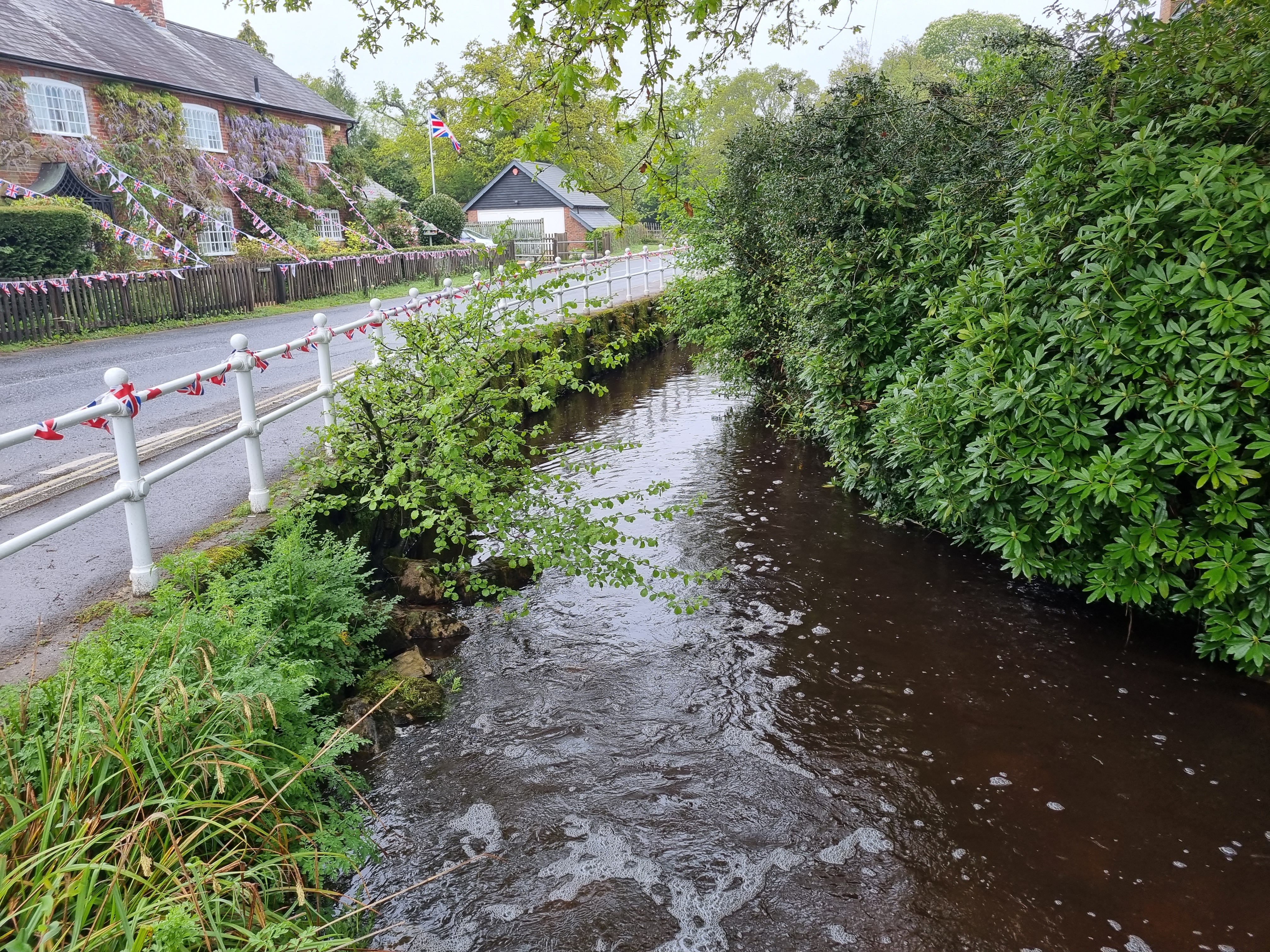
We left the pub and headed back towards Ashurst station. It was still raining. You can probably tell by the photos. Ashurst, Happy Cheese and Angry Cheese aside, doesn't have many claims to fame but it is the place where, in 2009 and at the age of 93, the last survivor of the 1912 Titanic disaster, Millvina Dean, died. She'd been living in the village and had staunchly refused to watch James Cameron's 1997 blockbuster film about the disaster after having nightmares when she watched 1958's A Night To Remember

The New Forest, motto - Old Yet Ever New - stolen for my walk's title, features in the Domesday Book and it began life as a royal forest under the proclamation of William the Conqueror. Also known as William the Bastard. He was a bastard too, using the forest to hunt deer. Two of his sons, Prince Richard and the then king William II (William Rufus), died in the forest. William II, believed to be Britain's first bisexual monarch, had his lung pierced by an arrow while out hunting. Game know game.

The forest's 71,474 acres span parts of Hampshire and Wiltshire and the four largest settlements (Brockenhurst, Lyndhurst, Ashurst, and Sway) all have populations below four thousand. Smaller villages included Bealieu and Minstead. It seems there's probably more animals than people out in the forest although we didn't see a lot of either.

Mammals included ponies (we saw them), cattle, donkeys, pigs, deer (we saw them but from a distance so we couldn't be certain if they were fallow, red, or roe), squirrels (grey ones, the reds died out here in the 1970s), European polecats, Eurasian otters, and American minks. 


There are reptiles and amphibians too. Adders, grass snakes, sand lizards, great crested newts, frogs, and toads. As for birds, the list is almost endless:- woodlarks, lapwings, warblers, nightjars, hobbies, cuckoos (we heard them), woodpeckers (them too), stonechats, snipes, pipits, kites, redstarts, shrikes, ouzels, harriers, and wheatears. There are even European honey buzzards.

But what there was yesterday, more than anything else, was water. We hit it pretty quickly. A supposed path by the side of the railway line was, in truth, a flooded field. A marsh. Some bits were easily passable but others less so. There was a lot of zigging and zagging for us zigzag wanderers (check out the maps at the end of this blog) and, at some points, it seemed advisable to take a run and jump to cross a large puddle or an improvised stream.

Pam was the first to fall. She jumped the puddle with ease but lost her footing on landing. I managed to hold on to her before she became completely caked in mud but she still end up with some lovely brown stains on her bag, coat, and top. Though she didn't look quite as ridiculous as I did in Epping Forest back in March or Shep did in Coulsdon's Happy Valley back in 2018.


Eventually we reached a path, which involved walking through even muddier areas and traversing a low lying thick set tree branch (most went over, a couple went under, Adam - ever the iconoclast - went round), and crossed a bridge over the railway line. There was brief respite from the mud and we even saw our first ponies, as large as horses I thought - some eating leaves from the tree like dinosaurs, of the day. 

When I say the respite was brief I mean it. About one kilometre of damp, but manageable, walking and soon we were in far trickier terrain. It looked amazing but it wasn't easy to navigate the puddles. I'm glad it happened at the start of the walk while people's spirits were still high. The walkers took different approaches, Neil and I trudging through in our boots while Shep, Laura, Adam took their shoes and socks off and got closer to nature.

Laura, at one point, was nearly waist deep in the water. It didn't seem to bother her at all. She was on top form. We had to cross the Beaulieu river (not a tributary, not a brook, not a stream, a bloody river) and that wasn't easy. Some us us jumped it, some crossed on improvised and not particularly sturdy looking bridges, some were carried across in their ponchos. Bee was last to cross and at one point it looked like she'd not make it. She did though. We were all very glad about that.


I was first over, and got to see some deer which soon ran off, and it quickly became apparent that we'd have to alter our route a little because the river was winding and wending all through the fields and we didn't fancy crossing it again without a bridge.

Of course, we had to. As we squelched our way through the marshes we soon heard the rumbling traffic from the A35 between Ashurst and Lyndhurst. We aimed for it but to get to it we had to cross the Beaulieu river again. A tree had fallen, or been placed, across the banks but the water was very deep and the tree looked a bit slippery.

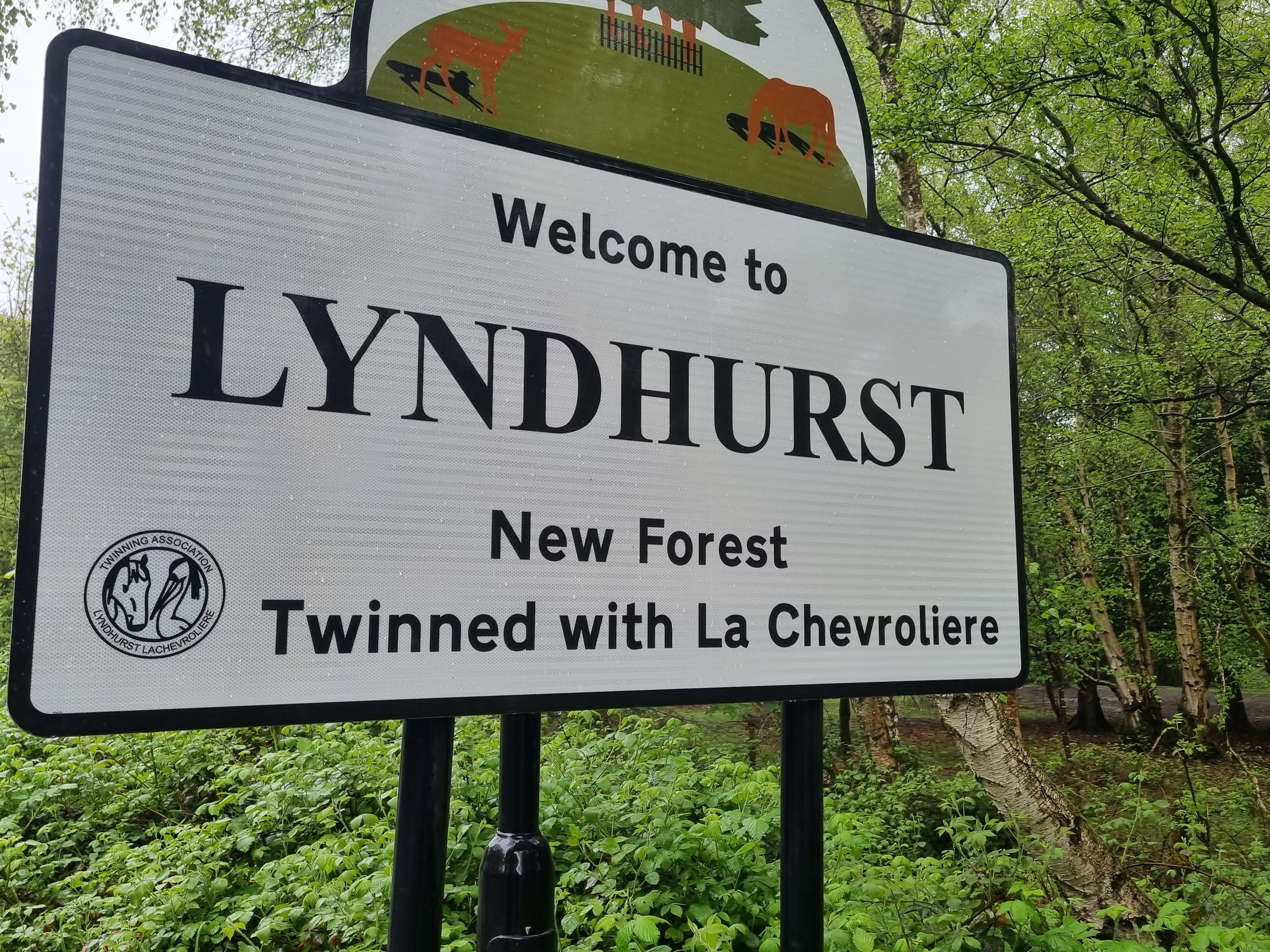
Somehow we all made it across okay. I was last over this time and I was very nervous crossing so it was a relief to get over. The next stretch was a fairly dull, although we saw some nice wisteria, but easily walked path alongside the road into Lyndhurst. A place I'd not even planned for the walk to visit.


Everyone had earned a drink so, tempted by the fact it hosts a rum & reggae night, we tried The Mailman's Arms, opposite a large Ferrari garage - there's some money in the New Forest, but there were no tables free. We carried on up the High Street and ensconsed ourselves in The Fox and Hounds, a home from home for the Tadley contingent.

Some of the walkers sat barefooted, Laura put her trainers on the radiator in the toilet, and I nursed a pint and half of Peroni in amongst the bunting and balloons (even if the ER & GR postboxes are yet to be joined by a CR one). We discussed why there's no fucking beavers around when you need them and Pam mentioned that the day's walk, so far, had made the infamous Groombridge disaster of 2016, seem like a doddle.

Spirits remained high. We're a jolly bunch of walkers (or at least that's what I think I heard someone call us). Lyndhurst was once home to the infamous snake catcher Brusher Mills and to a young lady called Alice Liddell who Lewis Carroll used to read stories to and many believe is the inspiration for Alice In Wonderland. It is also, in folklore, the location of a famous dragon slaying. The Bisterne Dragon used to fly around local villages and steal, or be supplied with, milk.

Even better than that, no less of a man than ventriloquist Keith Harris was born in Lyndhurst. So I like to think of it as being the birthplace of Orville the Duck and Cuddles the Monkey. This, rather unfortunately, gave me an earworm of "I Wish I Could Fly", and also led to us betting each other to order drinks, or the curry later, in the voice of Orville. I possibly went too far when I imagined Orville working on saucy 0898 phone calls.


From the pub, and once Laura had bought a new pair of socks, we left Lyndhurst and headed south on the busy A35/Gosport Road. We didn't giggle once at a road called Shaggs Meadow (no sirree) and we didn't, though three of us were tempted, make a pub stop in Ye Old Crown & Stirrup. The pub I'd planned for us to stop in until our route was so rudely altered.

Despite the burnt out van in the car park, it looked a nice pub too, and it let Laura and Pam in to use the facililties, but if we'd stopped we'd have been making time very tight for ourselves. Instead, not long after the pub, we crossed a cattle and pony grid back into the forest proper. It had stopped raining but it was still wet. If not anywhere near as boggy as the earlier stretch. This was very much a walk of two halves.


This section was quite delightful. Mossy trees, copper hued pools of water, frolicking deer, waterways with names like Highland Water, Fletchers Water, and, er, Spaniard's Hole, and people feeling pleased they'd soldiered on and not quit - which, briefly, had seemed an option earlier on. Not long after a campsite we crossed a bridge, an actual proper bridge rather than a fallen tree trunk, over the fast flowing Lymington River and then we cut a long and straight diagonal line into Brockenhurst itself.

The 'capital' of the New Forest, apparently. During World War I, Brockenhurst hosted the Lady Hardinge Hospital for Wounded Indian Soldiers and, in 1934, Cass Gilbert died in Brockenhurst. Most people won't know who he was, I certainly didn't, but he's the architect (born in Ohio, 1859) of the US Supreme Court Building in Washington DC and New York's Woolworth Building which was the world's tallest between 1913 and 1930.


Brockenhurst, like Lyndhurst, was festooned in coronation bunting but we were more taken by watching cars splashing through the surprisingly deep ford on the outskirts of the village. I was tempted by a game of pooh sticks but there were no other takers.

We could see the Indian restaurant, the Dynasty, I'd booked in advance but we had an hour to kill so passed through the town, some stopping to sit on a HAPPY TO CHAT Bench, to the infamous Snakecatcher pub (named, of course, for Brusher Mills) and had a quick aperitif in there. It was busy. Coronation revellers or just people out on a Bank Holiday weekend, who knows?


I can't remember what, specifically, we talked about in there but I know I laughed a lot. As I did in the curry house. Dynasty is the only Indian place in Brockenhurst so choosing it wasn't difficult. It was busy so it was a good job we booked. We soon tucked into sixteen poppadums and, for some of us, pints of Cobra and my garlic chilli paneer masala was both spicy and tasty.

Most of the others enjoyed theirs too though the navrattan korma got only a lukewarm review from Teresa. The two hours in the restaurant flew by and soon Pam, Neil,  Bee and myself were on the way back to the train station. Stopping for train booze of course. Neil and Bee got off at Basingstoke and Pam and I in Clapham Junction. An Overground train to Peckham Rye and a 363 bus took me home where I watched the news.

It was all about the coronation. It didn't look like I'd missed much at all. I was much happier getting soaked, walking through muddy fields, doing Orville the Duck impressions, eating curry, drinking beer, and laughing with my friends so I'd like to thank Pam, Neil, Bee, Teresa, Adam, Shep, and Laura for making that happen (and, in the case of several of them, providing some of the snaps used here).Let's do it all again next month but this time from Battle to Hastings. Always different, always the same.