Wednesday, 26 June 2019

Theatre night:The Damned.

I'd gone along to the Barbican to see Ivo van Hove's The Damned (Les Damnes), adapted from Luchino Visconti's 1969 film, to, I admit, hopefully see a play that spoke both about the terrible consequences that befell those who cosied up to, and those who opposed, the rise of the Nazis in Germany in the 1930s and to seek parallels for what's happening today in Britain, America, and elsewhere.

I got more than I bargained for. While the first half was confusing but did, indeed, show the tensions played out between family and friends as they argue and debate what the best policy is for dealing with the rise of fascistic, authoritarian, and downright cruel regimes, the second half was, to put it quite frankly, utterly fucking bonkers. Men with their cocks out, people being tarred and feathered, buckets of blood lobbed over the stage, and the occasional, completely inappropriate, breaking out into some kind of German drinking song. It made about as much sense as a Boris Johnson interview and in places it was nearly as unpleasant to look at.


If van Hove was hoping to convert Brexiters (Brexiters, not Brexiteers - they're not fucking superheroes, mostly just pricks) to a more rational, considered, and less prejudiced way of thinking it seems inevitable to fail. They're as likely to watch a two hour play about politics and history as they are to read this blog about it. For the most part, their minds are made up - it's an article of faith for them now. They'd rather destroy the union and wreck the economy to get their hands on the precious, non-existent unicorns that Johnson and Farage promised them than admit they've been had.

The fact the play was in French won't help much either. Imagine your average common or garden xenophobe going to see a play that has subtitles? Hell, even a sophisticated internationally minded member of the metropolitan elite* like me found it hard going. I wasn't sure whether to look at the subtitled words high above the stage, the action (often several different actors on different parts of the stage at different times), or the big screen at the back which was relaying close ups of the performers live.

This meant that there was a black clad cameraman wandering around the stage following the actors for much of the play. A little confusing when some of the Nazi officials, who'd occasionally wander on to stage to reprimand somebody or shoot them in the head, were done up in similar garb.


The basic premise centred around the von Essenback family, steel magnates undergoing tough times and colluding with the Third Reich to try and keep out of trouble. Some think, correctly, that every inch they give to the Nazis means they'll be asked to concede more and more until they have nothing left. Others opine that it's best to keep their heads down, wait for this to blow over, and put business first. We know how that panned out.

There are so many characters it's hard to keep on top of who's who but I'll give a shout out to Christophe Montenez, who as Martin seems to be dangerously, and highly dubiously, attracted to an underage girl, to Elsa Lepoivre who plays his mother as a mixture of moll and matriarch, and Denis Podalyes whose Konstantin throws his lot in with Hitler only to find that that'll cut no ice with the regime when they consider him a nuisance.


I was disappointed that it was so difficult to follow because, certainly, there was a hard hitting point to be made that's as relevant now as it's been anytime since World War II and although it's not the job of artists or theatre directors like van Hove to make that point too obviously, I'm starting to think the time for subtlety is through. It's time to throw some bricks, smash some windows, and, if need be, crack some heads**. They'll be coming for us soon enough.

If you're poor, if you're the wrong colour, if you have mental health problems, if you believe in truth then they're already coming for you and I don't mean an amorphous 'they' - I mean, specifically, Nigel Farage and his Brexit party, a Tory party that will probably make Boris Johnson their leader whatever he does and whoever he does it to, and a whipped up crowd of illiterate hate merchants on social media who see the answers in violent misogynistic rape threatening thugs like Stephen Yaxley-Lennon (creator of the character Tommy Robinson) and Carl Benjamin (Sargon of Akkad - these bastards are even ruining pseudonyms).


It's obvious right from the start that van Hove's play is meant to shine a light on to these cowards and bullies and make very clear that the scapegoats they're trying to blame for all our woes are just that - scapegoats. Godwin's Law states that the longer an online conversation goes on the more likely it becomes that somebody will call somebody else a Hitler or a Nazi.

But we're past Godwin's Law now. We're in a world of Orwellian speak where asking questions about the policies of leading politicians is an affront and can be booed, where women MPs can be told they're not worth raping, where other women MPs can be shot dead in the street by right wing thugs shouting 'Britain First', and where the likely next PM has threatened to have journalists beaten up.

There's not a lot of laughs to be had with The Damned (although when Lepoivre goes runaround, followed by a camera - naturally, around the backstage and out by the lake of the Barbican it's pretty amusing) and that's quite right. The Nazis, on the whole, weren't a very humorous bunch. In fact, if it wasn't for the concentration camps, over sixty million dead bodies, and a poison unleashed into world politics which will never, and can never, be fully washed away that might be the thing we castigate them most for.


I might not have understood everything that was going on with The Damned, to systemise confusion is key to how the new right work now so that's probably fair enough, but one thing was very clear. The collusion that brought about von Essenbeck's wasn't unfortunate, it wasn't a bad call. It was a clear and intentional decision to side with evil in the hope that that evil would not come to their door.

But when you vote for hate you get hate, when you vote for division you get division, and when you vote for evil you get evil. You'd have thought that, in Britain, we'd have realised that by now but over the next month it seems absolutely apparent that, with the election of Britain's worst ever prime minister, it will get much much worse.

After each death in The Damned, the dead character is lead to a grave by the side of the stage, lowered into it, and the case closed upon them. It happens painfully slowly, we can see what's happening very clearly, but we can do nothing to stop it.

After that the camera pans out to the audience. We appear on the large screen staring back at ourselves. As complicit in the atrocity as anyone else. We're not yet at the stage of full on right wing authoritarian rule in this country - but we're not far from it. We can still be better than the von Essenbacks, we don't have to be destroyed by our own prejudices and selfishness. But, we haven't got long. We need to start fighting now. I didn't really need to see this play to know that.


 *If, on the off chance any angry Brexit voters are reading this. This is what's known as a joke. You know, like your hero Boris Johnson makes. In fact, like your hero Boris Johnson IS!

**Don't really throw bricks, smash windows, or crack heads. Instead, get out there and educate, agitate, organise!

Tuesday, 25 June 2019

Fleapit revisited:Diego Maradona.

"I am black or white. I'll never be grey in my life" - Diego Armando Maradona.

You'll feel many things about, and for, Diego Maradona during Asif Kapadia's new film about the footballing legend who became both a messiah and a pariah. You'll admire his skills, you'll bristle at his dishonesty, you'll feel charmed by him, and you'll be frustrated by him. Ultimately, you will probably find yourself feeling empathy, or at least sympathy, for him.

But, one thing's for certain. You won't be bored by him. Over a slightly ambitious one hundred and thirty minutes Kapadia tells the tale not of Maradona's entire life (though there are flashes back to his childhood in the ghettos of Buenos Aires and forward to his later, podgier, years) but, instead, the seven year period, between 1984 and 1991, he spent under the volcano (metaphorically and literally) of Vesuvius at Napoli.


In many ways, Kapadia and even Maradona himself suggest, these years act as a condensed version of Diego's life story. Arriving in a whirlwind of camera flashes, chanting crowds, car chases, and chaos and leaving silently by the back door. Totally alone.

In that time he'd changed the fortunes of the club, the fortunes of the city, become a hero, almost a God (his blood is decanted into a bottle and left in a Neapolitan church), before being turned into a villain for having the audacity to captain Argentina to semi-final victory over Italy on home turf, amazingly in Naples, in a World Cup (1990) in which the home team were the favourites.

Being an England fan, I was more concerned with our own penalty defeat to West Germany the following night so I'd not really taken on board the significance of events. Also, Maradona (and it hardly bears repeating) was not very popular here after his handball ('hand of God') goal against England in the previous World Cup four years earlier in Mexico City. Something Maradona claimed was his revenge for Argentine defeat in the Falklands War four years earlier.


England were out and Maradona captained the Argentines to their second ever World Cup victory over West Germany a week later. For the football alone it's a remarkable journey but this isn't a film about football so much as it's one about Diego Maradona. Or Diego and Maradona! The point is made many times, a little too many perhaps, that Diego and Maradona come to be seen as almost two separate people.

Jekyll and Hyde style. Diego is the bright eyed street kid, fond of keepy-uppies, who loves his mum and Maradona is the coke-addled monster who refuses to recognise a child he's fathered during an affair, consorts with the Camorra to an extent that he starts to become their property, and (understandbly) tires of the the paparazzi shoving microphones in his face and asking sometimes probing but often impertinent questions of him wherever he goes.

His story is told in parallel with that of the city of Naples as well as the city's football club, S.S.C.Napoli. When he arrives the city is crumbling, an almost perfect illustration of faded beauty. The peeling yellow paint of the city centre buildings giving way to brutalist monsters like, in fact, the 60,000+ capacity Stadio San Paolo where Napoli play their home games to a sea of fire crackers, screaming fans, and blue shirts and flags.


When Maradona arrives, Napoli have never won Serie A. The club is laughed at, belittled, and loathed by the titans of the Italian league like Juventus and the the two big Milan clubs. The city too, in fact the whole of the mezzogiorno, is traduced in a fashion that makes rivalries between Man Utd and Liverpool and Arsenal and Tottenham look like tickling contests.

The Neapolitans, we hear fans from Florence, Turin, Verona, and Milan, are cholera sufferers who should be washed away by an earthquake and as teams like AC, Inter, and Juve have always had bragging rights it seems Napoli have had to suck it up.

Maradona's initial arrival doesn't change much. We see, in footage so extremely close up that we feel every kick of the ball and every hack at Diego's ankles, Napoli turned over by bigger, northern teams time and time again until, eventually, they start to turn it around and, in an echo of Tom Hooper's The Damned United from ten years back, we see a league table on the srceen and we see Napoli, like Nottingham Forest before them, gradually moving up it.

Maradona is, of course, key. In fact, except for the Naples born centre-back Ciro Ferrara whose testimony is crucial to the narrative of the film, none of the other players get more than a cursory mention. In Maradona's first season at Napoli (84/85) they finish eighth, the next year they're third, and then, in 1987, they go and win the bloody thing for the first time ever.


A couple of second place finishes, behind AC and Inter follow, and, in 1990, they repeat the title winning feat. Something they've not done since. Maradona seems to be at the heart of everything, as he is with Argentina's remarkable run to two World Cup finals, but as he's mesmerising fans, and antagonising opponents - there's some serious on pitch aggro shown, his personal life is spiralling out of control and his cocaine addiction is taking a grip.

That Kapadia and his team, backed by Antonio Pinto's moving score, manage to convey the duality of the situation whilst not providing a traditional voice over but instead by carefully stitching together found footage, old TV coverage, and voice overs of those who were there at the time and saw the story happening in front of their eyes is nothing short of masterful.

Like Kapadia's other subjects, Ayrton Senna and Amy Winehouse, Diego Maradona appears a man with a talent so great that it, ultimately, destroyed everything else in his life. But that's not the whole story. As with Senna, and especially Winehouse, Maradona is the fatted calf that everyone wants a piece of. We see him receiving a series of painful injections in his back so he can play when he probably should be resting.


When everyone wants a piece of you it's understandable that a journey into drug induced oblivion should appeal. Maradona, he provides some voice over himself, describes first taking cocaine in Barcelona and feeling like Superman and it's to Kapadia's credit that he never moralises on this.

Kapadia doesn't need to steer the story too much or impose his own narrative. It's powerful enough as it is. Maradona's already done the hard work! Towards the end of the film we see Maradona in tears during a television interview as he talks about his time in a psychiatric hospital. Icarus has flown too close to the sun. His wings have burned. But the view he had while he was up there was one the rest of us can't even begin to imagine.

How fantastic the story was was never in doubt. All Asif Kapadia had to do was tell it with at least some of the passion Maradona expended on football, women, dancing, drugs, cheating, and, most of all, life. Luckily he did just that. Gooooooooooooooaaaaaaaaaaaaaaaaalllllllllllllllllllllll!!!!!!!!!!!!


Sunday, 23 June 2019

A cultural cul-de-sac:Phyllida Barlow @ the RA.

"Today I knocked upon their door and said that I was passing and Charlie launched a scathing attack. When I asked him what I'd done, he said 'You stupid bastard! We live in a cul-de-sac!'". - The Best Things in Life, Half Man Half Biscuit.

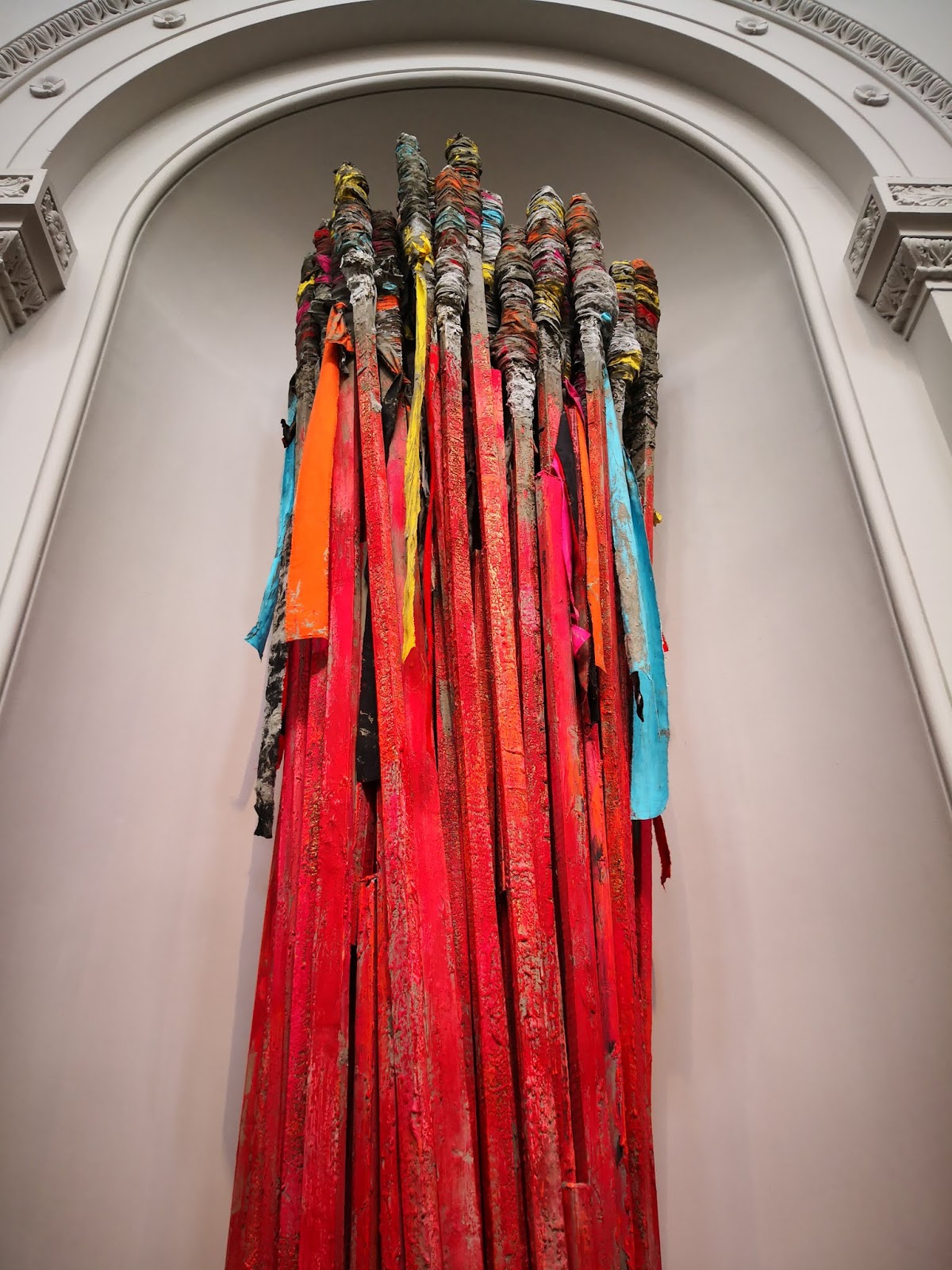
Phyllida Barlow's cul-de-sac exhibition at the Royal Academy was a waste of money. I'm not saying it was bad or even that it cost me much money. I'm just saying it was a waste of money and I'll outline the reasons below. But I won't spend too long doing so - because I didn't spend too long inside the exhibition - and because, according to the artist, I was one of the components of the art. So I feel like I've put in a shift already. Perhaps she could come round and write the blog. Fair's fair.


I wasn't as angry I'm pretending to be for comic effect here and I didn't feel particularly short-changed. What with it being a gorgeous sunny day I was actually quite glad to be able to go and sunbathe in the park instead of peruse further galleries. But, considering Barlow herself deems the visitor, me, to be "of critical importance" to her work and that my "sensory response" and memory of the art is integral to what the art is then why should I pay? She's made me, against my will, part of her media. Though, to be fair, she is now, against her will, part of mine.

So it goes. All of the works are untitled, they're all made either this year or last (so no need for titles), and they're all perfectly pleasant to walk around and look at. There's just three rooms (and a few outliers on the stairs and corridor that take you to the main exhibition) and once you've been in all of them you have to walk back through them as the exit and entrance is the same door. This, I presume, is the reason the show is called 'cul-de-sac'.


Either that or because it's something of an artistic dead end! Barlow's story is that she began her career inspired by the modernist sculpture of the fifties and sixties but soon took against "its weighty formalism and monumentalism, sensing an imposed morality, and gravitated towards Arte Povera in Europe and concurrent sculptural developments in the United States". 

It's true these works don't seem to offer up any gravitas or message and, indeed, they're more open and inviting than some. I saw people touching them without getting ticked off by invigilators, photos were completely allowed, and you could pass through and under many of the sculptures. If you could climb on them, which I'm assuming you could not, it would be like a playground for adults.


Except less fun. Unfortunately. For all the talk of energy, instability, and incongruity it looked to me just like a load of big stuff painted, occasionally, in bright colours. I didn't care that it had no meaning, or at least not that much, but how long was I supposed to look at it all? I was neither discombobulated nor disorientated but I was a little disappointed.

When the materials used are not the memories of exhibition visitors they are pretty 'mixed'. Cement, paint, plywood, steel, timber, polystyrene, sand, plastic, polyurethane foam, wire mesh, and a whole load of Hessian scrim. Whatever that is.


These are put together in ways that are sometimes aesthetically pleasing, sometimes not. That doesn't seem the purpose of her art and nor does the size. The trouble is it's hard to work out what the purpose of it all is. You're given a booklet on entering the show, full of the usual alphabet soup, that serves only to obfuscate matters further.

We learn that "her ability to effectively translate and communicate, to her team, the abstract notions she develops as the work evolves, is of fundamental importance to the process" and that "the perception of the object within the space it occupies is extremely important to" her. Which just goes to prove the truism in the zinger me and my friend Bugsy came up with when addled at a festival over twenty years ago:- "anybody can talk perfect sense. It's backing it up with hours of total bullshit that counts".


I'm not saying Barlow's art is bullshit, or any other kind of shit for that matter. Just that her reason for making it is probably not the reason she's giving for making it. I paid £6 to go in because I have an Art Card. If I didn't it'd have been £14 (£12 without donation) which to put it bluntly is a complete fucking rip off. These sculptures should be outside in the garden, free for all, so kids could clamber all over them. Not only then would it be more fun and more fair but the art would work much better as well. Shutting them away in a back room of the ever expanding, seemingly exponentially, Royal Academy as if they were holy and important relics didn't do them, Phyllida Barlow, or this visitor (a vital part of the art, remember) any favours at all. It's a no from me.


Saturday, 22 June 2019

Matita e Carta:Who's Afraid of Drawing?

"I sometimes think there is nothing so delightful as drawing" - Vincent van Gogh.


Umberto Boccioni - Against the Light (1910)

It was a sunny Friday afternoon and I'd walked from Canonbury station, along the New River, to the lovely little Estorick gallery to see an exhibition they'd called Who's Afraid of Drawing? Works on Paper from the Ramo Collection. Truth is, I wasn't that thrilled by the prospect of it and an afternoon in the park or, better still, a beer garden seemed far more tempting.

What with it being the longest day, the solstice, and all that, those things would surely arrive soon enough and when I arrived at the gallery I realised I'd not need to wait long at all. It was a small show - which I was quite happy about it, but it was also a much better show than I'd hoped for. It's good to override negative instincts.

Stretching from the early years of the twentieth century to the 1990s when art, apparently, became 'contemporary', it was an attempt to show that Italian drawing was both central and, conversely, on the edge of 20c art. It also sought to challenge the perception that drawing is somehow subordinate to painting and sculpture.

Split into four questioning, and ever so slightly pompous, sections (Abstractions?, Figurations?, Words + Images = ?, and What about Sculptors?), I'd say the show was a qualified success. There was some great stuff in it (Umberto Boccioni's tenderly cross hatched girl's face being a prime example) but there was also some utter dross. Cosi cosi!


Fortunato Depero - Trinacria Beer (c.1926-27)


Giorgio de Chirico - Untitled (study for Archaeologists) (1928)

I've left out most of the rubbish and tried to include as many of the good drawings as possible. It's too easy to slag stuff off, people do it on the Internet from the moment they wake up it seems, so I like to focus, when possible, on positives. On art. On music. On countryside. On friendship. On love. 

Fortunato Depero's Trinacria Beer is all angular vorticist lines and pleases the eye just as much as metaphysical maestro de Chirico's study for Archaeologists and Soldati's Olympic Champions (Italy picked up twelve golds, second only to the hosts, at that year's games held in Los Angeles). They're all very different drawings but they could all be lumped together loosely by both style and era.


Atanasio Soldati - Olympic Champions (1932)


Lucio Fontana - The Cowards (Pratelli, Sironi, Panti) (1933)


Cagnaccio di San Pietro - Untitled (Study for the Triptych at the Ospedale al Mare, Venice Lido) (c.1941)


Giulio Paolini - Untitled (1977)

You could chuck a rare pre-abstraction sketch by Lucio Fontana, The Cowards, in with them too. Simplified forms bringing portraiture down to its essence and essentials. These artists were masters at doing that but others like Cagnaccio di San Pietro and Giulio Paolini take a far more traditional approach, unsurprising perhaps from the country that gave us the Renaissance

There's room for both devotional and more transgressive forms of art in this world and there's also space between the two. A space that Gino Severini, Renato Guttuso, and Domenico Gnoli all inhabit - yet all inhabit in their own very different ways. 

Severini's watered down cubism is stylish if not as forward thinking as you imagine he likes to think it is, Guttuso does a great job of capturing the spirit and energy of a peasant's march in Sicily, and, best of all, Gnoli's two works both fascinate and amuse in equal measure but in completely different ways,


Gino Severini - Untitled (Romana at the Table) (1947)


Renato Guttuso - Untitled (Study for Occupation of Uncultivated Land in Sicily) (1949)


Domenico Gnoli - Caprice no.6 - The Apple (1955)

Caprice no. 6 looks like James Gillray has attempted to turn a Roman altarpiece into the marvellous mechanical mouse organ from the seventies kids TV show Bagpuss and Boat IV features a poor ol' horse looking sadly out to a presumably ever lasting sea on a strangely curving boat. It's an alluring, and odd, piece of work that made me both giggle and feel a bit sad simultaneously.


Domenio Gnoli - Boat IV (1957)


Tancredi - Untitled (Witticisms) (1960)

Just along the wall from it you get a rare flash of colour. Tancredi's watercolour witticisms certainly brighten up the room and have all the expressiveness of a van Gogh if, sadly, none of the depth. Lack of depth is certainly not something you could accuse Lucio Fontana of. He's famous for ripping holes out of his paintings!

Turns out, and it's no surprise really, he took the same 'liberties' with his drawings.Truth be told, though, they don't work quite so well without the aspect of colour. Not for me anyway - and certainly photographs don't do them justice. A nice idea but it didn't delay me long.


Lucio Fontana - Untitled (Spatial Concept) (1951)


Lucio Fontana - Untitled (Spatial Concept) (1951)


Adolfo Wildt - Animantium Rex Homo (1925)


Giacomo Manzu - Untitled (Two Lovers) (1943)

I didn't spend that long with Wildt's Animantium Rex Homo or Manzu's lovers either. Technically proficient, not lacking in charisma, and all that old stuff but my eye was distracted by the far scribblier Medardo Rosso drawing nearby. It had something of a haunting, mysterious quality. It's the sort of drawing you can't help but create a narrative for. Mine was of a detective nature. Detective instinct.


Medardo Rosso - Untitled (Figures on a Street with Tree)


Bruno Munari - Illegible Writing of an Unknown People (1973)

I was equally taken by Munari's made up writing. It looked like upside down faux-cyrillic and the cube of red gave it a kind of Wyndham Lewis quality which is never a bad thing in this blogger's eyes. Merz's Fibonacci was hardly aesthetically pleasing but as fan of mathematics, and a man who used to be familiar with the Fibonacci sequence, I felt compelled to check the sums.

I much preferred the voyages into abstract expressionism and retrofuturism space age chic provided by Carol Rama and Maria Schifano. They were two of my favourite drawings in the Estorick. They both had .... movement. To create movement in a still picture can be quite easy, picture Billy Whizz or the puffs of smoke we draw near people's bums to indicate they've just farted, but to create a realistic and powerful, forceful sense of movement is quite another.

Rama's marks rush on to the page with an impatient urgency that clearly owes a little to Jackson Pollock and Lee Krasner while Schifano's seem to float in space, a gravity free drawing that acts as an amniotic fluid to calm the troubled mind.


Mario Merz - Fibonacci (1970)


Carol Rama - Untitled (1969)


Maria Schifano - Louis Jacques Mande Daguerre (Drawing with the Sun) (1964)


Maria Lai - Diary (1979)

Taking a cold shower after my ejaculation of purple prose I moved over to Maria Lai's illegible diary and Gianfranco Baruchello's childlike assemblage. Wasn't sure what to make of the diary (although I've returned, drunk, from gigs with notes not much better in my moleskine) but was quite taken with Baruchello's precarious looking scene. Some sort of combination of beehive, a Japanese pod hotel, and the set of the bizarre Saturday night TV show All Together Now!

No idea what it's all about but that's hardly the point of art. Equally, Alberto Burri's bagel spiral and Antonio Sanfilippo's dots were sheer abstract decoration. Burri's dirty doughnut disappearing down a black hole was the one that most drew me in.


Gianfranco Baruchello - Nous, mon Coeur, que... (1977)


Alberto Burri - Untitled (Combustion) (1957)


Antonio Sanfilippo - Manuscript (1962)


Roberto Crippa - Untitled (Spiral) (1960s)


Tano Festa - 15. N. 11 (1961)

I also liked the abstracted pencilisations (I know that's not a real word but it's what a guy I went to school with, Philip Hoare, used to say and it just came to mind) of Roberto Crippa (something avian about it), Tano Festa (like one of Barnett Newman's 'fag packets' or a view from a ceiling down on to a double bed), and Achille Perilli whose work could be read as a bastardised landscape.

Carlo Accardi left me cold, there's no rhyme or reason in this - it's down to feeling, yet Pino Pascali's rusty looking typography pleased me no end. I love rust and I love the alphabet so what was not to like about it?


Achille Perilli - Untitled (1958)


Carla Accardi - Untitled (1954)


Pino Pascali - Untitled (Alphabet) (1960s)


Tomaso Binga - E is for Erba (Pop Alphabet Book) (1976)

More letters, and even a naked lady, cropped up on Tomaso Binga's E is for Erba and, nice though that was, my eye was more drawn to Mirella Bentivoglio's Stamps. It just looked kinda neat and that was the thing with this show. There was no great over reaching story, no huge narrative to be had, no political points to be made, just lots of very good, and some not so great, drawings.

Art for art's sake. A pleasure in the act of creation as much as a pleasure in creation in itself. The Estorick, as ever, had put together a tidy little show that brought to my attention lots of artists I'd never heard of before and soon I was back out in the sunshine and in a park, not a beer garden. Saluti!


Mirella Bentivoglio - Stamps - Oofs for OOFice Hours (1971)