Monday, 3 June 2024

TADS #61:Christchurch to Bournemouth (or Hengistbury Head).

""Consumed with premonition of trouble on the horizon. By the remarks I was certain I was destined persecution" - Bournemouth Runner, The Fall

I've written before, many times, about how getting out for walks, alone even - but ideally with friends, can be a real tonic. Well, Saturday's TADS walk from Christchurch to Bournemouth via Hengistbury Head was certainly that. Near the end of the day, over a dosa and a pint of Cobra, I was asked to score the walk out of ten.

I gave it 8.5/10 which is, in retrospect, possibly a bit miserly. It was a fantastic day (great weather, great scenery, great food, 35,391 steps, and, most importantly of all, really really lovely people) and it was a fantastic day that I really needed. I've been bedevilled of late by minor physical health problems and, more seriously, financial woes. Which is what you'd expect after fourteen years of the worst Tory government in modern history.

Worse still, these two things - and my ongoing anxiety, led me into a period of quite deep, and what felt like - at the time - unending, depression. I took some time out, spent a few days with my parents, went for a walk and a pizza with my nephew Dan in Winchester, and even spoke to doctors as well as going to hospital. It wasn't great and though I may have had (brief) periods of suicidal ideation I never attempted suicide.

Family and friends were super supportive and helped pull me out of it but my behaviour was erratic and worrying and I don't feel good that I caused so many people so much worry. I even announced, stupidly - like a drama queen, I was retiring from TADS via WhatsApp. That's when people started to really get worried. I postponed May's TADS walk and didn't even write a blog for April's (from Battle to, almost, Hastings) - though the day was fun and I thank Mo, Pam, Tracy, Mesude, Chris, and Ian for joining me (and Arlow, Tony H, Andy and Jo for joining us on a Sunday 'recovery' session).

I'm glad I reversed that decision. TADS walk, along with the London by Foot and Thames Path walks - and trips to Wales to see Michelle and Evie, Fortean and Skeptics nights, and art galleries - give my life meaning and with no partner or kids of my own I need to give my life meaning. So, hopefully everybody enjoyed the walk on Saturday but for me it was, almost literally, life saving.

It was a long day too. I set my alarm for 5am and woke up before it (at 4.25am) and got up. Not long after 7 I was out of the house, picked up a Guardian, a bottle of Evian, and some ibuprofen (for a mosquito bite that had swollen up right in the ball of my armpit) and then took the train from Honor Oak Park to Crystal Palace and on to Clapham Junction where I met Pam on, of course, platform nine.

Adam, Teresa, and Tina joined us on the train in Basingstoke and soon we were whooshing through Winchester, Southampton, and the New Forest and arriving in Christchurch. A place I'm sure I've been to before but probably not since I was a small child. What had started as a cold day was turning warm and sunny and my combo of jacket and jumper started to look a little ridiculous.


Heading out from Christchurch station, we made our way into the town centre past lots of historical plaques, an impressive Art Deco cinema, and a shop called Davis Tackle which we sniggered at because it reminded us of an off-colour chat we'd just had.

Oh, and there was a dunking stool too. I'm pretty sure none of us had ever seen a dunking stool before but there it was. I'm not sure if Christchurch had a serious witch problem but the name of the town suggests that it was a hotbed of religious nutters so it seems quite likely that many innocent women were once dunked in the nearby Mill Stream. It's not deep enough to dunk anyone now. Not even the King of Tadley himself who gamely perched himself atop the stool.


Adroitly avoiding the tempting looking Dunking Stool tea room and Dirty Gertie's Gin Parlour, we took a snicket to the hipsterish but very pleasant Streetside Cafe - where Shep and Laura soon joined us. Sat across from the first Ian Stocks lookalike of the day (photo - sneakily snapped by Pam - below, followed by another TC who cropped up later in the day, when I shared the photo on Facebook, my friend Dave Fogarty thought it looked like another friend of ours, Richard Sanderson), I had a felafel and chili jam wrap and a chocolate milkshake in a jam jar. Bob Marley was playing and, as if to echo my culinary choice, it wasn't long before the song Jamming came up.

It was something of a musical day and, in my view, days with lots of music are the best days. From the cafe we headed into a green space (past a sign that informed us that the town once had its own 'aletaster' - some guys have all the luck) and, keeping with the torture theme, there was a set of stocks. From Ian Stocks to the stocks.

Christchurch tortures itself these days by having one of the most far right Tory MPs in the country. Christoper Chope, most famous for blocking a law banning upskirting, commands a huge majority and may be one of the few Tories to keep his seat in the upcoming general election. Let's hope not.


Christchurch Castle, now in ruins, sits atop a small hill and we went to have a look. It's one of the ruins that Cromwell knocked about a bit but it is of Norman origin. Nearby stands the 11c Priory which was once a monastery but was given to the town by Henry VIII following the 1540 Dissolution of the Monasteries. It's home to a 'miraculous beam' that attracts pilgrims from all around the world.

Suckers. Not that Christchurch is an unpleasant visit. Certainly not on a sunny Saturday in June. We continued through some pleasure gardens and came out on to the fantastically named Quomps. They were hosting a regatta, people were picknicking and eating ice creams and the kids were splashing around in a paddling pool. All felt right with the world. At least this little corner of it. If Christopher Chope had wanted to do some upskirting he'd have plenty of options though it's hard to imagine anything would be more tempting than upshorting Adam who'd stripped down to his shorts and wasn't even wearing his leg warmers/pull up tights.

The Quomps were conveyed to Christchurch by the 5th Earl of Malmesbury (Adam was only telling me recently how he and the current Earl of Malmesbury are bezzie mates) and it hosts a 'Stompin' on the Quomps' smooth jazz festival each year. Past the boaters and sunbathers we walked and made our way over Tuckton Bridge to Tuckton. Once home to the model village Tucktonia. A place that only existed from 1976 to 1986 and I remember seeing from the nearby BMX track when I used to race BMXs. Apparently, Arthur Askey ("ay thang-yaw", "hello playmates") opened it.

Tuckton Bridge crosses the Stour river and Christchurch itself sits in the confluence of that river (which flows sixty-one miles from Mere in Wiltshire) and the Avon (the Salisbury one, not the Bath one). The Stour hosts pipistrelle bats, harbour porpoises, great crested newts, and medicinal leeches. None of which we saw but we did see lots of gulls and swans.

Thomas Hardy wrote about the Stour and the Stour Valley Way is sixty-four mile footpath which may (or may not be) a future project we'll look into. Fish in the Stour are many and include trout, bream, chub, dace, barbel, tench, salmon, perch, pike, grayling, rudd, and roach. There are cuttlefish, oysters, and crabs and the local Blandford fly can leave a painful bite. Perhaps one of them bit me - and not a mosquito.

Christchurch was initially named Twynham (we'd walked down Twynham Avenue near the train station) but the name changed with the arrival of the priory in 1094. In the eighteenth and nineteenth century it was a hotbed of smuggling and another big industry was fusee chains for clocks and watches. Big names in the town include the former Poet Laureate Robert Southey and Bob Wilson (Anchorman) who was born in Chesterfield but made Christchurch his home when he wasn't on telly or playing in goal for Arsenal and Scotland.


Passing through the suburb of Wick, we soon arrived in the countryside. Decorative benches, lists of birds (including oyster catchers and ones with googly eyes - much to Pam's amusement), and reeds as tall as a human. Soon all we could see of Christchurch itself was the priory. Which reminded some of us of Chichester. In fact, some of us had trouble telling Christchurch and Chichester apart. Some of us mistook a bird for an elephant. I won't mention names.

Hengistbury Head, where we soon were, was once Christchurch Head and is scheduled as an ancient monument, a local nature reserve, and lots of other things too. You can, if you're lucky - we were not, spot Britain's rarest amphibian - the natterjack toad - on Hengistbury Head but you certainly won't be able to miss the beach huts. Among Britain's most expensive, the average price is somewhere between £400,000 to £500,000 but some go for a million which is, in a country with a large amount of homelessness and poverty, obscene.


Hengistbury Head, itself - I'm pleased to report, is far from obscene. Goats relax on the head, Noddy trains take happy kids for spins, and some brave souls were even risking a dip in the cold, sewage filled, briny waters of the English coast. Pam and Tina, particularly, took an interested in the local aquatic birds and with the ferry across to Mudeford out of action (pontoon damaged in a recent storm) we soon repaired to the Beach House for drinks.

I took an Estrella as Matthew Wilder's deathless classic Break My Stride played out to our pleasure. Soon I did, indeed, break my stride and we sat, looking across to the Isle of Wight (a place, remarkably, I've never been to) and the Needles and chatting away. Laura offering, almost threatening, to lance my mosquito bite with a knife. Nobody give Laura a knife.

Soon Tony, Alex, Grace, and Izzie - and, of course Freddy, came to join us. Freddy chased a ball and ran into the sea and Grace and Izzie were quizzed about their recent navel piercings while refusing to be photographed. It was good of TAGI(F) to come all this way to join us and I'm reliably informed that Grace and Izzie are back in Hengistbury Head tomorrow on a school trip. Not fair. My school trips consisted of going ice skating in Southampton while Renee Smith sat at the back of the coach doing foghorn impressions.


Pam made an impressive cairn, Freddy had some doggy donuts, and, inevitably, a two pint mistake was made before we headed back along the Head to the coast. Diggers were constructing defensive sea walls but, otherwise, this stretch was almost deserted. Goats looked down on us from the rocks and we all agreed that walking in dry sand is tricky and steps should count double when on that surface.

Eventually we reached a promenade and the coastal path led us to Southbourne (which they now try and style, rather daftly, as Sobo) which was full of people playing beach volleyball, eating and drinking, and, listening to Nickelback's 2002 How You Remind Me. The day was so enjoyable that even that AOR dirge sounded passable.


We grabbed a table at the Sobo beach bar (a far more agreeable soundtrack of post-disco classics that included Jocelyn Brown's Somebody Else's Guy and Evelyn 'Champagne' King's Love Come Down) and had another drink. Teresa disappeared off and then returned with two portions of chips (smothered in parsley and chives) and ketchup and mayonnaise to dip them in. I said I'd only have a couple and then ate bloody loads of them.

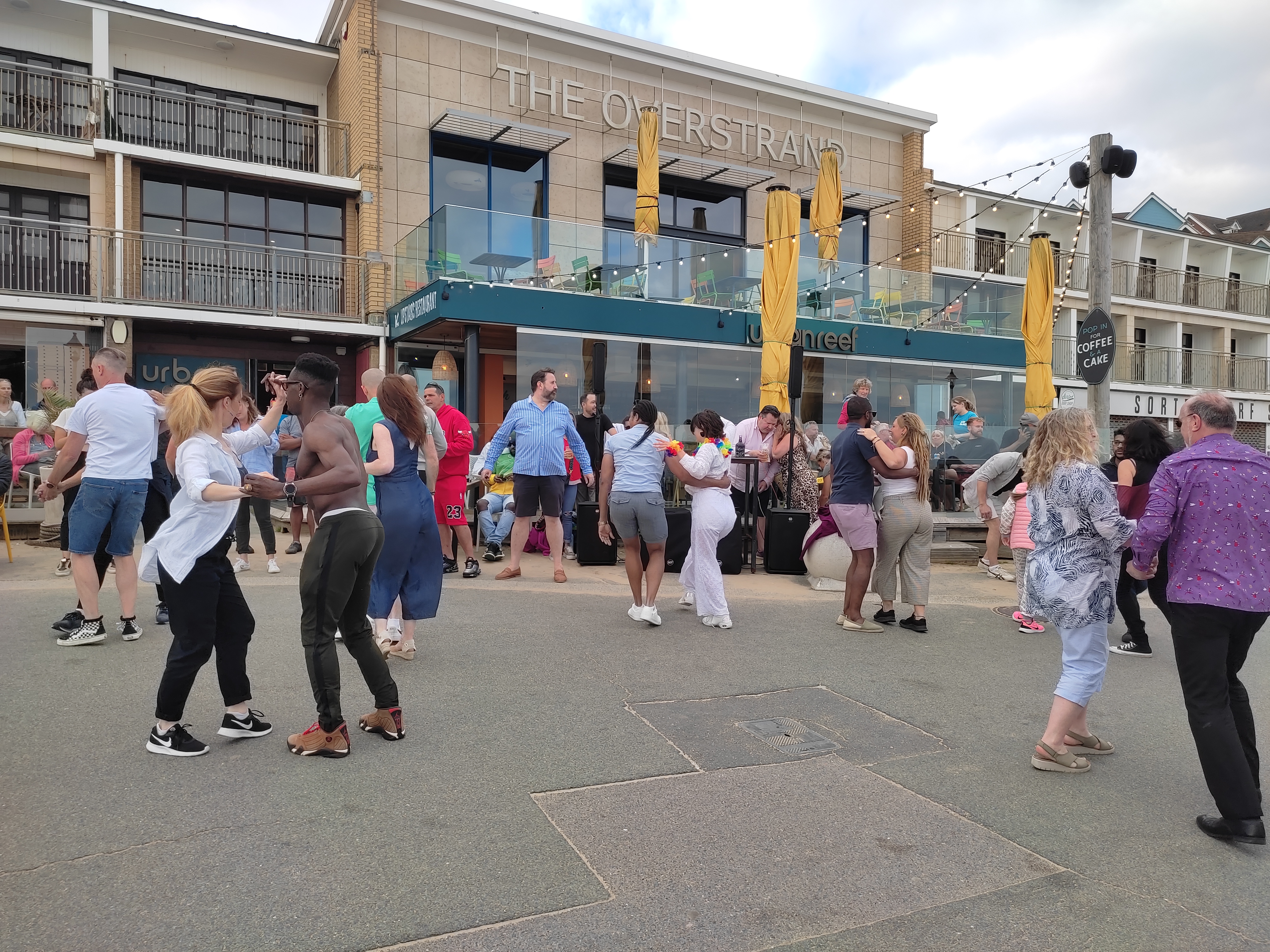
They were good chips and I was at the point where I was nearly ready to end the walk but there was still an hour and half to go. We passed Boscombe pier, lots of enthusiastic salsa dancers, and more games of beach volleyball (though sadly nobody was playing 'grids' - a game that Adam, Rob, Bugsy, and myself invented in Bournemouth decades ago) and took the zig-zagging Toft steps up from the coast - the steepest walk of the day.

Shep and Laura headed off and the rest of us continued on in to Bournemouth proper - past an impressive building that reminded Pam and I of Lambeth Town Hall. I wondered if it was built by the same architect, a man I erroneously told Pam was called Decimus Burton but who is actually Septimus Warwick. I looked on the Internet and could find neither confirmation nor refutation.


Soon we arrived in Dosa World and I had a paneer raae masala dosa and a brace of Cobras. The beer was cold, the food was tasty, and the service was pretty swift. I was more than satisfied and we were out of the restaurant in plenty of time to get back, via Tesco for some train booze, to Bournemouth train station. Just time for a quick roll call of famous Bournemouth names:- Tony Hancock, Anthony Blunt, Sophie Rundle, Virginia Wade (second HMHB reference of the day), Andy Summers, Gareth Malone, Tobias Ellwood, Millie Bobby Brown, Christian Bale, Christine Hamilton, Mary Shelley, Radclyffe Hall, Max Bygraves, and William Doyle AKA East India Youth.

Although I forgot to mention the Bournemouth Runner, my 89th favourite Fall song which, surely, should have been the name of the walk. Missed a trick there. On the train we played Heads Up (Joao, the friendly Portuguese ticket attendant, joined in - very enthusiastically), talked shit, and mucked about. Tina, Teresa, and Adam got off at Basingstoke and Pam and I continued to Clapham Junction - solving crosswords en route as we so love to do.

At Clapham Junction we said goodbye and then I saw my train to Peckham Rye was seriously delayed due to a lorry crash! So I took a train to Vauxhall and got the 185 bus home. Listening to Pavement and Caetano Veloso and uploading photos on the way. By the time I got home it was nearly 1am so I'd been awake the best part of twenty-four hours. Better than being awake though, I felt I'd been alive. I'd been living not merely existing which was a vast improvement on some of the shit days I'd had recently.

Thanks to Adam, Laura, Pam, Teresa, and Tina for the photos I've added to this blog and thanks to them and Shep, Tony, Alex, Izzie, and Grace (and, of course, Freddy) for joining me on Saturday for a wonderfully enjoyable, wonderfully spectacular, and wonderfully healing even, TADS walk. Next month we're walking from Guildford to Horsley and, who knows, we might be bumping into, or walking straight through, The Captain, Julian Fawcett MP, and Lady Fanny Button. Hopefully no mosquitoes though!


Friday, 31 May 2024

Image And Insurrection:Jannis Kounellis @ Tate Modern

"I have seen the sacred in the common object. I have believed in weight as the right measure ... I want the return of poetry by all means available: through practice, observation, solitude; through language, image and insurrection" - Jannis Kounellis, 1987

 Untitled (Hanging Knife) (1991)

Knives, bells, toy trains, coal, steel, chickpeas, kidney beans, lentils, old beds, bricks, chairs, rope, sewing machines, and dead (stuffed) birds. If you're looking for a definition of mixed media then Jannis Kounellis (whose work is currently showing, for free, at Tate Modern) is just the man to give it to you.

It's easy to see what he made his work from and it's easy enough to understand why but the reasons he chose to make THIS art with THOSE materials is a little bit more confusing. In some ways his art means absolutely nothing at all. In other ways, and if you're pretentious enough - and sometimes I am, you can read multiple interpretations into his work. I'm happy for it to mean nothing - and lots of things. At the same time.

Untitled (Sack with Z) (2001)

Kounellis (1936-2017) was born in the Greek port city of Piraeus but lived and worked in Rome from 1956 where he found himself, eventually, becoming part of the Arte Povera ("poor art") movement along with Alberto Burri, Mario Merz, Michelangelo Pistoletto, Luciano Fabro, and - my favourite - Alighiero Boetti.

The Arte Povera group used ordinary, everyday, materials to create their art in the hope of bringing the art closer to most people's normal lives. As Italian society was undergoing a rapid transition and people were torn between industrial and agrarian lifestyles there were clashes - both in society and its reflection in the art of the Arte Povera.

Kounellis reflected this by making art works that combined steel (industrial) and wood (agrarian) but he also made works that considered other juxtapositions and pondered other ways of trying to resolve, or even intentionally leave unresolved, dichotomies that were springing up in both the art world and in society at large. Even though he considered himself a painter (despite there not being a lot of painting here) he expanded his artistic vision to include sculpture but also smell and sound. Hence the coffee beans and the church bells.

There are hints and illusions in his work (the sack with a Z on it does not refer, twenty plus years in advance, to the Russian army's use of that letter during their ongoing invasion of Ukraine but the sack of coal is believed to be a reference to the trade and commerce of the port of Piraeus) but they're not always clear. Sometimes quite the opposite.

Untitled (1960-98)

Untitled (1960)

Before he'd fully got involved with, and inspired by, other Atre Povera artists, Kounellis was attracted to numbers, words, and graphics found in street signs which he'd reduce to ever more basic symbols and arrange them, seemingly on a whim, against a plain background. It's mathematics by way of abstract expressionism (Kounellis admired both Jackson Pollock and Franz Kline - the latter's work not being massively dissimilar to this) but though I looked for meaning and tried to decipher some kind of code I was unable to. 

Which was a little frustrating. But is there even a code there? Is it just a pattern that appealed to Kounellis sense of aesthetics? I don't know. Sometimes he would "expand" these paintings into "performances" by reading them out loud. It doesn't sound like one of the most thrilling of events to have attended.

Preferable, to this visitor at least, is the steel bedframe that Kounellis has hung from a meat hook and hung in front of a painted yellow square (a cheeky reference, it is suggested, to Kasimir Malevich's iconic Black Square of 1915). Meat hooks and beds? Is Kounellis trying to say something about sex as a commodity, something you buy and sell, something you trade in, bodies as meat? Or is he just teasing us. I was quite surprised that the artist himself, because of the use of yellow, claimed the work to be inspired by Van Gogh's sunflower paintings.

Untitled (1993)

Untitled (2005)

Untitled (1969)

And what of the work that consists of seven sad looking burlap sacks (sad sacks, quite literally) left on the floor, as if waiting taking in following a delivery, and containing coffee beans, lentils, peas, maize, and kidney beans. These are, one would imagine, similar to products that a young Kounellis would have seen arriving, or leaving, Piraeus as a boy and it's quite possible that the burlap sacks would have been used to.

Again, it seems to be an exercise in reflection on times gone by and a nod to the work done by the lower classes of Greek society. Like it or not, and I rather did, it is very much an Arte Povera piece. The same could be said of 1971's bricked up doorway but that also shows a more playful, pranksterish, side to Kounellis - which is always good in the often po-faced world of art.

Untitled (1969)

Every time the work is displayed it is always, on Kounellis' instructions, installed in a doorway where it performs a physical art of 'blockage', blockage of the 'threshold' if you will. Kounellis also insisted that the curators, or whoever is responsible for replicating this piece, use stones that are sourced locally to the venue of installation. Which is nice.

Another more fun work, also called Untitled - you're getting the hang of it I suspect, shows a chair and an abstract expressionist adjacent green canvas with feint music notation depicted on it. In 1971, when this work was first exhibited, a cellist would sit on the chair and repeatedly play from that notation. Which is an excerpt of Bach's oratorio St John Passion (composed in 1723-4). If I'd attended on a Saturday, rather than a Friday, and been lucky with my timing I could have heard a presumably different cellist getting to grips with Bach. It is suggested, by the curators, that I could imagine the music by simply looking at the notes but I don't know who they think their average visitor is. All I could hear, as ever, was the internal, and infernal, monologue inside my head.

Untitled (1971)

Bells (1993)

Bach, or church bells, would have been preferable. I'm not religious but churches look great and church bells, unless it's too early on a Sunday morning - in which case there ought to be a law against them, sound great. Kounellis thought so too. He was particularly interested in the presence, omnipresence even, of church bells in the Southern European communities he grew up and lived in.

When 1993's Bells (a work not called Untitled - wonders will never cease!) was first exhibited in Pistoia in Tuscany, that city's impressive cathedral was visible through the gallery windows creating a visual, if sadly not aural, echo. Kounellis believed that bells represented "language, a magnified human voice - and the enthusiastic roar of liberation". He really ought to let us visitors have a ding on them.

Untitled (Sewing Machine ) (2004)

Coal Sculpture with Wall of Coloured Glass (1999)

Untitled (Scissors) (2004)

Untitled (Hair) (2004)

Untitled (Coffee) (1989-91)

Other works, some of which - disappointingly - have my gormless fizzog gurning back at me in their reflection, reminded me a little bit of a pared down Joseph Cornell. There's a sewing machine and a crumpled blue coat (sadly not a famous blue raincoat) which is said to be a comment on industrial manufacture and, because of the anchor on the buttons of the coat, naval life.

There's a pile of coal (that and iron, according to Kounellis, are the two materials, that best reflect the industrial revolution), a paraffin lamp (like one that would have been used for mining), and a doorway of glass lumps that look very pretty even if I'm not sure what they are meant to represent. Let's just say that as a juxtaposition, and as an aesthetic piece, it works very well. Which sometimes seems the main point of Kounellis' work.

Then there are three cabinets containing, variously, scissors, hair, and coffee beans. All things you may encounter in a hairdressing salon I suppose. Though I doubt that's the intention. Scissors, like the hanging knife that heads up this review/blog/total waste of time, can be used for violence as surely as they can for tonsorial purposes.

Hair is something most of us like. It looks nice on people's heads. But when it's removed from their head it can look a bit weird - especially if placed in a steel and glass box and put in a gallery for people to look at. Hair cutting, we're informed, is not always a good thing (though when I had my hair - and David Bellamy style beard - shorn recently it was definitely for the best) and can sometimes be used as a punishment or signify trauma or even illness.

Coffee smells good (I actually prefer its smell to its taste) and, for Kounellis, "the smell of coffee ... is painting - because it's a reality". Which brings us right back to the point I was making earlier about pretension. But I prefer pretension to the use of dead animals for art purposes so 1979's stuffed birds (a jackdaw and a hooded crow) is an unhappy view for me.

It's not clear if Kounellis had the birds killed or just stuffed already dead ones and I'd like to know as it would help inform my view of him as a person if not as an artist (not that he cares, he's dead). As an artwork, I will admit it's one of his most powerful. Some abstract prints and an industrial looking townscape where there is, and you can see, an influence of Giorgio de Chirico in his metaphysical pomp.

It speaks of transformation, decline, regeneration, and disappearance and, like much of Kounellis' work it is frustratingly difficult to get a grip on. There's something there but you can't quite work out what it is. After attending this show one suspects that's exactly how Jannis Kounellis used to like it.

Untitled (1979)


Wednesday, 29 May 2024

Half A Century Of Fakers?

I've never bought, or even read, the Fortean Times. I use the (completely unaffiliated) London Fortean Society to get my fix of Forteana. But having attended last night's LFS talk, 50 Years of the Fortean Times, with that periodical's news editor Ian Simmons at The Bell in Whitechapel, I'm starting to think that maybe I should. I'm missing out on stuff.

Good stuff too. Talking partridges in Uganda, Bigfoot piloting a UFO, Spring-heeled Jack, Edinburgh fairy coffins, women who vomit up frogs and lizards, feral bishops, and Zimbabwean poltergeists that remove people's trousers when they're asleep. Of course, some of these may not actually exist but it is the Fortean way to neither be too gullible nor too sceptical. With a smile, a Fortean simply examines the evidence and comes to their own, sometimes speculative, sometimes cheeky, conclusions.

It is, ultimately, supposed to be fun. Even if the Forteans these day take things a bit more seriously than Charles Fort (the man who began the 'movement') did. Beginning, with a theatrical flourish, Simmons told the story of the Fortean Times (which turned fifty in November 2023) from the very beginning. From before the beginning in fact.

Charles Fort (1874-1932), as a young man, was an adventurer, a short story writer, and a journalist and he was a man who refused to adhere to dogma. His 1909 novel The Outcast Manufacturers was not a success - by any metric - but when he started to take an interest in the likes of UFOs and seamonsters he found a richer seam to mine.


1919's The Book Of The Damned saw Fort attempting to classify anomalistic phenomena and it was followed by other (slightly) more successful books like New Lands (1923), Lo! (1931), and Wild Talents (1932). Perhaps I should try and read them one day. But, apparently, they make for tough reading by today's standards.

At the time, however, Fort's writing was admired by the likes of H. L. Mencken and Fort's friend (and drinking buddy) Theodore Dreiser. It was Dreiser who formed the first Fortean society, in 1931, and early members included Dorothy Parker, Frank Lloyd Wright, and Buckminster Fuller. He of the geodesic dome fame.

While neither Fort nor Dreiser were cranks, just curious, the editor of the first Fortean publication, Tiffany Thayer - that's a male Tiffany by the way, was. The magazine, Doubt, did include some of what we may now recognise as Forteana but it was also used as an excuse for Thayer to air his 'eccentric' political views and to suggest nuclear bombs didn't exist and were a government hoax. 

Thayer also wrote romantic fiction which seems to have been universally panned. Dorothy Parker once saying of his writing that "his power lies in his ability to make sex so thoroughly, graphically, and aggressively unattractive that one is fairly shaken to ponder how little one has been missing".

She wasn't the only one who wasn't a fan. Thayer himself easily made enemies and once expelled the entire San Francisco chapter of the Forteans. Doubt carried on until 1959 when it died with Thayer and then fourteen years later Bob Rickard (who showed up at the talk - late, he'd got lost on the way - and later posed for photos, answered some questions, and received a huge round of applause) started what would soon become today's Fortean Times. 

In 1961 Paul and Ronald Willis rebooted the International Fortean Organistion and they put out a magazine called INFO and about the same time Rickard, then at Birmingham School of Art, himself launched a sci-fi journal called Speculation which included features on Michael Moorcock and lots of other people I haven't heard of.

In 1969, Rickard saw an ad for INFO in the countercultural magazine Oz and that inspired him to get in touch with Paul and Ronald Willis. In 1973, they launched the first ever issue of The News (essentially the first ever Fortean Times, the initial title was inspired by William Morris's News From Nowhere). The first copy featured toads falling from the sky, feral children, mass hysteria, kestrel attacks, and somebody who somehow managed to swallow a fork.


Everything was pretty much in place from the start and Simmons gave us a run through the magazine's history which took in quite a colourful bunch of characters:- William Burroughs, Bill Drummond, David Icke, Uri Geller, Paul Giamatti, Alan Moore, Derek Jarman, Colin Wilson, Jerry Hall, Jamie Hewlett, Play Away's Brian Cant, Ken Campbell, John Michell, Stewart Home, the author John Higgs, and the comedian Andrew O'Neill.

The Fortean Times was, and still is, "the point where science and surrealism meet" and it was with the sixteenth issue that it changed its name from The News to the more descriptive Fortean Times. In the early nineties, John Brown Publishing, flush from the extraordinary success of launching the hilariously vulgar Geordie comic Viz nationally, bought up several titles and Fortean Times was one of them.

In 2001, John Brown sold Fortean Times to I Feel Good which was run by the former Loaded editor James Brown and the magazine started expanding into features about film, gaming, television, and music. When I Feel Gold folded the FT went to Dennis Publishing (where my mate Gareth used to work, he might still do actually - not spoke to him for a while) and then on to Diamond Publishing where it remains now.

Still priding itself on finding the world's weirdest news and still priding itself on being a print magazine. Simmons ended by saying he sees no reason why the Fortean Times should not last another fifty years. It's not as if weird stories ever stop coming through. If anything, there seems more weird shit out there than ever.

I've titled this blog, with tongue in cheek - and a nod to Belle and Sebastian, Half A Century Of Fakers, but these people aren't fakers. They're very serious about this stuff but that doesn't mean they believe in UFOs, aliens or bigfoot. They're having fun (while also trying not to belittle those who do believe) and they're providing fun for many others.

I certainly had fun last night and for that I'd like to thank Ian Simmons, Bob Rickard, and the Fortean Times as well as David V. Barrett for hosting, and Jade, Paula, Tim, and Michael for keeping me company. Disappointingly though, I had to take the Overground home as Bigfoot failed to pick me up in his UFO.


Tuesday, 28 May 2024

Get Outta My Car, Get Into My Nightmares:The Responder S2.

"The same fucking mistakes over and over again. Just when I think I'm moving in the right direction" - Chris Carson

Police officer Chris Carson (Martin Freeman) is still working nights, he's still on 'response', he's still got serious anger management issues, and he's still bedevilled by his demons - though he is trying to be a better person. He's even attending a male mental health group. Though the chair of that group is the unlikely named Father Liam Neeson (Matthew Cottle) and he's got his own problems. He likes the booze so much he'd make a great character in a Graham Greene novel.

Series two of The Responder (BBC1/iPlayer, created by Tony Schumacher and directed. variously, by Mounia Akl, Jeannette Nordahl, and Charlotte Regan sees him separated from his wife Kate (MyAnna Buring) and struggling to fit his nightshifts in with visits to his daughter Tilly (Romi Hyland-Rylands). Kate's paired up with Chris's nemesis, fellow copper Ray Mullen (Warren Brown) and she's on the verge of accepting a job in London which would mean relocating from Liverpool and putting two hundred miles between Chris and Tilly.

Something Chris is none too happy about. He's looking to move to day work and he's applied for a job but he's tipped off that he won't get it because everyone thinks he's a "knobhead". Instead, he manages to get caught up in a war between two of Merseyside's leading drug dealers. The always excellent Adam Nagaitis plays Franny Sutton and when Chris searches Franny's garage and finds something disturbing, Franny (who hides his criminal enterprise under the front of a plastering business) uses that to compromise Chris and his colleague Rachel (Adelayo Adebayo).

Rachel starts the series partnered with the irritating Eric (Ian Puleston-Davies), who waffles on endlessly about The Pirates Of Penzance, and regularly considers burning herself with an iron (preferable, she suggests, than working in response) but, inevitably, she ends up embroiled in Chris's mess.

She even brings a fresh mess of her own to proceedings when she takes it up on herself to try and warn her abusive ex-partner Steve's (Philip Barantini) new girlfriend Lorna (Izuka Hoyle) about his behaviour. Something she doesn't handle particularly well.

Following husband Carl's death in the first series, his widow Jodie (Faye McKeever) is getting their drug empire up and running again with help from 'baghead' Casey (Emily Fairn) and hapless Marco (Josh Finan). Jodie works at an ice cream parlour (and sells drugs from there), and Casey and Marco work the nightclubs. Marco briefly holds down a day job at Krunchy Fried Chicken and is looking after his young baby after the mother, Moire (Debbie Brannen), is sent to prison for assaulting someone she believed was, but wasn't, a paedophile.


He's not a natural when it comes to fatherhood. The goonish henchmen Barry (Mark Womack) and Ian (Philip S McGuinness) are back to create further trouble and Chris and Rachel's colleague DCI Debs Barnes (Amaka Okafor) has clearly got herself into something way over head which will further test Chris's patience. On top of that he's dealing with a very uneasy reconciliation with his estranged father Tom (played by Bernard Hill in his last ever role, Hill - most famous for playing Yosser Hughes in Boys From The Blackstuff - having died earlier this month).

Tom had been a mostly absent father - spending most of his time in the pub - and there is, at first, little love lost between Tom and Chris. With his mum now dead, Chris tells Tom, in no uncertain terms, that he considers him to be a "fucking cunt". If you don't like f-bombs and c-bombs, don't watch The Responder, they go off as regularly as air-to-ground munitions in Gaza.

All of these strands can get a little confusing at times and it takes a while for the second series to get going but when it does we see Chris, Rachel, and everyone else thrown into a world of guns, blackmail, death threats, double crossing, assaults with torches, unappetising looking meals, social workers, antiquated mobile phones, CAPITAL LETTER TEXT MESSAGES, and, rather oddly, dancing to The Magnetic Fields.

There are nearly as many very bad people in The Responder as there are cups of tea consumed. There are odd people too. People with too many cats, people with too many dogs, eccentric pissheads, and people who throw actual shit at coppers. There's a cameo from Kevin Eldon as a man with no memory who doesn't understand that it gets dark after sunset and there's also appearances from two Brookside legends in Sue Johnston and Sue Jenkins. They were both in Coronation Street too - but it's their roles in Brookside (as Sheila Grant and Jackie Corkhill) that matter to me.

But I digress. As for this series of The Responder? It's bleaker than the first series - nihilistic in places even - but it's not quite as good. I didn't find it as gripping. But it's still an enjoyable watch. Even if you are never in doubt that to live the life of any one of the characters in The Responder would be far from enjoyable. Watch it. Don't live it.


Sunday, 26 May 2024

A Butterfly Bewildered By A Universe Of Flowers:Rob And Rylan's Grand Tour.

 "I fell into a delightful delirium that none but souls like us experience, and unable to check my rapture flew madly from bust to bust and cabinet to cabinet like a butterfly bewildered in a universe of flowers" - William Thomas Beckford

The novelist, art critic, and politician William Thomas Beckford (1760-1844) was one of many who took the infamous Grand Tour of Europe as a rite of passage between the 17th and 19th centuries. Many others did too. Edward Gibbon, Mark Twain, Inigo Jones. But for Rob and Rylan's Grand Tour (BBC2/iPlayer) the focus is Lord Byron (on the 200th anniversary of his death). and specifically the time he spent in the three Italian cities of Venice, Florence, and Rome.

All of which Rob (Judge) Rinder and Rylan Clark visit during this enjoyable three part series. We learn a bit about Byron, we learn even more about Venice, Florence, and Rome, and perhaps we learn, more than anything, about Rob and Rylan who are an odd couple of pals but have a very sweet friendship. They seem to have bonded recently after both going through painful divorces and this trip seems to bring out the best of them. Even if I can't help thinking what lucky bastards celebrities are getting to do this kind of thing. Somebody send me on a tour of Italy. I'll tell you some good stories.

Tintoretto - Il Paradiso (c.1592)

Canaletto - Venice:Entrance To The Cannaregio (1742)


 Artemisia Gentileschi - The Allegory Of Inclination (1616)

The trip begins in Venice. Canals, gondolas, Piazza San Marco, the Bridge of Sighs (as well as the Bridge of Tits - yes, really), Casanova, Canaletto, Tintoretto, a history of prostitution and sexual wantonness, masked balls, Vivaldi, and glass blowing on the island of Murano. Rob conducts an orchestra, both of them go on dates, and they both get dolled up as drag queens. Rylan looks like Conchita Wurst. Less happily, Rob looks more like Pauline Fowler as Rylan points out.

Later on he gives a shout out to Letitia Dean suggesting he's a proud Eastenders fan. Well, he is from Stepney Green. Which must feel a long way from Florence. Florence is, of course, Brunelleschi's dome atop the Duomo (still the largest brick dome ever built), Michelangelo's David, Donatello's David, and countless other nude sculptures, the Uffizi, the Bargello, the stories of Artemisia Gentileschi and the horrific torture she suffered, and a bloody game of calcio storico. A sport that appears to be a mix of rugby and a fight in a pub car park.

Botticelli - The Birth Of Venus (1485)

Caravaggio - Judith Beheading Holofernes (1598-9)


 Caravaggio - Death Of The Virgin (1606)

Both Rylan and Rob pose semi-naked for their own portraits. Perhaps surprisingly it is Rylan who is more self-conscious about his body. Of course the trip ends in the eternal city - Rome. The Trevi fountain, the Parthenon, the Spanish Steps, and the Colosseum ("a noble wreck in ruinous perfection" - Byron). There are scooters, churches - not least the Vatican, and trips to see the Castel Sant Angelo and the tomb of Cecilia Metella.

There are stories of popes, fashion (how British nobs returned home dressed as "macaroni" - even if they don't go into the links with eighties British casual culture and Italian designer labels), and the castrati. Perhaps the most celebrated of whom, Farinelli - the "blazing star", is described as like "Harry Styles on steroids" and there's a beginner's guide to baroque art and architecture as well as coffee in Caffe Greco, a place once haunted by the likes of Shelley, Keats, and, of course, Byron.

En route, we learn about Byron's pet monkeys, his narrative poem Childe Harold's Pilgrimage, his reusable sheep gut condom, his penile mercury injection, and how Lady Caroline Lamb once sent him an envelope containing her snipped off pubic hair.

Rob and Rylan are pretty tame in comparison. Rob Rinder is clever, cultured, and a fan of high art and opera - he loves classical music so much he even gets to conduct an orchestra playing some Vivaldi. He's concerned with authenticity and excited by ceiling frescoes but he's also, by his own admission, "buttoned-up" and is called by his friends "the gay that style forgot".

Rylan's not, at least at the start, so into art and culture. But for a guy not into art he has some very perceptive readings of it. He's a proud working class lad and celebrates working class culture (see those Eastenders mentions and multiply them by an amusing musing on The Only Way Is Essex) but he's far from stupid. As with Rob Rinder, you can't help warming to him the more time you spend in his company.

It's a fun three hours watching the two of them sip Aperol Spritz or drink Birra Moretti on beautiful Italian balconies and in glorious sun dappled plazas. It's funny when Rylan learns to say in Italian "I like your big dick" and when he refuses to eat a cow's arsehole and it's funnier still when Rob tells Rylan off for calling a gondolier Giuseppe. Rob points out you can't just call Italian men Giuseppe but Rylan tells him he met the guy earlier and his name IS Giuseppe!

But perhaps the most moving moment of the whole show, and particularly pertinent to me considering my own recent mental health struggles, is when Rylan talks about spiralling into depression following his divorce and how bad he felt about causing his much loved mum so much worry. It reduces Rob Rinder to tears. I'm not far off. If a programme can make you laugh AND cry then it's a pretty good programme I reckon. Right, who's buying me a ticket so I can make a similar programme. They haven't covered Milan, Bologna, or Naples yet.