Friday, 6 December 2019

Danger UXD:A brief (and badly remembered) history of the Unemployed Christmas Dinner.

Let's go back three decades to 1989. Margaret Thatcher was still our Prime Minister, Jive Bunny and the Mastermixers were number one in the charts with Let's Party, and I was twenty-one years old. My friends Rob and Tony were both twenty years old. All three of us were, quite happily, unemployed.

Most days I'd sleep on Rob's sofa, Tony would knock round and we'd watch Home and Away and Neighbours, then Rob would get up, and the three of us would head into 'town' (that's Basingstoke) for a quick tour of the job agencies, a bun in the bakery, a chat with about fifty different people, and then on to The New Inn where we'd get drunk.

From where I'd wake up on Rob's sofa (strictly speaking, Rob's mum's sofa) and we'd do it again. Jobless youngsters? Layabouts? For certain! But, looking back on it now, it was a grand time and it wasn't to last all that long. One thing we were missing out on, as well as money - obviously, was, far more than work, the annual works Xmas dinner that many of our friends were attending.

So we had an idea. If the employed got a Xmas dinner why shouldn't the unemployed? We set a date in the week leading up to Christmas and decided the three of us would meet that day for a Christmas dinner in a pub somewhere. Of course it was a pub. We could barely afford to eat in restaurants and, at that time, I'd have found it quite uncomfortable to do so.


Come the day for what we'd decided to call the Unemployed Xmas Dinner, one of the job agencies only went and got me a job. A really crap job packing plants for a company a large shop had outsourced to do their shitty work for them. In a warehouse somewhere near Worplesdon. In the middle of nowhere basically.

Certainly not a destination I could travel back to Basingstoke for lunch from. So I missed out that first year (I never have since) but the event still happened. Rob's brother Damon joined Rob and Tony for a meal in The Lamb pub in Basingstoke. A pub that, it has to be said, was, even then, not considered one of the town's finest.

I've no idea how the meal panned out but it can't have been too bad because we decided to do it again the next year, and the one after, and the one after, and we're still doing it now. 2019's meal will be the 31st year we've done it and though, for the most part, very few or none of the attendees are actually unemployed any more we keep the title Unemployed Xmas Dinner. I'm proud we've been attending it far longer, now, than any works functions!


I find it hard to remember exactly where those first few events took place. I remember there were a couple in the now defunct Food on Potter's Walk in Basingstoke town centre. Those years it was a quick jacket potato with cheese'n'beans, a giggle at the animatronic Santa that appeared to be wanking, and off to the pub for a skinful. There was also a couple of years where we ended up in a fast food joint called Uptown at the end of the night because we'd overlooked, up until then, the act of eating during our Xmas dinner!

Eventually we made our way to a restaurant and, if memory serves, the first of these, ever so slightly more formal events, took place in Pizzaland, a chain that ceased trading in the UK in 1996! Remarkably, photographs still exist (thanks, Tina) although there seem to be none from the two years in which the event took place at The Watership Down in Freefolk (a popular quizzing venue at the time).


My main memories of the Watership Down years are accidentally setting fire to a menu with a candle (can't remember who was responsible) and Stuart and Laura remonstrating with a taxi driver on the way home about some perceived dereliction of duty.

It was fun - but it was hardly convenient. So, having moved to London in 1996, it was decided that in 1997 we'd move the Unemployed Xmas Dinner (later to be abbreviated, well - by me anyway, to UXD) to London. It took a dip in numbers to begin with but by the mid-2000s sometimes there'd be thirty or more in attendance.

It was, at times, a logistical nightmare. But it was always a lot of fun. Sometimes too much fun. There are a handful of events I can barely recall. We ate Indian, Chinese, Mexican, Brazilian, Turkish, Greek, Spanish, Italian, and Thai, and there were one or two places where it would be hard to describe exactly what area the food came from.


At some point around the turn of the millennium, Adam instigated a Man of the Year Award (I, somehow, won it three times - most recently last year, a shared victory with Ben) and that's become part of the tradition now. One year, in La Perla on Charlotte Street, the voting took up about two hours but, mostly, it's a painless, funny, and not entirely serious award. Above there's a photo of Darren being presented with his award. In 2003. In La Perla.

Recent years have seen us finally get with the times and instigate a Woman of the Year Award (that's Alex who was not actually in attendance when she won a few years ago) although to some critics it's all still a bit binary!


The general gist is that we convene in a pub at 6pm and go for the dinner around about 8pm. I used to think it was big and clever to try to drink four pints in that two hour slot which, most likely, explains how I'd often end up not far short of having my face down in my meal by about half-nine.

Following the meal, if there's time, it's off to another pub and, on occasions, even a bit of dancing. Last year ended up in The Elephant's Head in Camden and other years have seen the night end up in the After Dark or the Purple Turtle in Reading. Quite often Ian's trousers would come down but, alas, the photographic evidence of a bouncer ordering him to pull them back up has not come to light.


In 2010, after nearly fifteen years of hosting the event in London it was decided to bring it back home to Basingstoke. We had a nice evening in an Italian place at 'the top of town' (I don't think it's there anymore and I can't recall its name) and it was the only occurrence of the UXD in which Rob was unable to attend. It was snowing and he sent Sean Provis in his place. Between courses Sean would pop out to McDonalds and have a burger!


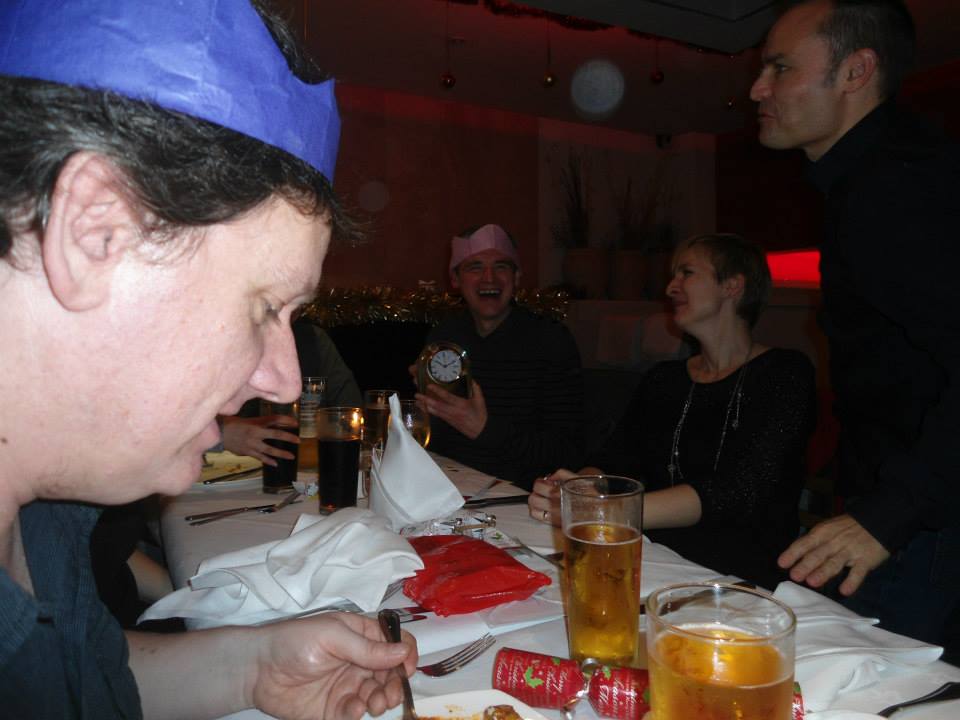
After twenty five years of UXD, I presented Rob with a carriage clock at The Spice Oven in Reading for his long service and a year later my gift of a much smaller timepiece for Tina (and her long service) was completely overshadowed by Rob's presentation, to me, of a blue plaque. It was amazing. I was gobsmacked and genuinely touched.

 Photographic evidence of these events can be seen below and, as Cheryl commented on the time, you can observe that Bugsy was far more interested in his food than the carriage clock presentation!




Over the years there have been belly dancers in Dalston's Stone Cave, somehow managing to crash Gok Wan's party in a room under a pub near Trafalgar Square, the odd argument, but much more laughter, much more alcohol, and much more tasty food. I loved the Mexican food in La Perla and the Greek food in Jimmy's (and the garlic bread in La Porchetta in Finsbury Park was so huge I thought the pizza had arrived) but in recent years, as the UXD has grown up (it's all relative), I can't recall a terrible meal.


Except the legendary disaster that was Ruby in the Dust on Upper Street in Islington. Nearly twenty years ago but still a legend that gets mentioned every year. Uncooked food, waiters who simply wouldn't serve us, rude staff, and a massive wait in a smelly basement room before the table was ready. It was dreadful - but, for most of us, it was funny and a few drinks in The King's Head theatre bar afterwards had us laughing at the experience before the night was even over.

Most of us anyway. At least four people who attended that evening never returned! I thought of making a list of all attendees ever but I think that list would run close to one hundred and there would be people on it whose names I barely remember. There would also be some ex-partners who people might prefer not to be reminded of!


Let's just say it's a very large amount of people, and we're still recruiting. Last year saw debuts for Pam and Valia. Pam's back this year and Jack will be joining us for the first time (I've only known her for over three decades) and Colin was supposed to be joining us until he got a better offer!

But we'll also be without a few regulars this year. Tony and Alex are only coming to the pub and Darren and Cheryl will be in Brighton watching The National. They'll be missed but I'm sure they'll be back soon. Far more missed will be Bugsy who, of course, we lost this year. Behind Rob, Tina, and myself (with thirty appearances each) Bugsy had always been one of the most regular attendees and always, always, brought something to the party.


It's a huge understatement to say it won't be the same without him and though it's likely there may be the odd moment of sadness I think we all know that Bugsy would have wanted us to have a good time in his memory and we're holding it this year in Reading's House of Flavours as Carole said it was a place he particularly liked.

I hope we can raise a toast to him as well as one to Pat and Stuart (both attendees of earlier meals and both no longer with us). I'm also hoping we'll be able to toast a new arrival. Ian and Miriam are regulars at the meal but not this year. That's because Miriam is eight and three quarter weeks pregnant. She's due on December 12th (election day!) but could she surprise us and pop out a baby to mark the annual UXD?


It'd be great but all that really matters is that mum and baby are fine. In recent years we've fluctuated between Reading and London for the meal but wherever it's held and whoever attends it is, for me, always one of my favourite social events of the year. I'm really proud that we've been able to keep this friendship group so close for so long.

I've seen friends grow older, get married, have kids, and move away to new towns. Some I catch up with regularly. Some I see less. But I love the fact that we still have this event each year and, aware of life's impermanence and our fading memories, I wanted to get something written down now while I still can and, more than anything, I wanted to say thankyou to everybody who's come along over the years and to everyone who will do in the future.

This blog is as much to act as a repository for some photos of my friends at this event over the years as it is to read and I've managed, thanks to Alex and Tina primarily, to collect way more than I really need to illustrate the words. So enjoy these photos of us looking young/happy/drunk/greedy/delete as appropriate and I look forward to seeing at least twelve of you tomorrow for more food and silliness. Just remember though:- "what happens in The After Dark stays in The After Dark".


Wednesday, 4 December 2019

Read It In Books:The Courage To Be Disliked.

One of the few birthday presents I got this year, courtesy of my lovely and much loved friend Michelle, was a book. The Courage To Be Disliked (subtitle:How to free yourself, change your life and achieve real happiness) by Ichiro Kishimi and Fumitake Koga. Its cover proudly claims "OVER THREE MILLION COPIES SOLD WORLDWIDE" and on the back it boasts that "reading this book could change your life".

I trust, and value, Michelle's recommendations as she's got great taste in music, comedy, art, and even food but I've always been a bit wary of 'self-help' books. Even if last year's read of Irvin D. Yalom's Creatures of a Day proved to be both enjoyable and beneficial. Could Kishimi and Koga's advice, using the theories of Alfred Adler, Sigmund Freud, and Carl Jung, prove equally, or even more, useful? Could it really change my life?


It certainly needs changing. Or at least tweaking. I'd never heard of Kishimi or Koga (although I had, at least, heard of Adler, Freud, and Jung). Kyoto born Kishimi lectures on, and has written about, Adlerian psychology while also providing counselling for youths in psychiatric clinics and the younger Koga has won awards for his writing and marries his own studies of Adler to the classical 'dialogue format' method of Greek philosophy.


That's the style they've used for their book. One that imagines a conversation between a philosopher and a young, curious, and questing man. It's suggested in a brief author's note that I might very well discover 'simple and straightforward answers to the philosophical question:how can one be happy?'. It sounds like a big boast and one, for me, that's hampered by the fact I'm not particularly unhappy.

I'm anxious, I'm not satisfied with how my life has panned out, and I worry about the future all the time but, for the most part - and if I don't drink too much - and I don't get rejected too often (both far from certainties) - I'm pretty happy most of the time. I love my friends, love my family, love writing, love walking, love music, and love art. If Boris Johnson, Donald Trump, and Nigel Farage would fuck off for good I'd be even happier.

But sometimes my anxiety edges very close to depression, not least because at the moment (for the last five or ten years in fact) my confidence is low, and it's at those times I have a tendency to catastrophise and have even flirted with suicidal ideation if not suicide itself. It's not a nice place to be and I know, deep down, that I will eventually negotiate myself out of that state. But it'd still be useful to have an emotional skill set that enabled me to do so without hurting myself and worrying those around me. I think I'm a reasonably intelligent and talented bloke. Nothing brilliant, but if I wasn't so beset by anxiety I'm sure I'd have made more of my life. I fucking hope so.

The Courage To Be Disliked is broken down into five sections, each of which imagines a conversation taking place across the course of an evening and thus these sections are simply named The First Night, The Second Night, The Third Night, and so on. Each 'night' is broken down even further into smaller sections with titles often as beguiling as 'Trauma does not exist', 'Why you dislike yourself', 'Cut the Gordian knot', 'Exist in the present', and 'Give meaning to seemingly meaningless life'.


While maintaining a tiny, and hopefully healthy, morsel of skepticism (not cynicism - that's different, that's destructive), I was eager to dig in and find out what these answers were. Kishimi and Kogi had certainly got me curious even if it didn't seem necessary for me to need to imagine that the philosopher lived 'on the outskirts of a thousand year old city'. If he lived in the middle of a housing estate in Milton Keynes would his words be any less sagacious?


I digress. Back to the book where we're introduced to the second of our key protagonists. A young man who finds the world 'a chaotic mass of contradictions' and felt, that in such a place, 'any notion of happiness was completely absurd'. I'm neither young nor do I believe happiness is impossible to achieve (though I do accept that it is not possible to live in perpetual happiness - the sunshine always feels better after the rain) but the world we've created, and the way people behave in it, certainly does seem like that chaotic mass of contradictions.

The first question the youth asks the philosopher (they're not given names, choose your own) is "do you believe that the world is, in all ways, a simple place?" but it's followed by the youth speculating on how idyllic childhood is (no taxes, no work, protected by parents, and free to image an eternal future) and how the 'grim reality' of adulthood will replace that 'romantic view' with a 'cruel realism' and a life of anxiety, doubt, and worries about inequality, discrimination, and war.

The philosopher, using as examples things like sunglasses and the temperature of water, explains that how we see the world is subjective, not objective. There are objective things in the world, sure, but our view of those things is subjective. He goes on to suggest that to see the world in a more positive light the key is to have the courage to do so.


Courage!? I wasn't convinced. But, like the youth, I came to see that when the philosopher spoke of courage he meant the courage to allow yourself to be disliked, the courage to accept being hurt by others, and the courage to hurt others. To enter into any meaningful interpersonal relationship these things are, ultimately, inevitable. They may even be necessary. The mental protection we build for ourselves can easily end up caging us in.

How courage and freedom are bundled up together was a fairly easy concept to get my head around but I was concerned that the book also included a denial of the existence of trauma. Adler's theory, very divergent from Freud's, was that "no experience is in itself a cause of our success or failure. We do not suffer from the shock of our experiences but instead we make out of them whatever suits our purposes" before even going on to suggest that people fabricate anger and unhappiness!

The youth opines that people can't control anger, the red mist descends too quickly, but the philosopher counters that if you stabbed someone in anger that defence wouldn't stand up in court. The youth counters that the circumstance of your birth and the nature of your parents could have a very strong affect on your happiness but the philosopher attests that unhappiness is a choice. I agreed with the philosopher, up to a point, but I was with the youth when he asked, quite outraged, why on Earth anyone would choose to be unhappy!


The book continues in this manner. The youth landing verbals blows on the philosopher only to have them bounced back by the older man's glacial and reasonable arguments. Cause and effect, determinism, the idea we shouldn't think about 'past' cause but instead think about 'present' goals, the pursuit of superiority, the inferiority complex, teleology (which I have trouble understanding), and the difference between teleology and aetiology, are all touched on and there's a lovely and gentle dismantling of spurious doctrines that suppose there are such things as innate human goodness and innate human evil. They're written about in such layman's terms that it's easy for anybody to understand and you never suspect the authors of using sophistry to push through points they may not be able to argue coherently enough.

They're too committed to their theory for that. I liked the stuff about focusing on improving yourself in recognition of your own goals and what you consider to be truly important rather than trying to assert superiority over others, play by societal rules (keeping up with, or ahead of, the Joneses), or, worst of all, trying to pull people down when they're up (crabs in a bucket theory) so that, in theory if not reality, you'll look not so bad.


Elsewhere in the book the youth speaks about salvation no longer being an option as "there is no real belief in God", we touch on Dostoevsky's supposed assertion that money 'coins' freedom, and, this one I found particularly interesting, the book looks at how praise should be viewed as a form of manipulation that can be used to create hierarchical structures.

If I tell a child they're 'good' for doing something I want them to do, they'll feel happy about that and want to do more things to receive more praise. While it seems necessary to impose some sort of authority on children for their own safety and well being, these ideas transferred into the work place (appraisals) or adult life in general may be less useful.

Harmful even. They form what the book calls 'vertical', rather than horizontal, relationships and create something of a master/servant dynamic. The book suggests one must neither praise nor rebuke others as they are both forms of judgement and enforce a hierarchical structure of personal relationships. It's not something I can go along with as I like to both dish out, and receive compliments and I think when people say kind things to each other it makes everyone feel better, makes the world a slightly better place.

I also accept that there are times when a harsh word is necessary. In my life I've needed to hear those words far more than I've needed to say them but I'm old and ugly enough to know the difference between someone putting me to rights because I've behaved, or acted, wrongly and someone trying to manipulate me in to doing their bidding for them.

Experience has taught me. It's been a long and painful lesson and it's one I'm still learning. The book goes on to talk about Kant's idea of 'inclination', the very human desire to not be disliked, and, here, also, I find myself both agreeing and disagreeing. It seems beneficial to all if we try to build friendships, human beings became a global success primarily due to our social nature, but that doesn't mean we build friendships at all costs. We accept that our friends sometimes don't do what we want them to, they sometimes say things that upset us, and they sometimes hold opinions that are uncomfortable for us to accept.

At the same time we need to be sure to move on from truly toxic relationships. I experienced a former friend becoming so poisonous, violent, and threatening that, after years of trying to help him (or, far worse, indulging him), I had to move on. I wasn't helping him at all, he was getting worse and worse, and the situation was starting to destroy me nearly as quickly as it was him. I had to accept that I didn't have the power to change him. I hope one day he finds somebody that does but I know, now, it wasn't me. It still saddens me but I hope, and think, I did the right thing.

Kishimi and Koga propose that the greatest life-lie of all is to not live in the here and now but to live in the past and the future and that we are the only ones who can assign meaning to our own lives. Life is essentially meaningless and anything anyone can do to give it a sense of meaning we should applaud. Should it be trying to improves the lives of others less fortunate than us, trying to keep our children safe and happy, or even something seemingly as dumb as devoting our life to the company we work for, a football team, a musical movement, or, and it really pains me to write this, a religious movement.


We don't have to play for that team, we don't have to manage them. We don't need to become a priest, an imam, or a rabbi. We don't have to be the best parent or most charitable person that ever lived. We just need to decide what we care about and work towards it whilst trying our best not to hurt anyone else.

We just need the courage to be 'normal' as opposed to 'special'. It sounds, as the book claims, quite simple really. But simple doesn't mean easy. There's something within us that strives to be the best. Maybe not at everything, but at least at something. The acceptance of one's inherent mediocrity, kowtowing to the strictures of society, class, and circumstances, or simply accepting, after a while, that one will never be Gandhi, Socrates, Einstein, Martin Luther King, or even, and this was an odd name for the authors to use, Napoleon (wonder if they considered Hitler!) is the key to finding an inner happiness and, for me more difficult to achieve, an inner satisfaction.


It's frustrating, and unfair, that many of us cannot rise as high in life as we'd like to. That frustration can only be compounded when we see the criminals, liars, and frauds that often do. But it's worth remembering that good people are still in the majority and it's worth remembering that finding joy and pleasure in the small things can bring immense happiness. Maintaining good friendships, looking forward to a nice cup of tea or a tasty dinner, or going for a lovely walk in the countryside. These things can have an immeasurable affect on one's mood and we should always strive to remember that for many on the planet those things are not guaranteed.

Most of these thoughts didn't come directly from the book but were spinning around in my head anyway. The book forced me to focus on them, get them down in words, capture a feeling at a specific moment in time. It wasn't necessary (but it was certainly interesting) for me to know how the authors found belief in the works of Socrates, Plato, and Aristotle and, even more so of course, in the writings of Alfred Adler.


But did I enjoy the book? Was it helpful? The dialogue style of presentation made it very easy to read but the way the two protagonists spoke didn't come across as the way people really speak conversationally or professionally. It felt a bit 'forced'. Understandably, as getting the point across was the reason for the book!

I started to write this piece a few months ago so that I could read the book slowly, trying to take it all in. I look back at my opening paragraphs now and I see a less content version of my self than the one I feel I am now. So, something seems to have changed while reading the book. It could be the book, of course, but that could also be more correlation than causation. Possibly, it's a change of circumstances. More likely still, it's looking at those same circumstances with a different, more positive, angle. Which would be in keeping with the book's message. Perhaps, most of all, it's knowing I have someone out there who cares enough about me to send me a book on my birthday when I'm seriously down. That can only have helped lay the foundations for this new, and still fragile, positivity. Thanks Michelle. I owe you one.

Tuesday, 3 December 2019

Pussy Galore:A Visitor From the Vagina Museum.

The final event of the London Skeptics in the Pub 2019 season,  Clitical Thinking:Why the World Needs A Vagina Museum, sounded as if it had at the potential to be timely, informative, and something quite out of the ordinary but when speaker Florence Schechter walked on to the stage to the sound of klaxons and Pop Will Eat Itself's unreconstructed grebo pop 'classic' Beaver Patrol and people sprayed beer in the air as she launched into a routine that was more bluer than even Roy 'Chubby' Brown in his pomp I was quite astounded.

Or I would have been if that had happened. Needless to say the evening was quite unlike that. Neither, however, was it some dull school biology listen that could only be livened up by staring out the window and passing small pieces of paper scrawled with scurrilous rumours around the 'class'.

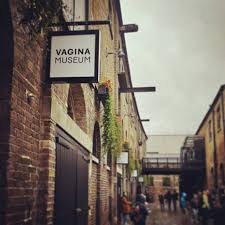
In fact, there was a lot of laughter (possibly the most I've ever heard at a Skeptics event, hardly stony faced affairs even when confronting traditionally grim subjects) and a lot of that was down to Florence herself. As the founder and director of the world's first bricks and mortar vagina museum, just across the road in Camden's Stables Market, she clearly knew her subject and she approached with the ease and the professionalism of someone who would be equally at home in either the stand up or the lecture circuit.


There was little fannying around (sorry) as she set out to tell us what the museum hoped to achieve, what kind of people it hoped to attract (spoiler alert - everyone), why she felt some were so offended by its very existence, and what sort of messages she'd received since announcing the creation of the museum. On the most part they'd been positive but the negative ones, on the whole, were funnier so we were treated to a brief snatch (sorry, I'll stop soon) of them.

"Vaginas have looked the same for thousands of years. Why do we need a museum"? was one of the less offensive tweets she'd received and this was backed up by a WhatsApp message from a friend of mine who, on being told how I was spending the evening, replied (not entirely seriously) with "can't think of anything to discuss on that matter. They are what they are".

Which is sort of true. But dinosaur bones haven't changed much in thousands of years either and nor have ancient Egyptian relics but there are plenty of museums devoted to both those things so, considering 50% of the population are in possession of a vagina, it does seem like a subject that people ought to be educated about. Or at least have the option to.

Some definitely need educating. One man had genuinely written, in anger, that he felt tampons should not be tax free as periods are caused by women's inability to control their bladder and another, Kyle, had written to say that he firmly believed that female orgasm was impossible to achieve and that the reason so many women were sexually unsatisfied is that they'd been fed a lie that orgasm was possible.


At least that's what's he's been telling himself! Although, to be fair, he did promise to do 'further research' on the subject! Although these examples show how clueless many men are when it comes to women's bodies there were others that were intentionally humorous. Although, in most cases, the repetition of the same jokes got to be a trifle tedious!

There's a building in London dedicated to 'crusty old cunts' wrote one jester before going on to say that that's enough about the Houses of Parliament and how, instead, he was looking forward to a visit to the Vagina Museum. Schechter joked back that, unlike members of parliament, vaginas are actually useful before observing that signs have been mocked up for when spillages occur reading 'CAUTION:SLIPPERY WHEN WET', many have asked if it will be closed once a month for refurbishment, and others have inquired as to whether or not there will be a knocker on the door as men may find it difficult to locate the buzzer. Some have gone on to suggest there is a nearby clitoris museum but, as yet, nobody's been able to find it.


Other wags have suggested that Bill Clinton could cut the ceremonial hymen and there have been rumours that the Trump administration were interesting in grabbing a piece of it should the chance arise. We all, of course, laughed heartily but the tone changed as Florence, feeling correctly confident she'd got us on side, pointed out some even more serious reasons why such a museum was long overdue.

The societal stigma around gynaecological anatomy prevails to such a severe degree that many women simply refuse to have cervical smears, there's further stigma when it comes to conversations about the menopause and, inspired by unrealistic pornographic imagery, labiaplasty (a surgery to, essentially, make the vagina tighter) is one of the fastest growing cosmetic procedures.

In Michigan, in 2012, two politicians were barred from the floor for simply using the word 'vagina' during a debate about abortion and the Japanese artist Rokude Nashiko was arrested for twice for using a canoe modelled on her own vagina to take her for a river ride.


As well as some still finding the mere mention of a piece of the anatomy half the world share offensive, there's a fear that, in the current political climate and particularly because of the fatal policy of austerity, women and the LGBT+ community (some observers, by the way, have been upset by the museum's trans-inclusionary stance) are being disproportionately affected.

Depressingly, that's often the way with the kind of alpha males that end up being president or prime minister. Everything, and everyone, that threatens their power needs to be constantly attacked and women, it seems, more than most. Donald Trump has five children and Boris Johnson has, according to Wikipedia, "at least 5" which suggests that (a) there's a lot of women out there who aren't so bothered about this state of affairs and (b) if the worst sexists are breeding at this rate we better hope their children don't take after them or we're all fucked.

As a man I'm fully aware that I've been guilty of thinking and saying terrible and hurtful things about, and to, women in the past. I didn't realise why I was doing it at the time. I didn't realise I'd been conditioned to think like that and I didn't realise I was attacking as a form of defence. I've changed my behaviour a lot over the years and I've tried to educate myself but I don't doubt I still have a very long way to go so I'll do my best to steer well clear of any #notallmen type stuff and, for now, I think it's unlikely I'll buy a t-shirt with an image of a vulva on it and wave it around like one well meaning guy did at the talk.

He pulled it off. But I'd get it wrong. I'm sure of that. Once Florence had explained why there was a need for the Vagina Museum (currently working towards a permanent home) to a packed house of those who seemed to be on her side from the start there was still time for a few other anecdotes about the last couple of years of her life since she tweeted about the idea of the museum to its opening just two weeks ago and on to its first exhibition, Muff Busters:Vagina Myths & How to Fight Them!


They've a membership scheme (the Cliterati, obvs) and despite there being no permanent collection we were treated to pictures of vagina dentata (the ancient myth of the toothed vagina was brought back into the public sphere in 2007 with Mitchell Lichtenstein's horror comedy film Teeth), a brief section about the pre-Columbian obsession with anal sex in the pottery of South America (especially Peru), and to stories about the art of Gustave Courbet (whose 1866 L'Origine du Monde is regularly censored by Facebook, one Danish science teacher even sued them over it) and Georgia O'Keeffe's 'flower' paintings.


While Courbet's work raised the shackles of the tech giants, it seems that Paul Gauguin's images of his underage brides in the South Seas go, often, without mention as if to suggest that realistic depiction of a female body is somehow more offensive than sexualised images of children and even actual paedophilia.

More amusingly, Florence told a story of a man who'd written to her suggesting that she should check out The Vagina Monologues. The idea that somebody opening a museum to vaginas would not have heard of The Vagina Monologues is, of course, priceless but the poor guy followed it up by making other suggestions for the museum. There could be 'information' and 'history' and a 'vagina launch pad'! While it's difficult to work out what form the launch pad would take it appears, elsewhere, that he not only assumed she was clueless about vaginas but that she also didn't know what a museum actually is.


Information! History! If the Science Museum or the V&A get hold of these ideas they'll run with them, you mark my words. Elsewhere we heard the tale of the Nigerian scientist who claimed he was able to 'prove' homosexuality was unnatural using magnets, there was a brief detour into the realm of Margaret Atwood's Handmaid's Tale, Call the Midwife, FGM, and menstruation, and a joke about exhibits being 'stuffed and mounted' from one audience member, before Florence proposed her own theory that human babies are born, essentially, prematurely.

That's why, unlike other animals, they take so long to learn to walk and that's why evolution, somehow, extended our life expectancy so that most young mothers would have their own mothers available to help them with the impossible looking task (I've never tried, I'd be rubbish) of bringing up small children.

Evolution, she went on to speculate, came up with the menopause so that these useful grandmothers wouldn't be conflicted time and priority wise by having to deal with their own newborns at the same time as their grandchildren. It was the one part of the talk I wasn't sure about but, hey, I'm no scientist and nor am I anything like an expert on either the female anatomy or evolution.

I'm just a keen student and Florence Schechter, it turned out, proved to be a more than capable tutor. It's hardly surprising she's spoken at both the Freud Museum and at Conway Hall and with her enthusiasm, sense of humour, and can do attitude it looks to me like the Vagina Museum can go on to be a great success.


There's a penis museum in Iceland so it was definitely time that a museum to vaginas appeared as well (hopefully my blog can be filed along with the one I wrote about cocks, and worship of them, back in 2016) and I'm proud that it's in my home city of London. If, for some weird reason, you're offended by its existence there's a simple answer to that. Just don't go there.

There are plenty of things to be offended about in Camden (the amount of homelessness, the price of coffee, and I once saw some buskers who sounded almost exactly like Mumford & Sons) but neither Florence Schechter's new Vagina Museum nor the long running London Skeptics in the Pub are among them.

It had been a great evening and an anything but dry (I'm really sorry for that one) speech and as The Monarch blasted out Prefab Sprout's Bonny and Blondie's Sunday Girl (which kids at my school used to change the lyrics so they referenced a 'hairy fanny') I reflected on a year of wonderful London Skeptics talks that had covered topics as bizarre and interesting as obscenity law, anxiety and anxiety cures, the ideas behind 'race science', flat Earth belief, pseudoscience, and, last month, critical thinking and how Florence Schechter's talk had been a great way to end the season.

London Skeptics in the Pub (as well as Greenwich Skeptics in the Pub, the London Fortean Society, SELFS, our TADS and London by Foot walks, art, and, more than anything, all my loved and valued friends) has been a shining beacon during a dark time both politically and personally. They are reasons to carry on. For if we look for the light then surely that is our best way out of the darkness. I make no apologies if that makes me sound like a pussy because, we should all know by now, there's nothing at all wrong with pussies.