Friday, 24 January 2025

Reality Asylum:Are We Living In A Computer Game?

"What is "real"? How do you define "real"? If you're talking about what you can feel, what you can smell, what you can taste and see, then "real" is simply electrical signals interpreted by your brain" - Morpheus, The Matrix

Children ask some awkward questions at bedtime, don't they? Why is the sky blue? What are rainbows made of? What was that strange noise you and daddy were making last night? While these questions come out of genuine curiosity and a keenness to learn they also serve as a good ploy to stave off having to go to sleep and having to be left alone in a darkened room.

One night, Professor Catherine Heymans was putting her young son to bed when he piped up with "Mum, do you think we could be inside a computer game?". The son in question was very keen on computer games whereas Professor Heymans was no gamer and didn't know the answer. Which bugged her.

She couldn't stop thinking about it and during a trip to the Paranal Observatory in Chile's Atacama Desert she found herself with plenty of time to ponder the question in some depth. A visit to the Atacama Desert may strike you as quite extravagant so here's some context. Heymans is the 11th Astronomer Royal for Scotland and the first woman to hold that title in its two hundred year history. She's also won the William Herschel medal for outstanding merit in observational astrophysics so the Paranal Observatory in the Atacama Desert is exactly the sort of place she would visit.

It's her job and it's a job she seems to absolutely love (I'd love a job that involved visiting Chile) and it's a job that also involves providing expert commentary on all things to do with physics and outer space. So, she's a good public speaker (even if she had long covid and had to deliver the talk via a pre-recorded film) and in last night's Skeptics in the Pub - Online talk, The Universe:Reality or Simulation - hosted by Clio Bellenis of the Winchester Skeptics chapter, she came across both theatrically and enthusiastically. At times like a children's TV presenter. She also laughed ever such a lot during the Q&A. Something the long covid didn't affect thankfully.

Back in Chile, Heymans looked up at the Milky Way - our galaxy. Somewhere between one hundred billion and four hundred billion stars and most of them with at least one planet orbiting it. The Milky Way is just one galaxy and we have no idea how many galaxies there are. There are at least one hundred billion galaxies but the actual number could be in the trillions or could even be infinite.

Nobody knows. But that's a hell of a lot of stars and planets. In Heymans' mind it seems almost impossible that not a single one of them except for our humble little planet, Earth, contains life or even civilisation. But what would that life look like? What would those other civilisations look like?

They could be less advanced than us but they could be more advanced than us. Far more advanced. They may have solved the problems of violence and climate change and they may have created such realistic computer games that we would be unable to tell the difference between those games and our own lived realities.

Of course, she is not the first person to think about this. In 2003, the Swedish philosopher Nick Bostrom came up with a 'simulation hypothesis' about just this subject. He posited three theories, one of which - according to Bostrom - had to be true.

(1) Humans will become extinct before reaching a post-human (for instance, AI) stage

(2) Any post-human civilisation is unlikely to run a significant number of simulations of their evolutionary history

(3) We are almost certainly living in a computer simulacra

The brainy prof, and the brainy Swedish philosopher, lost me a bit here but I got the general gist and Heymans was quick to explain that Bostrom's hypothesis was science fiction and not science fact. That cued her up for the first, but not the last, reference to The Matrix. A film that simply cannot be ignored when tackling this subject, so powerful is its cultural currency.

Heymans asked if our reality is mathematical? Can we describe everything that happens using mathematics? If the answer to those two questions is 'yes' then it's entirely possible that simulation could happen. She then went a bit deep and started talking about algebra, 1960s mainframe computers, and free will - or the lack of it - while throwing in a frankly unnecessary Billy Connolly impression and she lost me a bit but these blogs are my report of events, not some kind of Skeptics Hansard, so if you want to know everything that Professor Catherine Heymans said last night then you should have logged on last night. It was free.

I digress. Heymans continued by talking about how the binary world of computers breaks down algebraic equations into a seriew of logical questions, creating a mathematical calculation at lightning speed by simply asking yes/no, on/off, 1/0 questions. Heymans and her colleagues created simulations to see how the planets Jupiter and Saturn were formed and then created new Saturns and Jupiters. 

Only on their computers though, not in the tangible universe. Again, the science got a bit difficult for my enthusiastic, though uneducated, brain. Quarks, neutrons, gluons, leptons, and even our old friend the Higgs boson as well as a citation for the 19c Scottish physicist James Clerk Maxwell. At one point Heymans said "don't get me started on dark energy" which seemed like a good title for a book and if she ever returns for a talk on that subject that's the blog title sorted.

In the future, Heymans opined not unreasonably, we will be able to simulate human experience but to do this we will need to fully understand the mathematics of light and how it travels through time. Heymans, thankfully for me, explained it in layman's terms. Light travels across time in the same way ripples travel through water when a stone is thrown into still water. Ripples of water, or electromagnetic force fields, radiate out from a central point.

Our biggest light is, of course, the sun. The light from that big yellow bastard is absorbed into everything it touches and, for some reason, Heymans chose an orange as an example. An orange absorbs all light except for orange light (hmmm) and that's why oranges are orange. It's also why carrots are orange though we can't be certain if it's why Donald Trump is orange. What is certain however is that his IQ is roughly the equivalent to that of an orange or a carrot or even a Wotsit. Though oranges, carrots, and Wotsits all have far more moral fibre than America's worst ever President.

Our eyes absorb light too - everything does - and then send messages to our brains for interpretation. Could signals of senses (not just vision but smell and taste) be programmed to create a simulation? It's possible but it would involve the post-humans harvesting billions of human brains in vats. Why would they bother to do that? Wouldn't they be more interested in the future than the past?

How would this simulation explain our human consciousness? If we're just programmes running on the commands of some superior intergalactic beings then why do we have feelings? Why do we love? Why do we hate? Why do we care? Why do we worry? What purpose does consciousness even serve? Philosophers will give you many different answers to that final question but there is no consensus and there is no overwhelmingly definitive answer.

Heymans lost me again on a section that involved quantum computing, trilobites, electromagnetism, crustaceans, and an AI simulated photograph of Pope Francis in a big white puffer jacket (my least favourite kind of coat, just letting you know) but she soon won me back when she started talking about how creating a simulated universe would require unfeasibly large amounts of energy.

It's not just us, humans, that would need to be simulated but everything else too. Animals, plants, landscapes, seas, buildings, aeroplanes, tables, chairs, buttons, spoons, eggcups, paperclips, sticking plasters, Frazzles, score cards for games of Yahtzee, and Anusol cream. The human brain is so complex on its own that simulating that would be a mammoth task. Simulating over eight million human brains so that each person on the planet is simulated seems like too much work even for a non-sentient post-human.

Ultimately, though, Professor Catherine Heymans was unable to find a satisfactory answer to her son's bedtime question but, more importantly, does it matter? Does it matter if we're real or we're just under the illusion that we are real? What does that change? If you feel that your life is real then it is real. Use it well.

It had been an interesting, if sometimes hard to follow, talk and it's certainly an interesting subject. A Q&A involved space travel, satnavs, the quantumverse, David Chalmers, the Fermi paradox, Arthur C. Clarke, killer asteroids, existential fear, Einstein, chatbots, the redness of cherries, and the possibility of simulations within simulations within simulations and on and on forever as well as a guest appearance from Heymans' two sleeping cats - who I think were real but may be simulations. Either way they're not losing sleep over it.

Thanks to Clio Bellenis, thanks to Skeptics in the Pub - Online, and thanks to Professor Catherine Heymans for an illuminating Thursday night in January. Keep it real.



Sunday, 19 January 2025

A Change Is Gonna Come:Peter Kennard @ the Whitechapel Gallery.

"My art erupts from outrage at the fact that the search for financial profit rules every nook and cranny of our society. Profit masks poverty, racism, war, climate change catastrophe and on and on ... my aim is to unmask the connection" - Peter Kennard

"What I hate most about you is your textbook liberal agenda How we should legalise pot, man, how big business is crushing the underclass, how homelessness is the biggest tragedy in America" - Glenn Quagmire, to Brian

Defended to Death (1983)

Like Brian (the dog) in The Family Guy, I too have something of a 'textbook liberal agenda'. I'm a vegetarian, I'm an anti-capitalist, I'd get rid of the royal family, I celebrate immigrants, I don't like racists, I don't like homophobes, and I don't like sexists. It's been difficult lately to have that 'textbook liberal agenda' as I've watched people, people who form what Marina Hyde brilliantly calls "the hyper-engaged left", on the far end of leftist politics (and to talk about left and right really isn't a good fit for what's going on these days) make a horseshoe manoeuvre so that they're now closer to what we might term the far right than they are with the centre.

Those who hate Starmer and love Corbyn are far more likely to complain about Tony Blair than they are Boris Johnson or Liz Truss, those who understandably want to stop the bloodshed and murder in Gaza are happy to support the equally bloodthirsty and equally murderous Hamas regime even as they execute homosexuals and subjugate women. Take a walk down Whitechapel High Street and count the number of Palestinian flags and imagine what it might feel like to be Jewish there. The local synagogue was converted into a mosque in 2015.

None of which is to defend Netanyahu who is a murderous bastard who should be brought down and who should have his day in The Hague. Maybe now Hamas are finally releasing some of the hostages and now that the IDF have finally agreed to stop bombing Gaza into ever smaller pieces of rubble something will happen but with the Middle East, history suggests it won't be that straightforward.

And that's the problem with arch-polemicists like Peter Kennard whose free Archive of Dissent exhibition I went to see at Whitechapel Art Gallery this afternoon. Everything seems black and white. There is good and there is bad and there is rarely anything in between. I see shades of grey almost everywhere (so I'd be terrible at Kennard's job) even while there are some indubitably bad things and some bad people out there. One of those people will be sworn in as the President of the United States of America within the next 24 hours. 

World Markets (1997-2004)

None of which is intended to throw shade on Kennard's work. He has been, for the most part, fighting the good fight for nearly as long as I've been alive - and I'm not young. Born in Maida Vale in 1949 he has, since the 1970s, created some very powerful and influential images of resistance and protest. Some of which you can see in my last blog about him - back in 2016.

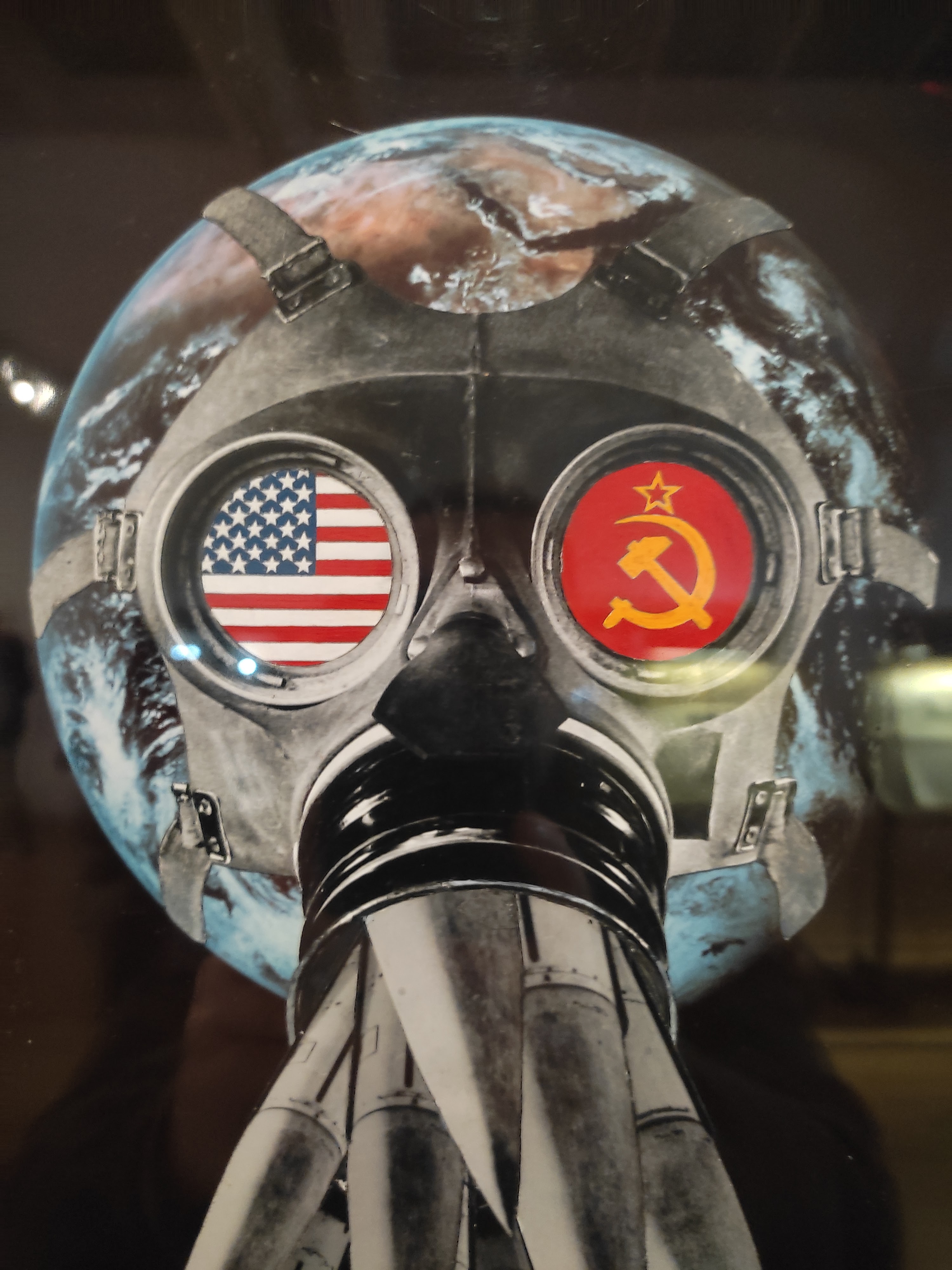
Because the show is a retrospective there is more Thatcher than there is Trump, more about Greenham Common than there is about the threat of the tech bro oligarchy in Silicon Valley, and more about the threat of nuclear war than there is about the rise of AI. That's fair enough. 

It's also a nice touch that the show is being hosted in what was, from 1892 until 2005, the Whitechapel Library, a place where local working class people - a very diverse group - could gather for warmth, company, and to read newspapers which were presented on lecterns - something you still see in some countries. People's Univeristy of the East End, the colloquial name for the former library, responds directly to that history and is a rare contemporary piece in the show. You can tell that by the inclusion of the now de rigueur Palestinian flag - complete with blood dripping down it.

People's University of the East End (2024)

Because of Kennard's political affiliations it's safe to assume that the blood has been spilt by the IDF though it's equally feasible that the bloodshed could have been caused by Hamas who are happy to use their own people as human shields and carried out the 7th October killings in the full knowledge, hope even, that Israel would respond with extreme and lethal prejudice. Not that I'll win many friends by saying that.

The curators of the show talk about how Kennard rips through something they call "the mask" by cutting, tearing, montaging, and juxtaposing the imagery that we are bombarded with daily, by what some on the far left (and the far right) would call the "mainstream media". Of course it's important to deconstruct the media and the message but it would be well worth remembering that two can play at that game. 

When the Corbynistas started singing the name of their leader, calling him by his first name, and blaming everything on 'the media' they set a template that the likes of Trump and Farage found very easy to adapt to their own ends. When hi-falutin' post-structuralist French philosophers like Michel Foucault and Jean Baudrillard claimed there was no such thing as objective truth and that truth was subjective, the likes of Steve Bannon and Aleksandr Dugin were taking notes.

Nothing in Kennard's work touches on, or even mentions, these complex interweaving threads or the compromised nature of protest. I feel compromised personally at the moment as I have enjoyed, for many years, using Facebook and have been very very critical of those who remain on Twitter/X since Elon Musk bought, and broke, it. "Why remain on a fascist website?" I asked friends and enemies alike only to see Mark Zuckerberg kneel down and suck MAGA dick after being threatened by Trump that he would spend the rest of his life in prison otherwise. I'm not taking a holier-than-thou position. I'm just acknowledging that taking such a position can leave one compromised.

All of which is, of course, to do Kennard a disservice. He is simply hoping to promote positivity by bringing people together to put a stop to entirely negative things like racism, nuclear bombs, and the belief that profit is more important than people. I believe in his message. We just live in different times now.

Stocks (1994)

Worktop (1966-2024)

Kennard's work comes from the pre-Berliner days of The Guardian when everything was different and, as if to underline this, there's some of the work he did for The Guardian on show in one of the rooms of this exhibition - as well as a 1981 copy of the NME in which there's a great review of an Echo And The Bunnymen gig and a terrible one of a Cure gig in which the writer suggests the band are on their last legs. FORTY-FOUR years ago! Robert Smith's aged better than that review.

Goth and post-punk legends aside, it's a world of mushroom clouds, skulls, and swastikas (so not so far from the goth/punk scenes after all) and you can relive the fall of Saddam Hussein who, surely - if the logic of those who now support Hamas is to go by was an anti-imperialist hero all along, as well as consider how well Denis Healey's Penguin publishing deal panned out. These aren't bad photomontages as it happens and, as with political cartoonists, having to respond to news as and when it happens can also leave one at the mercy of being overtaken by events. In all cases here, Kennard seems to have been on the ball.

Reading Room (1997-2024)

Reading Room (1997-2024)

Reading Room (1997-2024)


 Double Exposure (2022)

A series of Kennard's posters, hung on one of those racks you flick through like you used to get in Athena, have also aged a lot better than that unfortunately short-sighted Cure live review. There's Rupert Murdoch and the egregious strangehold over power he once had (he still has some but it's being diminished, replaced by the even more dangerous likes of Musk and PayPal's Peter Thiel), there's a CND gig featuring The Specials, The Pop Group, Mikey Dread, and Peggy Seeger (that looks like a bloody ace day out), there's an advert for an Auschwitz exhibition (less fun than a Specials gig, to be fair), and a call for public service to be prioritised over private profit.

A call that we all know was lost. Have a look at how much your bills cost, have a look at how much it costs to catch a train anywhere and then look at if the service has got better or worse and if you're still paying subsidies to fund it - but instead of being used to improve the services they are now going into the packet of fatcat corporates - and ask yourself if Kennard was not right on this one. He was and most people I know knew he was all along.

Posters (1979-2019)

Posters (1979-2019)

Posters (1979-2019)


Posters (1979-2019)

But once a battle has been lost it's hard to turn back the clock. It's easy for those with vested interests in upholding the now status quo to paint anyone advocating for that as regressive. Allowing the state to become secondary to capital has been the great failing of society in my lifetime. A neoliberal tragedy in which the only answer at the moment seems to be to move towards forms of autocractic nationalism, ethnofascism, Christofascism, and technofascism as promoted by the likes of Elon Musk.
 
This being a retrospective, we don't get to find out Kennard's thoughts on X, Meta, PayPal, or Amazon but a series of works, Boardroom, from just two years ago makes it clear he's not a fan of big poweful businesses having dominion over our lives. A series of anonymous human faces are reproduced on newsprint and are then blurred, all but obscured, by the logos of companies like Shell and BAE Systems. It's not subtle and it doesn't need to be. The message is simple. We are, as a society - as a planet, doing more to help capitalism than we are to help actual real people.

 
Boardroom (2023)

 
Boardroom (2023)
 
Nobody could ever accuse Peter Kennard of subtlety and so it proves in the fairly comprehensive photomontage section of the show which includes a montage of Trump with his head merging into some kind of nuclear submarine. We are under strict instruction that when it comes to this image of Trump that NO PHOTOGRAPHY is allowed. Wonder why that one? Of all the works? The day before his inauguration? 
 
I'm being flippant. There could be perfectly good reasons. Maybe it'll crop up in The Guardian tomorrow or something and they've insisted on it (even though it dates from 2018). Who knows? I'd have included it in this account of the show if I could but there's enough other good stuff in there so no worries.
 
Admitting inspiration from the likes of John Heartfield, Hannah Hoch, Walter Benjamin, and Bertolt Brecht, we can see how over the last few decades Kennard has made powerful and poignant points about Apartheid, about the nuclear arms race, and about Thatcherism. All things I imagine I'd agree entirely with him on.

But we live in a new world now and that world will become even more dangerous from tomorrow as Trump and the likes of Elon Musk and Vivek Ramaswamy start to redesign it in their own image, ably (or chaotically, it doesn't matter) assisted by many others across the globe. We will need to find a whole new language of protest to deal with these new threats to all that is right and good. Peter Kennard has spent decades at the coalface of international protestation. Younger people need to step up now and they need to step up with new ideas and not cling to old leftist/rightist absolutes. It won't be easy but this show reminds us that we defeated Apartheid, we defeated Thatcherism, and we defeated the Nazis. The bad guys always lose in the end.


Mandela (1990)

 
The Gamble (1986)


Thatcherism (1986)

Under Heavy Manners:Parmigianino's Vision of Saint Jerome @ the National Gallery.

This summary is not available. Please click here to view the post.

Saturday, 18 January 2025

Fleapit revisited:A Complete Unknown.

"How does it feel? how does it feel to be without a home? Like a complete unknown, like a rolling stone" - Like A Rolling Stone, Bob Dylan

What a joyous film A Complete Unknown (directed by James Mangold, based on Elijah Ward's book Dylan Goes Electric!) is! From the first minute to the one hundred and fortieth there's not a dull moment. There's hardly a moment when music isn't playing and the music is, of course, both first class and in the many live scenes it feels metaphorically as well as, later on, literally electric.

When some performances ended I felt myself getting ready to applaud, other times there was a lump in my throat. Timothee Chalamet plays the young Bob Dylan from the time he arrives as 'a complete unknown' in New York City to the infamous performance at 1965's Newport Folk Festival when him, and his band, shocked, outraged, and, in some cases, delighted the audience by performing with their instruments plugged in and turned up loud.

Chalamet's Dylan is just one version of Dylan and this story is just one version of Dylan's story, not one that pretends to be true but one that feels very true. Dylan comes across as mercurial and capricious, a genius with words and songs but also something of an 'arsehole' and a 'jerk'. Two accusations that are quite reasonably thrown at him by Joan Baez (a superb Monica Barbaro) whom Dylan enjoyed a complicated relationship with.


To be fair, all his relationships seem to be pretty complicated. There's his actual relationship with Sylvie Russo (based on Suze Rotolo with her name changed on Dylan's request and played by Elle Fanning) whom he falls in love with, moves in with, cheats on, splits up with, and then keeps on turning up at her apartment when the mood takes him. She accuses him of being like a French plate spinner they'd seen on television. Dylan replies that he likes those guys. To which she responds that, yeah, it's cool to be the plate spinner but not so great being the plate.

Then there's Edward Norton's Pete Seeger. A kindly avuncular figure who, with his wife Toshi (Eriko Hatsune), takes the young Dylan under his wing, gives him somewhere to stay and acts to all intents and purposes like a trendy school teacher intent on ridding the world of racism and war via the power of folk music.


Two people that Dylan shows nothing but total respect for are the frail and dying, and no longer capable of speech yet alone song, Woody Guthrie (Scoot McNairy) whom Dylan, and Seeger, perform songs to as he lays in his hospital bed and Boyd Holbrook's Johnny Cash. Dylan and Cash become 'pen pals' and when Dylan wonders about going electric it is Cash, in a drunken - or worse - stupor, who advises him to "get some mud on the carpet".

It's not just the live scenes and the performances that are excellent. New York looks fantastic too and the period detail is superb from the clothes to the cars to the televisions that blast out all the major events on the era:- the assassinations of JFK and Malcolm X, the Cuban Missile Crisis, and Civil Rights actions in Alabama.

All huge stories in their own right but background here to the story of Dylan, the attitude of Dylan (at one point he's asked if he thinks he's God, to which he replies "how many more times .... yes"), and the songs of Dylan. From the folk classics like Mr Tambourine Man, Blowin' in the Wind, and A Hard Rain's a-Gonna Fall to the far more interesting, and powerful, likes of Highway 61 Revisited, Maggie's Farm, Subterranean Homesick Blues, and, of course, Like A Rolling Stone itself.

Barbaro sounds great as Baez, Norton does a great Seeger, Holbrook may not look a lot like Cash but he pulls of his mannerisms and sounds like him, and Chalamet is a great Dylan. He's not the full Dylan, that's not possible - Dylan contains multitudes, but he is great as a version of Dylan and props should also go to Dan Fogler as Dylan's manager Albert Grossman, Will Harrison as Bob Neuwith, and Charlie Tahan as Al Kooper but most of all to Chalamet who is captivating throughout.

I wondered (curiously, rather than condescendingly) if the younger visitors to the Peckhamplex to see the film might have been Chalamet, rather than Dylan, fans, and what they made of it all but then realised that all the events in this film happened before my life time. I wouldn't normally wallow in nostalgia but James Mangold has pulled off an incredible trick by making Dylan relevant and revolutionary sounding for a new audience without losing the old. A trick Dylan himself found pretty tricky to pull off back in 1965 - but still managed. At the end of the film Bob Dylan rides his motorbike off into the distance and, as we all know now, one of the most glittering, fascinating, and inspiring careers in music history. How does it feel? How does it feel? It feels pretty bloody great.


Friday, 17 January 2025

Here's Looking At Leslie Green:The British Moderne.

Last year, on the 29th December in the gap between Christmas and New Year, I led a London by Foot walk called Here's Looking At Leslie Green:The British Moderne and, for the shame, I have only just got round to writing about it (been busy, in ways both constructive and not) so apologies for that but good things are, one hopes, worth waiting for.


The Moderne Style, British Art Nouveau, evolved from the Arts & Crafts Movement of William Morris, John Ruskin, C.F.A. Voysey, Charles Rennie Mackintosh, Edwin Lutyens, Eric Gill, and Gertrude Jekyll. British Art Nouveau gave birth to Jugendstil (Youth Style) in Germany and the Vienna Secsession and it took in many disciplines.

The paintings of Pre-Raphaelites like Edward Burne-Jones and Dante Gabriel Rossetti - as well as Aubrey Beardsley and William Blake (the subject of a previous LbF festive trek), the teapots and toast racks of Christopher Dresser, the ceramics of John Pearson and William James Neatby, and the architecture of Mackintosh (mostly found in Glasgow), Charles Harrison Townsend (SE23's Horniman Museum, the Whitechapel Art Gallery), George Skipper (whose work can be mainly found in Norwich), and our man for the walk - Leslie Green.

Green, who died of pulmonary tuberculosis at a sanatorium in Norfolk aged just 33, was born 6th February 1875 in Maida Vale and studied at Dover College and South Kensington School of Art as well as in Paris. He married Mildred Wildy in 1902 (in Clapham) and they one daughter, Vera, who died in 1995.

A member of RIBA, he was appointed architect for the Underground Electric Railways Company of London to design stations for three lines then under construction:- the Great Northern, Piccadilly, and Brompton Railway, the Baker Street and Waterloo Railway, and the Charing Cross, Eastern, and Hampstead Railway. In total, fifty stations. We'd not visit ALL of them but about a fifth of them. A decent cross-section and enough to get an idea of what Green, and his style was, all about.


His signature style was a two storey building with a steel structured frame (which was very modern back then), non-loadbearing oxblood red glazed terracotta (faience) blocks from the Bunnantofts Pottery in Leeds for the exterior, and large semi-circular windows at first floor level. They had flat roofs to encourage commercial development above, the steel helped with that.

Interiors were tiled green and white and platforms had individual geometric patterns. The lines (and stations) were opened in 1906-1907 and many of them are now Grade II listed and our exploration of them was to start at Elephant & Castle but not until after brunchington.

I'd arrived, on the 63 bus, early only to find the Black Cowboy Cafe (the venue I wanted to use) shut (it was the festive season and it was Sunday) so I repaired, as I'd specified as a backup plan, to the local Wetherspoons, The Rockingham Arms, where I met with Shep and Rodney. I had a veggie breakfast and a lemonade, Shep similar, and Rodney (a carnivore) had eggs benedict. Katie, Roxanne, and Clive soon joined us but were not in the breakfast/lunch club.

Once done, the walk (proper) began and our first stop was Elephant & Castle tube station (South London House). The Bakerloo building and not the Northern one (that's by Thomas Phillips Figgis). There's not a lot to say about each individual station (most of it has been said in the last few paragraphs) but there is a story relating to this station and a baby being born here on 13th May 1924, the first baby ever born on the underground network.

Initial press reports suggested she had been named Thelma Ursula Beatrice Eleanor (TUBE) but, disappointingly, the story proved to be untrue. Though her middle name was Ashfield and was named for Lord Ashfield who was chairman of the railway and agreed to be the baby's godfather but, grumpily, added that he wouldn't do that sort of thing again because he was a "busy man".


Past the Imperial War Museum, we found our second station. Lambeth North was opened on 10th March 1906. It was originally called Kennington Road, and before the Elephant & Castle station opened, was the Bakerloo line's southern terminus. It changed its name to Westminster Bridge Road after just four months and, in 1917, to Lambeth (North). Eleven years later the parenthesis was abandoned and another thirteen years later, in 1941, the Germans dropped a 'Satan' bomb nearby damaging the station and killing one person.


We crossed over Westminster Bridge, past the Houses of Parliament, down the Mall, and along the edge of Trafalgar Square. Most people take photos of these places but we were waiting until we found our first "ghost" station of the walk. Aldwych, or Strand, opened in 1907 and closed in 1994 when the cost of lift repair was deemed too high for the income generated by the station.

The station was used to shelter artworks during both world wars and the London Transport Museum runs 'Hidden London' tours inside it (sounds like fun). It's also been used in film and television:- The Krays, Sherlock, Fast & Furious 6, Superman IV, Mr.Selfridge, 28 Weeks Later, and Luther. The Prodigy filmed the video for Firestarter here and, in 2002, Most Haunted found no actual ghosts in the ghost station.


Up Kingsway, past the curious Square the Block (above) by Richard Wilson, we soon reached Holborn which didn't look quite right for Leslie Green and I still have doubts about now. But, apparently, it is. It's also another that has featured in music videos:- Suede's Saturday Night, Leftfield's Release the Pressure, and New Song by Howard Jones (which Katie asked me to remind her of, rendering it an earworm for me for the rest of the day).


Down Holborn, Chancery Lane, and past a festive penguin (there were many on show at the time, Tina had made a point of tracking them all down) and on to our first pub stop. I'm keen, when possible, to fit the pub stops into the theme of the walk so that meant that The Blackfriar was a must. It was nice and toasty in there and pleasantly busy and as we supped pints I did some brief spiel about the pub itself.

Grade II listed, it was built (in 1875) on the site of a former Dominican friary and remodelled in 1905 by one Herbert Fuller-Clark. The impressive internal decoration (see below) comes c/o Frederick T.Callcott and Henry Park (who also built Westminster Central Hall and Deptford Town Hall as well as various war memorials). The pub, thankfully, was saved from demolition in the 1960s by a campaign spearheaded by Sir John Betjeman. Who also had a hand in saving the incredible St Pancras station. The sixties may have been a progressive time (in some respects) but some of the history that they tried to sweep away really did need to be kept. Not least this pub and that station.


It would normally feel like a breach of protocol to have two pub stops so close together but The Fox and Anchor was relatively nearby, just a short walk under Holborn Viaduct and through Smithfield Market, and it fitted so well into the theme of walk it just had to be done. Plus, it was Xmas so fuck it!

It's not a big pub and it was standing room only. The beer wasn't cheap (and the mulled wine was astronomically priced - £10.40) but it was enjoyable. This Charterhouse Street pub was built in 1898 and designed by Latham Withall who mainly worked in Adelaide. Not much more information was available on this rather splendid pub so we chatted about our festive seasons, football, and other things. We don't have to talk only about things pertinent to the theme of the walk. That would be silly!


We said goodbye to Katie (who was off to watch football on the telly) and from the pub(s) we passed Coram's Fields, a very narrow road (Roxanne and Clive claimed the narrowest in London), and blue plaques for George Orwell (subject of a future LbF walk, all being well) and JM Barrie. By the time we reached Russell Square, after a couple of drinks, some bladders were in dire need of emptying and possibly this impressive station was not as appreciated as it might have been.

But people seemed to be having fun so that's the main thing, eh? Sadly the most famous thing about Russell Square station is that it was bombed on the 7th July 2005 resulting in the deaths of 26 people, Part of the 7/7 terrorist attacks, still the worst in British history.


More blue plaques (including Kenneth Williams), a canal, and the impressive stations of Kings Cross and St Pancras (as well as the former site of the Euston Tavern, thanks Clive, which may feature in an upcoming LbF walk dedicated to the London of The Pogues) and up York Way to the second 'ghost' station of the day.

York Road opened in 1906 and closed in 1932 but with the huge KX redevelopment project still ongoing (hey, my office is there) it may well reopen. Who knows? We passed my office (below), some impressive gasholders, and a bridge over the canal before we had our first proper adventure of the day. 

I thought we'd have to go round St Pancras Gardens and Old St Pancras Church but the gates were open so we passed through. The problem is they were only open one end so that resulted in us all clambering over a fence (luckily there were what appeared to be some old gravestones for us to use as steps) before we could get out and head down Crowndale Road to Mornington Crescent. Nearing the end of our Leslie Green inspired odyssey.


Mornington Crescent opened on 22nd June 1907 and is probably most famous for being the star of the radio comedy panel game I'm Sorry I Haven't A Clue. There's even a plaque inside to Willie Rushton (who died, aged 59, in 1996) which a few of us (well, me) eagerly snapped. Belle and Sebastian wrote a song about the station and it crops up in China Mieville's 1998 novel King Rat.

Camden was, as ever, busy but we made our way up to Camden Town (opened on the same day as Mornington Crescent by David Lloyd George, than President of the Board of Trade) and on to our final Leslie Green station of the day - Chalk Farm.


Chalk Farm opened the same day as Mornington Crescent and Camden Town (what a day for Camden) and is famous for appearing on the cover of the Madness album Absolutely as well as their single Baggy Trousers. I won't (as planned) list the forty stations we didn't see but I will mention that, quite remarkably, we didn't go for curry (I had Namaaste planned and that's been a hit in the past).

Shep had a rail replacement bus service ahead and there were no other takers so the five of us repaired to the Enterprise, talked shit for a while, watched some football, and then drew a line under a bumpy, but fun, year of LbF's walks.

Even if there'd only been four as opposed to the planned six. Thanks to Shep, Rodney, Katie, Roxanne, and Clive for joining me on this walk and to all others who took part in an LbF walk last year. That's Bee, Pam, Mo, Eamon, and Vicky. This year we'll kick off in March with another trip to Epping Forest and I'm hoping that this time I don't end up covered in mud like last time. Let's wait and see.