Monday, 7 February 2022

Theatre night:The Glow.

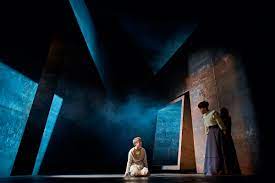
When a Victorian spiritualist medium, Mrs Lyall (Rakie Ayola), takes a miserable, and unnamed, young woman (Ria Zmitrowicz), who has forgotten her own name and even the reason she is being held in a windowless asylum cell, for her assistant she sets in motion a series of events that is far more mysterious, and more magical, than anything she could have possibly imagined for her own fraudulent act.

Sophie, as Mrs Lyall names the seemingly helpless wretch, can't speak (initially) and she refuses to eat, drink, or even sleep. Lyall's son Mason (Fisayo Akinade), a spoilt bully who has little love or respect for his own mother, takes all his anger out on Sophie. Not least when she takes his room, keeps him awake at night pacing about, and, soon, appears to replace him in his mum's affection.

The Glow (at the Royal Court theatre in Sloane Square, directed by Vicky Featherstone, and written by Alistair McDowall) got off, for me, to a pretty slow start but as the story (one of knights, kings and all manner of fairytale bullshit but also one of bereavement, loneliness, loss, and companionship) developed, at times jumping back (and forward) years, decades, and even millennia, it caught me off guard with one particularly chilling moment and another profoundly moving scene.


Laughter pealed out from the balcony of the Royal Court theatre although, a couple of lines from Akinade's Mason aside, I never found it to be a particularly funny play. Perhaps people were just glad to be out. I was. It was my first theatre visit for 765 days! But it wasn't just the jokes that didn't always work. The angular set, the intentionally jarring lighting, and the discordant sounds that marked changes of scenes and eras were, at times, overplayed and detracted, rather than added, to one's enjoyment of the play.

The introduction of some kind of medieval knight (played by Tadhg Murphy) didn't bode well as I feared The Glow descending into some kind of swords and sandals bunfest but on this The Glow made a great save. The play was, at heart, about the stories we tell each other, the stories we tell our children, and the stories we tell ourselves to make sense of our lives.

As well as of our histories. The contention, or belief, that drove the action was that history is, still, all around us and as Sophie and the unnamed knight journey both into the past and the future and meet with a tank-topped amateur historian (Akinade, again) and a kindly woman living alone (Ayola) who takes them in and cares for them, a story unfolds that somehow felt both unique and, paradoxically, eternal. In that The Glow was a success. But I left with a feeling that, much like life itself, it could have been so much better. 


Saturday, 5 February 2022

Becontree:In Praise of the Vernacular.

Becontree, in the London borough of Barking and Dagenham, is the largest public housing estate in the world. Still to this day, apparently. As a Londoner of many years, if not a born and bred one, I was surprised that not once had I visited the place. That's something I plan to remedy in October of this year when I lead an LbF (London by Foot) walk, Homes for Heroes, in and around the area.

But, before that, it was time for some research and Lived in Architecture - Becontree at 100 with Verity Jane-Keefe at the RIBA (Royal Institute of British Architects) building in Marylebone was not merely convenient. It was in fact the very thing that highlighted the existence of Becontree to me. On its one hundredth birthday. Not only had I not been to Becontree but, a full century after it was built, I knew next to nothing about it.


So I was eager to learn but, to be brutally honest, the RIBA show was a little prismatic for my tastes. Perhaps that's why during my visit I was the sole person there. Ah well, at least it meant I could dispense with the mask and not have my glasses steam up.

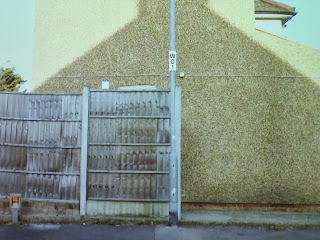
There were several small, interlocking, rooms, some of which contained models and images, and one larger room which contained a film showing scenes from present day Becontree. It is these that make up the bulk of the imagery used in this blog. Basically, if there's no title underneath an image it's from the film.

Constructed between 1921 and 1935 when the need for interwar housing became urgent, Becontree was initially in Essex until boundary changes in 1965 meant it came under the jurisdiction of Greater London and, eventually, the borough of Barking and Dagenham. By the time of the estate's completion, it had 26,000 homes in which lived roughly 100,000 people.

I'll go into more of that when I lead, and then write about, the walk in October but this piece is about my experience at the RIBA as much as it is Becontree itself and the experience was a little confusing - if ultimately worthwhile. It consisted of the brief stories of some buildings, for instance C.F.A.Voysey's Orchard in Chorleywood, that have been deemed to be influential to the design and development of Becontree.

Charles Francis Annesley Voysey - The Orchard, Chorleywood, Hertfordshire (1900)

 Charles Rennie Mackintosh - Hill House, Helensburgh, Scotland (window details) (1903)

Voysey, and - in Glasgow - Charles Rennie Mackintosh, were Arts and Crafts kind of guys so although Voysey's work was none too grand, Mackintosh's a little more so, it still looks a little fancy for an early public housing project. More relatable is the story of how when the popularity of decorative stucco waned in most of England from the 17th century onwards it remained popular in the Eastern counties of Essex and Suffolk. Areas I've always felt have had a very specific architectural feel. 

A style I sometimes, perhaps incorrectly, imagine to be inspired by these counties proximity to the Netherlands and northern Germany. In Essex, and elsewhere, these days they tend to call it pargeting. It's a development from the Arts and Crafts technique of using local and natural elements to create an English vernacular that was pleasing to the eye and yet able to be replicated on grand scale.


Though with the important distinction that owners of these homes could easily personalise and adapt their dwellings. There's been much criticism over the decades of such vernacular architecture and it usually amounts to nothing more than snobbery. Working class people have no taste, they have ugly satellite dishes and ornamental lions adoring their gaudy properties, and they should, essentially, stay in their lane.

What a load of complete and utter hogwash. Though I'm no fan of aspirational culture (primarily because aspiration always seems to be towards wealth and material possession rather than health, contentment, and good relationships) it seems to stink to high heaven that those with money should look down at those trying to better themselves in the best way they know how.

I've come to dislike Mike Leigh's Abigail's Party for its condescending manner (though many other Mike Leigh films I still love) and even a band as good as Radiohead, in songs like Street Spirit and No Surprises, make comments that seem to allude to their disgust at lower middle class mores and manners. 

Alienation within suburbia is understandable and real. I've experienced it. But you can't force your teenage angst on everyone else, not least when you're a long way from being a teenager. Many people like living in these places. Many people aspire towards living in these places. I need to understand places like Becontree from their perspective.

Harry Douglas Blessey - Design for Alterations and Additions to a House, South Glamorgan, Wales:West Elevation (1905)

Plurality of architectural styles blossomed in the early 19c as the industrial age led to a growing middle class who were keen to display their new found wealth. Architects were commissioned to recreate homes and other buildings in Renaissance, Gothic, Tudor, and Italianate styles and rural idylls were imitated in urban contexts.

A fictional authenticity was created and in Becontree today there are still pediments, columns, and balustrades that can be traced back to this period. It would be easy to prefix the architectural terms listed above with demeaning terms like 'faux' or 'cod' and though that would not be entirely incorrect it also harks back to the snobbery I wrote about earlier. Why should people living in polluted cities not want to feel as if they are in the country some times? Why should people whose parents and grandparents have grown up in far worse conditions, from tenement blocks to sooty terraces, not wish to create a safer and cleaner home for their own children?

George Vuillamy - Study of Column from Santa Maria in Cosmedin, Rome, Italy (1842)

At a time when foreign travel was prohibitively expensive, and all but impossible, for all but the wealthiest in the land why would you not want a piece of Italy or a piece of Greece in your own home? If you couldn't identify the difference between Corinthian, Doric, and Ionic columns does that really mean you have to live in a shed?

The Regency style that became popular in many British towns between 1810 and 1830 saw a revival in these form of classical architecture. Perhaps most notable among the leading lights of the style was John Nash who built much of Bath but RIBA have decided to show the works of less celebrated men like George Wightwick, a former assistant to John Soane, and Robert Lewis Roumieu.

Robert Lewis Roumieu - Designs for Alterations and Additions to a House in, Bushey Heath, London (1850)

Robert Lewis Roumieu - Designs for Alterations and Additions to a House in, Bushey Heath, London (1850)

Whereas men like Nash and Soane were established enough to create the buildings they wanted and to choose which work they accepted, men like Roumieu had to cater more to the whims of his nouveau riche clients. To indulge them a little. For this reason, him and others were often expected to produce two or more potential designs in differing styles before a commission was earned. You can see examples in Roumieu's Bushey Heath sketches above.

The reason these sketches are at the RIBA is because it is these styles, and more so the mixing of them - sacrosanct in hi-falutin' architectural circles, that is the key to Becontree's individuality. If you don't know the rules you can't play by them.


A ceramic lion on a two up two down may get sneered at by those who worship at the altar of Nikolaus Pevsner but it may bring joy to a child, to a parent, and to a passer by. Not everyone has to be Andrea Palladio. 

It helps that many of the shots of Becontree included in the film were taken on a sunny day. Everything looks better on a sunny day. But Verity Jane-Keefe makes an interesting point about another way we can look at the homes of Becontree and similarly dismissed estates.

Large, grand, architectural projects are often designed to the nth degree and, once completed, immediately revered or, sometimes, derided. There is a focus on perfection which almost precludes sympathetic alterations and amendments further down the line. The likes of Becontree rarely bother architectural critics so these homes are free, or freer, to breathe. They have more possibility. More capability even. 

Verity Jane-Keefe's contention is hardly a contention at all. Architecture should not just be celebrated for its newness but admired for its longevity, its durability, and its adaptability. That doesn't put her so much at odds with those of a more modernist persuasion as you may think. The radical interwar architectural group Tecton (think London's Highpoint II and, strangely, lots of zoos) were, in the 1930s, commissioned to restore a Georgian villa in West London that had been built, originally, for a clergyman in 1786.

Walter Gropius & Maxwell Fry - 66 Old Church Street, London:The Street Front (1972)

Of course it looks dated now, and the car parked out front even more so, but here, to me, is a highly sympathetic fusion of the modern and the traditional. Where modern techniques combine with long held practices to fuse into a style that works for everyone. It's not so much a compromise as a simple, yet almost radical, solution to a building need.

Following the bomb damage of World War II it was parts of the East End of London, going out towards Becontree, that needed these solutions the most urgently so the innovations of Gropius (who being German decided, understandably, to get out of Britain before the war as he had Germany in 1933 to escape the rise of Hitler) continued in the hands of home grown architects.

Halsey Ralph Ricardo - Working Drawings for Alterations and Additions to Crimbourne Farm, Kirdford (1925)

But not just architects. Home owners too - and it is the home owners, the people of Becontree, who have really made the place their own. As home owners do all over the country and the world. The RIBA exhibition was interesting if a little bit digressive but, for me, it gave me a feel for Becontree and some ideas to incorporate into October's walk.

More than that it made me look at, on the surface, quite prosaic dwellings in a new way and that, more than anything else, was the takeaway I got from Lived in Architecture. A house is not just the bricks and mortar (or concrete, glass, steel, wood etc;) it is built of but is a project for those who dwell in it, it is a safe space, and it is a repository of memories and emotions. These are not just houses. They are homes - sweet homes.


Friday, 4 February 2022

The Laughing Cavalier and Some Other Dead Men, Some of Whom are Wearing Hats:Frans Hals @ the Wallace Collection.

Men with hats, men without hats, men in ruffs, men holding skulls, men wearing what look like paper doilies, men with big collars, sad men, happy men. affluent men, successful men, aldermen, and a man who is neither a cavalier nor laughing but is nonetheless known to everyone as The Laughing Cavalier.


The Laughing Cavalier (1624)

It's not so much that every portrait in the Wallace Collection's Frans Hals:The Male Portrait is of a man, the title makes that very clear, it's more that these men, these mostly self-important and pompous looking men, are of little or no interest to anybody anymore.

"Look on my works, ye Mighty and despair" wrote Percy Shelley in 1818's Ozymandias. Shelley intended to both lampoon and puncture the hubris of the lives of 'great men' and though he succeeded in this it didn't change much. We live in a time when, during the worst global pandemic for over a century, the Prime Minister can, apparently, devote much of his time to scouring maps to see where he can build monuments to himself.

I've no idea if the people depicted in the work of Frans Hals were as awful as Boris Johnson. Statistically, it's highly unlikely - as few people are. But I do know that not one of their names means much to anybody know. The Netherlands in the 17th century was, I'm sure, a vibrant time of commerce and art but it's not one that troubles our minds much anymore.

So, instead of worrying about the sitters. The best way to look at Hals' portraiture is to look at the paintings themselves. During the Dutch Golden Age, Hals was admired for his his skill in making portraits that seemed "to live and breathe" and for capturing the personality as well as the looks of his various subjects. In the "cosmopolitan and vibrant" city of Haarlem he had plenty of flamboyant dandies and moneyed elders who were more than happy to be painted by him.

Portrait of a Man Holding a Skull (c.1610-14)

When Hals died, in his eighties, in 1666 his work, and name, fell into obscurity and some even claimed his modern, for the time, artistic style came as a result of his dissolute lifestyle. It wasn't until the second half of the nineteenth century when the 4th Marquess of Hertford purchased The Laughing Cavalier that his reputation was restored and, in France, the Impressionists took notice.

Not that you can necessarily see that in all of the works displayed at the Wallace Collection. The memento mori of Portrait of  Man Holding a Skull is too sombre. Partly because during that era strict Spanish fashions were prevalent in Dutch society and everyone seems to have dressed, bar a frill or a ruff here and there, as if in a gloomy Zurbaran painting.

But partly, also, because this earlyish Hals work shows an artist still learning his craft. Hals soon removed skulls and such like from his painting. Either he, or I imagine his wealthy patrons, wanted their lives celebrated. Not to be forever reminded that death is both imminent and inevitable.

Jan van de Velde II after Jan Saenredam - View of Haarlem from the South (1628)

Portrait of a Man (c.1635)

Another portrait, from nearly two decades later, demonstrates how Hals learned to relax into his style. When making it, Hals didn't allow one colour of paint to dry before applying the next - which gives it a more informal feel that seems suitable for this particular sitter who looks quite at ease. Perhaps he'd just a glass or two of jenever.

Apparently it was initially paired with a portrait of the sitter's wife and she was depicted in a far more formal pose. Hals' women, we learn, were not painted with the same honesty as Hals' men. Make of that what you will.

Look at the dude below. With his dinky arm akimbo and his long flowing locks. Considering the picture is almost entirely monochrome, Hals' backgrounds regularly feature a kind of shit brown colour familiar to observers of the set of Michael Parkinson's chat shows of the 1970s, but the image has, despite that, a lot of 'colour' about it.

Portrait of a Man (early 1650s)

Willem Coymans (1645)

As Van Gogh said, "Frans Hals must have had 27 blacks". Hals' other trick, and quite a neat one, was to combine refinement with nonchalance. Men like Willem Coymans, a member of one of Holland's most influential merchant families, were modern men. They were not stymied nor held back by social convention. If they want to don a big hat, a collar that could take your eye out, and lean into their portrait then they'll damned well do it - and Hals will enable that.

It's the below portrait of an unnamed man that, for me, is the work that seems to have most influenced Impressionist painters like Manet. Hals was an octogenarian when he made the painting so perhaps the looseness of it is down to him getting a bit fragile or a bit shaky. But I like to feel it was because he was more confident, and forward thinking, in his approach.

Portrait of a Man (c.1660-63)

Portrait of Francois Wouters (1645)

By that age, he didn't have a lot to lose. It's a pity, for me, that the Wallace Collection didn't have more like that. Maybe Hals didn't make many like that. For me, it was the highlight of the show and more rigid representations like that of Francois Wouters, above, pale in comparison.

Wouters was quite the man about town. An alderman, a burgomaster, a city councillor, and a brewer so Hals' painting of him is of course respecful. Wouters dons sober attire though, ever keen to make the case for Hals as a precursor to modernity, the curators of the exhibition direct us to Wouters' exposed wrist, just visible above his glove. Phwoar!

Portrait of a Man (1630)

Pieter van den Broecke (c.1633)

Hals' gallery of swells continue and after a fashion you long for something else. I'd mistakenly imagined there to be second, maybe third and fourth, room in the exhibition but there was just this one. Portraits on all walls like some hall of mirrors, eyes following you round the room as if in a haunted mansion, and, in the background, the hustle and bustle of people chatting over coffee and cake.

Which I am sure more people come to the Wallace Collection for than the art. So who have we got? Well, there's Pieter van den Broecke, a ruddy cheeked admiral and slave trader of the Dutch East India Company, there's Hals' friend Isaac Abrahamsz Massa - a prosperous merchant who had spent much time in Russia, and there's a man who may or may not be the Haarlem brewer and art collector Nicolaes Pietersz Duyst van Voorhout.

Plus, of course, that Laughing Cavalier. We don't know who he is and, for some reason, he was given that name as late as 1888 but he is, by some margin, Hals' most famous sitter. The paintings of these men, Cavalier included, are good. Hals was obviously skilled. But the show itself was too dry for my liking. There were times when I could see that Hals was, clearly, an influence on more dynamic later artists but there were many others where I had him down as a starchy pencil squeezer who made society portraits of men desperate not to be forgotten by history. In comparison to the man who painted them, though, that is exactly what did happen to them.

Isaac Abrahamz Massa (1626)

Portrait of a Man, possibly Nicolaes Pietersz Duyst van Voorhout (c.1636-8)


Tuesday, 1 February 2022

Head in the Clouds, Clouds in the Head:Late Constable @ the Royal Academy.

Arundel, Brighton, Hampstead Heath, Salisbury, Stonehenge, Waterloo Bridge. John Constable may have lived nearly two hundred years before me but he visited a lot of places that have become part of my life. Either where I live (London), where I visit often (Brighton), or where the TADS and LbF walks may take me (Salisbury, Arundel).

Even the places he painted that I haven't visited (especially the Suffolk locations like East Bergholt and Dedham Vale) have been on my radar as potential locations for future walks. If those walks are to happen, however, I'd probably be hoping for a few less clouds than John Constable was wont to paint. Constable loved to paint a pretty, idyllic, rural scene but I didn't count one single painting at the RA's current Late Constable exhibition in which, if the sky was present - as it usually is in his work, clouds didn't dominate.

A Boat Passing a Lock (1826)

A reflection on Constable's mental state, a reflection on the (sometimes) terrible British weather, or was John Constable just really unlucky and every time he packed his easel and brushes and headed out to paint the sun would dip behind a thick screen of little fluffy clouds.

Perhaps that's why he's so fond of adding rainbows. In Constable's work rainbows are more prominent than sunshine. You can see why. Rainbows are great. They never get boring. They're also a good way of showing off how good a painter you are and Constable's a great painter. Even if you find his work a bit chocolate boxy you'd have to admit it is technically superb.

With Late Constable, it seems to me that the RA are trying to show that Constable was more experimental, more groundbreaking, than we tend to give him credit for. I think what they're trying to do is put him up there with Turner as a maverick and a modern artist whose work paved the way for Impressionism and other revolutionary French styles of painting.

It's easy to see where they're coming from. Even A Boat Passing a Lock (the painting he chose to present to the RA when he was made an Academician in 1829, three years after painting it and already in his early fifties) which looks, initially, to belong on the side of your nan's biscuit tin is actually pioneering. For me, it's in that top left hand corner where a dark cloud hovers. There's something almost abstract about it. It could quite easily have influenced the work of Frank Auerbach.

Flatford Lock, A Path by a River (c.1810-12)

Even the woozy trees and almost three dimensional clouds of Flatford Lock, A Path by a River (from nearly two decades earlier) seem at odds with the more formal, starchy, landscape paintings of the era. I don't know if Constable was a fully signed up plein air painter but it certainly feels that way. These paintings don't seem still. They contain movement. Looking at them you can feel the wind, sometimes even the cold. You feel exposed to the elements. Most of them anyway.

Sadly not the sun. Constable had been born, in 1776, and bred along the banks of the Stour in Suffolk so it's no wonder the area features so regularly in his work. When he married Maria Bicknell in 1816, they moved to London and he opened a studio on Charlotte Street, Fitzrovia. Maria's poor health meant that she and Constable spent the summers away from London.

In Hampstead! Then in Brighton when her health got even worse. So you can see why London and Brighton crop up in his work. When Maria died of tuberculosis in 1828 (leaving Constable as sole parent to SEVEN young children), one year before he was accepted as a member of the Royal Academy, Constable had established a reputation as an accomplished landscape painter but had still sold very few paintings.

Cloud Study (1821)

I don't think that's why he painted so many clouds though. I don't think they were some kind of expression, direct or otherwise, of his mental state. At least, not at first. I think, quite simply, he was interested in nature and how it really was and he saw it in the shifting shapes of these aerosol masses of liquid droplets. At this exhibition you can read how he used to read widely on then current meteorological research. He was even planning to give a lecture on skies and clouds before he died.

Distant View of the Grove, Hampstead (1822)

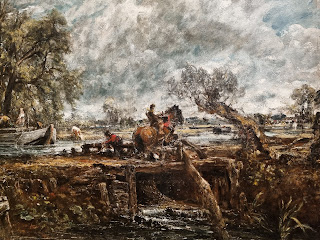
The Leaping Horse (1825)

The Cornfield (1826)

Of course, indulging his passion for realistic depictions of nature had to be balanced against providing for his family so when his 'canal' paintings of the Stour, such as The Leaping Horse, didn't sell he moved his attention to country lanes and panoramic vistas. The Cornfield shows Fen Lane between East Bergholt and Constable's former school in Dedham and I can't help but imagine the shepherd boy quenching his thirst in a puddle and the sheepdog were added to attract potential buyers who may have felt the scene too bare without them.

At the same time, Constable branched out into coastal painting. Brighton's chain pier had only been built three years before Constable painted it which demonstrates that, like Turner, Constable was interested in depicting the modern, and newly industrial, world as well as nature. Though, of course, fishermen still feature. The Chain Pier, Brighton's first pier, would last until it was destroyed during a storm in 1896 but the wreckage of it was clearly visible from Brighton's front until only about a decade ago. Those who lived in, or visited, Brighton will remember clearly.

Chain Pier, Brighton (1826-27)

Dedham Vale (1828)

Hadleigh Castle (1829)

While Constable regularly returned to Dedham Vale, East Bergholt, and Suffolk to paint he also ventured down to Essex where he captured the majestic ruins (what, today, we might call ruin porn) of Hadleigh Castle on the Thames Estuary between Benfleet and Southend. A spot where, rather happily, I'll be dragging the TADS out to in June this year.

Painted while still suffering the pain of his wife's death, and with anxious thoughts about his future, it captures the tumultuous emotions that must have been building in his head at the time and in the instance of Hadleigh Castle we can, I think quite safely, say that though Constable is showing his interest in meteorology, the clouds here do reflect his mental state at the time.

The same could be said of Rainstorm over the Sea. While Hadleigh Castle won Constable plaudits at the time it is the slightly earlier work, Brighton again being the subject, that looks, to our modern eyes, the most forward thinking. The torrential rain has been created by impatient impressionistic downward sweeps of Constable's brush and the surface of the sea ripples violently at a lower than expected horizon on the canvas.

Rainstorm over the Sea (c.1824-28)

Sketch of Michelangelo's 'Taddei Tondo' (1830)

Trees and a Stretch of Water on the Stour (c.1836)

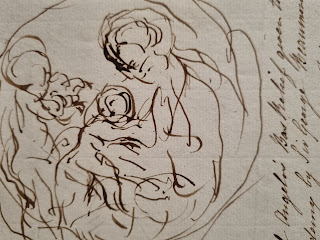
It's probably the closest Constable gets to late Turner. It's a side of Constable we're not often shown and that also goes for the watercolours, mezzotints, and hastily drawn sketches of Michelangelo masterpieces that fill out one of the smaller rooms of the RA's show.

Here we can see Constable expand his vision beyond landscape and into history and mythology. Jacques, with his wounded stag, is a melancholic philosopher from Shakespeare's As You Like It and Stonehenge, as everybody knows, is as storied a historical site as all England possesses. The British Museum, later this month, are hosting an exhibition devoted entirely to Stonehenge so that is something I look forward to, hopefully, attending and writing about.

Jacques and the Wounded Stag (c.1834-36)

Stonehenge (1835)

Constable painted Stonehenge with a double rainbow behind it and it looks almost as if a poster for a free festival for new age travellers. It's something of an outlier in his work but I still liked it. I like the fact that he's put people in it so that we can see Stonehenge as a site of wonder and interaction for visitors rather than the foreboding image of it we're often forced to accept.

Stonehenge has featured on a TADS walk but, alas, it was one from before the blogging era (in fact, the first TADS walk - the one in which the name TADS was coined) so I can't do a hyperlink to it. Netley Abbey, however, was one of the attractions of September 2019's walk from Bursledon to Southampton. Except it was closed when we got there so we looked at it through a fence while Adam stroked a guard dog.

Constable, it seems, had better luck. Returning to the medieval monastery so that he could depict it both in daylight and in moonlight, he captures something of the former austerity of the building while still instilling it with a sense of awe and wonder. The ruins, from 1826, were painted on his honeymoon (the old romantic) but the moonlit watercolour was made after his wife's death and it's got a spectral feel that may have reflected how he felt revisiting a site alone, a widower, that he had previously seen during the height of love.

The Ruins of Netley Abbey (1826)

Netley Abbey by Moonlight (c.1833)

There's a song I'm rather fond of called Postcards of Scarborough by the recently deceased Michael Chapman that, despite being set at the other end of the country, talks movingly about how sights and sites change dependent on our situation. A view that may have been pure joy when shared can be one tinged with grief when taken in alone.

To the point it can become overwhelmingly sad. When we walked from Salisbury to Stonehenge back in 2015 we passed over and through Old Sarum. Of course, it turns out, Constable had beaten us to it and included it in his English Landscape series. It almost looks too dramatic to belong in Wiltshire, in southern England. Again, it's the clouds that tie it to our green and (sometimes) pleasant land. My memories are of something more verdant but, again, perhaps the stark quality of Constable's painting is down to his personal circumstances.

Old Sarum (1834)

Hampstead, Looking towards London (1833)

Arundel Mill and Castle (1835)

Or even the fact that he was nearing the end of his life. Constable would die, aged 60, in London and is buried in Hampstead. Which seems apt as it was a place he was clearly so fond of. As am I. He paints it and I make people go for walks round it. As I have done with Arundel. Arundel Castle, which dominates the skyline of the small West Sussex town, is merely a background presence in Constable's graphite drawing of Arundel Mill.

You can just see it poking its head out from behind the trees at the middle rear of the composition. Constable's final decade was not spent entirely in grief and in making painting that reflected his grief in landscapes, ruined abbeys, and obscured castles. He threw himself into his duties as a Royal Academician with "great diligence and application". He delivered lectures, he taught life drawing, and he strove to elevate landscape painting to the level of history painting.

A Cottage with a Rainbow (1829)

Salisbury Cathedral from the Meadows (c.1829)

Which had, until then - and I feel it's quite the reverse now - perhaps thanks to Constable, been held to be a superior form. His range of subjects remained similar. Alongside quaint looking cottages and his trademark rainbows he took in impressive old buildings like the imposing Salisbury Cathedral and feats of modern engineering like London's new Waterloo Bridge.

Waterloo Bridge had only opened a decade earlier and Constable's painting shows the then Prince Regent, later George IV, about to embark the royal barge at Whitehall stairs while a cannon is fired in the distance. It's a surprisingly busy painting for Constable whose heart, you get the impression, seemed more at ease in quieter, more rural, settings.

The Opening of Waterloo Bridge (c.1829-31)

The Glebe Farm (c.1830)

The Valley Farm (1835)

A Farmhouse near the Water's Edge ('On the Stour') (c.1830-36)

Farms and farmhouses, ideally in Suffolk, primarily it seems. The Glebe Farm features a church that Constable considered converting into a windmill but then decided against it, The Valley Farm depicts Willy Lott's House which also features in Constable's most famous painting The Hay Wain (alas not included in this show - but a short walk to the National Gallery and you can see it for free), and A Farmhouse near the Water's Edge is an alarmingly violent piece of work for the older man.

It's scratchy and it's hard to tell if it's actually unfinished or if Constable intended it to look this way. Either to capture some inner turmoil or some particularly atrocious weather conditions. Or perhaps he'd just bought a new palette knife and was determined to make the most of it before he popped his clogs.

A Cottage at East Bergholt (c.1833)

Hampstead Heath with a Rainbow (1836)

The show ends, as Constable's life did, with the last painting he exhibited at the Royal Academy and the last painting he ever made. Cenotaph to the Memory of Sir Joshua Reynolds (the former) shows a monument to the older painter in the grounds of his home at Coleorton Hall in Leicestershire flanked by busts of Michelangelo and Raphael. Which seems like high praise indeed and praise, in my mind, that Constable earned more than Reynolds did.

The stag turns his head away from Reynolds' cenotaph and instead looks out at the painter, Constable, and the viewers, us. The stag knows where it's at. In 1837, while visiting Arundel with his eldest son, Constable died suddenly. He was working on, and had pretty much completed, another (very familiar by now) view of Arundel Mill and Castle.

Like much of Constable's work, it's prettiness can place a cloud over our ability to see his inventiveness and though we take these paintings these days to be rather small c conservative they were, at the time, anything but. The shock of the old may not work for us anymore but Constable's work is still great. He saw a Britain covered in clouds but knew, and constantly showed us, that those clouds were just as important a part of the overall picture as the glorious rainbows, tall trees, and riparian life that he foregrounded throughout his own eventful life and career. A good afternoon out for me.

Cenotaph to the Memory of Sir Joshua Reynolds (1833-36)

Arundel Mill and Castle (1837)