Wednesday, 12 June 2024

Read It In Books:Futebol - The Brazilian Way Of Life.

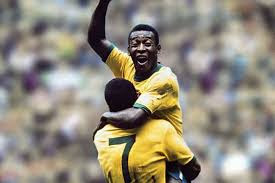
Pele, Jairzinho, Socrates, Ronaldo, Rivaldo, Ronaldinho, Neymar, Garrincha. The names just roll effortlessly off the tongue. Anyone who's a fan of football will know that Brazil, the world's most successful international side ever, seem to have an endless supply of absolutely incredible football players. But what could I get by reading about them that I couldn't get by watching them play?

I've had Alex Bellos Futebol - The Brazilian Way Of Life winking at me from my bookshelves for quite a few years now so it was finally time to get it off the shelf, dust it down, and give it a bloody good read and find out. I'm glad I did because it's an absolutely brilliant book. You don't have to be a football fan to enjoy it but if you are you will enjoy it even more. It's passionately written, full of little feints and jinks, and carries with it the weight of history. In that it's not unlike the Brazilian football team itself.

Written in the two year run up to Brazil winning the World Cup in 2002 (beating Germany 2-0 in Yokohama, both goals scored by Ronaldo) for the fifth time (still more than any other nation) it tells the story of football in Brazil since the arrival of the 'violent British sport' in the port of Santos in 1894. It doesn't just stay in Brazil. The story of Brazilian football is told all around the world and Bellos takes us from the small village of Toftir on the Faroe Islands to Manaus in the Amazon and Helsinki and, inevitably, to Copacabana beach, the Sugar Loaf Mountain and the Maracana stadium in Rio de Janeiro.

It follows football from its arrival in Brazil with Charles Miller, when it was a "nice little game" played by expat railway and gas employees ("it gives them great satisfaction or fills them with great sorrow when this kind of yellowish bladder enters a rectangle formed by wooden posts" wrote a 19c journalist) and on to World Cup victories  in 1958, 1962, and 1970 via twenty-a-side games, people kicking oranges - or bundles of socks - or coconuts - and on to the founding of Fluminense (Rio's first club) and Brazil's eventual emergence as the world's dominant footballing nation.

There's a whole chapter, The Fateful Final, given over to Brazil losing out to Uruguay in the 1950 World Cup (a cup whose final stages were played out in a group stage!). The defeat, watched by over two hundred thousand spectators, was seen as a disaster and was even compared to Hiroshima! It was their Waterloo, their Gotterdammerung, the goalkeeper Barbosa was sidelined and (often racially) abused for the rest of his life (despite being voted best goalkeeper of the tournament). In Brazil, it's pored over far more than any of the World Cup finals they actually won. There's even a word just for it - "maracanazo". Argentinians, as much as Uruguyuans, love to use it.

It even inspired the Brazilians to ditch their white strip and launch a competition to design a new jersey that made use of the colours of their flag. A nineteen year old illustrator, Aldyr Garcia Schlee, entered the contest for a bit of a laugh - and won it - and now everyone in the world knows exactly what the Brazilian football kit looks like. It's "possibly the world's most recognisable sporting uniform". Even if its designer supports Uruguay.

That's just one of many interesting stories that I'd not heard before. There's a whole chapter devoted to Manuel Francisco dos Santos. Better known as Garrincha. It talks of his incredible skill (Brazil only ever lost once with Garrincha in the side - the last game he played for them), bent knees, and his (rumoured) big dick (his 'pau grande' was apparently just shy of ten inches) which would go on to produce at least thirteen children. One of the mothers, Elza Soares, was a celebrated salsa singer making them the Posh and Becks of their era. But, unlike David Beckham, Garrincha was a troubled man. His awful driving resulted in the death of Soares' mother and that led to periods of depression, suicide attempts, and an alcoholism that would lead him to physically assault Elza and, ultimately, finish him off at the age of forty-nine.

Garrincha had been the equal of Pele and together they were formidable but as Garrincha's career petered out, Pele's was astronomically turbocharged. There was a time, in the 1970s, when Pele (who had registered his name as a trademark) was second only in brand recognition to Coca-Cola in Europe (Pele never once played club football for a European team). In 1999, two armed men held up his Mercedes but when they realised it was Pele inside they apologised. Some years later the same thing happened to Romario. Romario lost his car and phone and walked home alone.

The list of players doesn't start with Pele and Garrincha. It begins with ones I'd never heard of before stretching out into those world famous names. There's Friedenreich who scored the winning goal of the 1919 South American Championship, Leonidas - top scorer at the 1938 World Cup in France, and Zizinho - who played in that fateful 1950 defeat to Uruguay among many others.

There are some quite incredible statistics. As early as 1999 there were over 5,000 Brazilian footballers plying their trade outside of Brazil (everywhere from Vietnam to Senegal, Armenia to Haiti), there's Milene Domingues who played keepy-uppy for over nine hours (55,187 kicks) without the ball touching the ground once - she ended up marrying Ronaldo - though a footnote tells me that this record has since been beaten by one Ricardo Neves (roughly 210,000 kicks over 27 hours!),

Not just football ones. Some depressing ones too. Brazil imported more slaves than any other country (3,500,000, six times that of the USA) and was the last country in the Americas to abolish slavery (1888). Even bonkers ones. Sao Paulo club Corinthians ultras Hawks of the Faithful wave a banner at matches that is one hundred metres long and forty metres deep - it takes three hundred people to carry it! There are referees in the Amazonas region who spend weeks on boats travelling to officiate matches - as well as refs who stop the game in the middle of play so they can go for a shit, and football pitches in Manaus that are covered in stones, glass, and even bones.

Brazilians like to mix football up with other sports. It's been combined with volleyball, auto racing, and even, quite bizarrely, rodeo where during a game of football a bull is released on to the pitch. The bull doesn't chase the ball, it chases the players - and sometimes the referee. While there's nothing weird or abnormal about having a transvestite football club it does seem odd, as well as impractical, that the players play while wearing knee high boots, sequinned hotpant catsuits, and red plastic dresses.

But more than just facts, figures, and funnies, Bellos drills down into what it's like to grow up in Brazil, to live in Brazil, to be Brazilian. When he writes about the abject poverty many Brazilians live in he doesn't do it haughtily and he doesn't hector. He simply paints a picture of what life is like for many in poorer states of Brazil like Paraiba or Copacabana and how that compares to the obscenely wealthy Brazilians who live in places like Leblon in Rio.

He doesn't shy away from the racism of the times either. Black players were, initially, not allowed to join football clubs, a visiting chairman of Exeter City - M. J. McGahey - commented on how the players in Rio were as "black as your hat" and even dropped an n-bomb, black players like Carlos Alberto whitened their faces with rice powder to look more 'acceptable' and Bellos even goes on to explain how the native Americans were treated among the Brazilian football community. Many of them were simply given the name Indio

It all makes for a fascinating read, not least with the excitement of a major football tournament on the horizon, and despite some minor caveats (not least when Bellos claims that Brazilian drivers have won more F1 world championships than any other nationality - which isn;t true now and nor was it when the book was written about twenty years ago) the book is full of little gems that include a foreword from Socrates (the Brazilian footballer, not the Greek philosopher), a quote from the MPB singer-songwriter Chico Buarque as well as some lyrics from Caetano Veloso, and a section on the frankly ludicrous sport of Autoball:- football - but played by people driving cars).

There's a radio presenter who once interviewed the ball instead of the players, a female footballer who plays under the name of Michael Jackson, a children's story about a ball that falls in love with (and marries) a talentless goalkeeper, another about the composer Ary Barroso doubling up as a football commentator who blew into a mouth organ when his team scored, and a child by the name of Shampoozinho.

Obviously Brazil won't be able to entertain us during Euro 2024 but come the next World Cup - and the one after that - and the one after that (Brazil have never failed to qualify for a World Cup) - it seems likely these rich stories will only be added to. Gooooooooooooaaaaaaaaaaaalllllllllllllllll!


Tuesday, 11 June 2024

Tropical Hot Dog Night:Tropical Modernism @ the V&A.

Tropical Modernism! I like tropical things (most of them, not so keen on mosquitos) and I like modern things (again, not all modern things) so surely I'd like something called Tropical Modernism - which was the title of the show I attended with my friend Mark at the V&A on Friday. I'm also interested, and have been for a long time, in architecture so discovering the show is about tropical and modernist architecture I thought it'd be right up my street.

 Gordon Cullen - Illustration from The Architectural Review (1953)

Which it was. Not only did it look at the history of modernist architecture in, specifically, India and Ghana, but it also looked at the independence movement in those countries, Pan-Africanism, and the Non-Aligned Movement. There were nods to Le Corbusier and Buckminster Fuller as well as highlife music. The exhibition hit a lot of the right notes for me.

My only, very minor, complaint is that the show could have branched out to show other tropical countries that embraced modernist architecture. Some of Oscar Niemeyer's work in Brazil would have been nice. But there was a lot of stuff there anyway and, as with any show relating to architecture, much of it was in the form of models and diagrams. It's not that easy to bundle up the Palace of Assembly in Chandigarh and rebuild it in South Kensington.

The concept of 'Tropical Modernism' began as a British colonial diktat in the 1940s and 50s. Part of the thinking was that if the colonies were given bright and shiny new buildings and public infrastructure they'd quieten down their calls for independence. That, quite obviously, didn't happen. Modernist architecture hadn't really taken off - bar a few notable exceptions - in Britain itself so the architects Jane Drew and Maxwell Fry saw opportunities in West Africa and India and developed a distinctive style of modernist architecture that would work in hot and humid climates.

Where the story gets more interesting is when independence comes to India and Ghana (then the Gold Coast) under Jawaharlal Nehru and Kwame Nkrumah. The colonial architecture was repurposed and adapted and became signifiers of their countries progressive, up to a point, aspirations. Local architects were nurtured in both India and Ghana and tasked with creating modernist buildings and projects but with a distinctly local style.

Jane Drew and Maxwell Fry on their wedding day (1942)

Edward McKnight Kauffer - MARS Group New Architecture exhibition poster (1938)

Drew and Fry were members of the MARS (Modern Architecture Research Group) Group and that was part of the broader International Congress of Modern Architecture which had been set up by Le Corbusier. They had radical plans for redesigning cities but their plan for an almost total conversion of London obviously never got off the ground.

Walter Gropius, the Bauhaus founder, suggested this was because England was an "inartistic country". Vorticist painter Wyndham Lewis took a different approach and suggested modernist architecture was unpopular in Britain because it was "cod-liver oil to the sweet Anglo-Saxon palette". As it dawned on him he was backing the wrong horse in the UK, Gropius (who had arrived in Britain in 1934 to escape the Nazis) moved to America in 1937. Though, with Maxwell Fry, he was responsible for Cambridgeshire's Impington College during his brief time in the UK. There's a house in Chelsea too. They're both still there if you want to go and have a look.

Village College, Impington, UK (1939)

Jane Drew didn't give up as easily as Gropius. She set up her own all-female practice and participated in the V&A's Britain Can Make It exhibition in 1945, as well as designing part of the site of 1951's Festival of Britain celebrating British industry, art, design, and science and intending to lift the spirits of a country still enduring post-war austerity.

At this time her husband, Fry, was stationed in the Gold Coast. She soon joined him and they advised the British colonial government on town planning. Their designs were innovative and became known as Tropical Modernism and started to appear in Gambia, Nigeria, and Sierra Leone as well as Ghana/the Gold Coast. By 1965 all four of these countries had gained their freedom and independence.

Jane Drew and Maxwell Fry - The four countries of British West Africa from Village Housing in the Tropics (1947)

Maxwell Fry had been given a government handbook that reassured him, and its other readers, that West Africa was no longer the "white man's grave" and that malaria was now treatable. However, it didn't stop the British colonial powers from segregating themselves from the local population for fear of contacting infectious diseases. Or possibly down to plain old fashioned racism.

Drew and Fry actively dismissed local building traditions and did not employ any African architects. A 1955 book, Britain's Purpose in Africa by Kenneth Bradley, warned that these nations were not ready for independence and suggested the belief that self-government is better than good government was a dangerous half-truth. Britain believed that building new schools in Ibadan would quieten down these ungrateful would be usurpers. Spoiler alert:it didn't.

Britain's Purpose in Africa (1955)

Patrick Wakely - Design for a University College in Dar-Es-Salaam in Tanzania, fifth year thesis project (1962-63)

Ashanti stool (early 20th century)

Things changed - slowly. In 1954, the Nigerian student Adedokun Adeyemi complained that the training he'd received at London's Department of Tropical Architecture was inadequate and left him unprepared for work in West Africa. Within a few years most of its students were from the now independent former colonies but there was still a western bias in place. Not least in the fact that the different cultures of Western Africa were being treated as one homogenous whole.

The modernist art aesthetic of the early 20th century had heavily borrowed from African art. Not least the likes of Picasso and Eduardo Paolozzi who taught alongside Drew and Fry at the Department of Tropical Architecture. Paolozzi used African masks but stripped them of their cultural and ritual significance. For him, it seems. these things just looked cool.

In Western Africa, and in India, things were changing. Kwame Nkrumah, Ghana's first Prime Minister, took inspiration from the Indian anti-colonial activists Mahatma Gandhi and Jawaharlal Nehru and implemented his own Positive Action campaign. Between 1957 and 1967, two thirds of the countries of Africa won their freedom from the European colonial powers.

Ghana and India became founding members of the Non-Aligned Movement and adapted a policy of neutralism. They along, with huge numbers of other nation states from across Africa, Asia, and Latin America would refuse to take sides in the Cold War between the USA and the USSR. They would also support freedom struggles from other countries still under the grip of colonialism.

Nehru and Gandhi (1940s)

Unknown photographer - Mahatma Gandhi during the Salt March (1930)

Unknown artist - Portrait of Nehru, Gandhi and Vallabhbhai Patel (about 1948)

Demonstration against the handling of the Gold Coast riots, Trafalgar Square (1948)

Unknown photographer - The British colonial secretariat (1940-50)


John Harrison - Community Centre, Accra (about 1953)

In Accra, Ghana's capital, a community centre (designed by Drew and Fry) was built by the United Africa Company to restore their reputation after being accused of price fixing. Rioters burned down their headquarters in 1948. A mural on the building's side, by the Ghanaian artist Kofi Antubam, included a phrase in the Ga language which translated as "it is good we live together as friends and one people". When Nkrumah took over, Antubam became the country's state artist.

Ghana, it seems, was too small for Nkrumah. In 1958, Accra hosted the first Pan-African gathering where Nkrumah argued for a Pan-African federation and popular slogans included "Hands off Africa", "Down with Imperialism and Colonialism", and "Africa Must Be Free". In some ways, it seems that Nkrumah envisioned a United States of Africa.

Much of the early criticism of Nkrumah revolves around the idea that he was a "good African" but a "bad Ghanaian"! In India, the violent partition (that resulted in an estimated one million deaths) of the Punjab had ended up with Lahore becoming part of Pakistan so the Indian Punjab needed a new capital. Nehru planned for the city of Chandigarh to be built and become that capital and, as he perceived modernism to be an international style with no colonial baggage, no lesser a name than Le Corbusier - along with the seemingly ubiquitous Drew and Fry, was employed, along with local Indian architects, to work on it. Nehru was, in his words, building "temples of Modern India".

Before Chandigarh, no other modernist city anywhere in the world had been built from scratch. Its architecture was very much a reaction against New Delhi which had been built, mostly by Edwin Lutyens, to represent imperial power. Nehru said Chandigarh would be "unfettered by the traditions of the past" and that it would be "an expression of the nation's faith in the future".

Nehru insisted Le Corbusier employ Indian staff when working on Chandigarh and that the site should act as a "living school" for Indian architects and builders. A short film shows us that health and safety priorities were not high on the agenda back then. There's not a hard hat in sight.

Le Corbusier insisted on a strict grid for Chandigarh and put his main focus on the prestigious Capital Complex buildings leaving much of the rest of the city to Drew, Fry, and Pierre Jeanneret, Le Corbusier's often unsung cousin.

Pierre Jeanneret - Le Corbusier in Chandigarh with the plan of the city and a model of the Modular Man, his universal system of proportion (1951)

Pierre Jeanneret - Office armchair (about 1955)

Gian Rattan Singh - Scale model of the Tower of Shadows, Chandigarh (1957)

Aditya Prakash - Axonometric section for Tagore Theatre (about 1960)

Aditya Prakash had trained in London and Delhi and he joined the Chandigarh team in 1952, working on housing and a hospital. He had mixed feelings about Le Corbusier who he said treated the Indians like "uninitiated children" but also giving him credit for helping them to realise their own country.

Prakash developed his own take on modernism and in 1961 completed the Tagore Theatre in Chandigarh, celebrating the centenary of the birth of the Bengali poet and playwright Rabindranath Tagore. With its impressive acoustics and clear sightlines, it was a huge success.

Other Indian architects and designers, like Habib Rahman (who had trained in America under Walter Gropius) and Nek Chand, got involved. Rahman designed a memorial to Gandhi near Kolkota (then Calcutta) and Chand created a "secret kingdom" of over two thousand sculptures which was hidden in a forest near the centre of Chandigarh. Chand wasn't a fan of Le Corbusier and considered his work to be a critique of Le Corbusier's modernist grid.

Nek Chand - Rock Garden sculptures (1960-90)

Marjorie Shoosmith - Sir Edwin Lutyens and his team presenting a model of the Viceroy's House to the Viceroy (1931)

Promotional poster for the film Tere Ghar Ke Samne ('In Front of Your House') (1963)

Nehru's passion for modernism found its way into Indian popular culture. Vijay Anand's 1963 film Tere Ghar Ke Samne tells the story of an architect who returns to India from America and builds identical modernist houses for two feuding neighbours. Unsurprisingly, Chandigarh featured in the film.

Achyut Kavinde was another who'd trained under Walter Gropius. He returned to India in 1947 and by the 1960s was designing buildings like the Indian Institute of Technology in Kanpur, Uttar Pradesh that took Gropius and the Bauhaus school as their starting point but expanded to become almost miniature cities and incorporated more local architectural styles. Not least in dealing with the climate. Kanpur gets very very hot. It's actually 42 degrees there now as I write this.

Randhir Singh - Indian Institute of Technology, Kanpur (2021)

Kayinde was at the forefront of a new generation of architects and architecture schools that soon began to emerge across India looking to foster a distinct and specific Indian modernism. A National Institute of Design was established in the Gujarati city of Ahmedabad following recommendations from American designers Charles and Ray Eames, the architect Balkrishna Doshi (who'd worked in Paris with Le Corbusier) supervised his former boss's buildings being constructed in that same city but later came to see the buildings as being "foreign and out of milieu" and moved his energies towards his students who he got to conduct studies of rural villages and India's architectural heritage in looking for solutions to climate and housing concerns.

Doshi's campus included open spaces for teaching and aimed for a non-hierarchical atmosphere whereas Le Corbusier's parts of Chandigarh discouraged mixed income neighbourhoods. Doshi wanted to celebrate India's vitality and bring people together. A street view of his Aranya Housing plans gives us an idea of what Doshi was hoping to achieve.

Aditya Prakash was also displeased with some of Le Corbusier's ideas - again. Prakash didn't like that Le Corbusier banned cows (in India!) and informal markets and considered his design to be "a place for gods to play, it's not for humans". He developed his own design for a 'linear city' with green spaces (good) and elevated roads (not so good, put the cars underground in a tunnel and leave the city for pedestrians, cyclists, and electric trains).

Balkrishna Doshi - Street view of Aranya Housing (about 1989)

 Aditya Prakash - Sketch perspective for Linear City, Chandigarh (about 1975)

When Nehru died in 1964, modernist architecture didn't stop in India but lived on in large scale, expressive, constructions. The architect Raj Rewai, in 1972, completed a vast complex of pavilions in New Delhi to celebrate 25 years of independence. The truncated pyramid which was part of the complex was the world's largest concrete 'spaceframe' and was inspired by the work of Buckminster Fuller (who would go on to lecture students in Ghana). They were opened by Nehru's daughter and then Prime Minister Indira Gandhi.

In recent years, however, the rise of Narendra Modi and his aggressive Hindu nationalism has seen India turn its back on the ideas of being a progressive and modern society. Rewai's pavilion was demolished in 2017 and replaced with a corporate campus. Nationalists and populists, despite arguing to the contrary, rarely care about the artistic legacy of the countries they seek to lead.

Two interior views of the Hall of Nations (1970-74)

Model of the Nehru Pavilion (1971)

In Ghana, Kwame Nkrumah was inviting Ghanaian architects back from America to work in Ghana but he was also becoming ever more focused on the Pan-African movement. For Nkrumah, the independence of Ghana was meaningless unless linked to a 'total liberation' of Africa.

To celebrate the African, or Ghanaian, culture he was so proud of he wore traditional Ghanaian dress on the world stage, set up an architectural school for local architects, and oversaw a visit to Accra by Muhammad Ali, Malcolm X, and Maya Angelou. It was hoped that Ali would make Ghana his permanent home and he was even presented with four plots of land to use if he wished to do that. Which, it seems, he didn't.

Kwame Nkrumah on the cover of Drum magazine (1957)

Article about Muhammed Ali's African tour from Ebony magazine (1964)

Commemorative cloth designed for Ghana's Independence Day celebrations (1967)

Nkrumah commissioned the building of Black Star Square, a parade ground built in Africa on former colonial playing fields, and called up a local architect, Victor Adegbite, to head up the project. New schools and hospitals were constructed and a manufacturing city, Tema, was built - modelled on Chandigarh which handily pulls the two parts of the exhibition together.

Heading up the architectural team behind Tema was Theodore Shealtiel Clerk, another Ghanaian architect who had trained in Edinburgh. Clerk was, at that time, the country's only professionally qualified architect so it's maybe less of a surprise than it should be that British architects should be involved in the design - including our old friend Jane Drew.

Despite relying on former colonially and paternalistic minded experts, Nkrumah continued elsewhere in his mission to decolonise Ghana. He commissioned the National Museum of Ghana to display the country's artistic heritage and he promoted highlife music from the likes of E.T.Mensah. He even published multiple books. For example 1968's The Spectre of Black Power.

Michael Hirst - CEO House, Tema, designed by Jane Drew (1950-59)

Members of the Professional Uhuru Dance Band wearing fugu, a traditional smock from northern Ghana (1963)

Kwame Nkrumah - The Spectre of Black Power (1968)

E.T.Mensah and his Tempos Band (1969)

James Barnor - A shop assistant at the Sick-Hagemeyer store, Accra (1971)

KNUST students - Geodesic dome from KNUST (about 1964)

MDM Props Ltd (after an original by Nicola Cataudella) - Statue of Kwame Nkrumah (2023, original - 1958)

Ultimately, Nkrumah's plans were too ambitious and the power, like so many before and after him, went to his head. He was deposed during a coup in 1966 and statues like the original of the one above were pulled down and the arms pulled off. 

Nkrumah had overseen bold and progressive projects in Ghana, as Nehru had done in India, and later mistakes and abuses of power (imprisoning political opponents without trail, declaring Ghana a one-party state) perhaps shouldn't completely ruin that legacy. There's an interesting film that ends the exhibition and also some open ended questions about the future of Tropical Modernism. It would be great to think this style of architecture can continue, prosper, and develop in new directions and I don't see any reason why it can't. If the likes of Nkrumah and Nehru could wrest it, and adapt it, from the blueprints they were given by their colonial rulers then why can't contemporary architects and designers move it in yet another new and interesting direction? Time will tell but, for me, this was a highly enjoyable and educational exhibition.

Thanks to Mark for joining me at this enjoyable, and illuminating, show and for a very pleasurable debrief in The Anglesea Arms afterwards.

Thursday, 6 June 2024

Fleapit revisited:The Beast.

Paris 2044, the streets are almost completely empty and everybody wears some kind of plague mask. It looks, of course, like the height of the Covid lockdown but it's never specified why people are either at home or wearing masks. Perhaps there just aren't that many people left. At some point in the previous twenty years something very bad has happened, or maybe several bad things, and it seems humanity as only survived thanks to the intervention of AI.

The payback for this seems to be that AI is now running things and people are considered by their new robot overloads as "useless" unless they have undergone a 'purification' process which erases them of all their negative emotions. Which might sound good but it also erases all emotions, all feelings, all humanity - which doesn't sound so good.

Bertrand Bonello's new film The Beast (La Bete in French, and based -  very loosely one imagines - on Henry James' 1903 novella The Beast In The Jungle) introduces us to the young, attractive, and intelligent Gabrielle Monnier (Lea Seydoux) who is stuck in a dead end job because she is reticent to undergo the purification process for fear of losing what it is that makes her herself.

Her best friend is an unboundaried human size doll given life called Kelly (Guslagie Malanda) and when Kelly and Gabrielle visit a club to dance (in 2044, there are themed clubs where you experience 1963, 1972, 1980, and - one assumes - a whole host of other years) she meets with Louis Lewandowski (George MacKay) whom she feels a bond, and an affinity, with.

But nothing physical or romantic happens between them because Gabrielle is bedevilled by her overwhelming belief that a truly terrible thing will happen in her life. She doesn't want to drag Louis into that so retreats further into her lonely and unfulfilling existence.

When she finally resigns herself to the purification process, something she continues to have grave doubts about, she is taken back to two previous lives. One in Paris 1910 where she is a successful pianist married to doll maker Georges (Martin Scali) and one in 2014 where she is trying to make it as a model or actress in Santa Barbara and house-sitting an impressive looking, though spookily empty, modernist pile.

Apart from her name, there are two other things that don't change when she visits these past lives. Firstly, in each of her incarnations she is weighed down by her belief that something terrible will happen - she calls it The Beast and it's what gives the film its name - and, secondly, each time she meets Louis. In Paris 1910 he's a courteous admirer and in 2014 he's an incel intent on retribution on women because, at the age of thirty, he has never had sex, kissed, or even held the hand of a female.

As we slowly work out what these past lives have done to the 2044 version of Gabrielle we are introduced to regular motifs that come to symbolise her fears and anxieties. There are pigeons, eyes, creepy dolls, floods, fire, and not particularly well performed karaoke versions of Roy Orbison's Evergreen. The more over-riding themes of the film include how we process trauma, how we deal with our negative emotions, how we protect ourselves from love because we fear it, and what does it mean to be a human if there is no humanity left.

It's not always an easy watch - and I certainly wouldn't recommend it to everyone, it can sometimes get a little indulgent, and it's confusing in places - though that sorts itself out rather majestically as the film plays out. The performances are top notch, there are some genuine jump scares, and though it reminded me in places of Yorgos Lanthimos' Poor Things, Spike Jonze's Being John Malkovich, and even some episodes of Charlie Brooker's Black Mirror, it is, ultimately, a hugely original film and one I couldn't stop thinking about, and even identifying with, as I walked back from the cinema. We all have our beasts. It's up to us if we feed them or cage them.  


Wednesday, 5 June 2024

Shithole Itinerary III:The Misadventures of Romesh Ranganathan S4.

The fourth series (but the third blog, for some now forgotten reason I bundled up seasons two and three in one blog) of The Misadventures of Romesh Ranganthan (BBC1 - having moved over from BBC2/iPlayer) takes place entirely in Africa. Madagascar, Rwanda, and Uganda. Rom was initially going to visit the D.R.Congo but it was deemed unsafe so Madagascar was a late replacement.

It's a good watch. You can't help warming to Rom as he's likable, self-deprecating, and willing to give (almost) anything a go. First stop is Uganda where Rom asks "is Uganda all about Idi Amin?" before getting in to some Ugandan discussions (not of that sort, get that out of your head) with his guide Alex - an actual princess - though one of many thousands in the country. Landlocked Uganda is home to forty-five million people and Winston Churchill once called it "the pearl of Africa".

Its capital, Kampala, is super hectic and soon Rom is taking a boda boda (a motorbike taxi) through its busy streets and being shown around Mengo Hill and taught about the Buganda people and the Buganda kingdom. When the Brits colonised Buganda they mispronounced it as Uganda and the name has stuck. The Ugandan (or Bugandan) royal family still live in the Mengo Palace - though they're mostly ceremonial these days.

Alex talks a bit about Idi Amin and his reign of insanity and terror, there's some frankly terrifying looking white water rafting, a visit to the source of the Nile - and a statue of Gandhi, and there's lots of wildlife to be found in Uganda's various national parks:- elephants, crocodiles, and hippos being the big stars.

Oh, and there's a lot of homophobia to be found in Uganda too. The country having recently passed anti-gay legislation in which it is possible to be executed for homosexuality. Guide Alex, like many Ugandans, is conservative, traditional, and Christian, and - there's no avoiding it - homophobic. She believes men are men and women are women and that men marry women. She also believes people choose to be gay and supports the death penalty for homosexuality.

All of which, understandably, makes Romesh uncomfortable. He speaks, on the phone and with their voice disguised to protect their identity, to a member of Uganda's LGBTQ+ community who tells Rom that gay people are being accused of being child rapists and that most Ugandans are more than happy to conflate homosexuality with paedophile rape - not least because the accusations often come from highly respected preachers.

Yet more Christian hatred polluting the world. On a more positive note, Rom meets a guy called Mugabe Roberts who makes banana beer and banana gin, gets pissed on those products, does some (drunken) basket weaving, and meets with a herbalist who deals with cures for malaria and snake bites and, er, makes "sex medicine".

He also visits Idi Amin's former hunting lodge. Uganda seems a fascinating country with lots of wonderful things to see and do but the horrific homophobia that is only getting worse makes it a destination I have no intention of adding to the list of places I want to visit. Rwanda is a country many Brits, specifically the last few Conservative foreign secretaries, have chosen to visit recently but it won't be housing any migrants who arrive on British shores any time soon.

Perhaps Rom's visit would tell us a bit more about the country, perhaps we would learn if it is, or isn't, a "safe country". The problem is, however, Rom is treated to a sanitised side of Rwanda. It looks great - which I'll get to - but he's not shown, or told anything about, the rumoured human rights abuses, the crushing (with violence) of dissent, the invasive surveillance, and the death squads who are widely believed to operate in nearby countries.

All of which makes Rwanda sound like a very unsafe country. The Rwanda that guide Hyppo (!) shows Rom, however, looks not safe but almost idyllic. You can see why Arsenal (Rom's team) players have "VISIT RWANDA" on the sleeves of their jerseys and you can't deny that - previous caveats excepted - it's come on a long way from the genocide of 1994. An event that resulted in the deaths of more than half a million people - including Hyppo's own father.

Hyppo, quite understandably, gets very emotional when, on visiting a museum dedicated to the genocide, they finally talk about what was one of the most distressing events in all human history. Hyppo now writes poetry to help him exorcise his demons and since the genocide the country has banned the terms Hutu and Tutsi. Everyone is, quite simply, Rwandan.

 Rwanda, capital - Kigali, is about the same size as Wales and Rom and Hyppo visit the hotel where asylum seekers from Britain would have been housed (Rwanda already takes refugees from Burundi, DR Congo, and Afghanistan), have a pint of milk (milk is very big - and very significant - in Rwandan culture), and visit an artist's co-operative where they make rather beautiful tiles out of cow shit.

Is that what inspired Chris Ofili in his work? Rom camps in the savannah, makes friends (he always does this easily as anyone who's seen him on TV - and he's on TV A LOT - will know), and joins a group of mostly female cyclists (cycling being very popular in Rwanda). There is, also - of course, lots of wildlife:- giraffes, zebras, impala ("posh goats"), lions, buffalo, and mountain gorillas who live on, or near volcanoes.

The people, for the most part, are nearly as impressive as the animals. Rwanda has the highest proportion of female parliamentarians in the world (though it did strike me that it might be down to the grisly reason that so many men who would now be of that kind of age were killed in the genocide) and there is, as Romesh remarks, no litter anywhere.

That's because plastic bags are banned and the law dictates that every adult in the country up to and including the president must take part in a mandatory litter picking session at least once a month. It seems a good law - and maybe it would make people think twice about littering in the first place - but imagine somebody trying to introduce it to the UK. Good luck with that.

I know less about Madagascar than I do Uganda and Rwanda. In fact most people know more about the film Madagascar than the country. Some will be disappointed that it's not home to a zebra that talks like Chris Rock and a giraffe that talks like Ben Stiller. In fact neither zebras or giraffes are native to Madagascar. It's got its own thing going on wildlife wise which I'll get to soon.

The former French island is the fourth largest island on Earth (behind Greenland, New Guinea, and Borneo) and it's not an easy place to get around. It's a good job Rom's guide, a diving instructor called Bic, is so friendly as they end up taking some very very long car journeys together. Taxis for long distance journeys don't seem wise if the driver we see hotwiring his own car is anything to go by.

Madagascar's chaotic capital, Antananarivo, is home to more than three million people. Many of whom, it seems, like to enjoy a soup made from a zebu's penis. A zebu is a type of cow but it's very much the Dirk Diggler of the bovine world, having an average length penis of one and a half metres. You can make a lot of the soup with that - but I wouldn't try. I'm quite glad to be a vegetarian.

Bic takes Rom to visit the Rava, the palace of the mad and cruel Queen Ranavalona I (reign:1828-1861). She bathed in bull's blood, slaughtered thousands of Christians, and threw her political enemies from the top of a cliff to their deaths. It is estimated she was personally responsible for the death of over two and half million people.

Away from capital, and the blood curdling tales of Ranavalona I, the country is vast, wild, and poor. There are bandits but there is also much beauty. The needle like rocks of the Grand Tsingy are stunning, there are extraordinary baobab trees, pristine sandy beaches, and impossibly cute lemurs which, rather worryingly, we learn that some people still (illegally) eat. People who don't fancy eating a zebu's cock perhaps.

There is fine dining - neither lemur nor zebu penis - to be had in Belon'i Tsiribihina's Mad Zebu restaurant, there are multiple ferry rides - including one in which a snake is an uninvited stowaway, there's a launch of a schooner (which is such a big event that there's a party to celebrate), and there's a story of a tribe who believe twins to be a sign of bad luck and are so sure of this belief that infant twins are left in a yard with a zebu until the zebu crushes one of the babies to death.

It's a grim story to end the trip to Madagascar, and the whole African tour, with - and it's certainly not one you can see DreamWorks incorporating into any future Madagascar films - but it's not really typical of Madagascar which seems a friendly, if terribly poverty stricken, place. All three countries had amazing things to see and it'd be nice to visit Rwanda and Madagascar as a visitor (not so Uganda for reasons outlined above) but I don't think they'd be easy places to live in and I certainly don't think any of them - and Rwanda in particular - would be suitable places to send some of the world's most vulnerable asylum seekers. But we don't have to worry about that anymore. That plan is as dead as one of Queen Ravalona I's enemies.