
 Posts


As we walked through Hampstead Garden Suburb yesterday afternoon, I saw Pam pull some Factor 50 sun cream from her bag and apply it judiciously. Not long before that we'd been sat in the beautiful beer garden of The Spaniard's Inn and not long after that the blue skies that shined down on the expansive green spaces of the Hampstead Heath Extension almost belied the fact that only a few hours before that London has been experiencing something of a biblical downpour.

One that was so heavy and wet I almost cancelled, or at least postponed the walk. One, I know, that put some people off from coming and one that, even some of those who did come, thought very seriously about taking a 'rain check'. I'm glad I didn't postpone and I'm glad that Pam, Mo, Shep, Valia, and, for the first time in LbF history, Dave F, were able to join me.
Because it turned out to be a rather lovely day spent in a variety of, often hilly, terrains, looking at interesting things, walking around 30,000 steps (mileage varies dependent on leg size), stopping for drinks, sandwiches, and curries, and looking at a selection of what I think we can all agree proved to be interesting and unusual things.
Best of all, it was done in delightful company. I'd taken the Overground to Canonbury, changed there for Gospel Oak, and arrived very early. As I waited for, first, Pam, then Dave, Mo, and Shep the rain, slowly but surely abated and, eventually, stopped. The grass was wet and the rain would make a (very brief) return but for the rest of the day the sun was either out or doing its damnedest to be so.


The five of us departed Gospel Oak along Mansfield Road and, after passing under two railway bridges, we turned left into Parliament Hill and its rather magnificent lido - a place I've yet to enjoy a swim (although I have swam often in Brockwell Park Lido which, like Victoria Park Lido, shares an almost identical design).
The now Grade II listed Lido was opened in 1938, designed by Henry Rowbotham and TL Smithson, and is 61 metres in length. It is, as you may well know and we would soon discover, not the only place you can swim on Hampstead Heath,


There was, of course, no time (or inclination) to stop for a swim so we carried on up and into Parliament Hill itself to a pleasant little cafe where Valia met us (living a short walk away she'd been able to avoid public transport altogether). After everbody had been introduced, I ordered a tasty basil, mozzarella, and tomato sandwich (I mostly picked out the tomatoes) and a can of Coke but it was eclipsed by Pam's pesto soaked bread effort.
We carried north and upwards, past posters for gigs by Culture Club, James, Rag'n'Bone Man (each to their own), and, probably best of all, Rodigan, past the Stone of Free Speech, and towards Highgate No 1 Pond, one of about twenty ponds on the Heath - many of them former reservoirs that feed the river Fleet - an underground London river that emerges into the Thames near Blackfriars Bridge. At the top of Highgate No 1 Pond we turned between it and the Highgate Men's Bathing Pond (only a brace of brave swimmers in the water on, at this point, wet and windy day) and then past the Model Boating Point.
It, too, quieter than you'd expect of an August Saturday. The next pond up was the Bird Sanctuary Pond (Shep remarked of this, and the others, that it was surprisingly free of waterfowl - just the odd specimen) and then the Kenwood Ladies' Bathing Pond - currently closed.


Various follies briefly diverted our attention. An obelisk and an ornate fountain particularly. Then the sky opened up again and I feared, incorrectly as it turned out, that our walk would be ruined or cut short by the rain. I certainly worried people would say they'd had enough and either go home or drag me, admittedly willingly, into the pub for a ruinous session.
It was not to be. Just south of the Stock Pond, covered by a canopy of trees, we waited and in the time it took me to read my first few prepared paragraphs of spiel the rainfall had pretty much stopped. Apart from a few drips and drops that is how the rest of the day would remain and I was thankful. A TADS walk that had planned to take in Hampstead Heath in 2018 had been cut short by inclement weather and though that did turn into seriously drunken fun I wasn't keen on a repeat. I like Hampstead Heath. I wanted to show it off. Shep had never been there before. Pam was barely familiar.


Mo had a bit more knowledge, Dave had done plenty of lockdown walks around the area, and it's Valia's local 'park' (which is just rubbing it in - me, her, and her friends had seen the new year in atop of Parliament Hill back in 2018/9). Hampstead Heath first entered the record books in 986 when Ethelred the Unready granted one of his servants land in what was then called 'Hemstede'. A century later, the Domesday Book records the land as being owned by the monastery of St Peter's at Westminster Abbey and in 1133 it fell into the hands of a man named Richard de Balta.
During Henry II's reign (1154-1189), the whole of the manor was privately owned by his butler, Alexander de Barentyn and it stayed in private hands until the 1940s. Since when it has been decreed, and enjoyed as, for the most part, common land. When Karl Marx lived in London, Hampstead Heath was a favourite destination for family outings.
We continued upwards and, unfortunately, missed Athlone House, formerly Caen Wood Towers. A large Victorian house that has been the residence of several prominent industrialists (Francis Reckitt, Sir Francis Cory-Wright, and Sir Robert Waley Colen), an RAF station (during World War II), and a military hospital. In 2016, the Russian oligarch Mikhail Fridman bought the house for £65,000,000.
Kenwood House, one imagines, would cost even more. It looks spectacular, wedding cake white with prominent views of the Wood Pond and beyond to the rest of the heath - and inside there are paintings by Rembrandt, Vermeer, Turner, Gainsborough, Van Dyck, Reynolds, and George Romney. As well as collections of jewellery and shoe buckles.
Niches. The gardens, designed by Humphrey Repton, are festooned with sculptures by luminaries like Barbara Hepworth, Eugene Dodeigne, and, below, Henry Moore. The films Notting Hill (1999) and Sense and Sensibility (1995) were filmed in and around Kenwood House but its history dates back to the 17c when it was built as a residence for the Earls of Mansfield.


Remodelling in the 18c came courtesy of Robert Adam and there is now an orangery added to the ensemble. We had a look at the Moore, walked through a broad, pretty, tree lined avenue and, almost immediately, took a wrong turn.
Hampstead Heath, in its wooded area, is much like my brain. Each path splits into two, three, four, and five before doing so again. Sometimes they link up, sometimes they take you in useful directions, sometimes they lead to dead ends, and sometimes into muddy puddles that benefit nobody. It's hard to negotiate and soon I relied on the blue dot of my phone's GPS. When Kazimir Malevich imagined his Black Square painting of 1915 as a modernist version of a religious icon he was on to something but the trick he was missing was it should have been a blue circle. We were all in debt to it as it lead us out of the maze of rather attractive trees and on to Hampstead Lane.


Which, soon enough, it did. If a little further south on that road than I had intended. We got a sneak preview of our next pit stop, The Spaniard's Inn, before turning into Winnington Road. A wealthy, and lifeless, avenue of mansions for the mega-rich. Porsches and other upmarket vehicles were parked outside and one property even had a guard (armed or not, we weren't sure but I didn't risk a snap) outside. Some made do with fierce looking dogs.
It struck me as a soulless existence of luxury. Shut away from the outside world and so terrified that somebody might take even the smallest amount of your vast wealth away from you that you are virtually unable to enjoy it.
When we turned into Holne Chase, Meadway, and Lichfield Way things became far more tasteful. Still clearly a wealthy area but one that didn't feel the need to shout so loudly about it. Less garish, less ostentatious. This was, of course, Hampstead Garden Suburb.


Pam, Shep, Ian, and myself had passed through it recently on a leg of our Capital Ring and I instantly recognised the red bricks and manicured hedgerows. There's not a lot of shops, bars, or restaurants though - or, it seems, anything else to do. Not even many people knocking about. Perhaps they were all inside their nice houses or looking after their lovely gardens.
Henrietta Barnett, the social reformer, educationalist, and author, founded Hampstead Garden Suburb (as well as Whitechapel Art Gallery and Toynbee Hall) and appointed Rotherham's Raymond Unwin as the architect for the new, large, development. The brief was that it should cater for all classes of people and income groups (that may have been true once but is patently not so now), that roads should be tree lined and wide (tick), that housing should be low density (tick), that it should be quiet with no church bells (I didn't hear any), that woods and public gardens should be free to all (we tested this quite thoroughly and found that to be the case), and that houses should be separated by hedges rather than walls which even the most cursory glance will confirm was successfully implemented.
There's been more than a few famous people choose to make it their home. Nowadays, Hugh Laurie, Harry Styles, Jonathan Ross, and Robert Winston call it home and in the past the list was even more extensive:- Robin Day, Noel Edmonds, Vanessa Feltz, Harold Wilson, Rachel Weisz, Peter Mandelson, David McCallum, Vikram Seth, Ringo Starr, Jerry Springer, Sir Ove Arup, Constantine - the last King of Greece, Charlie Chester, Bruce Kent, Robin Day, Eric Coates, Tony Hancock, Heather Mills, Donald Sinden, Will Self, and Evelyn Waugh - and that's just a sample.


We continued up on Northway and through Northway Gardens alongside the Mutton Brook, a tributary of the Brent, before passing through the strangely named Big Wood (it's not that big compared to the nearby Heath though it is, to be fair, a wood - one where it is said they once grazed elephants).
This brought us to the impressive architectural set piece that is Central Square. The first building we noticed was the Henrietta Barnett School, looking like a piece of civic Americana and certainly looking smarter and cleaner than any school I was ever unfortunate enough to attend.
The square is bookended by two rather lovely, steep roofed, churches both designed by Edwin Lutyens. As the man who designed New Delhi, these are unlikely to be his most ambitious projects but they were each impressive. Both built in 1911, the first we encountered was the Free Church of Hampstead Garden Suburb with a low concrete dome which contrasted with the towering spire of St Jude's which serves as the parish church of the area. It would appear these churches seem to serve two different denominations but further research suggests lines are more blurred than that.


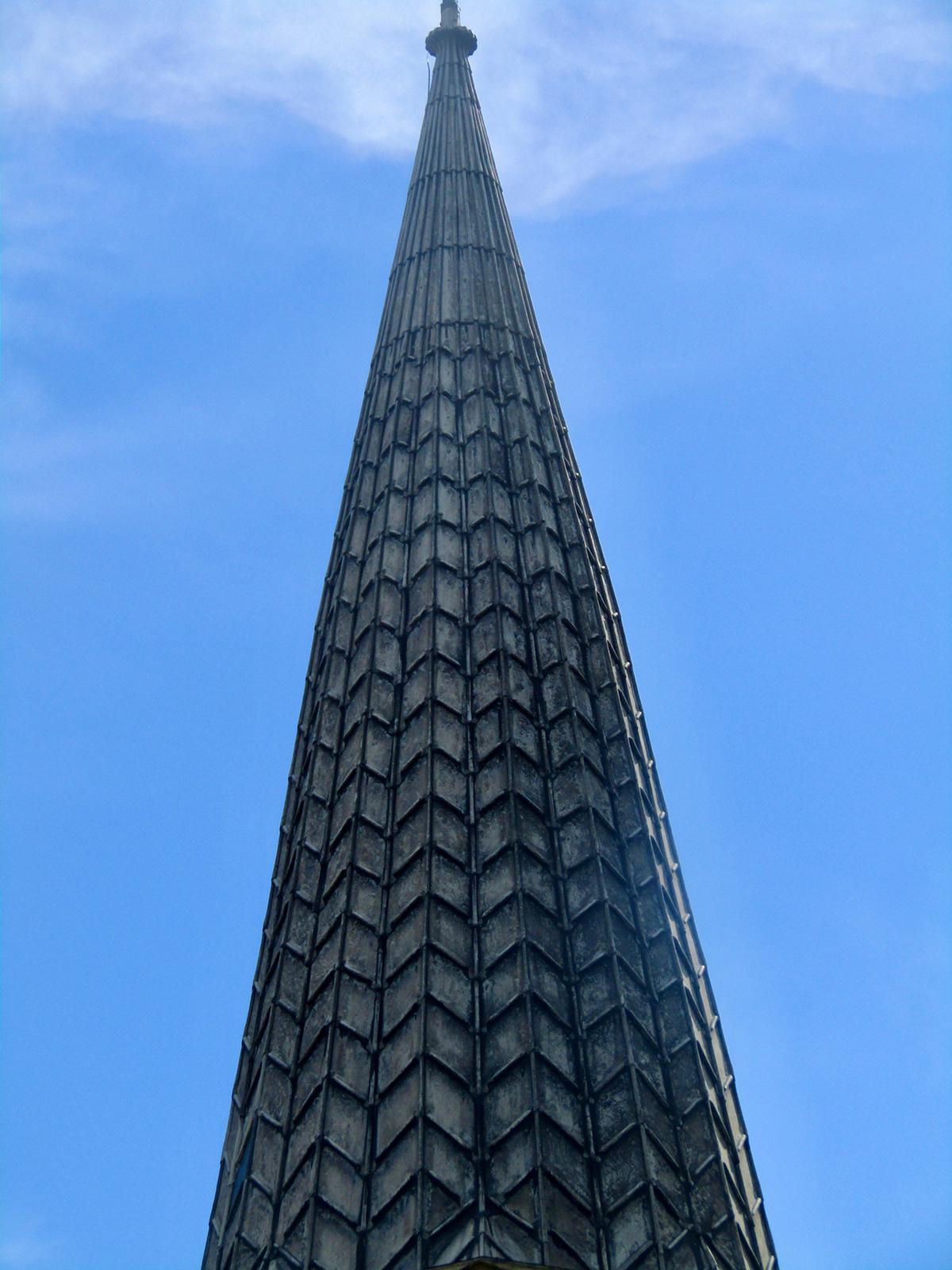


Either way, on a now resplendently sunny day they looked great. As did the flowers of nearby gardens and the open green spaces of the Hampstead Heath Extension which we'd soon be passing through on our way back to The Spaniard's Inn. A walk which seemed to be uphill - as most of the day, for some unfathomable reason, did.
Arriving back on Hampstead Road we passed different sides of the toll house (this is the borough border, the toll house is in Camden, the pub in Barnet) and settled down, as John Keats must have done many times, in the garden for a round that consisted of three beers (I had a delicious pint of Timothy Taylor Landlord) and three soft drinks.
John Keats is said to have penned 1819's Ode to a Nightingale in the pub garden so I read a few lines ("My heart aches and a drowsy numbness pains my sense, as though of hemlock I had drunk or emptied some dull opiate to the drains. One minute past, and Lethe-wards had sunk") to see if anyone recognised it. Nobody did.
The Spaniards', another Grade II listed building, is believed to have been built back in 1585 and Dick Turpin, whose father was the landlord, was once, unsurprisingly in the circumstances, a regular. The pub is mentioned in Dicken's The Pickwick Papers and in Bram Stoker's Dracula. As well as Keats, Byron and the artist Joshua Reynolds have helped prop up the bar.


It's a lovely place and it would be nice to have stayed a bit longer but we were on a walk and we still had things to see - at least five of us. Valia, who'd been out to 2am the previous night, headed home and we wandered back on to the Heath and to the Viaduct Pond. We crossed over it and then passed down alongside it to admire both the picturesque viaduct and pond itself - and a nearby heron.
A very beautiful place. We carried on to the Vale of Health Pond and into the peculiar hamlet named Vale of Health itself. A hamlet entirely enclosed by the Heath, full of pretty bohemian houses with spectacular views. Both the Bengali polymath Rabindranath Tagore and the novelist D.H. Lawrence had once called it home - and blue plaques testify to this history. There are white and blue houses with peeling paint, dinky pink houses, and ramshackle bohemian dwellings.


I loved it - and I will never ever be able to afford to live there. Returning to Hampstead Lane via some windy and steep paths, we came face to face with Jack Straw's Castle. Now under repair, I whipped out another sheet of A4 and explained how it was named not for Tony Blair's former Home Secretary and right honourable member for Blackburn but for the 1381 Peasants Revolt leader, and ally of Wat Tyler, Jack Straw who took refuge on the site before his execution.
It is now Grade II listed, what isn't round here?, and when it was a pub was a regular haunt of Charles Dickens (who enjoyed a "red hot chop for dinner" and "a good glass of wine") as well as William Makepeace Thackeray and Wilkie Collins. Fictional drinkers imbibed there too. In Dracula, Professor Van Helsing and Dr Jack Seward took repast there during a gap in local vampire hunting.
Jack Straw's Castle, like Kenwood House et al;, is impressive but it is, for my money, Inverforth House (or 'The Hill') that takes the Hampstead biscuit. On North End Way, we turned down a track and entered the back garden. Full of walkways, whimsies, quirky statues, architectural follies, and a pergola - and a man drinking a large bottle of industrial strength cider. Probably not his first of the day.


It's a stunning area, almost reminds me of Portmeirion, full of antique streetlamps, bridges, ponds, views, and an overwhelming sense of WTF! It seems remarkable that the product that caused its owner to amass such incredible wealth was such a humble one - soap!
Built by architects Grayson and Ould in the Queen Anne style of English Baroque in 1895, Inverforth House was home to the Bolton born William Lever, 1st Viscount Leverhulme, from 1904 until his death in 1925 and it was during his tenure that most of the incredible additions were built.
The soap maker was responsible for brands like Sunlight, Lux, and Lifebuoy and had a rivarly, I like to imagine an intensely vicious one - one worthy of a film, with Mevagissey's Andrew Pears. We wandered the gardens briefly before repairing to another one of Hampstead's many celebrated hostelries - The Old Bull and Bush.


Grade II listed, natch, it became a pub in 1721 and William Hogarth was known to frequent it. But its greatest claim to fame is its use in Australia born music hall star Florrie Forde's version of an American beer hall song, Down at the Old Bull and Bush, in Edwardian times.
"Come, come, come and make eyes at me down at the Old Bull and Bush. Come, come, come drink some port wine with me down at the Old Bull and Bush" sang joyful and inebriated cockneys holidaying in Hampstead to escape the smog of central London in that era. It's a more genteel affair these days with comfy sofas and tasteful music. I took a London Pride (well, I had to), we had a nice chat, and we headed off for some food.


I'd hoped to book the vegetarian Indian restaurant Woodlands which I have used on a few pleasant occasions before but it turned out it was no more. So, instead, we headed through central Hampstead, past more lovely looking pubs, to the Shahbag Tandoori - an Indian restaurant that has been there since the fifties so one we felt fairly confident would be good. I like to imagine that when George Michael crashed his car into the branch of Snappy Snaps next door he was overwhelmed by the smell of delicious curry but I suspect other aromas were responsible.
Shahbag did not disappoint. Cold, sharp Cobras, crisp warm poppadums with lime pickle, raita, and mango chutney warmed me up for a perfectly spicy paneer jalfrezi and a chapati. I can't recall what everyone else had though at least two others took the paneer jalfrezi. Service was friendly and prompt and if it cost a few quid more than normal it was worth it. It rounded off a rather smashing day.
We all walked back to Hampstead tube and took various Northern line trains to our connections. Mine was a 63 bus from Elephant & Castle. When I got home the men's marathon from the Tokyo Olympics was on. I tried to stay up and watch it. I lasted about ten minutes before I fell into a deep, and pleasant, sleep. My legs were full of walking and my belly was full of paneer jalfrezi. My mind too was content that a day that could so easily have been a failure had gone so well.
Thanks to Pam, Dave, Mo, Shep, and Valia for joining me for this walk (and not letting the weather forecast put them off) - and thanks to Pam for some of these snaps (and Mo for the maps). In two months time, we're heading west for the next LbF walk. One that leads from Strawberry Hill to Acton and one I'm calling In the Shadow of the Castle of Otranto.


