Friday, 29 May 2020

Isolation XX:Anarchy In The UK.

"I am an anarchist. Don't know what I want but I know how to get it. I want to destroy the passer-by" - Anarchy in the UK, The Sex Pistols.

My mate Rob Uriarte always used to claim he'd like to live in a land with no laws. It was a contention I countered by suggesting that though some laws are, indeed, stupid - no law at all would be worse. It would give a green light for people to do whatever the fuck they wanted and in a land like that the greedy, the vain, the selfish, and the corrupt would prosper.


The debate was academic but now we're seeing what happens when the anarchists do take over. In the last week Boris Johnson stood in front of the nation and delivered patent, and bare faced, lies about his chief aide, or his boss, Dominic Cummings and Cummings breaking of the lockdown rules that he did so much to shape. Dominc Cummings, simply, was deemed too important to fail and if that meant the rest of us will feel depressed, upset, confused, and angry then so what? We're all insignificant plebs to them anyway.

Most of the general public were outraged by this (non) action and even Tories, the Daily Mail, and the Daily Telegraph joined the bishops, scientists, and celebrities in a chorus of condemnation until Cummings himself felt compelled to hold a conference in the Number Ten rose garden. Turning up half an hour late, like he's Guns'n'Roses or Barbra Streisand or something, just to let us know he doesn't consider us worthy of punctuality he launched into a series of blatant lies, sprinkled with the odd bit of truth to keep us arguing among ourselves, that culminated with his assertion that he went on a sixty mile drive to Barnard Castle, with his kid in the back of the car, to test his eyesight.


The equally contemptuous Michael Gove piled in to announce he had, "on occasion", driven to test his eyesight. Are people who think driving to test their eyesight really qualified to run the country? Or do they not really think that at all? Of course they don't think it. They're lying, we know they're lying, they know we know they're lying and they simply don't give a fuck.

"We did ask the government to join us but no-one was available" is now the catchphrase of Emily Maitlis and she utters it, or a variation of it, on Newsnight almost every single weekday evening. It's not because they're too busy they're not going on. It's because (a) they're shirking responsibility and (b) they don't want us to have clarity. They want us to shout and argue with each other which, of course, we're doing. I've often described Johnson as incompetent but when it comes to shifting the blame his competence is legend. Or has been. Until now.


When Maitlis, admirably, began Newsnight with a powerful debunking of the lies of Cummings she was reproached and removed from presenting the programme the next evening. The government, supported by those on the far left, would like to get rid of the BBC so the BBC, with honourable exceptions like Maitlis and her Newsnight co-presenters, are running scared from them. Just at a time they need to, and people want them to, speak truth to power.


The intention of the government messaging right now, to 'stay alert' or to 'move on', is intentionally vague and ambiguous and the daily press briefings are often handled by ministers so minor in stature that nobody's even heard of them (if it goes on long enough will we all have to take turns? Like jury service or being the school runner?) and that's no oversight either. They know they can't rationally explain why the UK is having such a disastrous coronavirus result so, as with their beloved Brexit, they're seeking to divide us.

Last Friday I had a socially distanced meet up with Simon and Ian at City Hall. Me and Ian continued on to a quieter nearby park (Leathermarket Gardens in Bermondsey). On the way we passed a pub that was, legally, open for off sales and I went in a bought a pint for each of us. Later Ian went back to buy a second round and we took them to the park to drink.


That night on the way home a bus came past and as it was almost empty (just two extra passengers on a double decker) I jumped on it. I wasn't sure if going in a pub (for less than thirty seconds) or going on an almost empty bus was right or wrong so I wrote something, rather carelessly and with the same ambiguity I've been complaining about here and on other blogs, on Facebook and it all kicked off. Some of my very closest friends, and people I hardly knew, piled in both on me and for me. Other friends wrote to me in private to say they'd have done, or had already done, the same thing.

The upshot was that nobody knows what the rules are because the government are making them up as they go along and that I apologised for my actions because retaining dear friendships is important at all times and more important than ever right now. But underlining the exchange of words was the confusion and anger that has been sewn, quite intentionally, by Boris Johnson, Dominic Cummings, and Michael Gove.

So I've not written for a while because I've been feeling down and repairing friendships and walking in the park have been my priority for this week. I've chatted to Shep, Michelle, Adam, Gary, Darren, Mum and Dad and I've met Pam for two lovely walks around Crystal Palace Park (dinosaurs, sphinxes, the lake where we both saw Pixies play thirty years ago - and ten years before we met) and Brockwell Park (baby swans) and I've played Jo's, Ian's, Owen's, and Alex and Tina's Kahoot quizzes as well as hosting (and then playing) a family one.


Music, of course, has been a salve. I had a lovely listen to Dare by The Human League in its entirety and I even offered up a few African and Latin American selections for my friend Dan's Bank Holiday special round the world show on Burgess Hill Radio. I had a chat with my mum in which she told me about ordering some Mr Kipling marzipan battenbergs and it occurred to me we're all turning into characters in an Alan Bennett monologue. Perhaps if Bennett had co-authored The Plague by Albert Camus.

It'd all be quite funny if the current UK death toll wasn't just shy of 38,000 (globally just short of 360,000) and we're possibly facing a second spike in deaths due to the government's performative incompetence in easing lockdown. Possibly a third. Almost definitely a huge recession that will only be worsened by both Brexit and these shameless scumbags staying in power and laughing in our faces at us for voting them in.

"Move on" they say. Move on from the debate about Cummings, move on from the care homes scandal, move on from the UK having the second highest death rate in the world, move on from holding the people who are to blame up to scrutiny. Don't blame us. Blame each other. Snoop on your neighbour. Shout at people in supermarkets. Do whatever. Just don't judge us politically for politcal decisions.

The one thing we all do need to move on from is Boris Johnson and his toxic, venal, selfish, and now, for tens of thousands of people, murderous form of government. We need to move on from it and move away from it. Far away from it. More than two metres.


Thursday, 21 May 2020

The New Normal:Normal People.

"Looks good, fine to me. I'm in love with my very best friend" - Sunspots, Julian Cope.

"You're acting like you've never been kissed before" - Connell.
"I haven't" - Marianne.

BBC3's Normal People was an emotionally powerful, realistic, and obscenely touching meditation on star-crossed love, on growing up, on finding one's place in society, and on the quest to find a place both in the world and in someone you love and care about's heart. You'll not be surprised to read that I cried many times during its twelve half-hour episodes


Tears of joy as well as tears of sadness. Many people whose judgement I value had been raving about the show, and all the sex and nudity in it, for a while and I even feared that with such warm praise and high expectations I'd be disappointed.

I was anything but. The drama hinges around the complex will they/won't they/will they again/won't they again relationship between Marianne (Daisy Edgar-Jones) and Connell (Paul Mescal) as we follow them from school in Sligo to university in Dublin and, as the series progresses, around various scenic locations in Europe.

Marianne is a 'spirited' and smart teenager who shuns even the few friendships she's offered at school and is on the end of constant, merciless bullying. Things are equally problematic at home in the big house she shares with her cold mother Denise (Aislin McGuckin) and her toxic brother Alan (Frank Blake).

Their cleaner Lorraine (Sarah Greene, looking far too young to be playing the mother of a teenager) and her son Connell are regular visitors and though we see lingering glances between Connell and Marianne they seem, initially, poles apart. She reads books and has no friends, he excels at Gaelic football and appears to be the most popular boy at school with his choice of the girls.


But it's Marianne he has a soft spot for and she for him. Connell's stillness soon reveals its depth. What he lacks in confidence he makes up for in spades with his compassion, his keen intelligence, and his moral fibre. It may seem odd to see a boy in his school uniform driving a car and drinking down the pub (and one of his schoolmates has even got crow's feet) but that doesn't ruin a brilliant capturing of what that all encompassing first flush of lust and young love, all love, feels like.

Directors Lenny Abrahamson and Hettie MacDonald give you a hugely realistic picture of that exciting stage of life when the future opens up in front of you in a wide vista of fears, anxieties, and possibilities. The early stages of a relationship when it's almost impossible to keep your hands off each other, when you can't stop looking at each other, when you can't stop thinking about each other.

These days I am an observer of love rather than a participant, I stand outside the perimeter fence of that territory like some cheapskate who doesn't want to pay to go to a firework display, but I still remember how love felt. I've not gone completely sour. I still love the idea of love, I still love lovers, and I still love love.


It's still painful watching people who have the keys to unlock each other's happiness instead putting each other through such pain and heartache, pushing at the boundaries of love until something has to give. The first kiss, the first drunken 'I love you', the first break up, the first make up, the tears that roll down their cheeks, the looks in their faces. It all feels so very real.

As do the often, for TV, quite explicit sex scenes (well you get to see a cock and a bush as well as Edgar-Jones's tits on multiple occasions). When Connell and Marianne fuck each other, just as when they kiss each other, it never feels pornographic. It feels intrusive that we should be sharing these intimate moments with them and that's as it should be. It gives the scenes an honesty so often lacking when directors, instead, plump for cheap titillation.

As the action moves to Dublin we see Connell struggle to fit in in a very different, pseudo-intellectual, environment while Marianne, for the first time in her life, thrives. Marianne falls into other relationships, makes friends with Peggy and Joanna (the excellent India Mullen and Eliot Salt) and moves into (another) big house with them, where they sit drinking coffee and wine and putting the world to right.

Connell moves in to a more down-at-heel pad with his new friend Niall (Desmond Eastwood) and his natural conciliatory nature is put to the test in the cut and thrust of academic debating societies. On trips home Marianne is free to study while Connell works long shifts in a mundanely familiar garage. Meetings with his old friend Rob (Eanna Hardwick) show just how disparate the paths their lives have taken have become.

A night in the pub when Rob wants to carry on drinking but Connell has to head home to focus on other priorities illustrated perfectly that moment when one person really wants to get on the piss and drown all their problems while another has better stuff going on but is too sympathetic and kind to show it.


It made me think about my own friendships and relationships and which ones have been strengthened and consolidated (and which ones haven't) during this extraordinary time we're living through. I thought not just of friendships and relationships but how they so strongly affect the direction of our lives and how we cope with what life throws at us. I know, almost for certain, that without a few deeply felt emotional bonds to some very special people, I'd be struggling during this lockdown period instead of (almost) thriving.

In Dublin, Connell works as a waiter while Marianne has sex with her new boyfriend and, in this, Normal People is not shy on touching on issues of class, entitlement, and privilege. When we first leave our home towns for big cities or to go to college we often meet people from vastly different backgrounds to our own and Normal People, with this as with so much else, manages to convey how  that experience feels both precisely and beautifully.

It's not a perfect series. There are too many coincidences and neatly tied up plot lines, it sometimes hews too close to the cliched narrative that the humble small town dweller can teach the urban sophisticate good old fashioned common sense, and the soundtrack (Yazoo's great Don't Go aside) is too full of wishy-washy Nouvelle Vague acoustic drivel to really ring true.

Tuscany is, of course, cypress trees, sumptuous feasts, and large mansions while Sweden's never seen without a coating of snow and a soundtrack of Nordic pop. But these are minor quibbles. Normal People tackles rootlessness versus rootedness with gentle aplomb, it makes subtle points about how men often control relationship narratives while women, even headstrong independent women, and their wants and needs are regularly yoked to the plough of male sexual desires and fantasies.

It shows how people's pasts, Marianne's father abused her mother, map out their futures. Feint surface scars of past traumas can be prised open again by chance meetings and it's painful to watch people you've grown to like mistaking abuse for love. When Normal People looks at loss, alcoholism, depression, guilt, Gaelic football, and the bargaining we all must make between happiness and success it is at its most glorious.


When we witness a lingering glance between Marianne and Connell we know that extra second of camera time represents days, weeks, months, and years of longing. Every player in this series was brilliant (shout outs to Aoife Hinds as Helen Brophy, Frank Blake, Eliot Salt, Sarah Greene, and Desmond Eastwood for doing so well with relatively little screen time) as was Sally Rooney's writing and Abrahamson and MacDonald's direction but the highest praise must go to Edgar-Jones and Mescal who absolutely dominate the drama from the first second of episode one to the last second of episode twelve.

They are totally, utterly, believable three dimensional people who often frustrate us as much as they fascinate and enchant us. You genuinely can't wait to find out what will happen next in their life and, as such, it's no surprise that so many people boast of, or confess to, binge watching it. When Julian Cope sang about falling in love with his 'very best friend' he made it sound idyllic. The truth, of course, is far more complicated. But that's not to say it's any less magical.


Monday, 18 May 2020

Heathen Clemency.

There's no getting round it. Last week's second online evening with the London Fortean Society, Miracles of Our Own Making - A History of Paganism with Liz Williams, was somewhat underwhelming. It wasn't the online element (that worked perfectly well, just as it had done in April when John B Kachuba had spoken enthusiastically and knowledgeably about shapeshifting) and neither was it the subject matter.


On the 59th day of my isolation and with a beer from my fridge and, of course, my notebook in hand I was pretty comfy in my front room but Liz looked even more relaxed sat in a wicker chair in her verdant conservatory on the outskirts of Bath with birdsong in the background. LFS host Scott Wood quipped, not unreasonably, that he'd quite like to be there, rather than in his shed, sipping on a gin'n'tonic. By the end of a short, and disappointing talk, I got the impression that Liz Williams herself was eyeing up the Hendrick's.

It's not as if Liz didn't have the credentials. She holds a PhD in the History and Philosophy of Science from the University of Cambridge and has been widely published as both writer and journalist. She also owns a witchcraft shop and, perhaps, if she'd spoken to us as partially interested customers rather than in a dry academic manner the evening would have been more illuminating. As it was I struggled to overcome the temptation to check Facebook or play Words with Friends on my phone.


Something that would have been just as likely, if ruder, in the pub. Liz's book, which has the same title as the talk, covers paganism in the British Isles and, after briefly skimming over the ancient paganism of the Celts, Anglo-Saxons, and Romans, she launched into telling us about her findings and her belief that there is no evidence whatsoever of pagan survival during the first few centuries of Christian belief in Britain.

There was, however, magic. Or at least 'magic'. Which, again, was rather rushed over. Liz Williams couldn't wait to get to the revival of paganism, via witchcraft and wicca, one hundred and twenty years ago but, sadly, things here were still more than a little unclear. The talk was lacking any real narrative thrust and I'm struggling to build one here too. Why do I even do this?

The birth of wicca saw false, or at the very least unproven, claims made in an attempt to legitimise it. A controversial attempt to link it to ancient traditions based, Liz felt and she was on to something here I thought, that there's an inbuilt prejudice in society that believes that older and more tribal beliefs equate with good, natural, and honest and new stuff, as so often, is treated with suspicion.

Pagans are no different. Pagan groups compete, it seems, to be recognised as the oldest. The English 'ceremonial magician', 'Hermatic Qabalist' (yes really), and writer William G. Gray questioned this line of thinking while others have pointed out that our view of ancient paganism often comes to us through Roman accounts, that Druidic belief is oral and was rarely, if ever, written down, and that it's all mixed up with worship of Isis, Mars, Mithras, and in Bath, Sulis Minerva too.


There were too many ingredients in the pot already and I was starting to lose track of what was being cooked up here. Things only got more confusing (though, strangely, less interesting) when Tacitus, a made up slaughter in Anglesey that acted as propaganda for the Romans, herbalism, charms, and talismans were thrown in. It was turning into a game of pagan buzzword bingo and though I scribbled the words down I was struggling to make sense of them or learn anything.

I got that the church, initially, chose to ignore folk magic to instead focus on the more threatening, to their existence, heresy and that monks, like the fictional Cadfael, were expected to have a knowledge of herbalism and I already knew that the medieval belief that witchcraft wasn't real but was simply a delusion that people had was in place.


I even agree with that. In that witchcraft is no different to Christianity, Islam, or any other bullshit religion. Those mainstream religions escaped mockery because, depending on where you lived in the world, most people believed in them. Those believing themselves to be witches, or pretending to be for whatever reasons, escaped persecution for a long time because if there's no such thing as witches how can anyone be punished for being one?

But, logic not being a strong point of Christianity, the church soon started to prosecute people believed to be witches. While, at the same time, insisting there were no such thing as witches. To try and square this inconvenient circle, clerics changed their tune. Nobody was born, or chose to be, a witch they now said. But Satan was using his dark powers to turn people into witches and making them eat babies.  Always with the baby eating. That train's never late.

With this convenient lie accepted the witch trials could begin. They took place from about 1460 to roughly 1650 and, again - sadly, Liz didn't offer up anything like enough gory detail for me. I've not been out for two months. Give me some scandal, dude.

What I did find out is that Scotland carried out far more witch trials than England and that Wales had only five. Which is five too many but still. Other parts of Europe had more even than Scotland. It was all a bit vague but it was no surprise to learn that, for the most part, people were being reported, and tried, as witches for trifling matters and arguments with neighbours. In the current climate, and if witch trials were still a thing, you can imagine being burnt at the stake for inadequate social distancing or failing to clap for carers.


There was good money in it for witchfinders (general or specific) and it soon, essentially, became a business enterprise. There were lots of mentions here of the historian Ronald Hutton and we touched on Agnes Nutter (some confusion as to if Liz meant Alice Nutter), the Catholic heretic from Pendle in Lancashire whose suspicious behaviour saw her condemned as a witch. Elsewhere mentally ill people were tried as witches as were those who believed in magic.

Anyone who didn't fit in, basically. My friend Jack had asked me that should Madame Blavatsky get a mention (as Jack felt sure she would) I should do a little dance around my front room. At 8.03pm that evening I got to do that Blavatsky boogie and got so carried away with it I even missed a bit of the talk. When I returned we'd moved on to Arthur Machen, Rosicrucianism, and freemasonry.


All interesting subjects but, alas, the talk made them sound as dull as it did so many other interesting things. We ventured into cultural cul-de-sacs that touched on the Law of Threefold Return, the Victorian fashion for investigating Oriental and Native American beliefs, my local Horniman Museum, Extinction Rebellion, and the Fabian Society.

It all ended up with the contention that paganism was, for the most part, a service industry and, strikingly - and as if to shoehorn in some link to the current crisis, it was even suggested that paganism was in some way a forerunner to the NHS.

Hmmm. Nothing else in the talk was as contentious but, disappointingly, little of it thrilled me either. It's a rare miss, for me, for the London Fortean Society but I still thank them, Conway Hill, and even Liz Williams for delivering a knowledgeable, if dull, talk. If her mind was distracted at the moment who can blame her? Many of ours are. I'd logged in expecting to be distracted from the current distraction but it wasn't long before I was logging out and pushing my face back into the chainsaw of the news. Ouch.


Friday, 15 May 2020

Isolation XIX:Give Me Convenience Or Give Me Death.

The last five days or so, for me personally, has actually been rather lovely. I've chatted to Mum, Dad, Michelle, and Adam, I've attended (online) a London Fortean Society talk about paganism, I've done Kahoot quizzes with family and friends, I've laughed out loud (while remaining righteously angry) at Charlie Brooker's Antiviral Wipe, and I've taken, as ever, solace in the world of music and walking.

Visiting local spots like Peckham Rye Park, Horniman Gardens, Blythe Hill Fields, and Brenchley Gardens even once a day is enough to fill my heart with sunshine. I return with my heart full of hope too, and that's not just because I've had a walk, got some sun, and seen some flowers and grass. That's also because (almost) everyone I pass while I'm out behaves kindly and respectfully. The vast majority of people are doing what they can to make this as pleasant and bearable as possible. Not just for themselves but for everyone.


After years of division, stoked by those who seek most to benefit from it, people, as I've written before in these Isolation blogs, are grabbing the chance to be kind with both hands. It's been a joy to witness but will it continue after lockdown, after coronavirus even? If there is to be an 'after coronavirus'.

Not if the government and their supporters get their way. The creatively ambiguous, blame shifting, and deliberately vague 'stay alert/control the virus/save lives' slogan has been followed by a steady drip of hints and nudges that it's time we (not all of us, just the working classes) got off our lazy arses, got back to work, and got the economy, for which read the capitalist system that does so much to crush those that are yoked to its plough, up and running again.

Factory workers, builders, and teachers should get out there and risk their lives just like doctors, nurses, and care home workers are doing while their bosses enjoy the wide open spaces and fairways of the reopened golf courses and garden centres. It's no accident that leisure options are reopening first for the rich and work is reopening first for the poor. That's how the rich stay rich. On the back of the poor, and this government is, ultimately, a government for the rich. It will do whatever it can to govern in their favour.


I'm not saying Boris Johnson and his cabinet of cronies want poor people to die. I'm saying they're pretty indifferent to it, relaxed about it even. As long as they don't appear to be responsible in any way for those deaths. That's why the messaging is changing to 'stay alert', that's why they're setting up a narrative whereby anyone who catches Covid-19 now has done so because they were too lazy, too stupid, or too feckless not to do so.

When a highwayman asked for your money or your life you can be guaranteed that they'd end up with your money whichever you choose. When this government ask you to choose between your money or your life you can guarantee they'll get you to make money for them whichever you choose. Of course many will return to work and not die but some won't. Some of their more vulnerable family members they pass the virus on to won't.

Today's front page headline on The Daily Mail is LET OUR TEACHERS BE HEROES (all caps, obvs) and the rest of the front page goes on to talk about the 'magnificent' teaching staff who are 'desperate' to return to work but are not being allowed to by the 'militant' unions who are standing in their way.


There's a lot to unpack there but let's try because once this poison is out in the wider world it tends to circulate like, for instance, a virus. (1) Many teachers have been going in to work during this crisis, (2) the teachers are not being held back by the unions (the teachers ARE the unions), and (3) the entire purpose unions were created is to protect staff from danger and exploitation. If you were to make a list of all the dangers of going to work that you may need protecting from, you'd like to think dying would be quite near the top of that list.

Maybe I'm some awful bleeding heart liberal but I'd go so far as to place it right at the very top. The Daily Mail calls the unions militant because they're trying to protect the health and lives of the people they represent. I can't help thinking it's The Daily Mail with their constant, and bellicose, reference to heroes that's the militant party here.

Siding with The Daily Mail in this willingness to sacrifice so that the rich stay we rich find fervent Brexiters like Isabel Oakeshott (Katie Hopkins with a thesaurus) and, a new name to me but not a good one, Luke Johnson (no relation to Boris). Luke Johnson's appearance on Question Time was one of the vilest I've ever witnessed. My mum said she had to check it wasn't April Fool's Day so close was his schtick to that of a Harry Enfield parody of a grasping businessman.


Luke Johnson questioned figures, questioned data, and questioned science in an utterly immoral display of self-interest that beggared belief but his inclusion on the show was not a travesty as much as his wealth and success is a disgrace. He represents a band of Conservative outliers who serve as testing mechanisms to see what the public will accept, to find out how widely the Overton window of what's acceptable to the great unwashed can be prised open.

They offer up outrageous, deadly, exit strategies as they run turd smeared flags up the flagpole to see who salutes. If nobody, or barely anybody, does they simply scrape a bit of turd off it and run it up there again. Many, remembering the heavily turd stained flag, will see a lightly turd stained flag as an improvement and happily salute it.

These people evoke the language of their beloved Brexit. They talk of 'scaremongering' and warn of 'Project Fear' and they make accusations of disloyalty and insufficient patriotism. If that worked in securing and delivering a Brexit (which may, and almost certainly will, cause enormous damage to the economy that they claim to care about) it's not working so well when there are, at the very least, over 33,000 people dead in the UK alone.

Telling people that being scared of dying is 'cowering', 'scaremongering', or 'Project Fear' is cruel beyond belief. Government by slogan (Boris Johnson's big initiative) isn't working and neither is a government of bullying and intimidation. Another tactic Johnson has excelled at during his political career but is failing him now.

NHS workers are interviewed about their difficulties at work under conditions of anonymity like beaten wives who fear their abusive partners. But who are they scared of? Their bosses, it would appear. Bosses who report to nobody but Johnson's government. James Clayton, on Newsnight, labelled it, correctly, a 'be quiet' culture and stories have come forward of health workers being discouraged from reporting dangers and even deaths.


At a time when Boris Johnson is calling on us to use good old fashioned British common sense! Clearly, so much better than any of that foreign common sense, especially in those countries who have kept their death tolls much lower than ours. If the British had common sense they'd not have voted such an obvious charlatan to lead them in the first place.

Johnson's return to nationalist, jingoistic, populism suggests nothing's changed for him. He may be physically well following his brush with death but he's still a complete moral vacuum and one that, sadly, had sucked us all in. Banging desks, empty slogans, waving flags. These are the things that pass as policy in this accursed and shameless administration.

I'd hoped, earlier in this series of Isolation blogs, that we'd see a change of thinking at the top but it's clear, now, that that will not be led (or driven) by Johnson and his medieval court of harlequins, almoners, and pursuivants. It's up to us. If we want change (and we surely do) we must force it. We must make it happen. We must persuade, we must demonstrate, we must confront liars and right wing cheerleaders with the brutal truths of the shame and wanton death they have brought down on this country.

If we do not they will lead us into further, and worse, disasters. We must do everything we can to stop them. There is hope that those on the centre right are moving away from the far right thinking that has held sway in the Tory party of late. Piers Morgan, of all people, has turned on Johnson. I'm no fan of the man, not even close, but (for unfathomable reasons) he holds huge sway in the public arena and minds are changing, scales are falling from people's eyes.


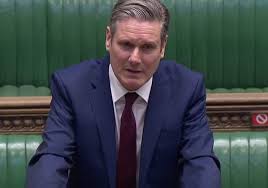
The Daily Telegraph, in recent years basically a Boris Johnson fanzine, ran a piece (following another disastrous PMQs for Johnson, he can't perform without his mates backing him up with their boos and jeers) by their parliamentary sketchwriter Michael Deacon which was headlined 'Keir Starmer took Boris Johnson apart like a Duplo train set' and if the Telegraph can turn, or even start to turn, then anything can happen.

Keir Starmer did take Johnson apart like a kiddies train set as well. The quieter atmosphere in the house, and the fact that people are watching now for answers and not showbiz, makes Johnson look like he's been caught stealing knickers from a washing line and  Starmer's serious, forensic approach and gravitas stand in stark, and admirable, comparison.


We're under a government that will only allow you to visit your parents if you're accompanied by an estate agent of if you're going to be paid to clean their house while you're there. We're under a government that not only does not, but simply can not, tell the truth. We're under a government, and this bears repeating time and time again, that has presided over the second highest coronavirus death toll on the entire planet.

If you don't want this government gone you really need to take a long hard look in the mirror. Sadly, some ultra Corbynites (though not Corbyn himself) are still choosing to rant about the biased BBC, the biased MSM (mainstream media), and are still calling Starmer's Labour Party the 'red Tories' instead of getting behind the democratically elected leader of the Labour Party as they, when they weren't telling people to 'fuck off and vote Tory', instructed people to do during Corbyn's tenure.

You'd think a socialist man leading a socialist party, destroying the Prime Minister in debates, and even winning over writers at the Daily Telegraph as well as huge swathe of middle England would be enough for people to get behind him. But there are people out there who if they can't get their first choice of dish on the menu won't accept the second.

You might have wanted creamy black lentil dhal with autumn squash and burnt coconut but that option's not available any more. The roasted kabocha pumpkin soup with chestnuts looks quite yummy but you wanted the dhal and if you can't have the dhal you won't settle for second best. So, what you get is the same overflowing plate of festering shit and broken glass that we've all been gagging on for the last decade except this time it might actually kill you.

Last year Channel 4 screened a series called Chimerica in which F. Murray Abraham played a press boss. In it he tells a Bernie Sanders supporter who's planning to abstain rather than vote for Hillary that the election "isn't a fucking salad bar. You don't get a bespoke artisanal candidate. You choose the thing that's not a giant shit".

The giant shit is running, and ruining, Britain right now. If you're not against him you're for him and the blood of thousands will never be washed from your hands no matter how many times you sing Happy Birthday.


Tuesday, 12 May 2020

Isolation XVIII:The View From The Gaslit Uplands.

"So we are saying don't go to work, go to work, don't take public transport, go to work, don't go to work, stay indoors, if you can work from home go to work, don't go to work, go outside, don't go outside - and then we will, or won't, er, something or other" - Matt Lucas' parody of Boris Johnson's new 'Stay Alert' advice.

"Well, it’s clear what we have to do then: go outside, but don’t go outside, start to socialise again but not with more than one person and not at a distance of less than two metres, and go to work but don’t go to work, and don’t go on the bus if you have to go to work, but if you do go to work don’t get the bus, please, and if you have to work (and you can! And should! But don’t) then drive yourself there. Fines will be increased for rule-breaking. Nobody on Earth has any idea what the rules actually are. Just know that fines are looming, somehow, for something. So to clarify: work is bad, buses are bad, rules are bad, work is good, rules don’t exist, fines are everywhere, fines are nowhere, disorder reigns" - Joel Golby's take on that same 'advice' in The Guardian.


On Sunday night at 7pm Boris Johnson spoke to the nation. As he stared out at the screen earnestly, with the face he uses to deny affairs to his various wives and girlfriends, he strung out a load of fluently (for him at least) expressed bollocks that even a cursory scratch of the surface proved to be vague and divisive and will, more than likely, prove to be dangerous, and deadly, too. He made a complete fucking pig's ear of going into lockdown. Why would anyone imagine he'd take us out of it in a different way?

Telling people, some people at least - construction and factory workers - not important people, that they can go back to work tomorrow morning at 7pm on a Sunday night. That's a shitty move on its own (people like at least some notice for stuff, you know) but by not being in tune with the far more safety-first and, small c, conservative measures announced in Wales and Scotland he's created yet further confusion at a time when many many people, though admittedly less than a few weeks back, are still dying from this 'thing'.


Of course the economy is a concern but dead people don't spend a lot of money and surely it'll be hit even harder by a botched relaxation of lockdown and then a return to another, possibly lengthier, period of quarantine than it will by a very gradual easing? Johnson's message (using, as Golby hilariously described it, "a graphic stolen from the Nando's peri-peri sauce-meter", when you read between the lines, seems to be that those already most at risk (lower paid workers, often BAME) need to go back to work and risk their lives even more so that the rest of us can stay at home having Zoom meetings and that shareholders aren't too badly hit by the crisis?

'Stay alert' is far more unclear than 'stay home' as a message and that's no accident. The ambiguity is intended. If you go out and catch the disease now, if you die of it, then it's not their fault anymore. It's yours. For not being 'alert' enough. Johnson most likely knows more people will die because of his messaging. He doesn't want people to die. I don't believe that of him. But I do believe he's quite indifferent to their deaths. He's far more concerned with covering his arse.

A jokey mock up of the government's slogan heavy new messaging reads "OOH, CAREFUL > MIND HOW YOU GO > BE LUCKY" but a more hard hitting one reads "BE VAGUE > COVER OUR BACKS > SHIRK RESPONSIBILITY" and that's where we're at now. It was noted that the colour red on these signs has been changed to green. Red means 'stop' or 'stay in'. Green means 'go' or, here, 'go out'.


That might sound like reading too much into a simple change of graphic design but this incarnation of the Tory party spend a lot of money researching how to send subliminal messages to people to get them to do what they want them to without actually having to say to them to do it. That way they can't be blamed for it. We're back, again, with the nudge theory that proved so fatal a couple of months ago. Even worse, Johnson and his toadies (all competent and sane voices in the cabinet were kicked out in favour of hard Brexiters and arse lickers) are, it seems, still pushing us towards the discredited herd immunity. As many have already pointed out they're not telling us to get back out there because the threat from coronavirus has disappeared but because they've now got enough ICU beds for us should we catch it.

As with so many things from Brexit to veganism and on to trans rights the people are being divided into two and the noises being heard the loudest are those from either extreme end of the spectrum. There's little room for nuanced voices, few attempts to reach consensus or make compromises, and the centre, as has been the case so often in recent years, struggles to hold.

Fervent Brexit supporters once waxed lyrical about the sunlit uplands we'd emerge into once we'd rid ourselves of the imaginary shackles of the European union but, instead, we've come out from the first wave of coronavirus darkness blinking into a different kind of uplands. A gaslit uplands. A place where we know there are rules but we don't know what they are, a place where the government have shown a deadly dereliction of duty to the people that elected them, and a place where we know whatever we do somebody, somewhere, will tell us we're doing the wrong thing.


It's almost as if, following weeks of unprecedented kindness in our communities, the government are getting scared. This can't carry on. We need people to get back to being nasty and prioritising wealth and aspiration above health, family, and friends. We were always likely to get there but why so soon?

The current global Covid-19 death toll is north of 280,000, there are 80,000+ dead in the US alone, over 32,000 have perished in the UK, and 20 countries in total (from India to Indonesia, from Portugal to Peru) have registered more than 1,000 deaths. Brazil, as predicted by many due to Bolsonaro's denialism, are the big climber in the global death league, becoming the sixth nation (besides the US, UK, Italy, Spain, and France) to get into five figures.

With this as the background you can imagine how disappointed, though not surprised, I was to see someone, a former friend, from Tadley (where I grew up) sharing an image of Johnson dressed as Churchill telling the 'haters' to fuck off. An idea that thinking 30,000 deaths are bad now makes you a hater. Johnson's BFF, Trump, goes further. 30,000 deaths aren't enough for him. 80,000 aren't enough. He now claims that the US needs to accept a lot more death and he's opening the country up again, before they've hit their peak, because, he says, the economy is more important than life.


That's insane but the truth behind it is far worse. Trump's re-election is, to him, more important than the economy and people's lives. He's indifferent to anything other than himself. He'd piss in a dying baby's face if it got him votes - and it probably would do. To be fair to Boris Johnson I don't think he'd do that. He'd probably snigger at the fact that Trump was doing it and allow his supporters to trot out the old mantra that at least he's not as bad as Trump.

George 'Useless' Eustace, the Secretary of State for Environment, Food and Rural Affairs appeared on Question Time to say we shouldn't compare ourselves with other countries (even though his own government had been doing exactly that until the comparisons started to look really bad) and, elsewhere, excuse after excuse is wheeled out for Johnson's negligence in dealing with this. As Keir Starmer pointed out to Johnson at Prime Minister's Questions last week. Starmer was forensic and dispassionate in his debunking of government lies. To his critics that was a bit boring. Why bother with a serious approach, you fucking square?


Ok, the morgues are full to bursting and people can't even be with their loved ones on their death beds but we've just had VE Day so why not get the bunting out and celebrate British (always meaning English) exceptionalism while, at the same time, conveniently forgetting our allies because it doesn't fit the idea that we're the best, the very best, in the whole world. A belief shared with Brazil and the US. It's almost as if jingoistic populism, myths of exceptionalism, and nationalist rhetoric aren't effective ways of countering a deadly virus.

Elsewhere in the coronavirus-sphere we're seeing, as Afua Hirsch said on Question Time, a lack of 'intellectual curiosity' on the part of the government as to why BAME people are more susceptible to succumbing to Covid-19. The lack of information on this baffles me. Is it because BAME people are disproportionately working in key worker and frontline positions or living in more densely populated areas (which would highlight how much racial inequality our society still allows) or is there a genetic factor? If that turns out to be the case it seems highly unlikely that that would not be juiced by the racist extreme right to 'prove' white racial superiority. Talk of eugenics, which were already in the air before all this, tend not to be far behind such twisting of science.


I'd love to write more about that but, first, I'd need to have more information about it and it's not coming. Instead, we're distracted with stories about Professor Neil Ferguson, the government advisor from Imperial College in London, who, despite being one of the key people behind the decision to go into lockdown, breached it himself, twice, to visit his married lover.

Don't get me wrong. What he did was wrong, very wrong considering his role in all this, and he deserves reproach but the first of his transgressions occurred, and was seemingly well known about, in March and it appears that the government held on to his (unpaid) services until they needed a distraction, a dead cat to throw on the table. Becoming the European country with the second highest death toll, it was time to throw someone under the bus and Ferguson, stupidly, had put himself in a position to be just that sacrifice.

Ferguson had made a great mistake but that mistake has been used to mask far greater (and more deadly) failings on the part of the government. This government cannot, and will not, lead by moral example so it was hardly a surprise that they were taking advice from a man cut from the same cloth. When the government announced relaxation of lockdown, in England only, they said we could sunbathe, have picnics, and leave the house more than once a day. Even meet with friends as long as we do it outside and maintain social distancing.

These are not necessarily bad moves and most of us had realised a few weeks ago that social distancing is key. Many in London, including me, who have no gardens have already been inching towards those things. It was once said of Boris Johnson (and I can't remember who by or I would credit them) that he is a man who when he sees a crowd runs to the front of it and shouts 'follow me'.

It's a very accurate and prescient consideration of the man's character but it's a terrible pity that so many who chose to follow him did so to their own deaths as will surely happen to those who follow another cult, that of Christianity. There can hardly be any denying that Johnson and Trump are cult leaders. They encourage their followers to place faith above reason and when you hear Christians campaigning for increased relaxation of lockdown because they "need to physically be with Jesus" more than they need food (yeah, good luck with that) you realise that the most deadly development in the politics of the US and the UK in recent years has been that politicans have started acting like quasi-religious figures beyond questioning and criticism.


That never ends well and this story has got many twists and turns to take yet. With a charlatan like Johnson at the wheel there will be plenty of crashes along the way, more and more mistakes, and, worst of all, more scapegoating, blaming, and passing the buck. If he comes out of this looking like a hero we're in, almost certainly, for further bad times. If we learn our lesson we can start to make the much talked about 'new normal' a better, more fairer, more equal normal rather than the same old normal we had before that left so many in poverty, depression, and despair.

I've, fortunately, escaped those things over the last couple of months (today is my 59th day of lockdown) and that's, primarily, down to the generosity and kindness of friends and family. Since I last wrote about this I've spoken, multiple times in some cases, to Mum, Dad, Michelle, Adam, Ben, and even my brother Andy and my nephews Alex and Daniel. We even did a family quiz to go along with the Kahoot quizzes I've been doing, and loving, with a very dear group of close friends.


My friend Dan has been sending me a tune a day to keep my spirits up (today was the Dave Holland Quartet, yesterday was Pauline Oliveros, the day before Sister Rosetta Tharpe - the quality has been excellent), I'm continuing to set my daily music challenge on Facebook (most days the thread stretches beyond one hundred posts), and, on the same platform, I'm still running down my one hundred favourite reggae songs (today it was Alton Ellis, yesterday Culture). On top of that I've been listening to lots of the joyous, beautiful, and transcendent music that Little Richard, Kraftwerk's Florian Schneider, and Millie (who have all passed away in recent days - none, it seems, Covid-19 related) have gifted us. If you formed a triangle of my musical tastes those three could easily be the three corners.


I've been for walks on Peckham Rye Park, Dulwich Park (where I 'bumped into' Pam), One Tree Hill, and Nunhead Cemetery. All of this has served to keep me feeling positive about things. Even when there is so much darkness around and, in the threat posed not just by coronavirus but our negligent and self-serving leaders, the promise of much more to come. Writing about the VE Day celebrations in The Guardian, Jonathan Freedland said "it was natural for Britons to bask in the May sunshine and remember a brighter moment, to take comfort from it and draw strength from its lesson: that even the darkest hours end eventually. It made sense to come together and raise a glass for the day when we will meet again. But we are fighting a different war now, against an invisible enemy, and led by lesser men."

We can, and should, come out of the darkness. But when we do we must make absolutely certain the person that leads us out of it does not lead us somewhere even darker. Current evidence suggests that's a lesson we've yet to learn and if we can't learn it from this can we ever?