Friday, 24 February 2023

Trauma?

The understood definition of what constitutes trauma has changed quite a lot over the last century. In 1941 it was considered to be something specific to the neuroses of war veterans. PTSD basically. This, of course, meant there was a belief that only military people, mostly men, could be affected by trauma.

That idea was put forward by the American psychiatrist Abram Kardiner in his book, The Traumatic Neuroses of War. In 1967 the definition was broadened out to mean anything that causes harm to the psyche. It's been broadening out ever since. By 1980 trauma was considered to be "a psychologically distressing event that is outside the range of usual human experience" and, in 1987, Bessel van der Kolk (another American psychiatrist turned author) described trauma, quite simply, as something that affects someone who has undergone "overwhelming life experiences".

Another seven years on and the meaning changed again. Trauma was now something you may suffer if you have undergone "an event involving actual or threatened death or serious injury". It was associated with feelings of intense fear, horror, or helplessness. By 2013 most defined trauma as something you may feel if you have experienced "actual or threatened death, serious injury or sexual violence".

In the following decade that's been added to. Now trauma can be caused by any event that leaves an imprint on the brain or the body. It lingers in thoughts and memories. It is an emotional pain that often goes unseen but changes our brains pyschologically and biologically.

The reason I start with an outline of what trauma is is because that's what Carrie Poppy - an independent journalist and podcaster, in her Mental Health Pseudoscience on Social Media talk for Skeptics in the Pub - Online (hosted by the ever reliable Michael Marshall), did. She felt she needed to explain what trauma is before she could debunk some of the online treatments that have been offered up since we entered the age of social media.

Those online treatments have exploited the ever broadening definition of trauma (now so wide that absolutely anything that might happen to you could cause trauma) and the era has given rise to hundreds of people claiming, wrongly, to be experts on trauma. Regularly, they will espouse antiscientific ideas when it comes to treating, or coping, with trauma.

Carrie's speech was too long, twice the length of a normal Skeptics online lecture, and I've left a lot out here (you can listen to her podcast or buy her book if you want more) but there were some very interesting points. It's just they were often laboured over in such detail I found myself making a sneaky move on Words with Friends on my phone or doing a quick Jetpunk quiz.

I didn't even stick around for the Q&A which is quite unusual. The bits of the talk that were good, though, were really interesting. Carrie's been working, intensely, on a book about trauma. It's a subject she says she has found to be incredibly deep and very complex but this talk was not about the depth and complexity of trauma (well, not much). It was about the fluff around the edges of trauma. The misleading social media take on trauma that, predictably, has resulted in misleading ideas of treatment for trauma.

If almost everything can lead to trauma then, it seems to follow, almost everything can be a sign of trauma. During Carrie's travels online she's seen multiple behaviours described as being symptoms of trauma. They range from people pleasing, over explaining, and being unable to accept kindness from others to defensiveness, sadness, and anger. 

Physically, symptoms of trauma can include headaches, ovarian cysts, numbing, inattention, and detachment. The list does not stop there. In total there are over five hundred different physical issues that online 'experts' have decided are signs of trauma. Many of them genuine and serious physical problems that need treating. They're more likely, especially if untreated, to cause trauma than to be the result of trauma.

Some of the cod psychology offered up by these online frauds comes from Sigmund Freud, other ideas come from Ivan Pavlov, and other theories baked in to this gumbo of half science come from people I've never heard of. It's a mish-mash and though it may sometimes sound scientific, and regularly seems to be accompanied by photographs of young women doing yoga, none of it has really been put to the test.


The few proper studies that have been done as regards these theories have been highly criticised for poor methodology. Trauma therapists are invested in trauma therapy so if you visit one they may, rarely for malicious reasons and more often because they've been blinded by their own biases, see you as a trauma sufferer when you're not. Carrie spoke of her own personal experiences of visiting trauma therapists. One told her, incorrectly, she's been sexually abused by her father and another told her, equally incorrectly, she's grown up in a MKUltra style cult.

The fact she had no recall of being abused by her dad or growing up in a cult didn't matter. In fact, it was 'evidence' that it must have happened and was so bad she'd mentally blocked it out. Perhaps we all grew up in a MKUltra style cult and we've all blocked it out. By that logic, that must be the case.

When dealing with the idea we may be suffering trauma it's good to remind ourselves that the mood we're in at any given time dramatically alters how we remember things. We need to remember that false memories are quite normal, everybody has them, and we need to be aware that, as life goes on, people start to feel haunted or possessed by their learned behaviours.

As if they can't change. As if they're locked in to being a certain person. It's important to evolve our behaviour as we go through life and circumstances change but being resistant to change is also quite ordinary. It doesn't mean we're suffering with trauma. The trouble with ascribing almost everything to trauma is that actual health issues may not be being addressed and that the trauma police of the Internet prime their clients to believe that medical options are a form of 'gaslighting'.

Which, when you think about, is quite an advanced form of gaslighting in itself. If you tell somebody they're suffering trauma so much that they believe they are then you're creating an atmosphere in which any dissenting voice appears to be lacking in empathy, cruel even. Trauma does, indisputably, happen but is far far rarer than depression and anxiety. If you're suffering deep depression or anxiety that is ruining your life, a treatment for trauma probably won't help you.

It's a case of making sure things are labelled correctly and though Carrie Poppy may still be talking now for all I know one thing I can't accuse her of doing is labelling her talk incorrectly. It dealt, as promised, with mental health pseudoscience on social media. Something I suspect isn't going away any day soon.


Thursday, 23 February 2023

Danger! High Voltage:Guy Martin's Great British Power Trip.

It'd be hard not to like Guy Martin. He's affable, he's enthusiastic, he's knowledgeable, and he's curious. He's eager to learn and he's eager to try things out. It seems to me like a recipe for a life well lived. You certainly won't begrudge him his nice house.

On Guy Martin's Great British Power Trip (Channel 4, narration by the ever reliable Shaun Dooley and his no nonsense Barnsley accent), Guy's out to travel all over Britain to find out both why his, and our, energy bills are so expensive and what can be done about it. Of course he delves wider into the world of energy creation. Both its history and its possible future.

Having just had a bill from British Gas that saw a 422% mark up from the last quarter it was a subject I had some personal interest in. But, that aside, the programme was fascinating and had me wondering why nobody had addressed this subject in this way before. Perhaps they had and I'd missed it.

There's lots of old black and white footage of men clambering up pylons with no harnesses or any safety gear whatsoever (before the days of health and safety), there's plenty of statistics to blow your mind (the National Grid has over 600,000 miles of wires, electricity travels at 600,000,000 mph), lots of amazing bits of kit (a battery so strong it could lift a battle cruiser out of the sea), and there's lots of stuff I don't fully understand.

Science, sadly, not being my strong suit. Guy starts in his not inconsiderable shed where he checks which of his devices use the most power/cost the most. Using a gadget he's got he works out it costs him 4p every time he boils his kettle. Estimating he does that ten times a day (he likes his tea, clearly) that comes to £146 a year. Another £312 is spent powering his parts washer and, in total, he estimates he spends £732 per year powering everything in his shed.

But then power isn't cheap. Guy visits the UK's biggest power station, Drax in North Yorkshire. The boilers, rubber on the outside - concrete inside, are twenty storeys high and the turbine hall is so large you could fit St Paul's Cathedral in it twice over. Drax powers 4,000,000 homes and though it does use some coal, it mostly relies on wood pellets to make power.

Though the white smoke that we see coming from the cooling towers is completely harmless water vapour, that doesn't tell the whole story. Wood is nowhere near as energy dense as coal and, therefore, creates more CO2 and other greenhouse gases. It gets even more complicated when discussions about the sustainability of biomass is hotly debated and I'm left not sure exactly what to think.

They're currently trialling a system called 'carbon capture' which will help reduce CO2 emissions. A pipeline is planned but that's not due to be up and running until 2027. My initial suspicion that the makers of this programme were coming from a reactionary, climate change denying, angle don't amount to much but it does seem reasonable enough to ask how can we rely, completely, on wind power when sometimes there's no wind? 

Wind, at the moment, only provides a very small percentage of our energy requirements. It's gas that's the thing costing us so much and not just because the people who own the companies, and have shares in them, are a bunch of greedy bastards. For the records that's my own personal opinion and not one offered up by Guy Martin or anyone else on this television programme.

85% of our homes are heated with gas and 45% of our electricity is produced by burning gas. Right now we're in the middle of a perfect storm as far as gas prices are concerned. A harsh winter, huge demand on India and China for gas as they start to move away from coal, supply issues resulting from the sanctions placed on Russia following Putin's invasion of Ukraine, and a government reluctant to do anything to help ordinary people and yet eager to boost the coffers of Tory donors. Many of whom are high up in oil and gas firms.

Guy Martin never takes the political route and, instead, just gets on with learning. Learning and doing. He joins a pylon service crew in Nottinghamshire and climbs 25 metres up a pylon. It's a bit vertigo inducing but it's something not many people ever get to do. Only about one hundred men and women in the whole of the UK are qualified as 'linemen'. 

I hear you singing in the wire. The makers of the programme missed a trick here by not playing Glen Campbell's Wichita Lineman, Snap's The Power got an airing but that seemed a bit obvious. Never mind. Once Guy's learned, and taught us, about the National Grid's ESO (a body that makes sure power stations can meet consumer demand) he's moved on to a part that particularly interests me.

Climate change issues. Solar power, at the moment, only provides 4% of our energy needs. On a sunny day that may rise to 25% but as anyone who lives in the UK knows only too well you can't guarantee a sunny day very often. I was surprised to learn that one of the places where solar power was being put to the most effective use was within the country's military.

The British Army Defence School of Transport in Yorkshire (a county that crops up a lot here) is where the army, air force, and marines learn to drive various military vehicles. Obviously this would generate a lot of pollution but they now mostly rely on solar power. There are a LOT of solar panels there.

As for wind farms, Britain's first was built as recently as 1991 but now the country is on course to be the world's biggest off shore wind farmer. Some see these wind farms as eyesores but I think that's frankly ridiculous and on a walking holiday in Wales last year I learned they were also brilliant for the local wildlife.

The Siemens Gamesa factory in Hull makes turbine blades for the wind farms. Guy Martin, as is his style, helps in the process and that involves undergoing Helicopter Underwater Escape Training. What some call getting in a "flying coffin". The programme makers go a bit over the top here with ominous music and an unnecessarily dramatic voice over but it's still instructive to see what's required of people who visit, and service, these wind farms.

Hornsea Two offshore wind farm is the world's biggest and each rotation of each blade is said to power a house (though, disappointingly, it's not specified how long for - an hour? a day? a year?). Wind farms are expensive to build but they're cheap to run. But, as already mentioned, the wind doesn't blow all day every day.

Sometimes it blows too much and that can be a problem too. Could the answer be huge banks of batteries on the outskirts of every town and city in Britain? Guy Martin visits a huge bank of batteries stored in a mountain, by the side of a loch, in Argyll and Bute and then he travels even furrther north to the Orkneys where the National Grid ends to look at another possible solution.

It's home to the world's biggest tidal turbine, Orbital O2, and that's partly because the tides around the Orkneys, where the North Sea meets the Atlantic, are very powerful. Tides are reliable, they happen twice a day regardless of weather, and the eventual goal is that tidal power will be used to create 10% of all the energy required for keeping the lights, and heating, on in Britain.

Although corrosion, especially when underwater, means lots of money spent on servicing and replacing rust damaged parts. In Orkney, where the relatively low population means they need less electricty than in big cities, they're looking at converting excess electricity into hydrogen fuel. That would help on the Orkneys but it wouldn't be a solution to net-zero on the mainland where demand is much much higher.

Is the answer nuclear? Possibly but there are only five nuclear power stations in the whole of the UK and they're all coming to the end of their lives. Hinckley Point B stopped making power last year and Hinckley Point A shut down in 2000. But, also in Somerset - near the Bristol Channel, they're building a new one. You guessed if, Hinckley Point C.

It's not cheap, the estimated cost will be twenty five billion pounds, and it's not a small project. The site will have one hundred and fifty buses to ferry staff around, two huge hotels for the workers to live in, and it's own fire service, police force, and doctors. In Big Carl, it's got the world's biggest land crane.

Nuclear waste has long been seen as one of the main problems of nuclear power. It stays dangerously radioactive for thousands of years so what to do with it? Cumbria is home to Britain's "nuclear dustbin' Sellafield. Formerly known was Windscale.

Opened in 1956, it was the first commercial nuclear power station in the world and the designs were sold to the Italians and the Japanese so they could open their own versions. But Britain was soon overtaken in the 'nuclear arms race'. Many people, myself included, conflated nuclear power with nuclear weapons and, on top of that, had more genuine concerns about how safe nuclear power was.

Now, unlike in the past, there are ways of storing nuclear waste safely and these ways are both understood, regularly reviewed, and reinforced rigorously. All well and good but the long term answer to our energy problems may come in nuclear fusion. In Oxford, Guy Martin learns a little about what they claim will be 'unlimited clean energy'.

But the progress is slow on this. Fusing atoms, it seems, is much more difficult than splitting atoms which even MC Tunes boasted of being able to do back in 1990. In fact we're so far from getting there that even the most optimistic forecasts say we're twenty years away. More realistic predictions say we're looking at close to eighty years so at least your energy bills may come down somewhere around the year 2100.

Guy Martin seems to enjoy himself throughout the series (he goes from making an incandescent light to blowing up a former coal power station in Eggborough) but, more importantly, he's brought us with him. Like him, we've both enjoyed ourselves and we've learned a lot. Also, like him, there's no sign of our gas bills going down any time soon. 


Wednesday, 22 February 2023

A Quiet Revolutionary:Cezanne @ Tate Modern.

"I paint as I see, as I feel... They also feel and see like me, but they don't dare... I dare" - Paul Cezanne, 1870

Mont Sainte-Victoire (1886-7)

Paul Cezanne's popular with the public now (on a Tuesday afternoon in February, Tate Modern was heaving with punters for their ongoing exhibition of his work, titled simply Cezanne) but he is, almost more than any other artist in history, an artist's artist. There are musings, mostly quite pretentious ones, on caption boards alongside his paintings by contemporary artists like Luc Tuymans, Ellen Gallagher, Laura Owens, Etel Adnan, and Pyllida Barlow, and then there's the big names who have sung his praises down the decades.

Picasso called Cezanne "the one and only master", Gauguin owned and treasured works by Cezanne, Monet too as well as Matisse (who said he "knew that Cezanne made no mistake"), Henry Moore, and Jasper Johns, Renoir said of the man that he "cannot put two touches of colour on to a canvas without it being already an achievement", and Pissarro admitted that while he was an influence on Cezanne, Cezanne was also an influence on him. The Austrian modernist poet Rainer Maria Rilke said of one Cezanne work that it "does not have a single unmoving part".

Being incredibly cultured myself (ha!) I am, of course, a fan. In 2005 I even visited Aix-en-Provence and had a look at Mont Sainte-Victoire, along with his apples one of his most famous subjects. To be honest I also got drunk and saw a man dressed up as a Stabilo Boss marker but they're stories for another time.

Portrait of the Artist with a Pink Background (c.1875)

The Tate show is both an education and a joy. It tells of how Cezanne (1839-1906) approached painting as both a process and an investigation. How he came to regard uncertainty as having a pivotal role in the creation of his work and how, famously, he tried to "astonish Paris with an apple".

It opens with a self-portrait of Cezanne in his mid-thirties (though looking older). Cezanne lived in a time, both in France and in the wider world, of political turmoil and at a time when life seemed to be speeding up. Perhaps that's one of the reasons why his art still speaks to us now.

Although considered to be a member of the Impressionist group (and participating in group shows with the likes of Manet, Van Gogh, Renoir, Degas, and Gauguin) he was, in many ways, a quieter painter than most of the others. He was, also, quite revolutionary in his approach. A quiet revolutionary who paved the way for the Cubism of Picasso and Braque.

The Basket Of Apples (c.1893)

In 1861, at the age of 22, Cezanne's future as an artist was not assured. His father wanted him to remain in his home town of Aix-en-Provence and become a lawyer. Luckily, for him and for us, Cezanne was persuaded to move to Paris by the writer Emile Zola, his school friend, and in the capital Cezanne began to move in creative circles within the city's avant-garde set.

He never fully settled in Paris and would regularly travel back to Provence but Paris influenced his life and career. He was able to visit museums and make studies of sculptures and paintings and in Paris he met Camille Pissarro. Nearly a decade older than Cezanne, Pissarro became something of a mentor as well as a friend. Under Pissarro's influence, Cezanne's painting style moved from the dark, moody Sugar Bowl, Pears and Blue Cup to the more colourful, light filled Still Life with Fruit Dish. They're shown on opposite walls at Tate Modern so we can see this for ourselves.

Sugar Bowl, Pears and Blue Cup (1865-70)

Still Life with Fruit Dish (1879-80).

Cezanne had found his style, he'd found his 'constructive stroke', but he would not rest easily. He would spend the rest of his career, the rest of his life, honing both his style and technique. He painted the grey skies and rooftops of Paris with an almost geometrical rigour yet still made them look evocative. Using 'considered parallel brush strokes' he painted the Francois Zola Dam near Aix (designed by Emile Zola's father) and the work was loaned to the Tate in London in 1922 where it received praise from the painter and critic Roger Fry.

You can see in these works a kind of subtle blockiness as Cezanne breaks both cityscape and countryside up into defined rectilinear spaces. He's trying to show us not what the Francois Zola Dam looks like if we stand in one place and look at it but what it looks like if we move around while looking at it. The mountain seen from multiple angles. It was exactly the sort of thing that Picasso would later develop into fully formed Cubism.

Rooftops In Paris (c.1882)

The Francois Zola Dam (1877-8)

The Murder (c.1870)

It may seem odd that his painting of Provencal countryside should seem more revolutionary, more controversial, than the one he made of a murder scene about seven years earlier. The French newspapers of the time had become pruriently obsessed with murder and violence and Cezanne, quite clearly, was sucked into this.

Which seems not to be typical of the man. He was, by all accounts, something of an outsider. He dressed formally, eschewed metropolitan fashions, and remained married to the same woman, Marie-Hortense Fiquet, until his death. He did, however, believe that a violent society demanded a violent style of painting. He even described his work as 'ballsy'. That's not aged well.

He felt the style of painting taught at the Academie des Beaux-Arts was stale, or bourgeois, while he saw his own work as raw or even 'virile'. The establishment, in return, considered his work to be too radical and when he submitted two paintings to the 1870 Salon exhibition they were rejected. Something that became a regular event for Cezanne. The caricaturist Charles-Henry Stock depicted him as a wild revolutionary with piercing eyes and an impenetrable expression.

The Battle of Love (1879-80)

Charles-Henry Stock - 'Le Salon pat Stock', Stock-Album No.2 (1870)

Nude Woman (1885-7)

The Eternal Feminine (c.1877)

He painted sex workers but he was too shy to ask anybody to sit for him so copied images from the side of champagne bottles and he painted love as a battlefield more than a century before Pat Benatar came to the same conclusion. The sexual politics of the time, quite clearly, were not as they are now and a popular phrase used back then to refer to idealised, or desirable, women was "the eternal feminine".

The curators of the exhibition claim Cezanne's take on the eternal feminine was quite possibly inspired by Eugene Delacroix, Cezanne's favourite 19c artist, and that is easy enough to believe. When they claim that the figure, the naked woman, represents Paris itself and that Cezanne is making a political and social comment on the state of the French nation I find it less plausible.

It looks like a load of pervs having a good lech to me. Though why some people have brought trombones along to the lechfest I'm not sure. I may be being a bit cynical here. Though Cezanne was never as politically outspoken as the likes of Pissarro (a committed anarchist) and Zola (who wrote in support of the Republican movement) he did take a deep interest in the political and social upheaval of the time.

Different groups in France fought for a different kind of Franc (a monarchy, a republic, or an empire?) and regional movements campaigned for more self-governance. In 1870 Prussia invaded and defeated France after a brutal siege of Paris and tensions and debates around slavery were intensified following the end of the American Civil War.

France, like other exploitative European powers, was reaching peak empire. Slavery had ended in France in 1848 but Scipio, possibly a nickname taken from Harriet Beecher Stowe's 1835 anti-slavery book Uncle Tom's Cabin, still bears the marks of it. Both on his back and, of course, in his soul.

Scipio (1866-8)

The Conversation (1870-1)

The Plate Of Apples (c.1877)

Madame Cezanne In A Red Armchair (c.1877)

Madame Cezanne In A Yellow Chair (1888-90)

Portrait Of The Artist's Son (1880)

It was a rare foray into political activism for Cezanne who was more at home with apples, portraits of his wife and son, Paul fils, and, best of all in my opinion, his wonderful landscape work. There's a room at Tate Modern dedicated to the works he made in the coastal village of l'Estaque near Marseille. Cezanne would holiday there in his youth and again with his wife and child as an older man.

He hid from his father (who didn't know he'd gotten married and may have stopped sending him funds) and military conscription in the Franco-Prussian war there from 1870 to 1871 and he found it an almost perfect place to paint. The isolation helped but so did the local geology, the Mediterranean sunlight on the rocks. When, during a later visit in 1876, Cezanne wrote to Pissarro he described the views as "like a playing card. Red roofs against blue seas". He'd needed to move to Paris to discover that his native region actually provided him with the conditions and inspiration he needed for his art to thrive. We never know our home town until we've been around the world.

Landscape:Road With Trees In Rocky Mountains (c.1870)

The Gulf Of Marseille Seen From L'Estaque (1878-9)

The Bay Of Marseille, Seen From L'Estaque (c.1885)

The Viaduct At L'Estaque (1879-82)

L'Estaque With Red Roofs (1883-5)

These paintings are absolutely gorgeous. You can almost feel the sun's heat as it beats down on the walls of L'Estaque's buildings, you can easily imagine how pleasant the shade of a tall tree would feel, and you look out to the sea with that pensive sense of longing. I enjoyed looking at these paintings but even more I wanted to be in them.

They're, along with the Mont Sainte-Victoire paintings, the very best works Cezanne did but at Tate Modern they're delving a bit deeper into his work so we get less celebrated lithographs (like The Large Bathers, below) and unfinished work (Still Life With Water Jug, also below). They're not as immediately impressive, little is, but they do help us understand a little more about how Cezanne worked.

The Large Bathers (c.1898)

Still Life With Water Jug (c.1892-3)

Curtain, Pitcher And A Fruit Bowl (1893-4)

Still Life With Apples (1893-4)

Grand Bouquet Of Flowers (c.1892-5)

Often he worked in his studio and on still life painting. Still life painting had traditionally been considered the least important genre of art but for Cezanne that was not the case. After - along with his mother and his sisters - inheriting his father's estate, Jas de Bouffan, in 1886, he set about a new, and singular, method of painting the same items over and over again. With often very minimal differences.

Apples (of course), pears, flowers, bottles, water jugs, and sugar bowls. Sometimes with a curtain as background. Often sections were left completely unpainted. These paintings may have been representations and depictions of real material objects but they were also, even more so, paintings about how we look at these things. How we choose to see them and how the light plays on them. An apple in the morning may not be the same as an apple in the evening.

The colours, often highly nuanced, that Cezanne used to create still life images were also applied to his portraits and to his landscape work. Below we can see a farm worker from Jas de Bouffan called pere Alexandre and below him the chestnut trees in Jas de Bouffan itself. Glimpsed through their denuded branches we can see the outline of Mont Sainte-Victoire.

Man In A Blue Smock (c.1896-7)

Chestnut Trees At Jas De Bouffan (c.1885-6)

A view Cezanne came to know very well. For him, familiarity did not breed contempt. It bred knowledge and a form of comfort in which he was freed to focus on his sensory feelings towards the landscape. What he called 'sensations'.

Cezanne painted Mont Sainte-Victoire more than eighty times between 1882 and 1906. From many different vantage points. No human figure, it seems, ever appears in these works. Instead we are invited to consider nature as a presence in its own right. It is unchanging and monumental and yet at the same time it looks different depending on where, and when, you look at it. Cezanne, almost miraculously, managed to resolve that dichotomy in his paintings.


Mont Sainte-Victoire (1902-6)

Mont Sainte-Victoire Seen From The Bibemus Quarry (c.1895-9)

The Bather (c.1885)

Bathers (Les Grandes Baigneuses) (c.1894-1905)

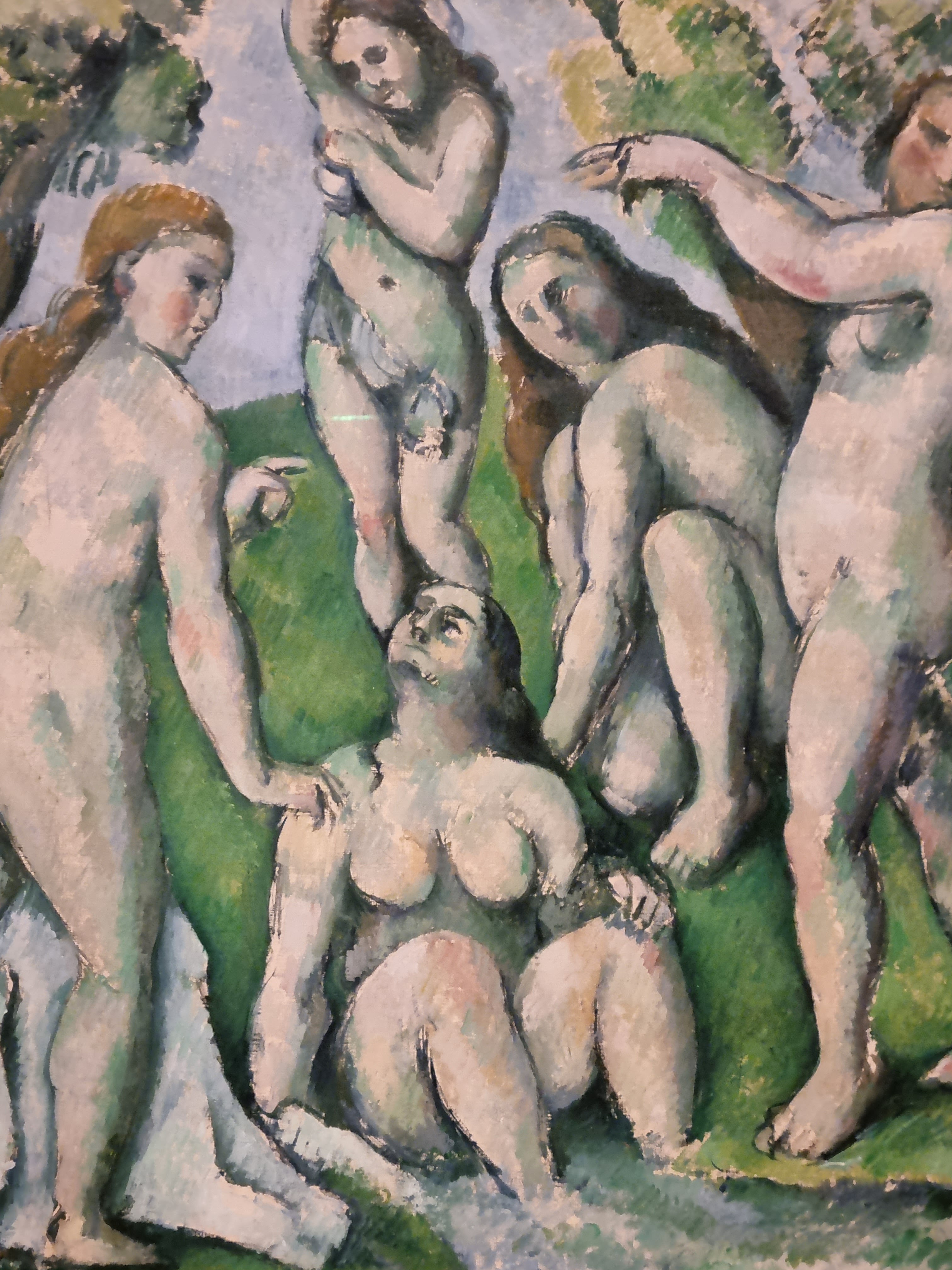
Five Bathers (1885-7)

Three Bathers (1879-82)

Cezanne was almost as obsessed with making paintings of bathers as he was with Mont Sainte-Victoire. It was a theme he returned to throughout his life and it's possible that the artist, often so unafraid to break free of convention, saw in his portraits of bathers a link to a long and distinguished classical tradition.

Nudes in idyllic, and imagined, landscapes. Cezanne painted male and female bathers and because he was too shy to ask people, except family members it seems, to sit for him much of his anatomical study came from long hours spent in museums. Which, of course, would have given the paintings an even more classical feel. If Bathers (Les Grandes Baigneuses) seems familiar that's because it's normally on display at The National Gallery on the other side of the Thames to Tate Modern.

In 1897, Cezanne's mother died and Jas de Bouffan was sold. Two years later, Cezanne sold the contents of his Paris studio and is said to have destroyed many of his early works. He'd been diagnosed with diabetes and was starting to feel increasingly frail. His work took on a darker tone, skulls even appeared.

But he remained busy in his last years. As if railing against mortality, he designed a purpose built studio and he received younger artists as visitors who found him to be a modest man yet one of art's all time greatest innovators. A man who created a new visual language for the world to be understood. A man who, mostly without fuss, changed how we look at art. A quiet revolutionary.

Undergrowth, Path Of Mas Jolie At Chateau Noir (1900-2)

Seated Man (1905-6)

Still Life With Ginger Jar, Sugar Bowl And Oranges (1902-6)

Chateau Noir (1900-4)

Three Skulls On A Patterned Carpet (1904)

Photograph Of Paul Cezanne (c.1870)