Thursday, 22 April 2021

Nothing but the Truth:Line of Duty S1.

"I swear to tell the truth, the whole truth, and nothing but the truth" - the solemn oath usually given in UK court rooms.

Way, way after everyone else, I am finally catching up on Line of Duty (on the iPlayer - it was originally on BBC2 but switched to BBC1 by the fourth series such was its popularity) and, of course, its excellent. You know when people whose values and tastes you trust tell you that stuff is good and you're, for some reason, initially cynical about that? You're almost always wrong aren't you? The things the people you trust say are good are, more often than not, good.

Your friends aren't trying to deceive you. They're trying to share things they love with you. That cynicism, which I have definitely been guilty of in the past, isn't the reason I didn't watch Line of Duty when it began back in 2012 though. The main reason, and it's quite an overwhelming one really, is that I didn't have a working television between summer 2011 and summer 2014 (this was actually quite a good thing as it forced me to do other stuff, it's not an experience I'd have wished to repeat during lockdown). 

I also suspected it might be like The Bill or maybe a police version of Casualty. More soap opera than drama. I've nothing against soap operas (as anyone who remembers witnessing me reciting the names of actors in Coronation Street, Eastenders, Brookside, and Emmerdale Farm back in the late 80s/early 90s will verify) but I've done my shift at the soap opera coalface and I now crave something different.

Line of Duty, now six seasons deep and with viewing figures that have gone from under three million per episode to over fifteen million, isn't necessarily that different. But it's not exactly what I expected either and it is, undoubtedly - even after just one series, great. It's tense, it's suspenseful, it's tightly plotted, full of well developed characters with intricate back stories, and the actors that play those characters are uniformly brilliant at all times.

When a police raid on a flat in a tower block goes horrendously wrong a cover story is immediately concocted by Chief Inspector Philip Osborne (Owen Teale) and everyone involved agrees to go along with it. An innocent man has been killed but the police are closing ranks and protecting their own. All except one. DS Steve Arnott (Martin Compston), an intense individual of strong moral fibre, refuses to play along and his moral stance brings him to the attention of Superintendent Ted Hastings (Adrian Dunbar), head of the AC-12 anti-corruption team.


Hastings recruits Arnott and puts him, almost immediately, on the case of DCI Tony Gates (Lennie James), a Jag driving wide boy with the gift of the gab and a southern accent who has recently won an Officer of the Year award for his clean up figures. Suspiciously high figures according to Hastings:- "no-one's that good".

Gates is suspected of 'laddering' (attributing numerous different charges to the same defendant to increase his number of successful cases) and when he absentmindedly accepts a free breakfast from a local cafe for apprehending a mugger it's an excuse for AC-12 to take him and give his collar a gentle, at first, feel.

As Hastings and Arnott investigate Gates from the outside, DC Kate Fleming (Vicky McClure), an AC-12 member, is embedded in Gates's teams of 'lads'. His best mate DC Nigel Morton (Neil Morrissey with a walking cane), DI Matthew, or 'Dot', Cottan (Craig Parkinson), and DC Deepak Kapoor (Faraz Ayub) are all working with Gates on a double murder case that looks to have been the result of a turf war between rival gangs of drug dealers.
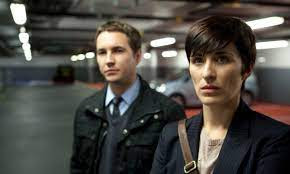


Gates is clearly a skilled performer but he's distracted by developments in his affair with Jackie Laverty (the always brilliant Gina McKee), a wealthy owner of a property holding company who has caused an accident drunk driving, fled the scene, and is now asking Gates to cover up for her. A request he vacillates over, to potentially his own detriment, for the bulk of the series.

As Laverty's behaviour and dealings are revealed more fully, and with that Gates complicity in protecting her, Line of Duty S1 opens up to reveal a complex web of organised crime, both at street and white collar levels, laundering, drug dealing, people being called 'slags' on Facebook, and even, it seems, terrorism and murder.   

Lennie James is superb as Gates. Cocksure and slightly chauvinistic on the surface, we witness his fingers wobble over a keyboard mouse, we see his uncertain stares and furtive glances, and in these moments he conveys to us that he is fully aware of how precarious the tightrope he is walking on is, and how dangerous it would be if he were to fall.

Even when he proudly applauds his young daughters at their school piano recitals, reads them bedtime stories, or plays What's the Time, Mr Wolf? with them, his mobile phone is a constant itch in his pocket. The news he waits for via text is rarely good and in what I believe, if social media memes are anything to go by, is something of a regular trick with Line of Duty, vital information for the viewer is often imparted partially. 

It's television made for the pause button or the ten second rewind as we try to interpret whispered conversations and decipher messages on phone screens or scraps of paper. It works brilliantly to create an atmosphere where suspicion is rife, loyalty, lust, and sense of duty are exploited, and age, sex, race, and rank are all weaponised as cop goes against cop in partitioned window office, escalator, or bar room.

You'd say paranoia was the order of the day if the things our chief protagonists were losing sleep over weren't real and fundamental to their lives. Offices liaise surreptitiously in underpasses, graveyards, and car parks, conveying information from window to window, and a backdrop of grey streets, feral kids on sink estates harassing pensioners and those with learning difficulties, laddish culture, narcotics, dead rodents deposited in cars, chopped off fingers, slit throats, and drug dealers hanged from lampposts manages to feel both outlandishly, even occasionally unrealistically, dangerous and very very British at the same time.

The language of slags, pillocks, bean counters (AC-12 to some other coppers), bent bastards, and chavs may not be the most erudite form of expression but it reflects, accurately, how people in this country actually speak. Earthy language gives way to genuinely shocking moments, I jumped out of my skin more than once, and the odd truly chilling scene.

We see Hastings try to slow down, manage, and almost father the over enthusiastic and monomaniacal Arnott, tightening the lead of his freshly converted attack bulldog but still utilising his threat to get the job done. This dynamic, and the one between Arnott and Fleming - there were some lingering looks and a cruel lie about Fleming performing fellatio on Gates that Morton told to Arnott left a bad taste in his mouth, will surely be played out in more depth in the next five seasons and I shall be watching all of them very soon.

For season one, it was a bit like starting a new job. Almost too many faces to remember, or at least match to names. There was Jools, Gates' wife (Kate Ashfield), drug dealer Wesley Duke (Dylan Duffus), and sink estate residents Terry (Elliot Rosen), Keeley Pilkington (Lauren O'Rourke) and her son Ryan (Gregory Piper) as well as waitress, and potential love interest for Arnott, Nadzia (Elisa Lasowski) on civvy street and there were as many police as you'd expect a quiet vigil to mark the death of a murdered woman on Clapham Common.


I don't know if DCI Alice Prior (Heather Craney), DS Leah Janson (Claire Keelan), DI Ian Buckells (Nigel Boyle), PC Simon Bannerjee (Neet Mohan), PC Karen Larkin (Fiona Boylan), or CS Derek Hilton (Paul Higgins) will be returning in later series of Line of Duty (or, for that matter, Alison Lintott as nervous civilian police investigator Rita) so I'll give them all a namecheck now because they were all great.

Greater still were the stars, Dunbar, Arnott, McClure, and Lennie James, and the direction of both David Caffrey and Douglas MacKinnon. Perhaps most credit should go to Sisters of Mercy fan Jed Mercurio for creating and writing Line of Duty in the first place. When it started in 2012 very few of us could have imagined what a piece of appointment TV it would go on to become for millions but even by the time series one ends, with those neat little captions you get in real life crime dramas that tell us what became of those involved afterwards as well as a massive set up for series two, you feel you're entering into a world that could become something of an obsession and that is, I suppose, hardly a surprise. We're fascinated, as people, by both criminals and law officers. Bent coppers give us all that in one handy package. Woop-woop! That's the sound of da police! That's the sound of the beast!


Wednesday, 21 April 2021

Kakistocracy XVI:Brassy Monsters (And Unctuous Freaks).

"The socialism I believe in is everybody working for the same goal and everybody having a share in the rewards. That's how I see football, that's how I see life" - Bill Shankly 

The Huish Athletic Ground, where Yeovil Town FC played their home games from 1920 to 1990 and is now the car park of a Tesco Extra, was infamous for having an eight foot slope from one side of the pitch to the other. It made for both an uneven surface and the odd uneven match and it was one of the main barriers preventing Yeovil from entering the Football League, something they finally did in 2003 after they'd moved to a new, even, ground.

But at least Yeovil Town switched ends at half time, and at least they accepted the need for relegation and promotion to keep football a competitive sport rather than a demonstration event or a circus. The recent proposals for a European Super League (which Man Utd, Man City, Liverpool, Chelsea, Arsenal, and, quite bizarrely, Tottenham Hotspur who have not won the league in sixty years signed up to and then, almost immediately, retreated from) was a far greater affront to the supposedly beautiful game than an uneven pitch in Somerset.

There would be, effectively, no relegation or promotion for the big English, Spanish, and Italian clubs and the likes of Leicester and Blackburn Rovers (who, unlike Spurs, have won the league in living memory) as well as Aston Villa and Nottingham Forest (unlike the North London rivals, European League champions at least once) would have virtually no hope of competing unless they raised both their wealth and their brand awareness.

The European Super League was a disgusting, insulting, and craven plan that, quite rightly, appalled everyone from fans to players to managers to club owners to politicians of every stripe and even on to members of the Royal Family. It would have meant the end of competitive football as we know it and it was, obvious to all, both indefensible and unworkable but don't think the idea is over yet.


Think of it as a kind of football Brexit. A wicked and terrible idea designed purely to make rich people even richer at the expense of the poor. To make Brexit happen, the rich people it would enrich further needed to convince those it would impoverish that it would work for them. Or if not for them, would at least hurt their enemies. Even if those enemies were merely imagined or created by the very people who sought to benefit from that imagining or creating. In the case of Brexit, immigrants. In the case of the ESL, we'll find out soon enough I suspect.

The fact that so many people rose up in anger about the ESL proposals gave us all hope this week. As did the news of Derek Chauvin being found, correctly - as anyone with eyes and a conscience could see, guilty of murdering George Floyd in Minneapolis. But much as nobody expects institutionalised racism to disappear from the US (or UK) police, surely nobody in their right mind thinks this ESL plan is gone forever.


Football fans will remain vigilant I'm sure. But what about society as a whole, where the sort of corruption and sleaze we've seen badmouthed in football has been allowed to run freer than ever in recent years, exacerbated by the pandemic which also proved a handy smokescreen to some of the more nefarious actions carried out by Johnson's gang of crooks and cronies?

Since I last wrote, a fortnight ago, the Tories have been very busy making enemies and dividing people. Gavin Williamson wrote, in Tory mouthpiece the Telegraph, that if children "haven't learned the importance of basic good manners, of courtesy and of respect for others, they will certainly struggle when it comes to making their way in adult society" and said they lacked "discipline and order".

Where do you even start with that? Do you start with the very fact that Gavin Williamson has done so well in adult society that he has, remarkably, become Secretary of State for Education despite lacking good manners, courtesy, or respect or do you start with the undeniable proof that there is no evidence whatsoever that children have behaved worse during lockdown. In fact, quite the contrary. 

Children, and their parents, have on the whole behaved in an exemplary fashion in very difficult times. It seems a harsh, and cruel, way to treat a generation who have sacrificed a whole year of their normal youth to save the lives of their grandparents and people their grandparents age they will never know. That they did that, to me, would be a perfect example of basic good manners, courtesy, and respect for others. All things that Gavin Williamson is performatively incapable of.


When Alan Duncan, the former Conservative minister, wrote in his recent memoir, In The Thick Of It, that Williamson is a "venomous self-seeking little shit", going on to add that Priti Patel is a "brassy monster" and Michael Gove an "unctuous freak" - giving me a clunky Bowie pun for this blog's title, it may have been score settling but it was written by someone with personal experience, and knowledge, of Williamson and it was written by someone who, nominally at least, plays for the same team.

Duncan writes about being Boris Johnson's deputy (or "pooper scooper", tasked with clearing up the mess behind his boss) at the Foreign Office and describes Johnson as an "embarrassing buffoon with an untidy mind" whose comments are, quite knowingly, "simplistic nonsense - designed to appeal to Tory activists" to serve Johnson's own ambition. Never the country he was elected to govern.


It's worth pointing out, again, that Alan Duncan is in the same party as Boris Johnson. It's also worth pointing out that this simplistic nonsense has, often very serious, consequences. The attacks by loyalists and/or unionists on the police in Belfast were, of course, forged over years of historical divide and resentment, exacerbated by the lack of action taken following the large crowds that gathered for the funeral of former IRA volunteer and senior Sinn Fein member Bobby Storey last summer, but we should not ignore the significant part that Johnson's botched Brexit deal has done to fan the flames of this resentment.

When he lied to the Northern Irish people that there would be no border in the sea between Britain and Ireland it wasn't an unfortunate accident. It was a lie typical of the man. When he told that lie he had already signed into effect that very border. Those who believed the lie believed it because they wanted to believe it. With Johnson (as his various wives and mistresses have found out, as well as colleagues like Duncan) this is an idiotic and dangerous policy.

These weren't promises he was sadly unable to keep. They were out and out lies and he knew they were even as they left his mouth. As the Tory party has found itself further embroiled in sleaze and corruption over the last week, this story has been sidelined. The kids rioting, at the behest of elder provocateurs, on the streets of Belfast may have gone quiet following the death of Prince Philip, rioting's not a good look for a unionist during a period of enforced national mourning, but it seems unlikely that they will remain so.

And what of HRH Prince Philip? A ninety-nine year old man, consort of the Queen for over seven decades, famed for both his racist gaffes and his admirable Duke of Edinburgh Award scheme to help youngsters improve themselves? Of course, every death is sad, even that of a man who nearly reached one hundred years old - not least to the Queen and the rest of his family, but to me, a person who would rather be a citizen than a subject, it is no more or less sad than the death of anyone else.

Cowed by rampant nationalist flag waving Tories and still with a flea in their ear after Peter Sissons wore a dark purple, rather than black, tie to announce the death of the Queen Mother back in 2002, the BBC decided that everything should stop so that we could mourn the death of Philip. Something they didn't feel necessary to do when over one thousand people per day were dying of Covid.

I've long defended the BBC for maintaining, or at least trying to maintain, impartiality in the wake of constant attacks from the far right, often emboldened by some on the left - but this time they struck a very wrong chord - and one that didn't even make sense. Do children's cartoons really need to be taken off air so they can mourn the death of a person they've never met and have no interest in whatsoever?

Of course not. Why did Six Music replace shows like Late Junction and The Craig Charles Funk and Soul Show with Mark Radcliffe and Stuart Maconie playing inoffensive acoustic ballads and instrumental tracks? Are we to believe that Sigur Ros, Paul Weller, and The XX are deemed appropriate music to mourn the death of a royal but Al Green and Frank Zappa are not? Are we to believe Prince Philip knew who any of these people, or bands, even are? Are we to believe Prince Philip ever once listened to Six Music?


Or that he would so much as give a toss about any of this? Every single channel on the BBC was either taken off air or had its entire Friday night, and a lot of Saturday morning and afternoon, coverage given over to the death of a duke and while I'm not disputing it was a big news story and worthy of an hour long news special, did we really need so many fawning, obsequious toadies lining up to relay their utterly unfunny anecdotes about how they once met Philip and he said something to them?

Nicholas Witchell must have taken home some good overtime pay. With that amount of footage you'd think there would have been room for at least some moderately dissenting voices. No wonder huge numbers of people switched over to streaming services and to Gogglebox on Channel 4. By the end of the evening the BBC news website was reporting more people reading about the death of the fifty year old American rapper DMX than Prince Philip.

As the weekend continued, news broke that there had been over one hundred thousand complaints to the BBC about the OTT coverage of Philip's death, the highest ever number of complaints they have ever received, almost double the number received about Jerry Springer:The Opera back in 2005. Some even complained that the BBC made it too easy to complain which does, at least, illustrate how the BBC can never win.

This one though, they undoubtedly lost. If the pubs had been open I suspect they'd have been packed full of people escaping the relentless grovelling tedium of the news but, of course, the pubs weren't open. They are now though. Lockdown is slowly but surely easing and we're emerging, blinking, from our hibernation. I've even made a visit. Of course I have. Following a 135 day hiatus. The longest in my adult life, I'm fairly sure.

On Saturday night, me and Ian (after a lovely day in Burgess Park with Darren, Cheryl, Tommy, and Luca in which we even witnessed a mariachi band playing a socially distanced version of La Bamba at a quincinera) had a drink or four in the garden of The Elephant & Castle pub in, er, Elephant & Castle, and it was bloody lovely. I'd missed draught beer, of course, but I'd also missed that general feeling of hubbub you get in a busy pub. Smiles and laughter from other tables. A feeling of possibility on a night out rather than the certainty we've grown accustomed to.

I waited nearly a week, although I did squeeze in a haircut beforehand (see below) and even went clothes shopping, but many were in the pub the day they opened. My local, Watson's General Telegraph, was busier on that Monday than it would normally be on a weekend. I was pleased. Pubs, like many other sectors, have struggled badly during the pandemic and they are vital community hubs as well as sources of joy for millions of people.

Britain without pubs is unimaginable and we've lost far too many in recent years already. I'm going again on Saturday, I've got a table at an undisclosed location booked for a few friends following a short walk we're planning, and I'm really looking forward to it but I have been doing other things. I've attended Skeptics online talks about hunting Russian spies and the Big Bang (theory) and I did Matt's Kahoot quiz in which I returned to winning ways, Ian and Mike completing the podium.

I've watched season three of Narcos, season two of Grayson's Art Club, Too Close on ITV, and the first season of The Terror, I've walked in Camberwell Old Cemetery, One Tree Hill, and Peckham Rye where I met Simon for a quick latte and a catch up. I've chatted to my parents, Ben, Vicki, Adam, Shep, and Michelle (with Evie joining in briefly to tell us she was hungry and wanted a burrito) and all of these things have been as life affirming as the continued existence of Johnson's administration is soul destroying.

As with every one of these blogs I balance the positives of my personal life with the unfortunate situation of having to live in a country with such an amoral and corrupt government. I've lost most of my interest in football in recent years (it's too ubiquitous, too full of blowhards, too bloody expensive, and I have a belief that making your own entertainment is better than the bread and circuses served up by football) but, like Bill Shankly (who would have turned in his grave this last week), and unlike Boris Johnson and his Conservative Party, I firmly believe that everyone does the work and everyone shares in the rewards. When that stops happening in football you can no longer call it a sport. The question we need to ask ourselves is if that stops happening in a democracy, can we still truly call it a democracy?


Sunday, 18 April 2021

Why Does The Sun Go On Shining? Too Close.

"Why does the sun go on shining? Why does the sea rush the shore? Don't they know it's the end of the world 'cause you don't love me anymore?" - The End of the World, Skeeter Davis

"How does everyone else function? I just don't understand. Why aren't the streets full of wrecked people?" - Connie Mortensen

In the dark of night as the rain lashes down almost biblically, a young mum with two children in the back of her car drives off a high bridge into the river below. Intentionally. Remarkably she and both the children survive. So, at least, it's not a case of bridge over double slaughter but there are serious questions to be answered by that young mother, Connie Mortensen (Debbie Gough) in ITV's recent Too Close.

With regards to both her intentions and her mental state. The person tasked with asking those questions is forensic psychiatrist Dr Emma Robertson (Emily Watson) and, it soon becomes clear, Emma has her own skeletons in the closet. Something Connie seems immediately, almost spookily, aware of.

When she spots a book of Simon Armitage poems in Emma's bag she begins a series of, often cruel, observations about Emma's appearance and her relationship with her husband Si (Risteard Cooper). Who Connie insists on calling Si Hubby after seeing that was the name his number was filed under on Emma's phone.

Connie suggests Si Hubby is having an affair and then gets further into Emma's head with talk of "once a month duty fucks" and how kisses between Emma and Si are now full of an "unbearable intimacy". Connie seems to be able to read Emma like a book and has the knack for both pushing her buttons and pushing her to distraction. Is this because Emma's life is not, despite huge surface differences, so different to Connie's after all?

Connie, who the tabloids have taken to calling the "yummy mummy monster", will talk about pretty much everything except what happened that night, on that bridge, with those children. Even as it is made clear she faces a potential thirty year stretch in jail for attempted murder.

As the story develops both from Connie's room in a secure unit and Emma's large suburban house and in flashbacks to happier (and unhappier) times for all concerned, Connie talks of being "skinned, boned, and filleted" and we pick up Connie's story from the time she made friends with her new neighbour Ness (Thalissa Teixeira).


Ness and Connie, initially, seem somewhat besotted by each other. From being freaked out when Ness buys, and wears, the same perfume as her - Single White Female style, to furtive glances at Ness's boobs during a bathtime wine session. Connie and Ness drink together, smoke joints together, and share the secrets of each other's lives and when Ness splits up with her partner Leah (Jackie Clune), "that lesbian that reads the news" according to Connie's unfiltered mum Julia (Eileen Davies), it seems like a green light for Connie to make a move.

Things, of course, don't pan out this way and soon a safe middle class world of acoustic guitars strummed at parties, yoga, face painting, faux hippy chic, and Foxtons estate agents is upended and a story soon unfolds of anxiety, insomnia, grief, betrayal, ageing, infidelity, medication, and dissociative amnesia. With a discreet, yet audible, background hubbub of paparazzi inspired pitchfork mobs.

Too Close ran the risk of being another example of cookie cutter ITV dead child misery porn but as the story developed it hewed away from police, or forensic, procedural to become more a character study of the two leads, their lives, and the shifting dynamic between them. There are genuinely moving moments and, until very near the end, I had absolutely no idea how things would pan out.

One scene sent a chill racing up my back and if there was nothing quite as moving as there was in other recent dramas like, say, Deadwater Fell or Noughts and Crosses that's not to throw shade on Too Close, its performers, and its creators. Most of which were female. A novel by Natalie Daniels had been adapted, produced, and directed by Clara Salaman, Sue Tully (Michelle Fowler from Eastenders!), and Laetitia Knight and with the two female leads filling the screen, either together or apart for almost all three episodes, Too Close was that still too rare a thing, a story about women's lives, told by women themselves.

For that alone it should be applauded but it wouldn't mean much unless it was comepelling viewing and, thankfully, it was. I never really got the significance of the kite stuck in the tree outside Connie's room, the scenes with the unicorn brooch were a little overplayed, and, brilliant and tender though the song is, they didn't need to include The End of the World by Skeeter Davis quite so many times.


Perhaps it was supposed to signify the earworms that tend to haunt, or inhabit, us at our lowest ebbs. Supporting roles were less well drawn than leading ones but Jamie Sivers as Karl (Connie's husband), Chizzy Akudulo (Addy, a care worker), Ariyon Bakare (Dougie Thompson, an old friend of Emma's she bumps into in the park), and Adrian Head (Kenneth Baines, a lorry driver involved in a very different kind of 'bump') and Davies and Karl Johnson as Connie's ageing parents, both suffering to varying degrees with dementia, all do well with the little screen time they're given in what, at heart, is a story of two women, how their lives have brought them to their current situations, and what, if anything, they can do about it.

While Skeeter Davis sings, once more, of not being able to see any future, of her heart continuing to beat long after the love in it has departed, we hope that, somehow, the women, and the children, in Too Close will find the healing they need. Night is always darkest just before the sun comes up.