We've all heard, to the point of infuriation, about post-truth, fake news, alternative facts and so on. We've all seen a new breed of politicians utilising these 'techniques' to further their, often quite mendacious and self-serving, agendas. There's always been bullshitters, and in the last few decades we've all grown familiar with 'spin', but why is so much shit being flung at us now - and why is so much of it sticking?
James Garvey (the editor of The Philosophers' Magazine who also works for The Royal Institute of Philosophy) was speaking at London Skeptics in the Pub on Monday evening about just that subject. His talk, titled The Persuaders, looked at his theories on why persuasion was winning a war against reason at the moment, how it's changing both us and the world we live in, and what we can do, if anything, about it.
We're all guilty of confirmation bias. Garvey cited studies that showed tall men tend to get paid more, attractive women are more likely to succeed in job interviews, how we're more likely to believe something if it's whispered into our right ear as opposed to the left (that's not the most bizarre), how we're more inclined to give to charity when we're drinking from a dirty coffee cup, and how we're more likely to expound right wing views when stood next to a hand sanitiser!
Some of those sound clearly bonkers but that's what studies have found - and decisions are often made on the results of studies. Perhaps more credible are surveys that say we tend to trust people with the same names as us or even the same initials. James even said we were more likely to feel affinity with, and fondness for, someone we share a birthday with. I've only met one person with the same birthday as me, so it's not a conclusive survey, but it was true in my case.
Clutching my ginger beer (I've got a 10k run on Saturday) I listened ever more intently as Mr Garvey, an amiable and humorous North American versed in the politics of both the UK and the US, warmed to his theme. He suggested what had changed, first gradually, then exponentially, in recent decades is that we've began to understand the science of persuasion. How a nudge, either gentle or forceful, in a certain direction can affect people, change how they think even. Put simply, we're perfecting the dark art of persuasion.
When we walk around a city we walk quite fast, constantly aware, monitoring where we are and where we're going. When we turn into a supermarket we slow down, move into browsing mode. As we pass through the door we're, briefly, in some kind of liminal state. Neither purposeful nor restful. Supermarkets don't put a lot of goods right by the door. Maybe colourful stuff like flowers that may catch our attention but more often than not they have the bins, the baskets, the trolleys and that kind of gubbins there. Some supermarkets put goods just outside the door as if they're reaching out to us, trying to get us to adapt to browsing mode sooner and therefore make purchases.
There are businesses that exist, real genuine businesses, where you can hire a crowd of people. A real life rent-a-mob. If you're running a nightclub they'll queue up outside to make it look more popular. If you've got an opening night at your new restaurant they'll sit in the window making the place look inviting to others. Donald Trump used one of these companies when positioning for the Republican nomination. He actually hired stooges to applaud him as he walked around. That's the sort of presidency only serious money can buy.
Trump, you won't be surprised, loomed large over the talk. His name wasn't mentioned often but, as in the future of the safety of the entire planet, his grotesque form cast a long dark shadow. It's often said that all politicians are the same, all politicians lie. That, to my mind, is dangerous thinking. Studies showed that Trump, when speaking in public, lied (proven falsehoods, there were many other dubious statements) once every three minutes. Hillary Clinton (placed under the same criteria) was shown to lie once every 12 minutes.
Both of those are terrible (and any politician who lies should be held to account in the same, if not stricter, way anyone seeking to advertise, and sell, a product should) but it should be noted that Trump lied FOUR times as often as Clinton. Not all politicians are the same. Some are worse than others. Some are a lot worse than others.
Most observers knew Trump was lying. Most people know Theresa May, on the rare occasion she makes a statement rather than an utterly meaningless soundbite, is lying. Yet Trump won and May has a huge lead in the polls. Why is this? It's because political strategists like Lynton Crosby have realised that people listen to slogans, not policies. In an age of information saturation it's difficult to take it all in, too time consuming to fact check everything, so repetition of phrases like 'strong and stable', 'coalition of chaos', 'Make American Great Again', and 'take back control' to an almost mantra like level cause them to stick. We might not like them. We may become sick of them. But we remember them and that, it seems, is enough.
That helped Brexit win. That helped Trump win. That might well help May win. Even people I'm glad have won have used these techniques. Obama's 'Yes We Can' and Macron's 'France is Back' spoke to voters (although Ed Miliband's mega on-message attempt to answer four slightly different questions with exactly the same answer, played back to the audience to much tittering, didn't seem to work for him). There was policy behind some of these claims, others much less so, but they all stuck.
A huge amount of people don't spend a lot of time thinking about politics so they may not even pick up their news from the television or the newspapers but, instead, second hand from others who've read those papers, seen those news shows. That's how the myth that May (who turns in the wind like a weathervane dripping arsenic) is strong and Corbyn (who has stuck to his beliefs and needs to shout louder about doing so) is weak has been able to prosper.
62% of Americans are said to take their news from Facebook. Whilst that organisation seems to, finally, be putting moves in place to counter fake news (Garvey clearly spelt out that fake news isn't opinions that differ to yours, nor is to do with what order stories are covered, but outright, and provably outright, bullshit like Hillary Clinton selling weapons directly to ISIS or running a nationwide child sex ring in the basement of pizzerias) but we need to do our bit too. Don't share, or spread, a story without checking its source, and veracity, first. You probably wouldn't do so if it was the sort of noxious crap that Katie Hopkins or Camilla Long propagate but maybe you need to check your own confirmation bias before forwarding on equally dubious claims from left wing clickbait sites like The Canary. I see many of my friends share stuff from this website all the time and each time I despair. Not because I hate Labour but because I want them to win and I don't want them to lie and cheat their way to victory. It might go down well with Tory voters but Labour people should be, and, on the whole are, better than that.
This not so gentle form of persuasion often takes us drifting into the choppy seas of fake news and post-truth but sometimes persuasion can be more subtle, nuanced even. James showed us two news reports. They were identical except for one word. They both concerned a crimewave that had befallen a city in recent years. One described it as a 'virus' infecting the city, the other a 'beast'. People shown these reports were asked what should be done. 75% of those who saw the 'beast' report said the answer was more police. That dropped to 54% for those who were shown the 'virus' report and, of course, those who felt the answer may be in education and social provision moved in the opposite direction depending on which report they were subjected to.
Words are important in shaping what people think. Or getting them to agree to things they might not otherwise agree to. Not many of us want somebody tortured during a war. More of us, it sadly turns out, are relaxed about 'enhanced interrogation techniques' being used during 'military operations'. Strategists realised that populists got further when slagging off Washington than they did when badmouthing government. Incentives sound so much nicer than bribes - and so on and so on.
In a nice touch James Garvey asked the crowd what they thought could be done about it. Calling out bullshit when you see it was one obvious, though important, answer. Another suggestion was teaching children critical thinking at a young age. Someone suggested that religious education should be banned for under-18s. I'd personally be happy with this as positing statements as truths when there are no facts to back them up is something that religions have done for years and it seems that only now that politicians are putting to use these techniques is there a serious (though not serious enough) outcry. One audience member countered this argument by saying he'd been to a religious school and after a few years of being indoctrinated with that kind of bollocks he was probably more questioning and cynical than anyone who'd not been to one of those schools.
It was a nice way to end the evening. It'd been a debate. Somebody had changed my mind on something. People spoke. But they also listened. There were differences of opinion but nobody called anyone else brainwashed, or stupid, or a liar. I walked off back to the tube station with, as so often after one of these evenings, my head buzzing with ideas. I wish more people would attend these kind of events and, maybe some times, listen to people with differing opinions instead of just dismissing them. Because that's not been getting us very far, has it?
Tuesday, 9 May 2017
Monday, 8 May 2017
Wire:Lowdown.
I never saw Wire in their post-punk heyday (I was too young) but I caught them in 1987 supporting Siouxsie and the Banshees (along with The Fall, Psychic TV, and Gaye Bykers on Acid) in a supertent in Finsbury Park and, then again, in 2013 at the Open East festival at the Queen Elizabeth (former Olympic) Park in Stratford.
So, I've been on the fringes of being a fully flown fan for nearly thirty years, and I'm fully aware of their enormous influence on so many bands that I admire, though I've never been a completist or even someone massively familiar with their back catalogue but when my friend Stuart asked me if I fancied joining him and regular TADS walker Pam on Friday night to see them at the Highbury Garage I jumped at the chance. A meal in the redoubtably cheap, and tasty, Chapel Market Indian Vegetarian beforehand only further cemented my decision.
Over the years they've flirted with poppier and more electronic sounds whilst always keeping one and a half feet in their post-punk background. They've even started to chuck a few slightly longer, pub rock influenced even, tracks into their usual oeuvre of short, sharp shocks. Their debut album, Pink Flag, had six songs that weighed in at less than a minute. Field Day for the Sundays didn't stick around for any longer than 28 seconds.
So, I've been on the fringes of being a fully flown fan for nearly thirty years, and I'm fully aware of their enormous influence on so many bands that I admire, though I've never been a completist or even someone massively familiar with their back catalogue but when my friend Stuart asked me if I fancied joining him and regular TADS walker Pam on Friday night to see them at the Highbury Garage I jumped at the chance. A meal in the redoubtably cheap, and tasty, Chapel Market Indian Vegetarian beforehand only further cemented my decision.
Over the years they've flirted with poppier and more electronic sounds whilst always keeping one and a half feet in their post-punk background. They've even started to chuck a few slightly longer, pub rock influenced even, tracks into their usual oeuvre of short, sharp shocks. Their debut album, Pink Flag, had six songs that weighed in at less than a minute. Field Day for the Sundays didn't stick around for any longer than 28 seconds.
Before Wire, Brighton four piece Cold Pumas were on. To make me feel light on my feet after a belly full of curry is no mean trick and they pulled it off with some panache. Their singing drummer, Patrick Fisher, pounded out a neat motorik beat over which he intoned in a stentorian vocal style, that owed no small debt to Ian Curtis, whilst being flanked by his brother Oliver and Dan Reeves who each coaxed woozy, Sonic Youthesque, 'cathedrals of sound' from their guitars. Watching Reeves in action, punctuating his Neu style Dingerbeats with airy fills became something of a fascination. Cold Pumas are at least two albums deep into their career but they'd hitherto eluded me (and therefore I know none of the song titles). I'm sorry to be late to the game. They're very good.
Wire, however, are 41 years into their career but they've kept the weight off - both literally and metaphorically. Colin Newman and Graham Lewis make great counterpoints to each other. Similar to The Go-Betweens Robert Forster and Grant McLennan one looks svelte and bookish and the other more rounded and earthy. Newman (or Forster) look like they'd kick back with a glass of Barolo and a slim volume of Baudelaire whilst Lewis (or McLennan) would appear more at home with a can and a bbq. Newman mentioned going to see Michael Chapman the previous work and Lewis did an impression of some "bloody difficult woman" who it's been hard to escape of late.
Of course, appearances are deceptive and this band wouldn't have continued, successfully and critically acclaimed, for so long if they didn't play off each other so well and be it in their grinding, churning art-rock numbers like the eight minute long set closer Harpooned (which could fit nearly an entire side of an early Wire album inside it), the pop thrash delights of Three Girl Rhumba (back off loan from Elastica) and Used To), the 80s/90s pop stylings of opener Ahead, Small Black Reptile, and Over Theirs, or even stuff from their new Silver/Lead album (Diamonds In Cups, An Alibi) they come across as the old hands they now are. To the point that Newman's Kindle (propped up in front of him, presumably to prompt him if he forgot any lyrics) looked incongruously modern.
I would've loved for them to have played Outdoor Miner, Dot Dash, or Mannequin but to hear Art of Persistence, Keep Exhaling, and Underwater Experiences was delightful enough. To watch Lewis imbue his basic bassline with abstracted funk flourishes and to hear him & Newman spit out their arch poetic diatribes in those London urchin accents with almost as much as passion as they would've done back in 1976 was enough to send me back to Highbury & Islington tube contented.
Fleapit revisited:Lady Macbeth.
It's not easy to remember a film where so many horrible things happen so quietly. In William Oldroyd's Lady Macbeth almost every major character, give or take a child and a couple of staff members, is utterly devoid of redeemable qualities. When rooting for someone in any confrontation or psychological game you're simply left plumping for the lesser of two evils. It's a bit like the current, parlous, state of politics in that respect.
That doesn't detract from what is a suspenseful, tautly plotted, and often violent spin on the classic Victorian costume drama. Katherine (Florence Pugh) has been purchased as part of a chattel, along with "a piece of land not fit enough to graze a cow on", as a wife for the unlovely, and unlovable, Alexander (Paul Hilton) by his colliery owning father Boris (Christopher Fairbank).
Mornings see Katherine woken by her maid Anna (Naomi Ackie), during the day she wanders the draughty house in restricting bustles all the time looking like she's just stepped out of a Vermeer or Hammershoi painting, and the nights are worse still as Alexander instructs her to remove her nightdress and yet fails to fulfil his own conjugal side of the bargain. Not only is Alexander incapable of physical love but mentally, too, he is only proficient at bullying.
That doesn't detract from what is a suspenseful, tautly plotted, and often violent spin on the classic Victorian costume drama. Katherine (Florence Pugh) has been purchased as part of a chattel, along with "a piece of land not fit enough to graze a cow on", as a wife for the unlovely, and unlovable, Alexander (Paul Hilton) by his colliery owning father Boris (Christopher Fairbank).
Mornings see Katherine woken by her maid Anna (Naomi Ackie), during the day she wanders the draughty house in restricting bustles all the time looking like she's just stepped out of a Vermeer or Hammershoi painting, and the nights are worse still as Alexander instructs her to remove her nightdress and yet fails to fulfil his own conjugal side of the bargain. Not only is Alexander incapable of physical love but mentally, too, he is only proficient at bullying.
As mentally pinned in by this stultifying existence as she is physically by the tight crinolines laced up each morning by Anna, Katherine longs to escape the open prison of the house. With her husband called away on unspecified business she makes good on this, exploring both the nearby moors and also the stables where she falls in love with Sebastian (Cosmo Jarvis), an abusive, yet passionate, groom. They embark on a dangerous affair predicated on an aggressive sex which soon becomes mistaken for love.
Need, too, is subsumed by greed (or 'aspiration' as politicians like to rebrand it) and we see what happens when morality is sacrificed for personal ambition. You find yourself heading down a very rocky road indeed and it seems clear, from very early on, that this won't end well for many of the people involved.
It's great testament to both the actors, the director, and the story (based on Russian novelist Nikolai Leskov's Lady Macbeth of the Mtsensk District) that we're never sure exactly how things will pan out. It's beautifully shot, Dan Jones' sparse score unobtrusively nudges you rather than tries to tell the story for you, and the performances are uniformly excellent.
As Katherine, Florence Pugh has something of the young Anna Friel. Her heart shaped, often poker, face deftly hiding a resolve at first impressive and, later on, terrifying. As Sebastian, Cosmo Jarvis journeys from brash, borderline racist, thug to passionate lover and on to a man undergoing a very deep dark night of the soul. Christopher Fairbank will be familiar to those of a certain generation as the permanently snotted up Liverpudlian plasterer Moxey in the era defining TV show Auf Wiedersehen, Pet but as patriarchal Boris his steely stare is utterly disturbing.
Pugh dominates the screen from start to finish in an absolutely bravura performance and, as a newcomer, a great future surely awaits but props, too, must go to Naomi Ackie who, with much less screen time (and considerably fewer lines - for reasons that will soon become apparent on viewing), manages to convey so much. As a black woman, and servant, in a house controlled by the very worst of the white upper class fear seems to inhabit her every glance as, in some very uncomfortable scenes, she's often humiliated for the amusement of her supposed betters.
This searing indictment of racial inequality is matched by the way the film artfully manages to also make valid points about modern relationships of class and sex by looking at them through a 19c prism. You could watch it for that or you could watch it because it is, quite simply, a wonderful, and shocking, story. A debut feature by Oldroyd worthy of comparison with Robert Eggers' The Witch.
Sunday, 7 May 2017
TADS #11:The Saxon Shore Way (or Funicular fun, Fire Hills, and Fairlight Glen).
It was an earlier start than normal for the May TADS excursion. That wasn't a problem in itself but dealing with the Byzantine bureaucracy and Balkanisation of the train network was. Undoubtedly privatisation has been a huge, huge failure and the rail network should be renationalised as soon as possible. As commuters and weekend walkers are slowly being priced out the bosses and share owners get richer and richer off the back of traveller's misery. It's a crying shame and if, when, the Tories win the forthcoming election you can expect to see the same thing happening, except with much more serious circumstances, to the NHS.
The guard at Honor Oak Park wasn't exactly helpful when trying to sort out what ticket I needed to travel to Hastings but back from Winchelsea. I don't blame him. He's probably pissed off with his employers and given up hope. That's another thing that happens when services are run purely for profit. Staff become dissatisfied and, eventually, quit. Ask teachers. Ask doctors.
With all that in mind it's hardly a surprise that Adam, Teresa, and Shep decided to drive down. In Teresa's new electric car. It required two charges along the way and single lane traffic made them a bit late but that didn't impact on what turned out be yet another utterly wonderful, truly rewarding walk.
I met Pam in East Croydon station and we joined Kathy on the stopping service down to Hastings. It took us past the remains of Pevensey Castle and the pretty little resort of Cooden Beach before dropping us off in Hastings where we made our way, sharpish (the new town's not all that), to the Old Town. At the Café Royale on Castle Street we took late breakfast. I had cheese omelette'n'chips and Pam was very artistic in the way she squirted her ketchup over her veggie breakfast.
The guard at Honor Oak Park wasn't exactly helpful when trying to sort out what ticket I needed to travel to Hastings but back from Winchelsea. I don't blame him. He's probably pissed off with his employers and given up hope. That's another thing that happens when services are run purely for profit. Staff become dissatisfied and, eventually, quit. Ask teachers. Ask doctors.
With all that in mind it's hardly a surprise that Adam, Teresa, and Shep decided to drive down. In Teresa's new electric car. It required two charges along the way and single lane traffic made them a bit late but that didn't impact on what turned out be yet another utterly wonderful, truly rewarding walk.
I met Pam in East Croydon station and we joined Kathy on the stopping service down to Hastings. It took us past the remains of Pevensey Castle and the pretty little resort of Cooden Beach before dropping us off in Hastings where we made our way, sharpish (the new town's not all that), to the Old Town. At the Café Royale on Castle Street we took late breakfast. I had cheese omelette'n'chips and Pam was very artistic in the way she squirted her ketchup over her veggie breakfast.
Sitting in the sun eating fry-ups on the English seaside (as Pam layered on her 'Baby in the Shade' factor 50 suntan lotion) we felt like we were on a proper old fashioned holiday. I resisted the temptation to don a knotted handkerchief on my head or buy a saucy postcard and instead, once Shep, Adam, and Teresa arrived, the six TADS walked along the front past a range of pubs with people enjoying early afternoon pints in the sunshine. It was tempting to go in and get rat arsed. It was tempting, too, to cross the road to play in the arcades or ride on the funfair but, instead, we stuck to the plan and carried on past Regency and Victorian buildings to the part of Hastings known as the Stade (old English for 'landing place').
There was a plaque for Dante Gabriel Rossetti and half-quaint, half-gloomy blackened clapboard fishing huts but more exciting still was our chance to ride Britain's steepest funicular railway. Who doesn't enjoy a funicular? The slight trepidation of being high up and exposed was countered by the beauty of the views and the way the golden sunlight lit up the tracks as we sped up Britain's steepest example (39 degrees) of this enthralling form of transportation. It certainly saved our legs too. We'd be needing them later.
Disembarking in Hastings Country Park we began our clifftop walk with a fairly sedate stretch that took in an Iron Age fort, a beacon, and some gently undulating grassland.
The walk gradually got hillier but the views and the beauty didn't let up one iota. We passed through Ecclesbourne Glen, Fairlight Glen, and Warren Glen and along the Fire Hills. The baked and cracked soil, the canopy of green, and the perfect blue skies gave the illusion we were somewhere far more tropical than East Sussex. A sign warned us of a closed path due to a recent landslide but as plenty of walkers were coming the other way we continued on. There's a nudist beach down from the cliff but we didn't see anyone on it. Perhaps we need to come again in August!?
Through gorse and bluebells we yomped until we met up with our friend Stuart, his wife Rachel and their three boys (Luke, Sam, and Jake). They live locally (St Leonards) and it was great to have them join us for a mile or two. Luke, the eldest of the boys, had already posted a fairly decent time in that morning's Park Run but neither him, nor his brothers, seemed remotely short of energy. A heartening sight when you read so much about childhood obesity. It was nearly as nice when I saw they'd installed a bench just so that I can sit down. Well, I'm not getting any younger. Or thinner it seems.
The village of Fairlight was our next destination. Amazing houses of all shapes and sizes. Modern architectural delights, textbook cottages, slightly shambolic affairs no doubt packed full of bric-a-brac. Such a different vibe to Hastings yet a highly appealing one. I felt pangs of jealousy towards those who could afford to live in such a place.
Fairlight sprawled out for further than one would imagine but, occasionally, through the branches of the trees, you're reminded you're still on the very edge of England looking out over the Channel. There was nobody swimming on the beach but there was a man urinating (or, the more dirty minded of TADS suggested, masturbating) up against a groyne. The houses in the next village of Cliff End were equally, if not more, impressive than in Fairlight.
Better still Cliff End had a pub. The bright blue Smuggler's offered this titanic wanker a pint of Titanic Anchor. They were playing some decidedly poor prog-rock and weren't allowed to give us their WiFi code (wtf?) but the pints went down well, the phones were charged, and Adam indulged in a pickled egg for the very reasonable sum of 60p.
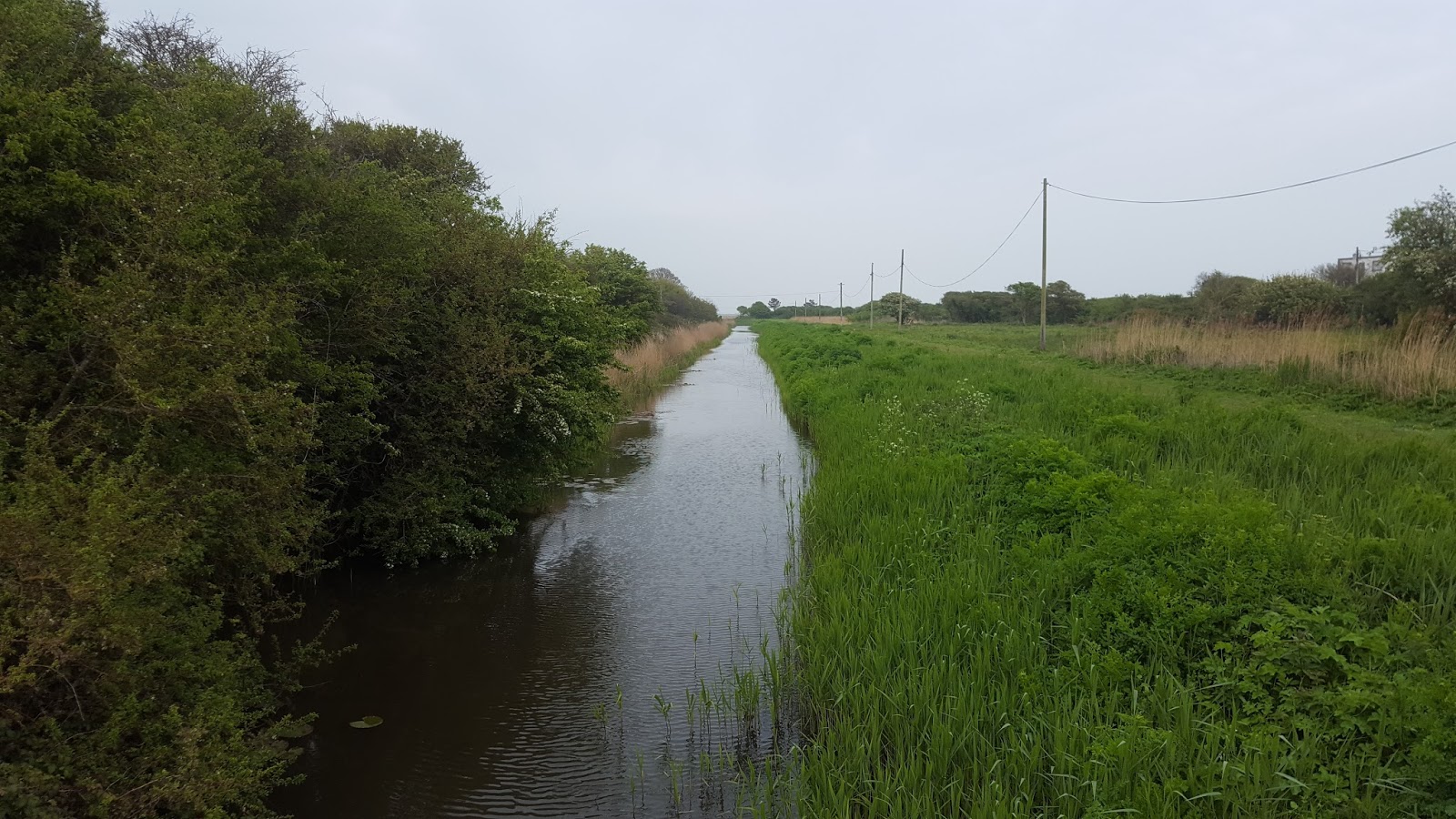
The hills had pretty much come to an end and we entered a 'pancake-flat' stretch. Past old pill boxes and the Royal Military Canal built by William Pitt the Younger to deter a feared invasion from Napoleon. The invasion never happened but it's unclear how a 12ft canal would have deterred an army that had just crossed the channel. Either way it was a pretty stretch which led us on to the Pett Level where we were exposed to some mild, and not intolerable, wind.
There were sheep, cows, and a swan glid by as if off for a pint down The Smuggler's. Less attractively a baby lamb lay dead in the canal. At one point the Dimsdale Sewer (not as stinky as it sounds, honest) ran the other side of us and we were hemmed in my two separate water channels.
We turned off the canal and headed up a quiet road into Winchelsea, our final destination. Winchelsea is a tiny village now but was once a far bigger deal. Edward I employed a French architect to design the town along the lines of a bastide (fortified town) on a neat grid plan that stands 'til this day. Winchelsea became a vital link in the wine trade with Bordeaux and, when the River Brede was wide and flourishing, each merchant (fish, wool, cheese, and salt were also traded here) took advantage of the links to France and the good road into London.
The king imposed a perpetual rent on the town in return for the costs of building it and a sum of £14, a figure that has remained unchanged, is still collected annually. Winchelsea, along with nearby Rye (which we considered getting a ticket to so I could name this blog Ticket to Rye), was, due to its strategic significance, added to the list of Cinque Ports that already included Hastings, New Romney, Hythe, Sandwich, and Dover. Britain, at that time, had no navy and these ports were the first, only, line of defence against possible invasion. In exchange for providing ships and men for a certain number of days a year the ports were granted freedom from taxation and granted self-governance.
Smuggling prospered, however, and the town's wealth and location made it vulnerable to attack. In 1359 the French stormed Winchelsea and killed forty people whilst burning and looting the town. Similar invasions took place in 1360, 1380, and 1449 but it was natural forces, in the end, that brought to an end the golden era of Winchelsea. In the early 16c great masses of shingle caused the Brede to silt up and narrow and the town's days as a port were over.
You can get a sense of it's former majesty by walking through the New Gate (below). Once a medieval entrance to the town but now some distance from any sign of life - except some weary walkers. Looking back through the gate you can see the early 16c farmhouse of Wickham Manor, a sight that Shep claimed to be barely worth turning round for! The philistine!
As we closed in on Winchelsea itself I was taken aback by its beauty. I'd known next to nothing about the place yet the ruins, the trees, they all, in the late afternoon sun, seemed to have an almost surreal aesthetic about them. I thought about the art of Paul Nash and how sometimes, in his paintings, trees stood in for people.
Daniel Defoe and John Wesley (who once preached sermons against smuggling here) both compared the town to a skeleton and you can see why. You can also see why artists and authors like Ford Madox Ford, Henry James, William Makepeace Thackeray, Radclyffe Hall, and Joseph Conrad were so attracted to the place. Spike Milligan's even buried here in the graveyard of the huge and imposing Church of St Thomas the Martyr.
We watched the sun go down and turn the church first orange, then red, from the nearby New Inn. I had an Old Speckled Hen and a couple of East Coast IPAs, Pam tried a gin infused pint of pale ale, Kathy got busy with her regulation goldfish bowl of gin, and Adam, Teresa, and Shep (even Shep) had a latte. The barmaid could barely believe he'd placed the order and she doesn't even know him. I started to wonder if my thoughts were being passed directly to her larynx somehow.
The staff in The New Inn were mega-friendly. They didn't let us have the WiFi code because it was open to all. The music was a bit shit, one of those dreadful compilations of White Stripes and Radiohead songs reduced to tasteful, and offensively bland, acoustic covers, and the pub was a little quiet but it was, after a fairly stiff old walk, just the ticket. No curry (or Bangla) for a second walk in a row so Teresa and I had mac'n'cheese and the rest opted for falafel burgers. I finished up with a tasty mint choc chip'n'vanilla ice cream and we walked another kilometre along the dark unpaved road to Winchelsea's tiny train station that only had one platform.
Shep, Teresa, and Adam were heading back to Hastings where they'd booked a guest house. Pam, Kathy, and I took the train to Ashford International where I said goodbye to them before taking one more train to Victoria, another to Peckham Rye, and a bus home. It was nearly 1am and I'd been up for the best part of twenty hours but it'd all been worth it. I don't think I could ever get bored of celebrating good countryside, good food, good ale, and, most importantly of all, good friendships. Here's to the next one.
Subscribe to:
Posts (Atom)