Monday, 20 March 2017

America after the Fall.

"By uniting we stand. By dividing we fall" - John Dickinson.

The Royal Academy's new America After the Fall show may not have been as big as I'd expected but it was absolutely bursting with vitality and chock-full of absolutely wonderful paintings. The big selling point was that Grant Wood's American Gothic was to be shown in the UK for the first time ever but not only is that not the best painting in the show it's not even the best Grant Wood painting in the show.

The Art Deco font utilised on the information panels is a sign of how lovingly curated this exhibition is. It may be a small touch but it's a nice one. America in the 1930s saw the horrors of the Dust Bowl, drought, and the Great Depression. Woody Guthrie sang about it, John Steinbeck wrote about it, and Dorothea Lange photographed it. Many of those who were living in it migrated to rapidly growing cities where they were joined by Europeans fleeing fascism. America, then at least, was seen as a friendly land of liberty where people would be safe and free from persecution.

Of course that wasn't the whole story but as Europe was crumbling under what would now be called populist rule America, with her more forward looking policies (except where race was concerned), went from strength to strength. It was in this decade, 1931, James Truslow Adams coined the term 'American Dream', an ethos of democracy, rights, opportunity, and equality. He wrote, in The Epic of America, of the "dream of a land in which life should be better and richer and fuller for everyone, with opportunity for each according to ability or achievement. It is a difficult dream for the European upper classes to interpret adequately and too many of us ourselves have grown weary and mistrustful of it. It is not a dream of motor cars and high wages merely, but a dream of social order in which each man and each woman shall be able to attain to the fullest stature of which they are innately capable, and be recognized by others for what they are, regardless of the fortuitous circumstances of birth or position".

It was admirable stuff but it was a lot easier to say than do. Later in the decade President Franklin Delano Roosevelt launched his New Deal with the aim of providing relief, recovery, and reform (the 3 Rs) for those who'd been most adversely affected by the Great Depression. Advances in social security were, of course, contested by Republicans but, by and large, history looks back favourably on both the New Deal and FDR's twelve year tenure.

It wasn't as if the rich were suffering because the country was helping the poor. Quite the opposite. Between 1890 and 1930 the US doubled in population and, for the first time in her history, more people were living in cities than in rural areas. New York was the greatest of all cities and as Art Deco skyscrapers like Raymond Hood's Rockefeller Centre, William Van Alen's Chrysler Building, and, the daddy of them all, the Empire State Building began to dominate the skyline American artists looked to respond to this new world.

 
Charles Green Shaw - Wrigley's (1937)

Aaron Douglas - Aspiration (1936)

Stuart Davis - New York (1931)
Charles Green Shaw predated Pop Art when he made use of the iconic Chicagoan chewing gum logo and set it against a backdrop of skyscrapers that could just as easily be building blocks. It borrows something from de Chirico's metaphysical paintings and Morandi's rectilinear simplicity. Swinging curves were permitted alongside the straight lines, though, and Aaron Douglas and Stuart Davis seem to have caught the jazz bug that was sweeping the country at the time. In New York Davis seems to be paving the way for Ed Ruscha six years before that artist's birth.

Industrialisation and increased city living played out in the works of Charles Demuth and Charles Sheeler too. Sheeler's American Landscape reflects the heavy industry of Pennsylvania where he was born. Now deindustrialised it's very much the Rust Belt from where Trump garnered much of his support. These paintings of nominally ugly things are invested with a beauty and dignity by Demuth and Sheeler's majestic depictions.


Charles Demuth - ....and the Home of the Brave (1931)

Charles Sheeler - American Landscape (1930)

Alice Neel - Pat Whalen (1935)
Alice Neel did the same for Irish union leader Pat Whalen and Joe Jones' Roustabouts populates these urban landscapes with actual humans complete with both their many foibles and graces. The Ford Motor Company's River Rouge Complex had become the largest factory on Earth and the Star Spangled Banner had become the national anthem but not all artists responded favourably to these developments. Neel was a committed communist and others looked to the loneliness that could be found just as easily in a crowded city as in America's remotest wildernesses.
Most notably of course Edward Hopper. I find his paintings more wistful than sad or depressing. Gas is as good example as any. We simply can't read the emotion of the man at the gas station so we imbue it with our meaning by conjuring up our own experiences, feelings, and memories. It's one of the many things that's so great about Hopper. He lets us do some of the work and, because of that, we share some of the reward.

Joe Jones - Roustabouts (1934)

Edward Hopper - Gas (1940)
After a hard week at the factory, or on the docks, there was fun to be had. William H Johnson's Harlem scenes look way ahead of their time whilst Cadmus' The Fleet's In, despite focusing on bawdy sailors on shore leave, could almost be from the Renaissance. Both are equally effective in showing the Manhattan milieu at the time of the talkies and the Golden Age of Hollywood. Philip Evergood's Dance Marathon (there was a craze for them at the time) doesn't look a lot of fun at all. It has something of the ghastly quality of a James Ensor. The grotesque mise en scene so expertly rendered you're loth to look away in case you miss something.

William H Johnson - Street Life, Harlem (1939)

Paul Cadmus - The Fleet's In (1934)

Philip Evergood - Dance Marathon (1934)
I kept returning, too, to Grant Wood's Midnight Ride of Paul Revere. Amongst tough competition it was my favourite painting of the exhibition. Mysterious, eerie, and utterly compelling. I'd not seen anything quite like it since an El Greco exhibition at the National Gallery many years ago.
It overshadowed everything else in the room with it though Paul Sample's almost Bruegelesque Church Supper and Charles Sheeler's Shaker furniture inspired Home Sweet Home were charming. Sheeler may not have been a Regionalist artist himself but this admiration of simplicity and rustic values as a bulwark against encroaching modernism was certainly well attuned to the ideologies of that group.


Grant Wood - The Midnight Ride of Paul Revere (1931)

Paul Sample - Church Supper (1933)

Charles Sheeler - Home Sweet Home (1931)
In some ways the Regionalists, with their comforting depictions of Mid Western rural idylls, were conservative throwbacks yet many of their paintings continue to astound. Alexandre Hogue's landscape looks like a comfy bed and it takes a little while to notice the female form. It's a nod towards the Surrealism that was already huge in Europe and would soon find itself slipping into a more American form.
Grant Wood's rolling hills can look both idealistic and unsettling at the time. Much like his iconic American Gothic (on loan from the Art Institute of Chicago). It's long debated if Wood was cocking a snook at the supposed values of the rural Iowans or showing solidarity for and respect with them. It's a painting that's been endlessly parodied. Even the most perfunctory Google search will find Trump and Clinton, Darth Vader and Princess Leia, Popeye and Olive Oyl, the Flintstones, Minions, and the stars of Breaking Bad. The parodies are as deathless as the painting. To have such effect it must be, and is, a fantastic piece of art but it's very hard not to view it through countless prisms of irony these days.


Alexandre Hogue - Erosion No.2:Mother Earth Laid Bare (1936)

Grant Wood - Young Corn (1931)

Grant Wood - American Gothic (1930)
So I gazed at it for a respectful amount of time, even having a brief moment with it to myself, before moving on to the equally conflicted Regionalism of Thomas Hart Benton. His rural scenes don't look so idyllic. They look tough and I couldn't be sure if his elongated forms were artistic devices or reportage. Georgia O'Keeffe's ruminations on the harsh landscapes of the frontier lands suggest the latter. Ivan Albright's self-portrait is as fractured as the cracked desert earth. It could be a Bacon, a Freud, or even an Auerbach. These British artists surely took influence from much of the work on show here.

Thomas Hart Benton - Cotton Pickers (1945)

Georgia O'Keeffe - Cow's Skull with Calico Rose (1931)

Ivan Albright - Self-portrait (1935)

Grant Wood - Death on the Ridge Road (1935)
If you added a splash of Fauvist colour to Grant Wood's Death on the Ridge Road you wouldn't be too far away from some of David Hockney's recent landscapes. It's no surprise he spent so much of his career working in America. Death on the Ridge Road has political allusions too. We can all see the head on crash coming but we're all powerless to do anything about it. It's highly possible that the curators of this exhibition were trying to hint at parallels between the 1930s and the current moronic, and venal, administration in the White House.
Joe Jones' American Justice leaves pretty much nothing to the imagination. This isn't a metaphor or an allegory. It's a straight out depiction of something very very wrong indeed and, more than eighty years later, it still has the power to shock. In fact with the emergence of alt-right figureheads and even the KKK themselves it's more topical than it has been for decades. What a fucking shame.

Joe Jones - American Justice (1933)
The surrealism that did arrive in America, much like the Surrealism of Europe, seemed to be turning away from the very real horrors the people of the world were inflicting upon each other and looking to internalise the macabre machinations of man's psyche. Darkened faceless figures, collapsing architecture, and a retrospectively bizarre reliance on Lenin as some kind of saviour (despite many of the artists involved receiveing funding from FDR's New Deal) became the tropes of the Stateside Surreal. It wouldn't be the last time a Russian leader was implicated in the American politic. Nor would it be the last time folks rebelled against those providing them with financial assistance during hard times as those in Cornwall will be able to tell you after Brexit.

Federico Castellon - Dark Figure (1938)

O Louis Guglielmi - Mental Geography (1938)

Peter Blume - Eternal City (1934-1937)

O Louis Guglielmi - Phoenix (1935)
War was raging across Spain and soon to engulf all of Europe and much of the world. Regionalism didn't really have an answer. Abstract Expressionism would soon become the dominant form and some of its practioners were already finding their way towards it. Philip Guston's Bombardment was his response to the bombing of Guernica. Though nothing could have the power of Picasso's masterpiece it was, nevertheless, a highly powerful work that boldly made use of the tondo form so popular in Renaissance Italy.
Ilya Boltowsky and George L K Morris moved away from figuration towards pure abstraction. They sought a new American style, paradoxically, in European artists like Picasso, Braque, and Miro. Another future Abstract Expressionist found influence in fusing the style of his teacher, Thomas Hart Benton, and the Mexican muralist David Alfaro Siqueiros. Pollock was to become the most famous Abstract Expressionist of them all, Jack the Dripper, but in his untitled work from the end of the 30s we can see a different side to him, the young painter, still in his twenties, obviously talented but still yet to find his style. When he, and others, found that (American) style the centre of the art world shifted from Paris, clearly helped by the war and the Nazi occupation, to New York.
New York was now where artists could dream of making it big but as Abstract Expressionism and Pop Art became the dominant styles something of the loose, experimental nature of the 30s was lost. The Royal Academy have done a terrific job providing us with a whirlwind tour of a decade, not unlike the one we're living in now, when outcomes, both in art and life, were uncertain and the painters of that time worked with necessary urgency to capture that,

Philip Guston - Bombardment (1937)

Ilya Boltowsky - Study for the hall of Medical Sciences Mural at 1939 World's Fair in New York (1938-1939)

George L K Morris - Indian Composition No.6 (1938)

Jackson Pollock - Untitled (1938-1941)

The quote from Founding Father John Dickinson that topped this piece came from 1789's Liberty Song. It was still relevant in 1932 when the US celebrated the bicentennial of George Washington. It's more relevant than ever now the reins of power are in the hands of divisive and amoral demagogues. This exhibition was a timely rejoinder of all that's great, and not so great, about America and how the concept of founding a country on an idea was such a bold, and admirable, thing to do. Militaristic adventures weren't the only reason the US became the most powerful nation on Earth but future militaristic adventures could soon see that title wrested away from Uncle Sam.

Thanks to Sanda and Kathy for accompanying me to this marvellous exhibition and for the debrief over hot drinks and shortbread afterwards.


Thursday, 16 March 2017

Bouchra Khalili:Maps of the Migrants.

"A map of the world that does not include Utopia is not even worth glancing at" - Oscar Wilde, The Soul of Man Under Socialism.

French-Moroccan artist Bouchra Khalili's Mapping Journey Project (at the Lisson Gallery just off London's Edgware Road) is the best, and most thought provoking, art I've seen focusing on the migrant crisis since Gideon Mendel's Dzhangal at the Autograph ABP Gallery in January. In common with Mendel's work Khalili seeks to see the individual humans involved and, in doing this, to cement in our heads that this, above and beyond anything else, is a humanitarian crisis.

The bulk of the exhibition is given over to eight large screens. Each one shows a different film in which an unnamed narrator tells their story of migration whilst their hand marks out the route on a map. I love maps at the best of times but this is far more than a celebration of either geography or cartography. It's a simple, and highly effective, method of getting us to sit down and listen to stories told by those who lived them rather than through the prism of the press.

The fact that the Algerian who travelled to Marseille via Sardinia, Naples, Milan, and Paris, on the way being coerced into illegally selling cigarettes and taking on back breaking leaflet delivery work, had probably the easiest journey of all should be enough to cause concern. We left him pondering joining the Foreign Legion.

A young Tunisian travelled to Libya to catch a boat to Lampedusa where he was arrested by Italian police and taken to Bari to stay in a Red Cross camp. He made his way from Bari to Naples where he found digs and work in a market. He journeyed north to Rome and on to Marseille where he now hopes to get papers, became a European citizen, and, one day, see his mum again.

Another North African began his journey in Beni Mallal, Morocco. He reached the northern port of Tangier before crossing to Algeciras in Spain where he spent four days in an orphanage. Arriving in Alicante he spent two years working on a farm before driving through France into Italy to reach Milan. Staying with family in Italy didn't work out so he went back to Spain. Barcelona. Alicante. Girona. Then to Breda, Holland where the expected work didn't show up. On to Utrecht to work in a phone shop before heading back to Alicante to see his lawyer. His application was rejected so he went to pick apples in France. He's since returned to Barcelona where he waits, in hope, to get his papers.

Equally exhausting is the Afghan who travelled through Iran, Turkey (spending four months in Istanbul), Bulgaria (two months in Sofia), Hungary, Austria, Germany (three months in Munich), Belgium, and eventually England before heading back to Rome via Paris and Milan.

A young Somalian lady took on an equally epic journey. From Mogadishu she travelled to Addis Ababa in Ethiopia and on to Gedarif in Sudan. She took a bus to Khartoum though she says it was more a glorified car. Then another 'bus' to Kufra in Libya. A five day ride in sweltering heat half-choking on sand. A planned ride to Tripoli was diverted via Benghazi. In Tripoli she spent two months before she could board a boat to Lampedusa and, finally, Palermo. In Italy she spent another two months in an asylum centre before being sent to Bari where she now lives, works, and speaks Italian. She's happier than in Somalia but would still prefer to be in either Norway or England.


Possibly the most mind-boggling story of all comes from a Bangladeshi man. He'd always had a dream of improving his life, like all the others, and had got it into his head that Italy would be the country he could do this in. He left Bangladesh for New Delhi and, via Moscow, reached Skopje in Macedonia. There he ran into problems with the Macedonian authorities and was jailed for eight months before being sent back to Bangladesh.

After five months he tried again. This time he travelled to Dubai from where he flew to Bamako in Mali. He ended up spending three months in Bamako as the man who said he'd sort out his passport disappeared. Giving up on that he paid 1000 euros to get into Spain. To get there he travelled to Niamey in Niger and then Agadez in that same country. Next was Algeria where he was arrested (again) and jailed for four months before being sent back to Niger to work in a sugar factory.

A six month journey, mostly spent walking through the desert, saw him reach Ghat in Libya where he was beaten up and, one more time, arrested by police. After three months in a Libyan prison the chief of police, somewhat bizarrely, gave him a job. He worked in Sabha for a year before taking a car to Tripoli and a boat from Zuwarah (at a cost of 2500 euros) to Lampedusa.

They went the wrong way though. All 24 people on their small plastic boat may've died if a large ship hadn't passed by and put them back on course. After a week they landed on Lampedusa where our narrator was taken in and started to attend school as he was, unbelievably considering all that had happened, still a minor. He learnt Italian and got a job in a bar in Rome where he works to this day. It'd been a five year journey and one he'd taken, for the simple and admirable reason, of trying to help his family.


None of this obviously fits with the narrative we're served up daily of lazy or criminal immigrants and the way Khalili had allowed these people to speak for themselves said volumes. I realised how rarely we hear the voices of those that are most adversely affected by the current geopolitical situation.

It would've been hard for the rest of the exhibition to match up to these films and, to be honest, it didn't. There's another film, Foreign Office,  that touches on the experiences of a female Omani freedom fighter. It contains music by both Archie Shepp and Miriam Makeba and makes use of the mantra "Jazz is a black power. Jazz is an African power".

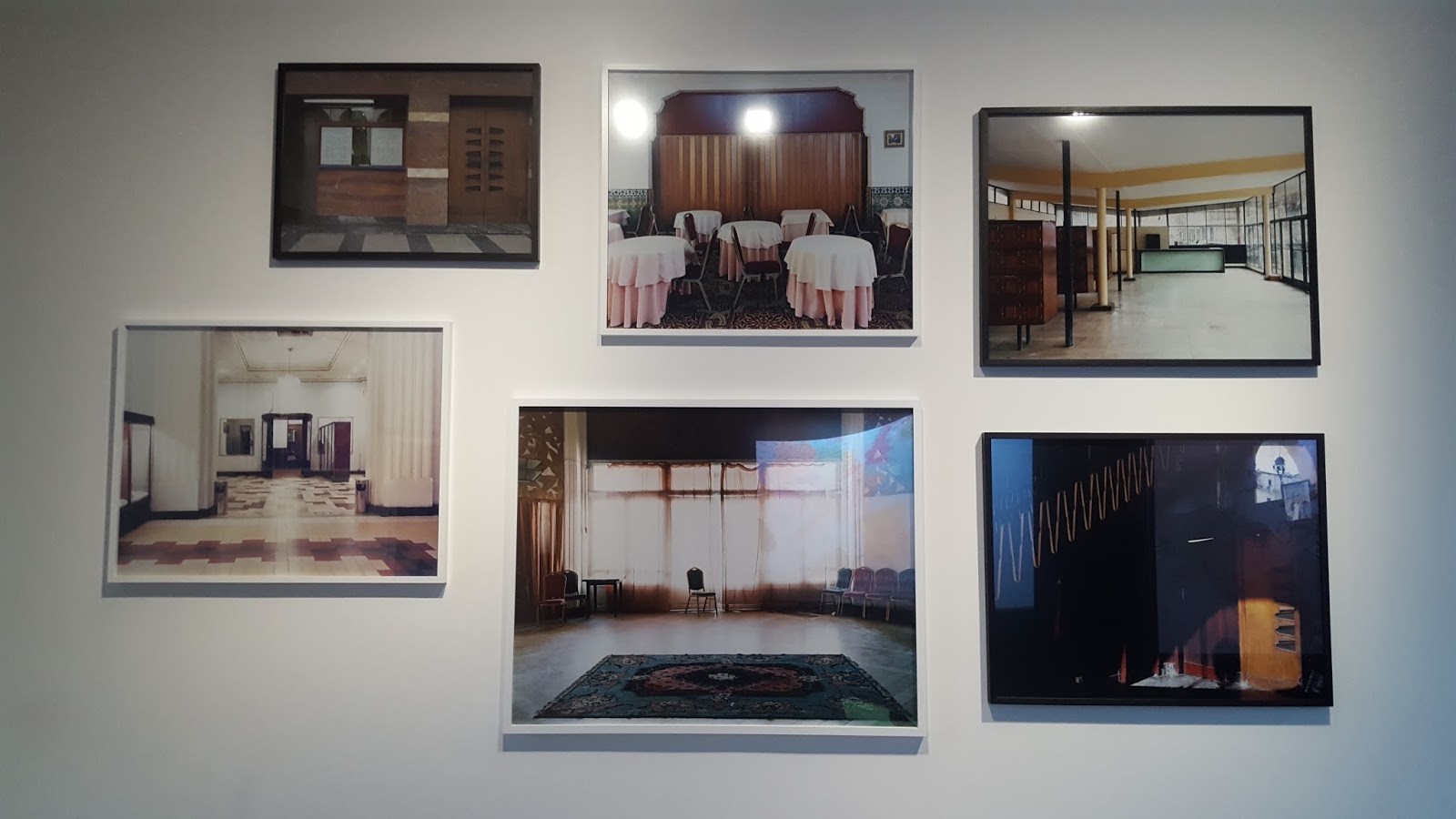
It is said that Christians go to Jerusalem, Muslims go to Mecca, and revolutionaries go to Algiers. To this end Khalili has provided some more maps. This time of the Algerian capital and she's marked out various points of interest on them. After Algerian independence from France Algiers housed HQs for a wealth of disparate, if sometimes interconnected, pro-independence and revolutionary groups. Movements from Guinea, Cape Verde, Mozambique, Angola, Portugal, Zimbabwe, Eritrea, Quebec, Oman, and South Vietnam all had addresses in Algiers. Palestine had several. Even the Canaries Archipelago had one. The photographs that adorn the walls of the gallery (and this blog) show some of the different architectural locations that this band of internationalists utilised to foment revolution.

The Black Panthers splinter group run by Eldridge Cleaver were there too. The father group in Oakland had disowned them but Khalili, in one of her few failings, makes hazy links with Nelson Mandela, Malcolm X, Agostinho Neto, and even Chris Marker. It's not that I'm disputing the validity of these links. I'm just saying I could've done with the level of clarity she'd provided with her migratory maps.


If it's in the nature of art to sometimes obfuscate then that's fine but I felt Khalili's work was better when it was bolder and more lucid. The quote from Gilles Deleuze and Felix Guattari, "The very conditions that make the State possible....trace creative lines of escape", didn't speak, to me, anywhere near as loudly as the simple pen lines over maps of Europe, Africa, and Asia and the testimony of those who made them.

The socially constructed nature of borders were laid as bare as the useless nationalism some of us still cling to. Metaphorically, and morally, as lost at sea as twenty four migrants on a boat between Zuwarah and Lampedusa. To even stand a chance of solving this huge, and highly complicated, issue, we'll need to listen to more of these voices and I applaud Bouchra Khalili for taking a small, but hugely significant, step in the right direction with her powerful and necessary installation.


Wednesday, 15 March 2017

Return to Sicily.

"We improve ourselves through other cultures. It's in our DNA".

These words, spoken towards the end of Michael Scott's excellent two parter Sicily:The Wonder of the Mediterranean, could serve not just as a manifesto for the island but for the whole of an increasingly insular Europe that is seeing individual nations turning away foreigners and blaming 'the other' for their own woes. As the Sicilian mayor says "Welcome is the best guarantee of safety".

Scott's a historian, not a politician, but in such vexed times do we live it's hard for him not to weigh in with a couple of pointed barbs. He's earned his right to. He's a great presenter. Knowledgeable and enthusiastic about his subject and a game sport when it comes to joining in. Witness him crushing grapes underfoot, stick fighting, and speaking, what sounds to me, pretty fluent Italian.

I'd really enjoyed the British Museum's Sicily:Culture and Conquest exhibition last year so the chance to learn a bit more about the Mediterranean's largest island was grasped with both hands. The programmes cover some of the same ground that the exhibition did but fill in some of the gaps also.

Scott starts in the beautiful city of Syracuse, founded by the ancient Greeks 2,700 years ago. Its church is five hundred years older than Christ himself. It only became Christian under Byzantine rule and later, after the Arab conquest, was converted into a mosque. The Normans turned it back in to a church. Its history acts as a microcosm of Sicily's own.


Sicily's position as a stepping stone between Europe and Africa was the key to its success. There's ample evidence of inhabitation before the arrival of the Greeks (rock cut tombs of ancient tribes for example). Under Europe's most active volcano, Etna, the Greek settlers cultivated olives and vines. Scott gets involved in the treading of the grapes. It was a practise that was continued until the 1990s before it was banned by the EU. If you take this as evidence of EU meddling you may wish to consider it was considered normal behaviour to urinate over the grapes whilst treading them. Time was precious. Lizards, too, managed to slip in to the grape juice and no doubt occasionally ended up in the drink. Ooh I could crush a grape!


Being Greek, in those days, wasn't a matter of geography. Put simply if you spoke Greek you were Greek. If you didn't you were a Barbarian. It's where that word comes from. Greek speakers thought people speaking other languages sounded like they were bahing like sheep!

As the Greeks dominated the east coast Phoenicians from present day Syria and Lebanon set up a trading post on a small western island, Motya. The rival Phoenician city of Carthage (in modern day Tunisia) seized Motya. Archaeologists now differentiate between the Carthaginians and the Motyans by their different shaped wells which just goes to show people will fight over pretty much anything. I wonder if they had different shaped gearsticks on their Mini Metros too.

Scott ponders urns of cremated children and the Greek sculpted marble Motya charioteer (check him out, he's got a fair sized dick on him) from the era. Phoenicians harvested salt from shallow lagoons. It's a custom that continues to this day so Scott, of course, dons the yellow wellies and shares in some ribald Sicilian humour.


When Carthage and the island's Greeks went to war the future of Sicily hung in the balance. We're shown the Iberian shin guards of a Spanish mercenary and a human vertebra with a bronze arrow embedded. The unfortunate Carthaginian had been shot in the back. The Greeks had won. They built a huge temple to celebrate. It looked out aggressively to the Med as if to say "come and have a go if you think you're hard enough".


The Zeus worshipping Athenians did but they failed to take Syracuse. The captives of war were put to use excavating the local quarries. Caravaggio arrived, on the run from a murder charge or something, and coined the name The Earl of Dionysius for these impressive quarries. They have something of the monumental power of a Richard Serra sculpture. Only more so. The Romans went so far as to call it their favourite prison. Imagine having a favourite prison.


Culture flourished alongside penal institutions. There were Euripides recitals and Sophocles debuted Oedipus Rex at the open air theatres. Probably under better weather than the Minack in Cornwall. Much Ado About Nothing is set in Sicily and our host, as ever, has a crack at joining in.

Carthage rose again and Greek rule came to an end but the Romans were the new guys on the island. Archimedes, a citizen of Syracuse, had designed catapults and a contraption called 'the claw' to defend against them, and for a while it worked. Brains beat brawn. But only briefly. A Roman soldier killed Archimedes. To this day no monument to the legendary mathematician stands in Syracuse. A shame.

Sicily was Rome's first foreign conquest. Rome saw off Carthage in the Punic Wars, possibly the biggest wars to have ever taken place at the time, yet Sicily didn't become Italian. The Sicilians still spoke Greek. In answer to the question what did the Romans ever do for Sicily we're left hanging. We get a quick look at the Necropolis of Agrigento before learning that, after the Romans, both the Vandals and the Ostrogoths took the reins of the island for a while before the Byzantines took over. They ruled from the Christian, Greek speaking, Constantinople. They later made Syracuse their new capital.


In 663AD an Islamic army arrived from Arabia. Ice cream for breakfast wasn't all they brought with them. Pasta was in Sicily before Marco Polo returned from China to give it to the rest of Italy. It'd come from the Arabs invited over by a rebellious Byzantine emperor in the 9th century. He may've come to regret that as within fifty years they'd taken control of the island. Palermo was made the new capital.

Christians and Jews had less rights than their Muslim overlords but they weren't forced to convert. The Arabs had brought pistachios, almonds, saffron, couscous, and water-cress. Delicious food and dubious religious dogma aside irrigation and agriculture made huge leaps under Islamic rule. Scott pops down a well to see for himself.

Palermo was a cosmopolitan melting pot. A column on the cathedral of Palermo even now contains a Qu'ranic inscription praising Allah. Islamic rule lasted for about two centuries until Norman mercenaries crossed the Straits of Messina. Robert and Roger de Hauteville found Sicily a tougher nut to crack than their fellow Norman, William the Conqueror, did England in the same year. Due to adapting a 'softly-softly' approach the conquest of Sicily took half a century.


The Castle of Venus was built in Erice and when rule was passed down to Roger II he had himself crowned first king of Sicily. The Palatine Chapel in Palermo was inaugurated in 1143. A highly heterodox edifice it was built after the great schism in Christianity and during the Crusades. As the world raged, fought, and killed over minor Abrahamic differences Sicilians, at least on the surface, celebrated inclusivity. Sicily was, at that time, Europe's third largest kingdom.


When Norman rule ended Frederick II found himself in power. A look at a Wikipedia timeline of Sicilian monarchs is exhausting and confusing but in 1282 five hundred years of Spanish rule began on the island. When Spain took over huge swathes of Latin America that affected Sicily too. The chocolate goodies were a positive but not much else was. The Spanish Inquisition and the expulsion of the Jews at the turn of the 16th century were particularly ugly events.

The Spanish Inquisition was active on Sicily for 300 years. Heretics were sought out, tortured, burnt, and executed. The graffiti in the palazzo made by those waiting for their trial (normally certain death) is utterly amazing. Scott goes as far as to compare their suffering as similar to that of Christ himself. When we look back on history it's never the men killing for religion that get given the Jesus treatment.


When the Inquisition ended in 1783 the inquisitors burnt their records so now the graffiti is all that stands to remind us of a very dark time in human history. Equally macabre are the mummified bodies in the Capuchin cemeteries. The last is that of a two year old girl from as recently as 1920. She's known as the sleeping beauty of Palermo. Rosalia Lombardo died of pneumonia and was named after the patron saint of Palermo. Because of her notoriety there has been some conflation between the two Rosalias. Pilgrimages to her shrine are made on hands and knees.


In 1693 a huge earthquake hit the island. Entire towns were destroyed and 60,000 people died. Afterwards, in a spirit of resilience, the Cathedral of San Giorgio was built in Modica. Further up the coast in Marsala, the port of Allah, Marsala wine was 'invented' by Yorkshire trader John Woodhouse.


He must've been popular for that but nothing compared to Garibaldi who arrived in Palermo to conquer Sicily in 1860. He finally freed it from the yoke of the Spanish Bourbons and started the path to Italian unification. Unification was such a cause celebre at the time that collections for it in London saw donations from both Charles Dickens and Florence Nightingale. The Sicilian referendum to join Italy saw a 99.5% yes vote (shove that in your pipe, Brexiteers) and Italy's largest opera house was built to celebrate.


As part of Italy things weren't completely plain sailing for Sicily. The Mafia is perhaps one of the things Sicily has become most infamous for. Scott visited a bar from The Godfather but the real story is much more depressing. Death followed death followed death. After Giovanni Falcone, a judge with a long history of prosecuting Mafia cases, his wife, and others were assassinated in an explosion on a motorway near Capaci in 1992 the Sicilian public realised things had got so bad that something had to be done.

This led to the arrest of mafia boss Salvatore Riina who was convicted of over 100 murders. Riina's still in prison now but his family left for their hometown of Corleone (yes, Corleone) from where Giovanni, Salvatore's son, continued the killing of those who wouldn't go along with his gang's extortion schemes.

The Mafia is still a problem in Sicily if not quite on the scale it once was. Nowadays when the World's cameras look to the island it's normally because of the migrant crisis. Scott travels to the island of Lampedusa. A Sicilian lifeguard, as heroic as the likes of Riina were cowardly, imparts, passively, that often they'll save 100 odd people from drowning in 10-15 minutes. In the waters of the Mediterranean these guys don't see colour, sex, religion, or nationality. They just see a fellow human being in trouble and use their own humanity to help out.


Under the shadow of Etna a young Sicilian lady and her husband grow vines. A 15ft high row of congealed lava from the volcano's last eruption borders her vineyard. There's a vine growing out of the lava. The roots have found a way to the sun. Even in the darkest times we can find a way to the sun. If Michael Scott's wonderful documentary taught me anything it's keep going on, never give up, one day the sun will shine.