Sunday, 16 October 2016

Fleapit revisited:The Clan.

Growing up in the UK at the time my knowledge of 1980s Argentina consisted mainly of the Guerra del Atlantico Sur (or The Falklands War if you prefer) and the pint sized footballing genius of Diego Armando Maradona. A man whose left hand became, for a while, even more famous than his feet.

I knew nothing of the Dirty War that was, and had been since the early 70s, playing out on Argentine soil. Over 7,000 left-wing activists, students, journalists, trade unionists, Marxists, and Peronist guerillas were killed by right-wing death squads and in retaliation took nearly as many lives in return. Leopoldo Galtieri was just one of four military dictators that led the country between 1981 and 1983.

It's against this backdrop that Pablo Trapero's crime drama plays out. It's closely based on the true story of the Puccios. A Buenos Aires family that used the political uncertainty and corruption of the time to get rich on the back of an ugly, violent, murderous kidnapping racket. 


Amongst middle class suburbia paterfamilias Arquimedes Puccio (played chillingly by Guillermo Francella) is the cold, calculated mastermind of a small mob dedicated to brutal extortion schemes. He's gentle, though not exactly loving, towards his family but seems capable of exploding into violence at any moment.

As his children grow older some are co-opted into the family business. Most importantly Alejandro (Peter Lanzini) who becomes the conflicted heart of the piece. A star rugby player nicknamed 'champ' and loved to the point of hero worship by both fans and team mates. He feels unease about destroying other people's lives but loves both his family and the extraordinary wealth it brings. So he carries on with it.

Lanzini's performance is great. His Kevin Keegan curls help cement him in our mind as a sports star of the era and such is his magnetism we can almost root for him, hope he can find the keys to the gilded cage his father has constructed for him and his family. New love Monica (Stefania Koessl), with her dreams of moving to Sweden, appears to give him the impetus to do this.


The other siblings are more sketched than fully realised. Brothers Maguila (Gaston Cocchiarale) and Guillermo (Franco Masini) are both out of the country for large parts of the film and the sisters appear to be shielded from Arquimedes and his gang's worst excesses for the most part. Silvia (Giselle Motta) looking out for her younger sister Adriana (Antonia Bengoechea) who becomes increasingly aware of what papa does for a living.

Their mother Epifania (Lili Popovich) is not, perhaps, unlike many other women of that era. She knows how Arquimedes makes his money and remains silently supportive of him. Perhaps mentally beaten into submission from years of psychological bullying. The admirable inscrutability of her performance makes it hard to tell.


What's not hard to tell is where the film's going. There are regular jump forwards to elements of the denouement and when the military dictatorship comes to an end and democracy takes over in Argentina the writing appears to be on the wall for the Puccios. It's abundantly clear that things will not end well - though not apparent who for.

That you care so much is testament to Trapero's tight, taut, storytelling and his eye for colour. Witness Arquimedes hosing down his yard in the early morning sunlight and then overseeing a brutal slaying by moonlight. The fact that the former act seems as sinister as the killing gives you an idea of how the tension has been ramped up.

Sebastian Escofet's score unobtrusively uses small tricks to highlight the unease in some of the seemingly ordinary family interactions and the use of pop music (The Kinks, Ella Fitzgerald and the Inkspots, er...David Lee Roth) to both delineate and link scenes may be borrowed from Scorsese but works a treat.

Clips of Argentine TV news from the time help to create context and though that all adds to the depth of the picture it's not necessary for you to know any more about Argentinian history than I did to appreciate this highly impressive, well shot, and well acted film. After watching I certainly wanted to learn more so not only was it an emotional cinematic event but an educational one too. Buen trabajo Senor Trapero.


Sunday, 9 October 2016

TADS #7:The High Weald Walk II (or Trusted of Tunbridge Wells).

Our last adventure on the Kent/East Sussex border was cut short due to a combination of rain, poor directional sense, dark nights drawing in, and chafing in the personal area. Such things don't defeat the TADS for long. A month approximately.

They were back down in Tunbridge Wells to complete the High Weald Walk. Strictly speaking it was KADS rather than TADS. Teresa had family commitments but Kathy was keen - as long as she wasn't playing out late. That was never likely to be a problem. The walk was short. We could even afford a wrong turn - and sure enough we got one.

I took a circuitous route to get to Tunbridge Wells. From Honor Oak Park it was a short hop to Penge West. From there I walked to Penge East. A new stop to me. The station stank of rasta shit and there were some seriously odd characters knocking about. Harmless. But odd. From there I took the train to Orpington. Kathy was already on board and we met Shep and Adam in the Pleasant Cafe in Tunbridge Wells where the lucky gits were indulding in veggie breakfasts and beans on toast.

We needed to get to Groombridge and pick up where we left off last time. So we decided to walk the route in reverse. That's not an easy task on the navigation front and pretty though it was, hey look at the photos, we, of course, took a wrong turn. A bum steer into Langton Green


Kind Mr T was not in the museum but the shop was open and I bought a Fry's Chocolate Cream. Tempting though the raspberry, strawberry, and local ale hut was we passed by. Down a road with no paths where it pissed it down. Adam knew a shortcut but we didn't take it. That was my fault.


On nearing the Crown Inn, Groombridge we saw a field full of goats and kids. Lovely - as was the pub. In honour of Kathy's month of abstinence I had a pint of Black Cat. They were playing Showaddywaddy. There were a couple sat around a big wooden table who had the same walking book as me. I'd never seen anyone else with one before. We sat for a brief chat with them. They lived on Brixton Hill. It was good to meet fellow South Londoners out in 'the sticks'.


After one pint I felt so refreshed I accidentally got the tip of my finger in my photo. We headed through a gate by the side of the church and reacquainted ourselves with the goats. A kid was sucking on his mum's teat while she did a big runny shit at the same time. I do love nature.


Groombridge Place had a moat. A fucking moat. We couldn't work out who lives there now but apparently Arthur Conan Doyle attended seances and wrote Valley of Fear there during one such sojourn. Keira Knightley had also been a guest during the filming of Pride and Prejudice. There was some debate about the swastikas on the wall. Adam told me they were originally a Hindu symbol of peace. I'm looking forward to our next walk when he tells me that the only one in ZZ Top that didn't have a beard was called Frank Beard.


Through the fields we yomped, Brown cow. Black cow. White cow. All the cows were there.


Choo choo! Thomas the Tank Engine puffed by. Cotton wool clouds puffing up in to the finery. The Fat Controller would've been very proud.


The obese patrician of Sodor would've been less impressed with the stink of the sewage works. At this point it started pissing it down. But we weren't far from the High Rocks pub. Or, indeed, the High Rocks themselves.


There was a wedding going on and the bouncer (at a wedding!?) told us it was too dangerous to come in. What the fuck sort of wedding is this? The penny soon dropped. He thought we were enquiring about climbing the high rocks. In October. In the rain. Dangerous indeed. The pub was anything but. Our Brixton walking buddies were ensconced already and I took a pint of Harvey's. Shep popped out for a vape and the smoke he produced was a very poor imitation of Thomas's steam.


Back to Tunbridge Wells where I went on a swing and saw crab apples of many different colours lying on the Kentish forest floor. The Guardian occasionally runs this thing where you send in photos on a theme. If they do autumn I've got something for them.


Through the wet and windswept Pantiles we wandered. Up hill to The Opera House. Possibly the poshest Wetherspoons in the UK. It's never pleasant to buff up Brexit wanker Tim Martin's bank balance but the Chennai IPA was as smooth as a goat's fur and we got it down pretty quick before retreating to the Bengal Brasserie.


Kathy and Adam were displeased with the slow service, vocally so, but I think Shep and I didn't really give a toss and just ordered another Cobra (no Bangla!). We all agreed the food was good. I had kodu bhaji, tarka dall, rice, and naan. It was better than it looked.


We took the train back to London. I got off at Waterloo East. I felt a bit sad. Summer very much over and, much as I enjoy it, the autumn does bring a little bit of melancholia with it. We've only one TADS walk left before the season is over. I need to do something with my life.

Friday, 7 October 2016

Picasso wins.

I was entering the National Portrait Gallery on the opening night of their new Picasso Portraits exhibition as a guy leaving at the same time exclaimed to the gallery attendant 'Picasso wins'. Apparently, he'd been to see the William Eggleston exhibition during the same visit and felt Pablo had come out on top. Art's not a sport but if it was you'd certainly hope to avoid coming up against such a titan of 20th century art in an early round of the cup. That just wouldn't be fair.

No other artist so accurately reflected the changes, the turmoil of that century. But as much as Pablo Picasso was a product of the 20th century the 20th century was, in some ways, a product of Pablo Picasso. Certainly he was at the forefront of nearly every major development in art that took place during his lifetime.

His career spanned decades and never once did he appear to be behind the times. With one eye on the future another was always looking back to the Old Masters whose influence he incorporated but never simply copied. One criticism of his portraiture was that all the portraits, even those of his many lovers, were essentially of him. Whilst, undoubtedly, the eye of the artist is present in these, and all, portraits, this wonderful exhibition makes it clear that Picasso did not simply see his own reflection in the faces of his sitters but strove, and succeeded, in getting to some elemental truth within.

The first couple of rooms definitely are self-portraits. Quite literally so. Some inspired by gloomy Norwegian Edvard Munch. Others show our hero sombre after Paul Cezanne's death in Aix-en-Provence. Self-Portrait with Palette from 1906, below, shows the young artist in his mid-twenties looking pensive yet quietly confident as he had every right to do.


He'd spent the first ten years of his life in Malaga in Andalusia but his father's work had taken the family to La Coruna, Galicia, in the far north-west corner of Spain. In 1895 they moved again to Barcelona where the young Pablo attended the School of Fine Arts. After a brief spell in Madrid he abandoned academia and joined a coterie of Catalan artists who'd meet at Els Quatre Gats, the tavern at the centre of Barcelona's avant-garde scene.

In 1900 he visited Paris for the first time and in 1904 he moved there. Between these two dates he painted himself in a top hat. Very much the flaneur this louche man-about-town affectation was no doubt influenced by Toulouse-Lautrec who passed away in 1901.


He took a studio in Montmartre and when the model Fernande Olivier moved in with him in 1905 women began to dominate his work. These twin obsessions with women and the work would continue throughout his life and these first few years in the French capital saw an astonishing acceleration in the way he worked. Compare and contrast the two portraits of Fernande below and then consider the first was painted in 1906 and the second only three years later.


When he wasn't painting his lover he was knocking out witty, scatological postcards of Guillaume Apollinaire, the forefather of Surrealism, and watercolours of bawdy sexual escapades. The jollity of these works gave way to a more sombre style, the blue period, after the suicide of a close Catalan friend, Carles Casagemas.

Portrait of Sebastia Jaunyer i Vidal from 1903 is a stunning example of these fin de seicle marvels. The blue filter lending the canvas a sorrowful, yet respectful, approach to the sitters. Picasso would often jest, even mock, his sitters but would always remain respectful.


Even with this 1957 portrait of the composer Francis Poulenc. It could be mistaken for that of a self-important dictator of the time but Poulenc saw in it only the articulation of the friendship that he and Picasso shared. He had a lot of friends and many of them were in high places. Jean Cocteau, Manuel de Falla, Igor Stravinsky, and Sergei Diagheliv all liked to be drawn by Picasso and he liked to draw them too.


In 1917 while working on a ballet in Rome (music by Erik Satie, of couse) Picasso met the Ukrainian ballerina Olga Khoklova who was to become his first wife. Her classical beauty reminded him of the society portraits Ingres had painted a century earlier and this, and Rome itself, became highly influential to his ever developing style.

In the mid-20s their relationship deteriorated and by 1935 they had legally separated. The three pictures below tell a story of their relationship. From the classical to the independent, sure of herself, woman to the twisted, contorted features of the final portrait. Almost a parody of a Picasso it boldly suggests a relationship, and a life, turned upside down.


As love faded with Olga it grew with Marie-Therese Walter (below in Woman in a Yellow Armchair, 1932). Blonde and buxom she was the antithesis of his wife. Picasso's taste in women was clearly as eclectic and comprehensive as his art.


Around this time he was feeling the influence of Rembrandt, El Greco, and Velazquez. Degas and Rapheael were depicted in Paris brothels. Tumescent cocks and cunnilingus abound. Accusations of sacrilege were countered by Picasso's assertion that the artists of the past were as alive to him as his friends and thus equally ripe for such caricature.

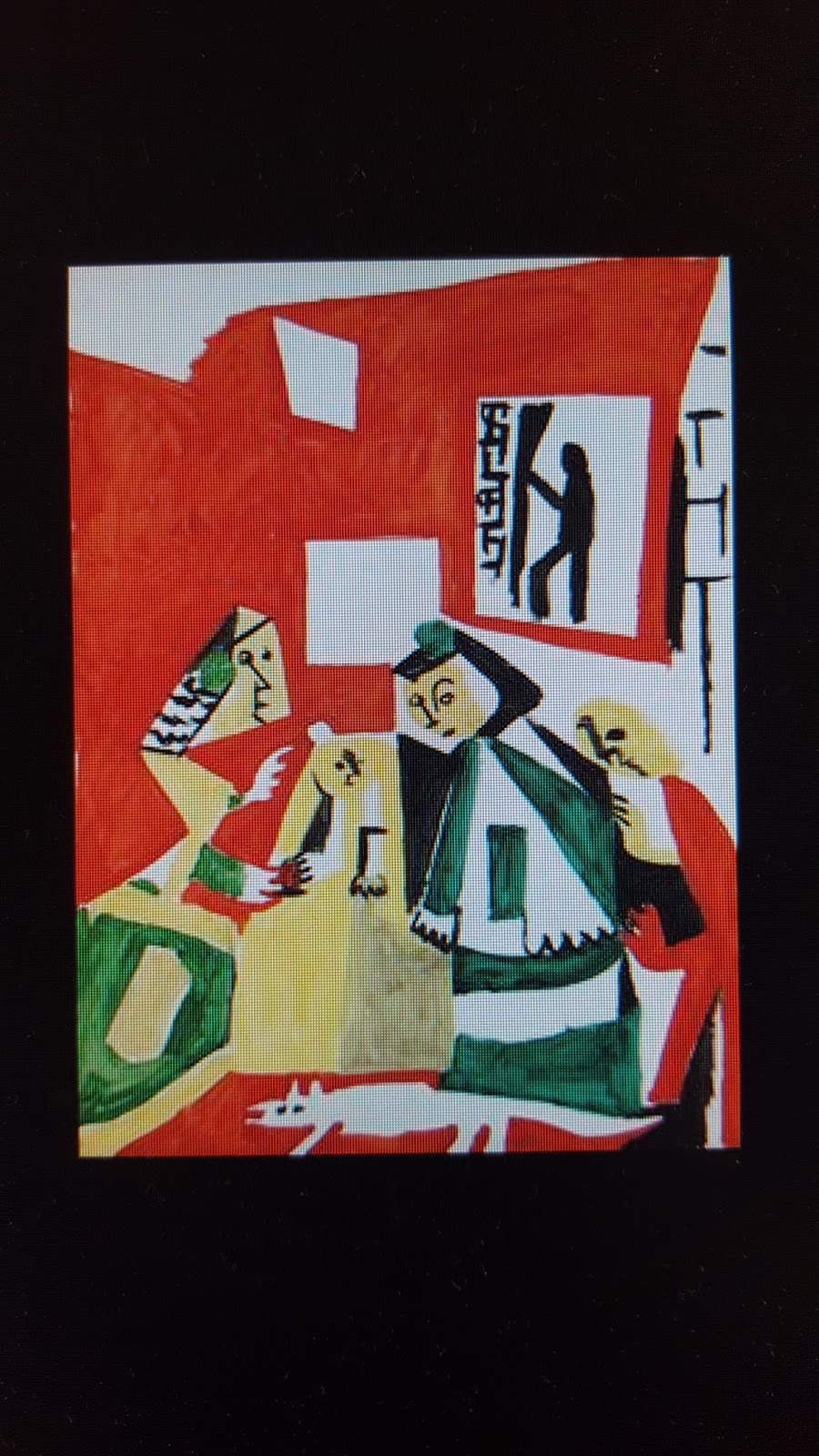
The influence of Velazquez, in particular, was so strong that in 1957 he devoted himself to a series inspired by Las Meninas. Painted in 1656 and hung in the Prado Picasso had not seen the original for over two decades but he didn't let that stop him. Further art historical reference can be read in to the heavy use of red in the painting. Henri Matisse had died in 1954 and the older artist held a strong attraction for Picasso. It's entirely plausible that we have an oblique reference to Matisse's masterpiece, The Red Room.


Velazquez had also been indirectly responsible for another of Picasso's relationships. The critic and author Francoise Gilot had visited the artist, forty years her senior, wearing a dress and a hairstyle that she knew would remind him of Velazquez. It did. They slept together that night and then stayed together for another ten years. That's her, below, in another armchair.


She'd replaced Dora Maar who'd replaced Marie-Therese Walter. In today's language, and culture, Picasso would clearly be considered a love rat - and worse still. Though some of his behaviour was clearly unpalatable it doesn't detract from, nor add to, his work.

Dora Maar was for Picasso the tragic embodiment of the Spanish Civil War and World War II. Her grotesquely exaggerated features in Woman In A Hat represents both the frailty of their relationship and the precarious state of Europe at that time. Yet, in his bronze Head of a Woman, we can also see that he saw in her the spirit, fortitude, and courage of a strong resistance fighter. Both these works were made in 1941 and tell of a dichotomy that Picasso seemed unable to reconcile.


He was with Jacqueline Roque from 1954 until his death in 1973. She devoted herself to the older man who painted her more times than any of his previous lovers. Often, as in Woman by a Window from 1956 below, in her favourite rocking chair. This devotion seems to have prolonged Picasso's career at a time others would be settling into their dotage. He saw in her echoes of Goya, Manet, and Delacroix.


In the last year of his life Picasso made a crayon drawing of his own head becoming a skull. A stark reminder to himself of his own very real mortality. Thirty-four years earlier he'd made the almost Peppa Pig like portrait of his daughter Maya in a sailor suit. The juxtaposition of these works, and many others would work equally well, show the range of the great man's portraiture skills. No one exhibition could ever do justice to the breadth of such a stellar career and life but this one gives a very good indication as to just how good he was.

Did Picasso win? Si, gano el premio a la mejor pintura del siglo XX y a causa de esto todos somos mas ricos.