In 1856, the same year the National Portrait Gallery was founded, a young textile industrialist named Pavel Tretyakov began collecting Russian art. 36 years later, in 1892, his collection was valued at 1,500,000 roubles (however much that is/was) and consisted of approximately 2,000 works. He donated it to Moscow and it now forms the core of the State Tretyakov Gallery - the world's largest collection of Russian art and that country's national gallery.
To commemorate a century and a half of both these institutions the NPG have got a lend of some of the Tretyakov's extensive collection of portraiture. Tretyakov himself commissioned Russia's leading painters of the day to depict their contemporary writers, actors, musicians, and even their patrons.
It's probably in the field of literature that 19th century Russia is most acclaimed. Russian writers of the day acquired unparalleled respect. Under autocratic rule and fierce scrutiny they nonetheless voiced their social, political, and moral concerns.
Some deployed subtle, and skilful, use of fiction and literary criticism to throw the censors off and get their voices heard. Others were so barbed in their critiques they could only be published abroad.
It's widely accepted that the three great novelists of the era were Dostoevsky, Tolstoy, and Turgenev. In 1849 the then 28 year old Dostoevsky was sentenced to a decade of penal servitude in Siberia for his involvement in an 'underground society'.
Vasily Perov's portrait of the much older man, above, 1872, hints at his pained inner life informed, as was his writing, from these experiences. He wrote of crime, depravity, illness, insanity, degradation, and irrationality. All the fun stuff. Oddly this painting became something of a meme in Russian society and his since appeared on stamps and biscuit tins.
Nikolai Ge painted Leo Tolstoy in 1884. Then in his late 50s and a writer of international repute. The portrait, below, shows a man, who corresponded with Gandhi and, later, devoted himself to philosophical and religious inquiry, working in Moscow on his, soon to be banned, tract What I Believe.
Ilia Repin travelled to Paris in 1874 to paint the emigre Ivan Turgenev. They didn't get on and Turgenev didn't like the picture. It shows. His grumpiness barely able to resist oozing out of the frame.
The literature boom went hand-in-hand with a flowering of Russian theatre. St.Petersburg's opulent Mariinsky balanced by it's elegant counterpart the Alexandrinsky whilst in Moscow the Bolshoy (sic) traded in pure spectacle as the Maly devoted itself to more intense works including those of Turgenev himself.
Most radical of all was the Moscow Art Theatre. Conceived by Konstantin Stanislavsky, father of method acting, and championing the works of Anton Chekhov. Iosif Braz's 1898 oil painting of Chekhov marks the era the former doctor, after several critical maulings, finally achieved success with The Seagull.
There was music too. Of course there was. There always should be. In 1862 Anton Rubinstein, who had played for Tsar Nicholas II at the Winter Palace aged just 14, founded the St.Petersburg conservatoire to develop homegrown musicians. His younger brother Nikolai did the same for Moscow. Some saw these as patriotic acts while others carped about the use of Western repertoire and professors.
Modest Mussorgsky and Nikola Rimsky-Korsakov responded in style. They
created identifiably Russian music, informed by folkloric traditions,
and became known (along with Balakirev, Cui, and Borodin) as The Five or, if you'd prefer,
The Mighty Handful.
Repin's portrait of Mussorgsky, above, was painted the year of the composer's death. 1881. His unkempt beard and ruddy nose telling the story of his chronic alcoholism. Much less the talent behind Pictures at an Exhibition and Boris Godunov.
Nikolai Kuznetsov painted Petr Tchaikovsky in Odessa in 1893. Tchaikovsky had won fame for Swan Lake and Eugene Onegin and had toured in Europe and the US. Kuznetsov managed to look behind that and capture some of the unease, the unhappiness, of a man who only married to cover up his homosexuality and now lived apart from his wife.
Rimsky-Korsakov seems a much less conflicted figure. Valentin Serov's 1898 depiction merely shows him immersed in his work.
Various patrons and critics flesh out the show up to a point. But as we move towards the 20th century and the mammoth upheavals that would visit Russia in that century the art becomes more interesting and takes over a little from the historical narrative that has dominated so far. It becomes more colourful too, more modern, and perhaps more Russian.
Olga Della-Vos-Kardovskaia's 1914 rendering of the poet Anna Akhmatova, above, puts a distinctly Russian spin on the fauvist/expressionist greats. It nods to Van Gogh, to Munch, and even to Matisse. The folds of the drapery even offer a callback to the Venetian Renaissance masters. But the work stands on its own. Proudly declaring the onset of a national art and hinting at Soviet styles to come.
Even more proto-Soviet, at least at surface level, is Ilia Repin's 1889 canvas of Baroness Varvara Iskul Von Hildebrandt, the wife of the Russian ambassador to Rome. There wasn'a red under this ambassador's bed. There was one in it! Statuesque hardly does it justice. But despite looking like a poster girl for Communism she actually departed for Finland, and eventually Paris, during the 1917 revolution.
It's curveballs like this that make for an intriguing and interesting exhibition. For logistical and art-historical reasons Russian art is probably not as well known in the UK as it should be. This show is a stepping stone towards a greater understanding and appreciation of it and as it'll only set you back a fiver I can recommend it. On that, this cat really is gone.
Friday, 6 May 2016
Thursday, 5 May 2016
Human after all.
The first Wednesday of the month meant it was time for another trip to Greenwich Skeptics in the Pub - and what a glorious day for it too. After the regulation pie'n'mash c/o Goddards I had a stroll, and a nice lie down, in Greenwich Park and a quick pint in CPFC pub The Plume of Feathers before heading down to The Star & Garter to get my skepticism on.
The evening's talk was being given by Chief Executive of the British Humanist Association Andrew Copson. He took over that position in January 2010 before he'd even celebrated his 30th birthday and I shan't allow my envy to colour my judgement of the evening.
He was here to offer an Introduction to Humanism and began by refuting some of the more common canards that often come attached to it. Humanism is not a western idea, it's a global one. It's not a post-religious idea that's evolved as a logical conclusion of spiritual ideas. Humanists haven't simply removed God (or gods) from the equation. They were never there.
For as long as human thought has been documented there have been humanist ideas and philosophies. 600BC (yes, we're using a Christian measuring stick - we don't need to throw out perfectly workable and reasonable ideas simply because they come from a different background) saw a flowering of humanist thought in Europe, specifically among ancient Greek philosophers from the Ionian school to Epicurus and Democritus, but also in India and China.
1200AD saw reason and rationality dominate debate in the Arabic world. It was, alas, a light that shined briefly. There's a great clip on YouTube where American astrophysicist Neil deGrasse Tyson lays the blame for the end of these advances squarely at the door of Persian Muslim theologian Abu Hamid Muhammad ibn Muhammad al-Ghazali who proposed a far more fundamentalist reading of the Qu'ran which has closed down scientific advances from a huge, and massively populous, area of the world for nearly a millennium. Very sad.
Heading further east Andrew spoke a little about the classical Indian materialists. Even an audience full of skeptics seemed to be in the dark here so it was enlightening to hear about the Charvaka school from 2,600 years ago who held as a mantra "O, the highly wise! Arrive at a conclusion, therefore, that there is nothing beyond this Universe. Give precedence to that which meets the eye and turn your back on what is beyond our knowledge."
Such is the vastness of Hindu philosophy and belief that the Charvaka philosophy was soon accepted as a Hindu school of thought. It seems bamboozling, if actually rather pleasant to me, that a system of belief can be so broad as to accept monotheistic worship, polytheistic gods, and atheism all under one banner. It made me curious to learn more about Hinduism.
Chinese religions and belief systems are another area I've never been very clear on. According to Andrew many of them (Taoism, Confucianism, Buddhism) manage to include both spiritual and secular aspects. Again, for me this is difficult to consolidate but something I'm certainly interested in learning more of.
Mengzi (or Mencius) was the most obviously humanist of the Confucian philosophers. He looked at the beauty of peacocks and decided that this beauty had not come from on high but from nature itself.
This, in many ways, predated the Utalitarianist beliefs of John Stuart Mill and Jeremy Bentham. The rise of Christianity around 600AD saw Europe entering the Dark Ages and much humanist literature destroyed by fundamentalist Christian clerics. Luckily they erred in holding on to the tracts which denounced these 'infidels' so, by fault rather than design, some invaluable historical documentation has been kept for the ages.
Andrew explained how humanism differed from atheism and skepticism. Though all humanists could be said to be both atheist and skeptical it's not necessarily true that all atheists could be said to be humanists. An atheist may see that there is no God, no higher power, no spiritual dimension, and take that to be a green light to lead a rapacious, selfish, and destructive life. Humanism insists upon its adherents working for the greater good. It looks for kindness, dialogue, and selflessness.
Obviously these aren't always possible but this is the ideal. This is what we should be striving for. In the Q&A after the talk Andrew was asked if there had been schisms within humanist groups. He said, on the whole, there hadn't. This is because humanism is not immutable. Ideas are not set in stone but there to be debated and, sometimes, changed.
Most countries have one main humanist group. In the USA and India there are many so it could be said there'd been disagreements there but they were more of an organisational and logistical nature than a philosophical one.
In Indonesia, Pakistan, and Malaysia humanist groups have to meet under false pretenses as they are outlawed. It's certainly Islamic majority countries, at the moment, that have the most problem with rational beliefs. You only need to read about the ongoing murders of atheist (and gay) bloggers in Bangladesh to realise this problem's not going away anytime soon.
In the West we shouldn't sit on our laurels although things have progressed reasonably well since the 50s. During that decade a lady suggested on the radio that religion and the state should be separated and religious instruction (not education) should not be taught in schools. This received more complaints than anything ever before broadcast and still held the record until Jerry Springer - The Opera a decade or so back.
Plenty of complaints also flooded in regarding the design of the Cenotaph. Now accepted and respected as an important monument to the war dead initially bishops were furious that it was not surmounted by a Christian cross. The lack of Christian insignia wasn't done as a sop to humanists or atheists, of course, but to not offend and pay tribute to the vast number of Muslims, Jews, Hindus, and Sikhs who fought against fascism in World War II.
Rightly so. But it does illustrate how those of no faith are still struggling to be held in equal regard to those of faith, any faith. On a day to day basis it doesn't really affect one's life. I've not heard of anyone being refused a job because they're godless but during larger state occasions it's noteworthy that heads of most major religions are offered an invite but there is nobody to represent the non-believers.
Andrew spoke about his dealings with various Archbishops of Canterbury and made it very clear he found Rowan Williams a much easier man to deal with than either his successor, George Carey, or his predecessor, Justin Welby.
This is sadly indicative of a trend in the last decade where the growth of rational thought has slowed down and many people have retreated into spiritualism or religion. Blame the Tories (they're to blame for most things so why not?). Blame the confusing and violent world we now live in. We really don't know why sometimes the most sensible belief systems struggle to gain ascendancy. It seems like it may always be thus.
That's quite depressing but I left the talk with a positive feeling and enamoured of the way Andrew dealt with a question from the audience. When asked if he respected religious people he replied, somewhat incredulously, that of course he did. He'd worked with many on humanitarian projects and would continue to do so. In fact he respected people of faith so much that he'd not do them the discourtesy of not questioning their beliefs.
So if you know someone who brings religion into the debate all the time, and it offends you or you think it's wrong, don't be afraid to tell them their views suck. Nicely though, of course.
With that I went home. My mind full of Bertrand Russell, Richard Dawkins, A C Grayling etc; Another inspiring evening down Greenwich way.
The evening's talk was being given by Chief Executive of the British Humanist Association Andrew Copson. He took over that position in January 2010 before he'd even celebrated his 30th birthday and I shan't allow my envy to colour my judgement of the evening.
He was here to offer an Introduction to Humanism and began by refuting some of the more common canards that often come attached to it. Humanism is not a western idea, it's a global one. It's not a post-religious idea that's evolved as a logical conclusion of spiritual ideas. Humanists haven't simply removed God (or gods) from the equation. They were never there.
For as long as human thought has been documented there have been humanist ideas and philosophies. 600BC (yes, we're using a Christian measuring stick - we don't need to throw out perfectly workable and reasonable ideas simply because they come from a different background) saw a flowering of humanist thought in Europe, specifically among ancient Greek philosophers from the Ionian school to Epicurus and Democritus, but also in India and China.
1200AD saw reason and rationality dominate debate in the Arabic world. It was, alas, a light that shined briefly. There's a great clip on YouTube where American astrophysicist Neil deGrasse Tyson lays the blame for the end of these advances squarely at the door of Persian Muslim theologian Abu Hamid Muhammad ibn Muhammad al-Ghazali who proposed a far more fundamentalist reading of the Qu'ran which has closed down scientific advances from a huge, and massively populous, area of the world for nearly a millennium. Very sad.
Heading further east Andrew spoke a little about the classical Indian materialists. Even an audience full of skeptics seemed to be in the dark here so it was enlightening to hear about the Charvaka school from 2,600 years ago who held as a mantra "O, the highly wise! Arrive at a conclusion, therefore, that there is nothing beyond this Universe. Give precedence to that which meets the eye and turn your back on what is beyond our knowledge."
Such is the vastness of Hindu philosophy and belief that the Charvaka philosophy was soon accepted as a Hindu school of thought. It seems bamboozling, if actually rather pleasant to me, that a system of belief can be so broad as to accept monotheistic worship, polytheistic gods, and atheism all under one banner. It made me curious to learn more about Hinduism.
Chinese religions and belief systems are another area I've never been very clear on. According to Andrew many of them (Taoism, Confucianism, Buddhism) manage to include both spiritual and secular aspects. Again, for me this is difficult to consolidate but something I'm certainly interested in learning more of.
Mengzi (or Mencius) was the most obviously humanist of the Confucian philosophers. He looked at the beauty of peacocks and decided that this beauty had not come from on high but from nature itself.
This, in many ways, predated the Utalitarianist beliefs of John Stuart Mill and Jeremy Bentham. The rise of Christianity around 600AD saw Europe entering the Dark Ages and much humanist literature destroyed by fundamentalist Christian clerics. Luckily they erred in holding on to the tracts which denounced these 'infidels' so, by fault rather than design, some invaluable historical documentation has been kept for the ages.
Andrew explained how humanism differed from atheism and skepticism. Though all humanists could be said to be both atheist and skeptical it's not necessarily true that all atheists could be said to be humanists. An atheist may see that there is no God, no higher power, no spiritual dimension, and take that to be a green light to lead a rapacious, selfish, and destructive life. Humanism insists upon its adherents working for the greater good. It looks for kindness, dialogue, and selflessness.
Obviously these aren't always possible but this is the ideal. This is what we should be striving for. In the Q&A after the talk Andrew was asked if there had been schisms within humanist groups. He said, on the whole, there hadn't. This is because humanism is not immutable. Ideas are not set in stone but there to be debated and, sometimes, changed.
Most countries have one main humanist group. In the USA and India there are many so it could be said there'd been disagreements there but they were more of an organisational and logistical nature than a philosophical one.
In Indonesia, Pakistan, and Malaysia humanist groups have to meet under false pretenses as they are outlawed. It's certainly Islamic majority countries, at the moment, that have the most problem with rational beliefs. You only need to read about the ongoing murders of atheist (and gay) bloggers in Bangladesh to realise this problem's not going away anytime soon.
In the West we shouldn't sit on our laurels although things have progressed reasonably well since the 50s. During that decade a lady suggested on the radio that religion and the state should be separated and religious instruction (not education) should not be taught in schools. This received more complaints than anything ever before broadcast and still held the record until Jerry Springer - The Opera a decade or so back.
Plenty of complaints also flooded in regarding the design of the Cenotaph. Now accepted and respected as an important monument to the war dead initially bishops were furious that it was not surmounted by a Christian cross. The lack of Christian insignia wasn't done as a sop to humanists or atheists, of course, but to not offend and pay tribute to the vast number of Muslims, Jews, Hindus, and Sikhs who fought against fascism in World War II.
Rightly so. But it does illustrate how those of no faith are still struggling to be held in equal regard to those of faith, any faith. On a day to day basis it doesn't really affect one's life. I've not heard of anyone being refused a job because they're godless but during larger state occasions it's noteworthy that heads of most major religions are offered an invite but there is nobody to represent the non-believers.
Andrew spoke about his dealings with various Archbishops of Canterbury and made it very clear he found Rowan Williams a much easier man to deal with than either his successor, George Carey, or his predecessor, Justin Welby.
This is sadly indicative of a trend in the last decade where the growth of rational thought has slowed down and many people have retreated into spiritualism or religion. Blame the Tories (they're to blame for most things so why not?). Blame the confusing and violent world we now live in. We really don't know why sometimes the most sensible belief systems struggle to gain ascendancy. It seems like it may always be thus.
That's quite depressing but I left the talk with a positive feeling and enamoured of the way Andrew dealt with a question from the audience. When asked if he respected religious people he replied, somewhat incredulously, that of course he did. He'd worked with many on humanitarian projects and would continue to do so. In fact he respected people of faith so much that he'd not do them the discourtesy of not questioning their beliefs.
So if you know someone who brings religion into the debate all the time, and it offends you or you think it's wrong, don't be afraid to tell them their views suck. Nicely though, of course.
With that I went home. My mind full of Bertrand Russell, Richard Dawkins, A C Grayling etc; Another inspiring evening down Greenwich way.
Monday, 2 May 2016
The small price of a bicycle
I like riding bikes. I like it now and I liked it when I was a kid. I loved my Grifter and I loved my BMX. I used to organise races for friends and compile lengthy lists and statistics collating the results. I lived in London far too long before buying a bike but in 2011 I finally got one and then last year upgraded to a slightly better model.
I also like museums. You may have noticed. One museum I like is the Design Museum. So when I saw they were hosting an exhibition 'Cycle Revolution' all about our two wheeled friends it went straight in the diary. This weekend I finally got along. Shamefully I didn't ride my bike there.
No doubt the post-Olympic popularity of cycling, both as sport, leisure pastime, and means of transport has enabled this show. I fully support the use of bikes for all three of these things although I find some of the ridiculously overpriced kit and fashion one-upmanship employed by a small minority of fellow cyclists does little to help the cause.
The Bauhaus inspired Design Museum is undergoing something of a refurb at the moment so once I'd managed to locate where the temporary door actually was I ambled up the stairs to see that the exhibition had been split into four sections:- High Performers, Thrill Seekers, Urban Riders, and Cargo Bikes.
The High Performers quarter really starts when Chris Boardman rode his Lotus 108 (first picture, below) to gold in the 1992 Barcelona Olympics before continuing through Bradley Wiggins's Tour De France win (on a modified Pinarello Dogma 2) and that same man's hour record. Before self-congratulatorily ending with a mention of Team GB's 14 medals in Beijing and eight golds in London.
As with the other sections there's some films you can watch. Also on show are the cycling jerseys of Chris Froome, Victoria Pendleton, and Nicole Cooke. There's a lot of helmets to look at too but mostly you're probably here to see the bikes. As well as the aforementioned Boardman machine you can see, in order below, Jo Rowsell's Shand Cervelo T4 track bike, Eddy Merckx's hour record bike, and Chris Froome's Victory Team Sky Pinarello Dogma K8-s.
Thrill Seekers begins with 1970s California mountain biking. Eventually mass produced stumpjumpers and slingshots appeared. BMX also began in California around the same time. It's represented here by Shanaze Reade (her bike below) but they could've equally gone for my cousin Sarah-Jane Nichols. If you want to know how good she was check her out on YouTube. It certainly makes me very proud as does the sterling work done by my local Peckham BMX track. Their reputation precedes them. Not just in the work they do as regards the sport but the care and attention they take in looking after local kids, many of them disadvantaged.
In this section you can also see a Raleigh Chopper. They still look cool but pre-BMX I was much more a Grifter kid myself. Sadly, there's no Grifters, Strikas, or Boxers here.
The Urban Riders section does exactly what it says on the tin. Mostly consisting of Bromptons and Moultons. The Bromptons are named thus because they were designed opposite Nick Cave's fave Brompton Oratory. There are currently 16,500,000 different variations of Brompton available and each one is still handmade. Though there's currently a problem with knock off copies flooding the market.
You can even hire a Brompton outside the museum once you're done with the show. You can obviously hire Boris bikes (if we must call them that, they were actually an idea Ken Livingstone imported from France) but would you risk riding an X-Bike around London?
I've never seen anyone on one but with London now said to contain 610,000 cycle journeys per day (or 223,000,000 per year) perhaps it's just a matter of time.
The Cargo Bikes section is perhaps the least interesting. Telling the history of cycle deliveries beginning in the 19th century with bread and milk delivery bikes and moving on to the sort of bikes you cycle while your children sit in a little box at the front. They have them in Dulwich Park and they look like fun. As do the fantastically named Bilenky Chuckwagon and the Boxer Rocket, both below.
An outlier in the show, and the oldest thing there, is 1888's Rover Safety bike. It doesn't look particularly safe by today's standards. In fact it looks something of a rustbucket death trap. But compared to the penny farthings it replaced it was quite a leap forward and still the basic bluprint for what a bike is today. It was designed by J.K.Starley in Coventry and that city, along with Birmingham and Nottingham, became the epicentre of the UK's bicycle manufacturing industry.
There's a room in the middle of the show that looks at the future of cycling. It's pretty Londoncentric, as is the rest of the show, but then it's in London I guess. There's some illuminating stats. For example in the UK 4% of people cycle each day compared to flat Holland's 43%. They're also keen here to stress the relative safety of road cycling. They claim only one cyclist is killed on UK roads for every 27,000,000 journeys cycled.
In attempts to make things even safer, and more environmentally friendly, we're introduced to a selection of prototypes. Wooden bikes, bamboo bikes, titanium bikes, three wheeled trikes, and electric bikes similar to the ones my parents (both now over 70) use. Some of them look more practical than others but I can't see myself zipping down the Old Kent Road on a Halfbike or a Velocino, both pictured undernearth, any time in the near future.
There's a look at advances made in the world's great cycling cities:- Bogota, Seville, Freiburg, and The Hague. This part of the show is particularly interesting to me as I'm more interested in sympathetic town planning than bike design per se. Every Sunday in Bogota huge swathes of road are made out of bounds to motorised traffic and taken over by cyclists. Bands and stalls set up and the whole thing becomes a weekly festival of the pushbike.
The fact I went there recently and didn't cycle feels a waste. The fact my bike's been parked up in my hallway all through the winter and most of the spring is even sillier. If nothing else this show has inspired me to blow the dust off the saddle, get back on it, and get the wind in my hair.
I also like museums. You may have noticed. One museum I like is the Design Museum. So when I saw they were hosting an exhibition 'Cycle Revolution' all about our two wheeled friends it went straight in the diary. This weekend I finally got along. Shamefully I didn't ride my bike there.
No doubt the post-Olympic popularity of cycling, both as sport, leisure pastime, and means of transport has enabled this show. I fully support the use of bikes for all three of these things although I find some of the ridiculously overpriced kit and fashion one-upmanship employed by a small minority of fellow cyclists does little to help the cause.
The Bauhaus inspired Design Museum is undergoing something of a refurb at the moment so once I'd managed to locate where the temporary door actually was I ambled up the stairs to see that the exhibition had been split into four sections:- High Performers, Thrill Seekers, Urban Riders, and Cargo Bikes.
The High Performers quarter really starts when Chris Boardman rode his Lotus 108 (first picture, below) to gold in the 1992 Barcelona Olympics before continuing through Bradley Wiggins's Tour De France win (on a modified Pinarello Dogma 2) and that same man's hour record. Before self-congratulatorily ending with a mention of Team GB's 14 medals in Beijing and eight golds in London.
As with the other sections there's some films you can watch. Also on show are the cycling jerseys of Chris Froome, Victoria Pendleton, and Nicole Cooke. There's a lot of helmets to look at too but mostly you're probably here to see the bikes. As well as the aforementioned Boardman machine you can see, in order below, Jo Rowsell's Shand Cervelo T4 track bike, Eddy Merckx's hour record bike, and Chris Froome's Victory Team Sky Pinarello Dogma K8-s.
Thrill Seekers begins with 1970s California mountain biking. Eventually mass produced stumpjumpers and slingshots appeared. BMX also began in California around the same time. It's represented here by Shanaze Reade (her bike below) but they could've equally gone for my cousin Sarah-Jane Nichols. If you want to know how good she was check her out on YouTube. It certainly makes me very proud as does the sterling work done by my local Peckham BMX track. Their reputation precedes them. Not just in the work they do as regards the sport but the care and attention they take in looking after local kids, many of them disadvantaged.
In this section you can also see a Raleigh Chopper. They still look cool but pre-BMX I was much more a Grifter kid myself. Sadly, there's no Grifters, Strikas, or Boxers here.
The Urban Riders section does exactly what it says on the tin. Mostly consisting of Bromptons and Moultons. The Bromptons are named thus because they were designed opposite Nick Cave's fave Brompton Oratory. There are currently 16,500,000 different variations of Brompton available and each one is still handmade. Though there's currently a problem with knock off copies flooding the market.
You can even hire a Brompton outside the museum once you're done with the show. You can obviously hire Boris bikes (if we must call them that, they were actually an idea Ken Livingstone imported from France) but would you risk riding an X-Bike around London?
I've never seen anyone on one but with London now said to contain 610,000 cycle journeys per day (or 223,000,000 per year) perhaps it's just a matter of time.
The Cargo Bikes section is perhaps the least interesting. Telling the history of cycle deliveries beginning in the 19th century with bread and milk delivery bikes and moving on to the sort of bikes you cycle while your children sit in a little box at the front. They have them in Dulwich Park and they look like fun. As do the fantastically named Bilenky Chuckwagon and the Boxer Rocket, both below.
An outlier in the show, and the oldest thing there, is 1888's Rover Safety bike. It doesn't look particularly safe by today's standards. In fact it looks something of a rustbucket death trap. But compared to the penny farthings it replaced it was quite a leap forward and still the basic bluprint for what a bike is today. It was designed by J.K.Starley in Coventry and that city, along with Birmingham and Nottingham, became the epicentre of the UK's bicycle manufacturing industry.
There's a room in the middle of the show that looks at the future of cycling. It's pretty Londoncentric, as is the rest of the show, but then it's in London I guess. There's some illuminating stats. For example in the UK 4% of people cycle each day compared to flat Holland's 43%. They're also keen here to stress the relative safety of road cycling. They claim only one cyclist is killed on UK roads for every 27,000,000 journeys cycled.
In attempts to make things even safer, and more environmentally friendly, we're introduced to a selection of prototypes. Wooden bikes, bamboo bikes, titanium bikes, three wheeled trikes, and electric bikes similar to the ones my parents (both now over 70) use. Some of them look more practical than others but I can't see myself zipping down the Old Kent Road on a Halfbike or a Velocino, both pictured undernearth, any time in the near future.
There's a look at advances made in the world's great cycling cities:- Bogota, Seville, Freiburg, and The Hague. This part of the show is particularly interesting to me as I'm more interested in sympathetic town planning than bike design per se. Every Sunday in Bogota huge swathes of road are made out of bounds to motorised traffic and taken over by cyclists. Bands and stalls set up and the whole thing becomes a weekly festival of the pushbike.
The fact I went there recently and didn't cycle feels a waste. The fact my bike's been parked up in my hallway all through the winter and most of the spring is even sillier. If nothing else this show has inspired me to blow the dust off the saddle, get back on it, and get the wind in my hair.
TADS #3:Woburn Estate (or Come on the Beds)
When you're eating a packet of Wotsits on a garage forecourt on the outskirts of Milton Keynes it's hard to see how the day can improve. The magic of the TADS walks is that you can never be certain what's round the next corner. Could it be a heavily restored Victorian church, a pub with an interesting range of ales and a sun trap beer garden, maybe a rhinoceros? Read on and see.
The day had got off to a pleasant enough start. After a week of unfavourable weather forecasting the sun was shining both in Euston where Pam and I met and in Bletchley where, after a good old chinwag on the train, we caught up with Adam, Teresa, and Shep.
Adam kindly drove us all to Aspley Guise as that particular branch line doesn't operate on Sundays. From the train station there we commenced our walk. Almost immediately I heard Shep. who was walking a little in front of me, exclaim 'what a cute rabbit'. I looked down the driveway where the sighting had been but saw only a cat. The cat dipped behind the hedge and came out carrying a live rabbit in his mouth. The rabbit made a squeaking noise like a cuddly toy and the cat disappeared off to 'play' with it. As Adam remarked to the cat's owner this feline not only had similar markings to his wild tiger cousins but had inherited some of the feral behaviour too.
We soon reached St.Botolph's church. A medieval construction heavily restored in 1855 with a Perpendicular tower. From there we cut down the side of Aspley House, the first of many ludicrously massive homes we'd see throughout the walk, on to Bedford Road.
In a field on Bedford Road there were two ponies. Each surely the beloved pet of a little girl. The tell tale signs were in the braiding of said ponies hair. After admiring these Hasbro unicorns we ascended an estate of terraced brick cottages and Georgian homes. There was supposed to be a pub, The Wheatsheaf, here but it was no more. Converted into a dwelling as is the story so often in rural locations.
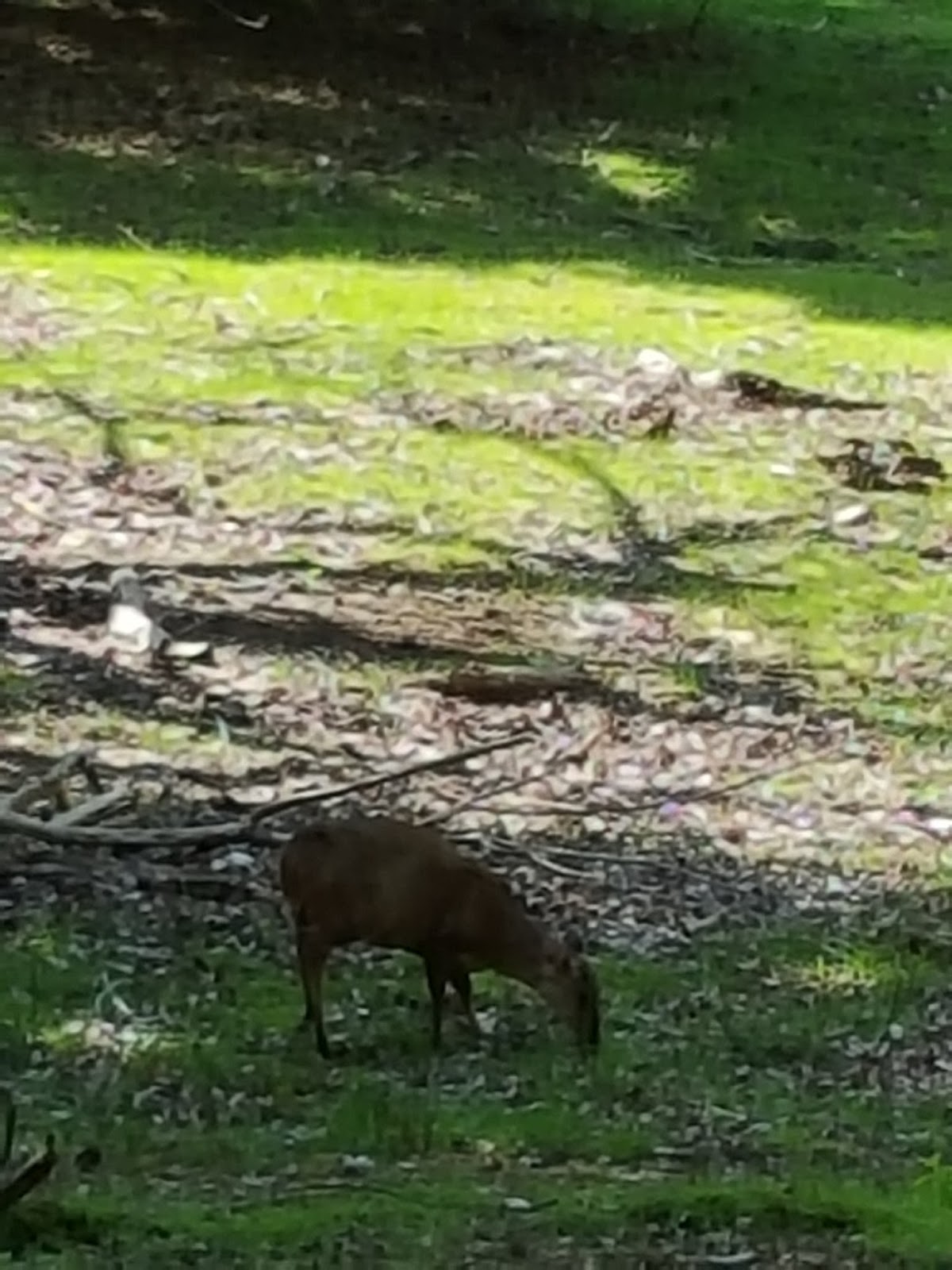
About a mile or so down a country lane we met, and crossed, the busy A4012 and turned into the gates of Woburn Safari Park. We weren't going into the park itself but we were lucky to catch a glimpse of some of the deer they keep in the grounds surrounding it.
Woburn's the largest deer sanctuary in the country in terms of number and types of species. Apparently they all look pretty similar to the lay person but the cast list includes Axis or Chital, Chinese water, fallow, muntjacs, Rusa stags and swamp deer with their bat shaped ears.
As we passed beneath the Go Ape zip wires the wildlife spotting increased stratospherically. A couple of Asian elephants, some rhinos, a field teeming with bison. Yes, we could see across to the safari park itself and although surreal is an overused adjective it seemed apt for the sight of these exotic beasts relaxing in the Bedfordshire sunshine. The tailback of cars adding further bizarre aspect.
One particular Asian elephant seemed to be on show for the benefit of walkers only, of which besides ourselves there were very few. Do people not know you can save your family £100 and see the wildlife for free? We watched the pachyderm trunking up bundles of grass for some time before heading towards another entrance of the park.
There we saw camels and zebras but once you've seen an elephant other animals don't get much of a look. I was more concerned with losing 50p in a vending machine trying to buy a Magnum.
From here we ascended a short, steep hill affording us further views over the Safari Park before gently rolling downwards past a series of small lakes and ponds. Now we were in the deer park proper. We had to walk through about 100 of these noble animals. We watched for some time as they gracefully trotted back and forth, stopping occasionally to give us a good look over.
I could've stayed for longer. I think we all could've. But we'd not seen a pub yet and some of the TADS were getting thirsty. We reached a mock-Tudor pavilion and then cut through the grounds of Woburn Abbey itself.
The west aspect of said Georgian pile faced us in all its grandiose glory. Impressive though its creamy white stone and Ionic columns no doubt were, and still are, it's not an elephant is it!?
We opted not to go in and ponder its collection of Van Dyck, Gainsborough, and Reynolds paintings. But to yomp on to Woburn village itself. Our book had recommended a stop at The Royal Oak pub and whistles were getting dry.
The Royal Oak, like the earlier Wheatsheaf, was, however, no more. Not a problem. Straight into The Black Horse. A pint of Yardbird Pale Ale please for Pam & I. A Hooky for Adam & Shep. A glass of Chenin Blanc for Teresa who also enjoyed a tiny tiny little loaf of bread to eat.
Knowing there'd probably be no more pubs en route we made another stop in The Bell Hotel. We looked up the Leicester/Man Utd result on our phones as we sipped Abbot Ales.The landlord informed us he kept the best beer in all Woburn which didn't seem to be that impressive a boast but his pub, and The Black Horse, were both nice enough.
We now headed back to Aspley Guise, through the diminutive and friendly hamlet of Market Place where the unfortunate denizens were treated to the sight of a slightly merry mob of minstrels passing through.
The road petered out into a dirt track that passed through field after field of glorious golden rapeseed. Whilst four of us were happy to pose in it one of our group found it at first boring and, finally, offensive!
As our poses, especially mine in my big coat, looked like something from a 1980s Echo & The Bunnymen album cover Pam loaded up The Cutter on her phone and we had a little singalong.
This took us, quicker than expected, into Aspley Guise itself. A quaint village but low on amenities. No pub stop here but a visit to a joint Indian/Thai restaurant. Blue Orchid or Little India depending on your preferences. Our female 40% opted for Thai. The male two thirds went Indian.
Both menus offered standard choices but everyone agreed their selection was tasty. In TADS tradition Shep inquired about the possibility of a Bangla beer and in TADS tradition they didn't have it. He also requested they change the music as they were playing stuff that could be best described as elevator muzak. The waiter tried to explain it was supposed to be relaxing and then put something even blander on.
Finished off the Cobra. Drove back to Bletchley. Train back to Euston. Bus back to SE23. I love it when a plan comes together.
The day had got off to a pleasant enough start. After a week of unfavourable weather forecasting the sun was shining both in Euston where Pam and I met and in Bletchley where, after a good old chinwag on the train, we caught up with Adam, Teresa, and Shep.
Adam kindly drove us all to Aspley Guise as that particular branch line doesn't operate on Sundays. From the train station there we commenced our walk. Almost immediately I heard Shep. who was walking a little in front of me, exclaim 'what a cute rabbit'. I looked down the driveway where the sighting had been but saw only a cat. The cat dipped behind the hedge and came out carrying a live rabbit in his mouth. The rabbit made a squeaking noise like a cuddly toy and the cat disappeared off to 'play' with it. As Adam remarked to the cat's owner this feline not only had similar markings to his wild tiger cousins but had inherited some of the feral behaviour too.
We soon reached St.Botolph's church. A medieval construction heavily restored in 1855 with a Perpendicular tower. From there we cut down the side of Aspley House, the first of many ludicrously massive homes we'd see throughout the walk, on to Bedford Road.
In a field on Bedford Road there were two ponies. Each surely the beloved pet of a little girl. The tell tale signs were in the braiding of said ponies hair. After admiring these Hasbro unicorns we ascended an estate of terraced brick cottages and Georgian homes. There was supposed to be a pub, The Wheatsheaf, here but it was no more. Converted into a dwelling as is the story so often in rural locations.
About a mile or so down a country lane we met, and crossed, the busy A4012 and turned into the gates of Woburn Safari Park. We weren't going into the park itself but we were lucky to catch a glimpse of some of the deer they keep in the grounds surrounding it.
Woburn's the largest deer sanctuary in the country in terms of number and types of species. Apparently they all look pretty similar to the lay person but the cast list includes Axis or Chital, Chinese water, fallow, muntjacs, Rusa stags and swamp deer with their bat shaped ears.
As we passed beneath the Go Ape zip wires the wildlife spotting increased stratospherically. A couple of Asian elephants, some rhinos, a field teeming with bison. Yes, we could see across to the safari park itself and although surreal is an overused adjective it seemed apt for the sight of these exotic beasts relaxing in the Bedfordshire sunshine. The tailback of cars adding further bizarre aspect.
One particular Asian elephant seemed to be on show for the benefit of walkers only, of which besides ourselves there were very few. Do people not know you can save your family £100 and see the wildlife for free? We watched the pachyderm trunking up bundles of grass for some time before heading towards another entrance of the park.
There we saw camels and zebras but once you've seen an elephant other animals don't get much of a look. I was more concerned with losing 50p in a vending machine trying to buy a Magnum.
From here we ascended a short, steep hill affording us further views over the Safari Park before gently rolling downwards past a series of small lakes and ponds. Now we were in the deer park proper. We had to walk through about 100 of these noble animals. We watched for some time as they gracefully trotted back and forth, stopping occasionally to give us a good look over.
I could've stayed for longer. I think we all could've. But we'd not seen a pub yet and some of the TADS were getting thirsty. We reached a mock-Tudor pavilion and then cut through the grounds of Woburn Abbey itself.
The west aspect of said Georgian pile faced us in all its grandiose glory. Impressive though its creamy white stone and Ionic columns no doubt were, and still are, it's not an elephant is it!?
We opted not to go in and ponder its collection of Van Dyck, Gainsborough, and Reynolds paintings. But to yomp on to Woburn village itself. Our book had recommended a stop at The Royal Oak pub and whistles were getting dry.
The Royal Oak, like the earlier Wheatsheaf, was, however, no more. Not a problem. Straight into The Black Horse. A pint of Yardbird Pale Ale please for Pam & I. A Hooky for Adam & Shep. A glass of Chenin Blanc for Teresa who also enjoyed a tiny tiny little loaf of bread to eat.
Knowing there'd probably be no more pubs en route we made another stop in The Bell Hotel. We looked up the Leicester/Man Utd result on our phones as we sipped Abbot Ales.The landlord informed us he kept the best beer in all Woburn which didn't seem to be that impressive a boast but his pub, and The Black Horse, were both nice enough.
We now headed back to Aspley Guise, through the diminutive and friendly hamlet of Market Place where the unfortunate denizens were treated to the sight of a slightly merry mob of minstrels passing through.
The road petered out into a dirt track that passed through field after field of glorious golden rapeseed. Whilst four of us were happy to pose in it one of our group found it at first boring and, finally, offensive!
As our poses, especially mine in my big coat, looked like something from a 1980s Echo & The Bunnymen album cover Pam loaded up The Cutter on her phone and we had a little singalong.
This took us, quicker than expected, into Aspley Guise itself. A quaint village but low on amenities. No pub stop here but a visit to a joint Indian/Thai restaurant. Blue Orchid or Little India depending on your preferences. Our female 40% opted for Thai. The male two thirds went Indian.
Both menus offered standard choices but everyone agreed their selection was tasty. In TADS tradition Shep inquired about the possibility of a Bangla beer and in TADS tradition they didn't have it. He also requested they change the music as they were playing stuff that could be best described as elevator muzak. The waiter tried to explain it was supposed to be relaxing and then put something even blander on.
Finished off the Cobra. Drove back to Bletchley. Train back to Euston. Bus back to SE23. I love it when a plan comes together.
Subscribe to:
Posts (Atom)