Sunday, 23 July 2017

Camberwell Fair 2017:Sunshine on a Rainy Day.

In 2015 Pam, Shep, and I went to the first Camberwell Fair to be held since 1855 (it'd been held annually since 1279 apparently) and had a great time. We bumped into our friends Lorraine and Jane, we drank too much, we danced to Kasai Masai and we swayed along to the summery sounds of Dawn Penn (you can probably imagine which song got the most rewinds!). and we ended up drinking shots in a Peckham Road barber shop.

I wasn't able to go last year because I was in Washington state watching two more of my best friends get married. No such jetsetting this year so I met up with Shep and Pam again in Waterloo station (in Benugo, on the mezzanine, near the big clock, standard) and we set off for a brief wonky stroll down to Camberwell Green.


The weather forecast hadn't been promising and, of course, as soon as we left the station it started hoying it down so, predictably, we took shelter in a pub. The Crown and Cushion on Westminster Bridge Road. An old Irish boozer playing the unlikely mix of The Carpenters and B*Witched to men drinking alone, one of whom had brought a loaf of bread along for company.

Less predictably both Shep and I opted for a soft drink. Pam, clearly made of stronger stuff, chose a Bermondsey Best. We chatted about John Ruskin's aversion to female pubic hair and recounted escapades from last week's Lambeth Country Show, an occasion I'd 'enjoyed' so much I'd only just recovered from (and hadn't even blogged about - shock, horror!).


With the rain relenting, briefly, we set off past the Imperial War Museum, across the Elephant and Castle roundabout (checking out the Faraday Memorial), before then cutting through what's left of the Aylesbury Estate. We witnessed gentrification and we witnessed areas very very far from gentrification. A visit to this area in 5-10 years will probably see a considerably different area.

We wandered across Burgess Park, saw local kids preparing to have a sack race, took in an old lime kiln, and heard the music blowing over from Camberwell Green. A quick slash in the disgusting toilets of The Tiger pub and we were in the site. The sky opened up again. Damn. 


We bought a pint from one of the most miserable barmaids in existence and watched a few fearless, or already drunk, punters dance to the reggae and African music the DJ was playing. First band up for us were Kakatsitsi, a six piece Ghanaian drumming ensemble. I'm not normally a huge fan of overly percussive set ups but this was different. It sounded like some of the drummers were playing rhythm and melody which gave the music much more depth, far more colour. One guy even winningly drummed with his socked feet. Despite the rain they bought the crowds out and by the end we were merely subject to drizzle - which was roughly how the rest of the day played out weatherwise.


Over at the Camberwell Stage (main stage was called Wormfood!) a decent poet called Sam was coping with drunken hecklers, drunken stage invaders, and child stage invaders to deliver some fairly heartfelt, and pretty well constructed, political poetry. He then introduced Reload who mixed up his own brand of political poetry with his Wolverhampton flavoured grime that nodded more to the first wave than J Hus or Stormzy. 


Reload was good but nobody could compare to the guy above who had a small reggae sound system set up and was spitting bars for several hours non-stop. With a passion and integrity bordering on insanity. His main beef was the closing of Brixton institution Passing Clouds but at one point he seemed to be toasting over some dancehall classics about jellyfish.

Tantz were on the main stage knocking out a fast and furious set of infectious clarinet led klezmer. One of the more 'enthusiastic' punters was sat on the front of the stage waving two plastic forks in the area, a girl was dancing in the rain in her bra, and an old lady was stood by with her Trolls (the DreamWorks film) shopping bag at hand. It's safe to say that Camberwell, like Brixton, is rich in 'characters'. It's why I bloody love those places.


Afrikan Boy was the only act at the (free) festival I'd ever heard before. I'd seen him support Criollo a couple of years back at Village Underground. His uptempo afrobeats (not afrobeat) songs about shoplifting from LIDL and getting his visa stolen had been complemented by a new, more political, dimension and, of course, a song about his beloved Nigerian cuisine. He was rather good.


All that talk of food had got us hungry. Shep has a pizza, Pam had a tasty looking bowl of Indonesian soto, and I went for a Cyprus Grill, a rather puntastic halloumi wrap that tasted good, filled the hole, soaked up some of the beer, and set me up for more music.

The Mouse Outfit played a sort of hip-hop infused rock that was full of energy and headliners Balafonics, over from Paris, got a huge crowd dancing to their headlining set of brass fronted bangers and African soaked guitar. But for us, Jellyfish/Passing Clouds guy was the sure winner of the festival. As his sparring partners and DJs cued him up with 80s ragga cuts, Atari computer game noises, and tape rewinds he ranted righteously about pretty much everything under the sun - and by that time the sun had indeed come out.

The Camberwell Fair may be a small event but it's one of those vital ones that communities sacrifice at their peril. Like its much bigger brother, the Lambeth Country Show, it puts smiles on peoples faces and brings people from different backgrounds together to dance to each other's music, try each other's food, and in some instances, swap each other's bodily fluids. What's not to like?


Friday, 14 July 2017

Lisa Yuskavage:Flesh for Fantasy.

I wonder how differently the art world, and myself, would have viewed the work of Lisa Yuskavage if she'd been born a man. In fact would the work be the same? Almost definitely not. Every little thing that happens in our life affects us, makes us see things in a different way, approach the world from a different angle. The gender you're born in to or, indeed, identify with is simply too large a thing not to affect your world view.

The proportions of most of Yuskavage's nudes or nearly nudes (very few are fully clothed that's for sure) are pretty unrealistic. They're Barbie or Sindy dolls grown up, gone bad, or, if you'd prefer, gone good. David Zwirner on Grafton Street in Mayfair has got a small show, spread over two floors, showing us what Yuskavage has been working on over the last couple of years.

The landscapes these overly eroticised women are painted in front of are equally fantastical and unrealistic. Consisting of bold colours, ludicrously expensive looking furniture, or simply gauzy clouds. It's hard, initially, to make much of a connection between Yuskavage's soft porn soft focus imagery and Alice Neel's psychological portraiture but that doesn't mean people haven't tried.

It's not just that they're both Pennsylvania born artists who relocated to New York City, or even that you can buy a book about Alice Neel in the bookshop at David Zwirner, but more that they both use heightened colour and exaggerated features to add emphasis to their work. Yuskavage, as will be immediately clear, just goes a lot further than Neel.


Stoned (2016)


(Nude) Hippie (2016)


Hippie (Nude Bra) (2016)

Often these women pose solo both delighting and, to a lesser extent, subverting the male gaze. Are we men so crap that even a fairly unrealistic representation of a naked lady will do it for us? I'm afraid the answer is yes. The pictures of loving couples are, on the surface, less problematic. There's tenderness for sure - but also tension. Who's in control of the situation?

In 2016's Lovers a young lady appears to be performing what can only be described as a titwank for her slightly obscured partner. Framed by an almost Matisse like red the man's head may be unclear but the woman is facing away from us. You could spend ages looking at some of these paintings and trying to conjure a narrative. Or you could just giggle at all the bums and boobs. I did a bit of both.


Lovers (2016)


Housewarming (2016)


Suburbs (2017)


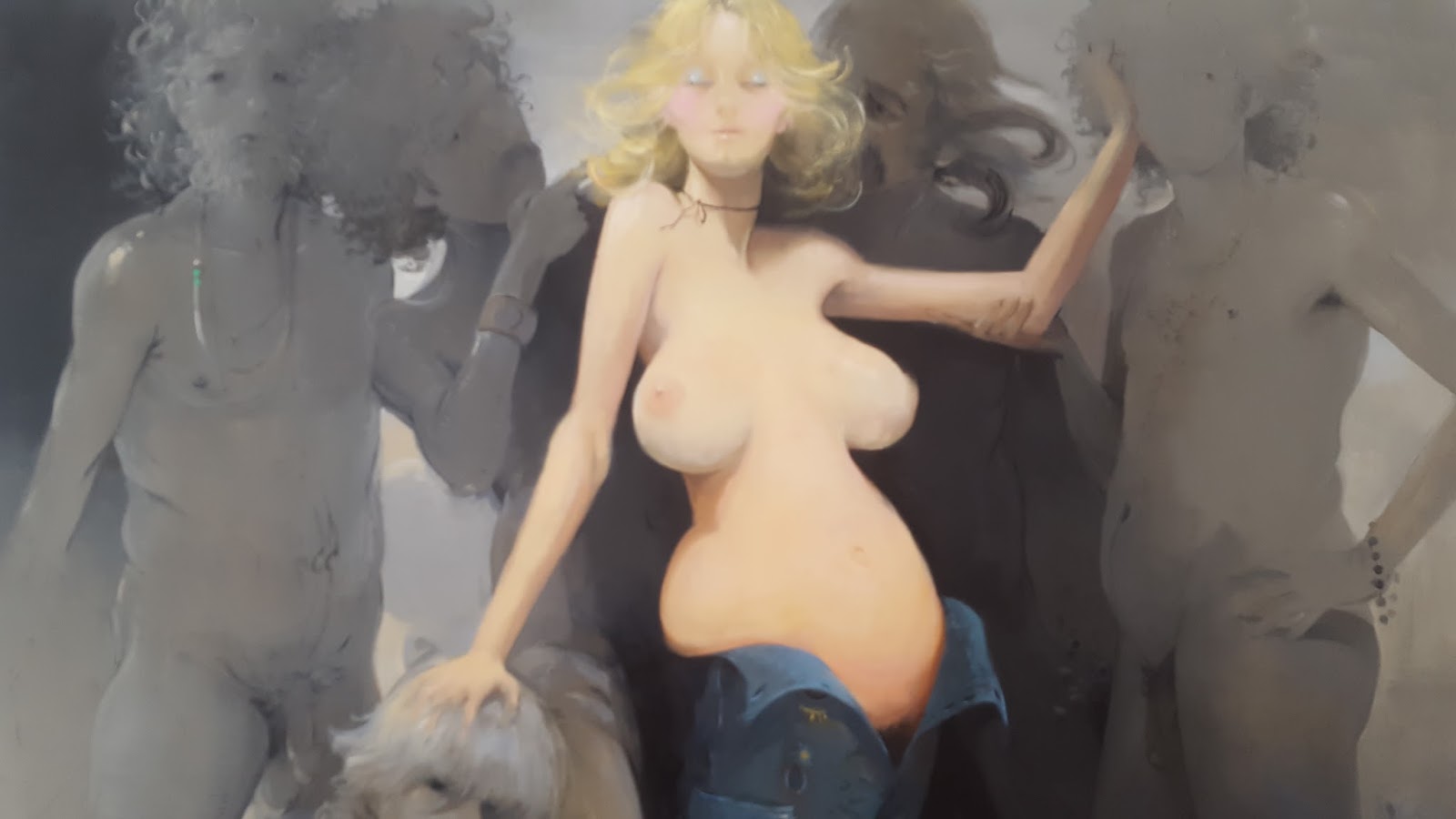
Deja Vu (2017)

One woman and about five shadowy men make up this year's Deja Vu. What's afoot here? A gangbang? Something worse? Why are the men greyed out and why do they all look the same? I don't think they actually represent real men, more ideas of men, memories of men but my interpretation was not as interesting as the one I overheard a fellow gallery visitor share with his friend. He opined that all the men looked like James Morrison. I wasn't sure if he was being over formal in describing the late Doors frontman and serial penis exposer or if he meant the very much alive pop-soul singer from Warwickshire. 


Super Natural (2017)


Ludlow Street (2017)

The most lovingly portrayed couples are the ones in Ludlow Street and Wine and Cheese. It's kind of cute that he's kept his green socks on and who wouldn't enjoy a nice glass of red wine when having their genitals caressed. Two of life's great pleasures at the same time.

There's no doubt that part of Yuskavage's schtick is to take a sideways, and playful, look at the way the nude has been portrayed across art history. A quick walk round any major gallery will confirm to you that naked women have been painted, and exhibited, many more times than naked men.. So it's hard to say exactly why Yuskavage has chosen to add to that history, even amplifying certain female, er, assets as she does. There's no denying that the colours, the compositions, and, yes, all that oil, graphite, and charcoal on linen portraying exposed (mostly female) flesh are a pleasure to look at but I can't help thinking she's aiming for something more than grubby ogling.

She's an amazing artist with an instantly recognisable technique, it's a joy to look at her work (even the rest of her oeuvre, sadly not presented here, which contains so much more than the nudes) but I wasn't quite able to process, or understand, what kind of contradictory psychological stunt she's playing. I guess the only thing I can do is try and get along to see more in the future. It'd be rude not to.


Wine and Cheese (2017)

Hynek Martinec:A beautiful dissonance.

You might say the 'figure' in Hynek Martinec's Chocolate Labyrinth and Tea is no oil painting but that's exactly what he/she/they is. In fact the skill, and attention to detail, in Martinec's smooth, technically excellent, and slyly surreal work is often quite astonishing

I visited his Birth of Tragedies show at the Parafin (a neat little gallery just down from Bond Street tube that recently hosted a delightful little show by Justin Mortimer) not 100% sure quite what to expect after taking in a press release that alluded to 'different registers of reality' and 'an unsettling currency'.

I needn't have worried. I may not have fully understood why Martinec had chosen to name one of his works Brexit, nor why he'd chosen as his subject matter, in The Boat on the Moon, a floating baby scan, but I couldn't fail to be ever so slightly mesmerised by the way he'd worked his oil paints up into such a beautiful dissonance.


Chocolate Labyrinth and Tea (2016)


Brexit (2016)

He'd named the show The Birth of Tragedies in tribute to an 1872 text by Friedrich Nietzsche, The Birth of Tragedy, in which the 19c German philosopher argued for an immersive form of art that emphasised the passionate Dionysian over the rational Apollonian. I've never really seen passion and rationality as opposites and, in fact, would make the case that some of the most passionate acts ever have been based on, what at least would've seemed to be the case at the time, rational and logical reasoning.

Never mind, Nietzsche wasn't right about everything but he certainly made some interesting points so it's no surprise that he's inspired an artist born eight full decades after his death. Martinec was born in 1980 in the small Czech town of Broumov near the border with Poland so he is, both by birth and inclination, a bohemian.

For someone with a keen sense of art history there's a fun game of spot the reference to be had with his works. I'll freely admit that I couldn't find the promised nod to Zurbaran  and had to be told that the satyr with the VR headset in Circus of Nightmares was a tip of the cap to Van Dyck.

Songs from the Last Century reminded me of the Gerhard Richter artwork that Sonic Youth appropriated for Daydream Nation twisted through the surreal genius of Salvador Dali and Peter Paul Rubens seemed to be the obvious progenitor of last year's The Shepherd Paris but why?

I think what Martinec is trying to do is get us, in these uncertain times (check the pluralisation of Tragedy in his show title), to question the very nature of history (art or otherwise) and the fluidity of truth. In the world of fake news, alternative facts, and barefaced bullshitting you're on shaky ground if you start saying there is more than one version of the truth but Martinec's argument is more nuanced than that. What he's saying with these works is that there's more than one way of seeing something - and that that can change over time depending on the viewer, where they are in their life at that moment, and what surrounds them.


Circus of Nightmares (2017)


Songs From The Last Century (2016)


The Boat on The Moon (2017)


Flogging Baroque Horse (2017)


The Shepherd Paris (2016)


Cross the Line (2016)

The well lit ground floor room contains most of Martinec's larger paintings but you can descend a small staircase into a darker basement room where can you witness an even more playful, cheeky, aspect of Martinec's work.

These drawings appropriate imagery from Old Masters and vintage photography and combine them with the signatures of internationally famous artists like Duchamp, Giacometti, Degas, Picasso, Klee, Beuys, and Schiele. The works and signatures don't match up ('Oscar Wilde' has signed one of them!) which, as well as cocking a snook, Duchamp style, at the art world, underlines Martinec's point about how our views of (art) history change over time.


Marcel Duchamp (2015)


Alberto Giacometti (2015)


Edgar Degas 1899 (2016)


Pablo Picasso (2015)

Martinec talks a good game, and he no doubt has serious things to say about how we see, what we see, and why we choose to see in such a way, and he's a great painter too. You can come and ponder matters of Nietzschean metaphysical voluntarism and the hegemonic nature of art historical narratives or you could just pop in and enjoy his rather beautiful, slightly disarming but aesthetically very pleasing, paintings. I like to think I did a bit of both.


Study of Baroque (2017)


Wednesday, 12 July 2017

Alice Neel:Uptown Top Ranking.

"What fascinated her was the breadth of humanity that she encountered" Hilton Als on Alice Neel.

In 1938 Pennsylvania born Alice Neel, then 38 years old, moved from the relative comfort of Greenwich Village to the edgier district of Spanish Harlem in pursuit of 'the truth'. I can't imagine why any one area is more truthful, or indeed more false, than any other but the work she made there was, if not 'true', certainly eye-catching, beautiful, and often thought-provoking.

She and her lover, Puerto Rican musician Jose Negron, lived in an apartment on East 107th Street. As well as the decade she'd previously spent in NYC she'd also lived in pre-revolutionary Havana with her then husband, the Cuban Carlos Enriquez. This, seemingly, had given her a taste for the 'other' and a dissatisfaction of, an aversion to even, white middle class society. Neel had had a very eventful, and upsetting, life up until this point. She'd lost one daughter, Santillana, to diphtheria when she was just eleven months old and a second daughter, Isabetta, had been taken back to Cuba with Enriquez who'd told her he was going to Paris to look for a house from them to live in as a family. These hugely distressing events led to a nervous breakdown and a suicide attempt but, even during such traumatic times (perhaps because of them), Neel kept painting. The now thirty year old woman who'd been told, as a child, by her mother "I don't know what you expect to do in the world, you're only a girl" was nothing if not determined to express herself.

It would be easy, and incorrect I feel, to criticize Neel, a white woman, for exoticising the Latin Americans and blacks of Harlem. It was admirable that she sought to portray a society that had, for the most part been overlooked by her contemporaries, or, often, depicted with patronising sentimentality. Though Neel was interested in politics she remembered, and it shows in her work, that people were, first and foremost, individuals. Endlessly fascinating individuals. Each, like her, with their own passions, fears, neuroses, and histories. Like the younger Diane Arbus she returned, time and time again, to the same subject, the same sitter, as if in an attempt to unravel what she knew to be the unsolvable mysteries of life.

 
Girl with Pink Flower (1940s)

 
Building in Harlem (1945)
 
The Victoria Miro Gallery on Wharf Road, under the curatorial eye of New Yorker and former Village Voice writer Hilton Als, have put together a small, but impressive, collection of her paintings, either acrylic on board or oil on canvas, and it was a pleasure to spend an hour or so in their company. All, except the shadowy, blood-red, Building in Harlem, are portraits and, though they span the best part of forty years, they're all rendered in a style that instantly marks them out as the work of Alice Neel.
 
That's not to say they're samey. They're not. Girl with Pink Flower's simplicity stands in stark contrast to the more regal portrait of Alice Childress and the pensive, or maybe he's just been to the dentist, pose of Harold Cruse.
 
Life in 'El Barrio' offered Neel many things. Inspiration, emotional sustenance, an affordable place to live, and, most importantly, another two children. Richard and Hartley Neel were born in 1939 and 1941 respectively. During the time they lived in Spanish Harlem she saw the neighbourhood go from a predominantly Italian enclave to a mostly Latin, particularly Puerto Rican, area. Along the way the Scandinavians, Irish, Jews, and Germans had come and gone in great numbers.


Alice Childress (1950)

 
Harold Cruse (c1950)
 
She was not, at this time, a successful artist and was receiving no critical or financial support for her work other than that bestowed upon her by the kindness of friends. Clearly, her twin passions, for humanity and painting, drove her on.
 
Some of those she painted were friends, some not. Many were notable academics, actors, and authors. Alice Childress (1916-1994) moved to Harlem, from South Carolina, with her grandmother in 1925 and joined the American Negro Theatre. In 1944 she was nominated for a Tony as Best Supporting Actress in a Broadway production of Anna Lucasta but after that she struggled to find worthwhile roles in the theatre that represented the black women she knew. So she began writing herself. She also got involved in social issues and helped unionise actors.
 
Thoughtful Harold Cruse would go on to become a key figure in the civil rights and black nationalist movements and is best known for his 1967 book The Crisis of the Negro Intellectual. He became a member of the Communist affiliated CNA (Committee for the Negro in the Arts), taught at the Black Arts Repertory Theatre in Harlem, and travelled to Cuba in the early 60s, after the revolution.
 
Horace Cayton is most well known as co-author (with St.Clair Drake) of Black Metropolis:A Study of Negro Life in a Northern City, a history of Chicago's South Side from the 1840s to the 1930s. 
 
Neel doesn't raise these people above the status of Julie (and her doll) or Anselmo, a neighbour who helped her out with jobs around the house and building bookshelves. She accords each sitter their own individuality. Snowflake has become an insult bandied about by right-wingers towards liberals these day but each snowflake, famously, is unique - as is each person. Neel let personality, rather than status, dictate her portraiture. She doesn't seem like the kind of person who'd take the word snowflake as an insult. Her work is all the better for it.


Julie and the Doll (1943)

 
Anselmo (1962)

 
Horace Cayton (1949)
 
In September 1962 Neel was relocated by her landlord from Spanish Harlem to a larger apartment in Manhattan's Upper West Side. The new place allowed for more generous helpings of light and you can see in the later portraits how that's poured into her work. The Upper West Side was just as diverse as Spanish Harlem had been. Jewish and Ukrainian families had long made up the majority of the populace but, by the 50s and 60s, the influx of Cubans and African Americans had further diversified the area.
 
Three years earlier Neel had appeared in Robert Frank and Alfred Leslie's 1959 avant-garde film Pull My Daisy and this increased her visibility as an artist. She'd made a portrait of the artist Robert Smithson while still living in El Barrio but her 1970 likeness of Andy Warhol, all pallid skin, moobs, and scars, certainly got more people to take notice of her.
 
Celebrity portraits weren't, for the most part, her thing though. Pregnant Maria was a friend of Neel's. Stephen Shepard (yes) was an art student, Ed Sun went to medical school with her son Hartley, Neel met Kinuthia when, in 1973, she travelled to Africa. He was a local radio host and had arranged an exhibition of her work in Nairobi.
 
The 'Woman' in the 1966 portrait is Ujjaini Khanderia, daughter of the Indian social-realist novelist Bhabani Bhattacharya, who was, at the time studying at the University of Michigan and suffering enormous homesickness for India. Ron Kajiwara (seemingly sat atop a chair on loan from Van Gogh) and his family had been detained in a California internment camp during World War II but later became a design director for Vogue before, in 1990, dying of AIDS, and sweet and innocent Benjamin was simply the son of the superintendent of Neel's apartment building south of Morningside Heights where she lived until her death in 1982.
 
Again, no portrait stood on ceremony alone. Each sitter was treated with respect and rendered lovingly. They may be what we'd call these days psychological portraits but, unlike some works that get labelled that, it's hard to imagine the sitters being anything less than thrilled by the finished result. All of the works are both beautiful and dignified. They present themselves to you, unflinchingly, in an instant yet you could look at them time and again and still not quite know what's fully going on. In that the portraits that Alice Neel made are very much like people themselves. Complicated, mysterious, alluring, and always the focus of one's eye.

 
Pregnant Maria (1964)

 
Stephen Shepard (1978)

 
Ed Sun (1971)

 
Kinuthia (1973)

 
Woman (1966)

 
Ron Kajiwara (1971)

 
Benjamin (1976)
 

As a coda to the exhibition there's a couple of Perspex covered tables where you can peer at literature relevant to the work and the times. Works by Harold Cruse, Alice Childress (her young adult fiction A Hero Ain't Nothin' But A Sandwich whose title later found itself co-opted by both The Goats and House of Pain), Horace R Cayton, Langston Hughes, and James Baldwin sit next to the less obvious tomes of W E B Dubois and Jean-Paul Sartre. There's a Lenin biography and a letter from Neel asking Fidel Castro if she could paint him.

Neel's politics were no doubt very important to her but it seems, from looking at this small retrospective, that, for her, the political always stemmed from the personal. The love of humanity really shines through in this lovely, and free, exhibition.