Monday, 23 January 2017

William Kentridge:Thick Time

I made it to the William Kentridge exhibition at the Whitechapel Art Gallery on the very last day. Not sure if that's why it was so busy or if it had been that rammed throughout its run but I even had to book advance tickets. A very rare occurrence indeed.

Kentridge is an ethnically Jewish South African born in 1955 in Johannesburg. His parents were attorneys known for their representation of those marginalised by Apartheid. This gave him a position as an observer to some key political activities of our time. Both that, and the abstract angles he refracts that vision through, can make his art difficult, challenging even, for the outsider to get a grip on. Which, again, makes the large crowds both a surprise and a delight.

The Whitechapel exhibition, Thick Time, is described as 'a series of environments' made between 2003 and 2016. Kentridge is nothing if not a Renaissance man. His works combine drawing, printmaking, film, music, sculpture, and tapestry and he often collaborates with dancers and puppeteers. He's even directed operas and staged works by Mozart, Shostakovich, and Monteverdi.

Thick Time is broken up into six immersive installations that shed light on Kentridge's interest in early cinema and theatre if rarely on the exact point he's trying to make. If, indeed, he is even trying to make an exact point. It seems far more likely is trying to create an impression in the vein of the expressionist tradition.


2012's Untitled (Bicycle Wheel) leads you into the first room. The Refusal of Time is a dialogue with science historian Peter Galison on how our measurement of time, space, and light has developed in tandem with the exploitation of global resources and people. There's some kind of Heath Robinson machine pumping away in the middle of the room while five different films play 'in the round' to the soundtrack of some parpy music. It's more fun than its high-falutin concept suggests but pretty impenetrable. Both due to the large number of visitors and its, er, impenetrability!


Second Hand Readings (2013) features slogans dancing to a composition by South African jazz musician Neo Muyanga. The animation of a dictionary turning its pages is pretty natty and the music itself is fine but, again, I was unable to appreciate it as anything other than pure spectacle.

Kentridge makes books as well. In Tapestry Library he's laid out a selection of his own tomes (and one on Durer) with chairs and tables you can sit at and peruse them. It's not unlike the reading room you'll find at the end of many an exhibition except this time it's halfway through and there are horses woven on walls with messages attached suggesting they were made in Naples.


He's made good use of the stairway which leads you up to 2016's Right Into Her Arms. A kinetic sculpture inspired by Austrian composer Alban Berg's opera Lulu (1929-1935) about a femme fatale in Vienna. Kentridge has added atonal composition by Berg's fellow Second Viennese School members Anton Webern and Arnold Schoenberg and a sound poem by German Dadaist Kurt Schwitters. Schwitters, alongside Francisco Goya, Max Beckmann, and George Grosz, being a key influence on Kentridge.


7 Fragments for Georges Melies, Day for Night, and Journey to the Moon from 2003 consist of a large room with nine short films on repeat. The sound is provided by South African composer Phil Miller. To his gentle piano music folks mill about not quite sure what to look at first or how long to spend looking at it. Again it's confusing but we've paid to get in and we don't want to look like we don't understand it.


When I'm not sure how long to take looking at something I tend not to take very long at all. So I moved on to the final room. Possibly the best in show. 2015's O Sentimental Machine ponders Trotsky's expulsion to Istanbul from Russia by Stalin. Set in a mocked up lobby of the Hotel Splendid Palace on Buyukuda Island where Trotsky stayed between 1929 and 1933 it's not clear what the doors that don't open actually mean or what the occasionally shaking gramophone signifies but it is evocative and makes you feel (even think) something though you're not sure what.

By the end I'd kind of got the idea that, despite its seemingly deep political intentions, Kentridge's art aimed to impress more on the heart than the head. As a newcomer to his work I was a little bewildered and a bit out of my depth. I'd like to see a bit more. Find out if the emperor was indeed naked or if his suit was so fine that my vision wasn't strong enough to comprehend it.



Punk's (still) not dead.

....and so the 40 year anniversary of punk continues. Following the British Library's rather good look back at the genre and some of its key players we have the Museum of London's considerably slighter retrospective. The Museum of London is a wonderful and fascinating place and, considering how difficult it can to be to find on a first visit, can get surprisingly busy. Their advertising reach (probably due to lack of budget) sometimes doesn't make it out as far as me so I'd like to thank Jo for giving me the heads up on this show.

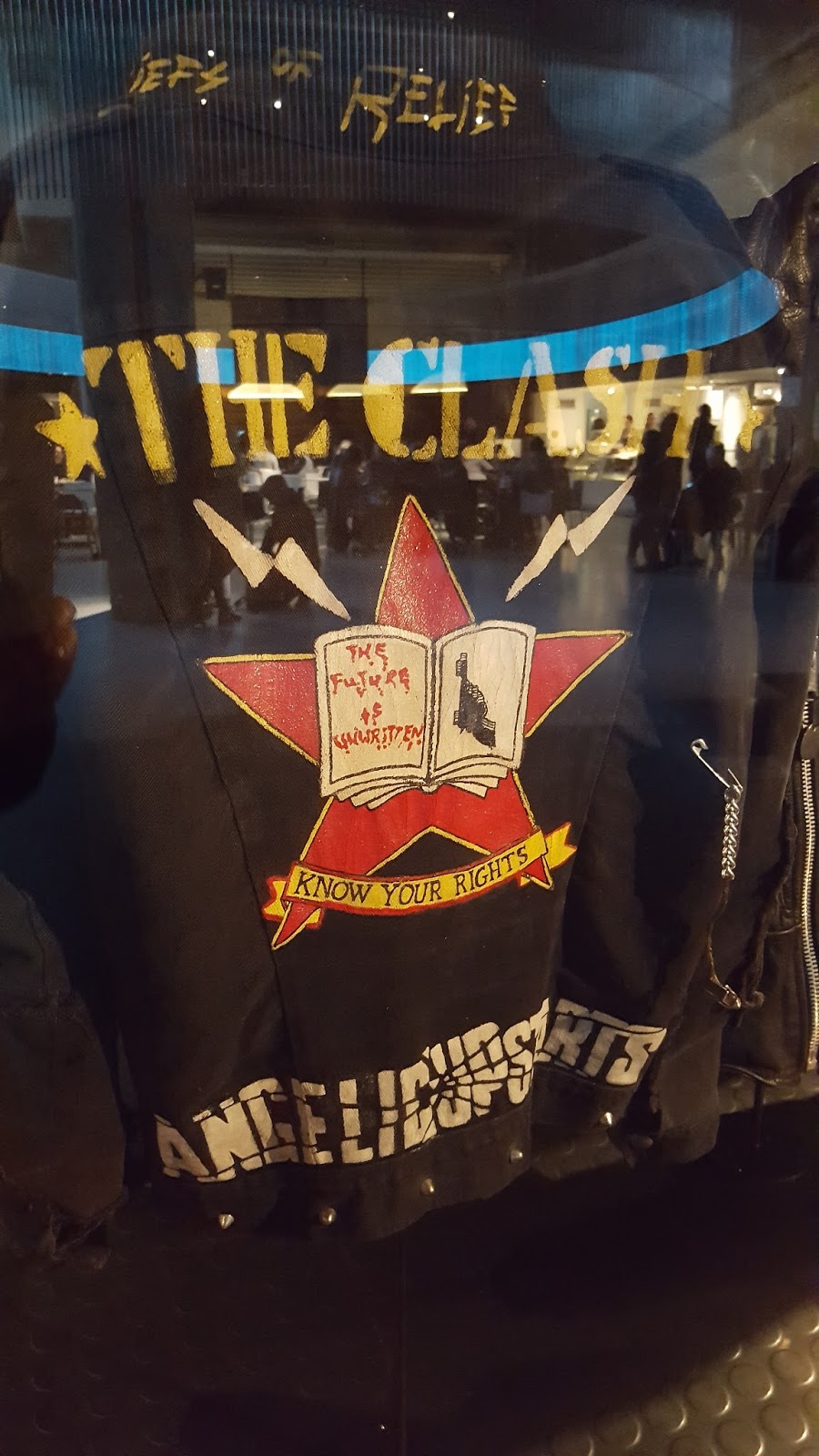
It tells the usual story of how the events of 1976 gave a voice to the disenfranchised but, instead of coming from the musicians, producers, and fanzine writers, through the voices, memories, and, most of all, clothes of the fans. The ones who were that at the time. So whilst the British Library exhibited Rat Scabies' leather jacket in a glass case here we get a Clash/Angelic Upstarts leather jacket in a glass case. Vive la difference!


To be fair there are more than enough stories, and artefacts, to justify the two shows. Testimonies of the fans include those of 13 year old Leeds schoolgirl Judi Atkinson who took to wearing chicken bones in her hair and Alberto Umbridge from Morden who sported the notorious 'tits' t-shirt and bondage trousers. Before that'd become part of the uniform of the postcard punk. Lesley Edgar would wear her customised t-shirt (below) with either fishnets or homemade plastic trousers.


There's a lovely little selection of lapel badges of the time. The Buzzcocks, Siouxsie, The Fall, ATV, The Lurkers, X Ray Spex, Spizz Oil, Penetration, and The Slits all represented. They've posters for punk gigs at the Coliseum and the Evening Standard piece about a riot at a '77 Clash concert at the Rainbow in Finsbury Park.

Zoe Neale's scrapbook from her punk days is notable for a few reasons. A Crass gig in Ealing and Rip, Rig, and Panic (Neneh Cherry's former outfit) at the ULU but mostly for the unlikely inclusion of Classix Nouveaux, Chicken Shack, and Slade!


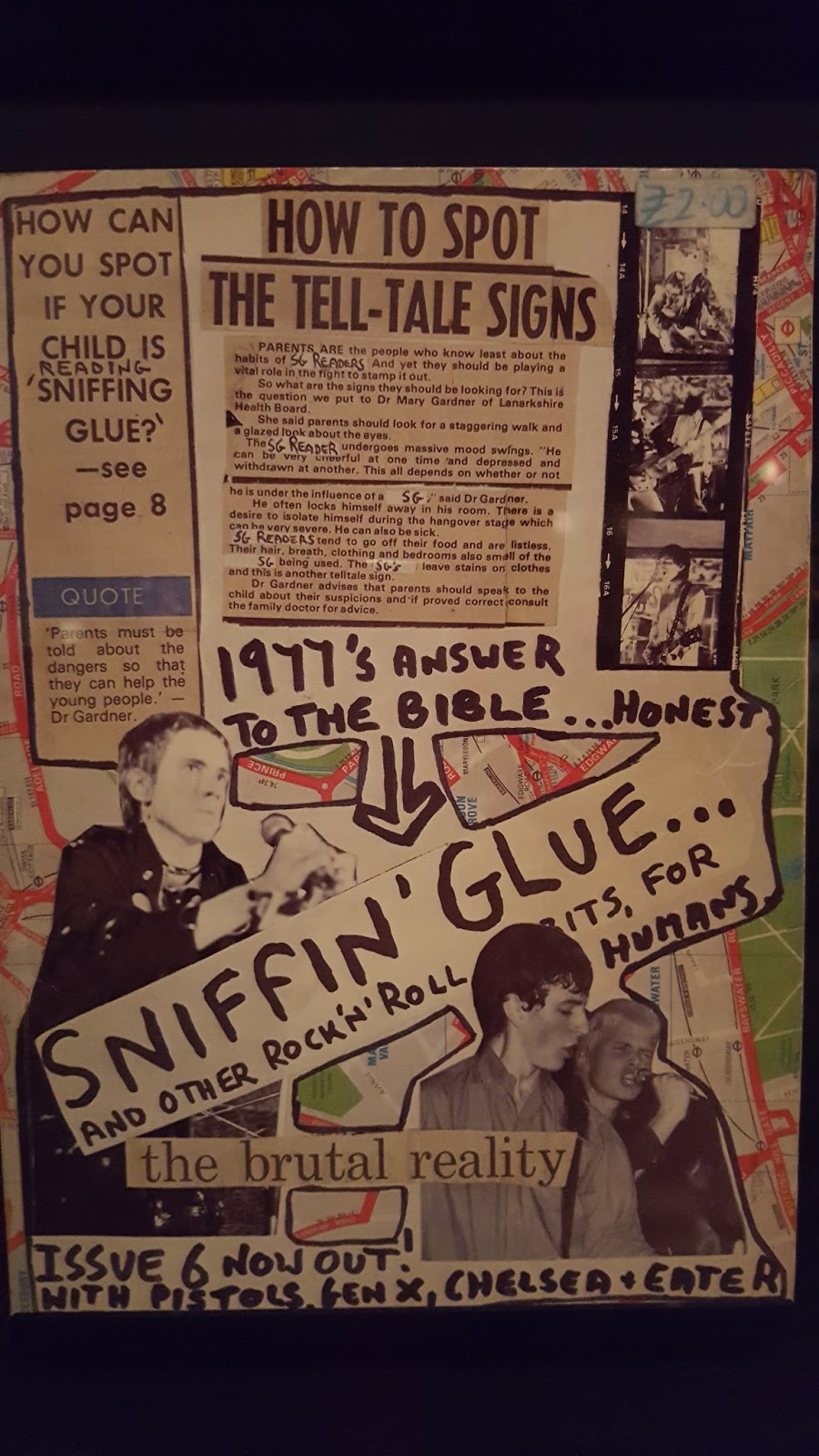
There's a very small section devoted to the fanzine scene and Sniffin' Glue in particular. This was covered far better, and in more depth, at the British Library show. Of more interest are the recollections of the politicising effect of punk. Witness the homemade Crass t-shirt and the story of one Julian Shulman. He'd initially been put off punk by seeing The Sex Pistols wearing swastikas on television in their infamous interview with Bill Grundy. Rock Against Racism, a movement formed as a response to an increase in racial conflict and the growth of white nationalist groups such as the National Front, turned him round.

As it did many. The NF were actively looking to recruit at both football matches and at gigs. RAR was a movement that changed the political direction of untold numbers of youths. It was no longer acceptable to spout racist bullshit and though it took a generation for that to become mainstream political thought I truly believe some of the seeds were planted at that time. They certainly were for me.

That's what those ranting and raving about the ineffectiveness of the Women's March, and other demonstrations, on social media don't seem to get. This is a long game, a very long game, and by showing the next generation that kindness, fairness, and equality are better than hate, blame, and inequality we've got a chance of things starting to improve in the future. If not the next four years.


Not that the initial punks made any great claims about making things better. The No Future slogan is nihilism in its purest form. That kind of destructive behaviour, often paired with incredibly regressive music, was never going to last and soon more intelligent, musically adventurous, and downright political factions grew out of punk. Read Phil Hunt's quote below for an example of how lives were improved. Observe a young punk posing in front of a poster for Jamaican reggae deejay Prince Far I to see how the youth of Britain became open to more sonically adventurous music than before.


Amongst all this the young punks were, don't worry, still wearing daft clothes and doing silly things. Trevor Smith hung out in The Chelsea Potter on the King's Road (one of the few old punk hang outs still there, me and my friend Pam popped in for a drink after a Blondie exhibition once unaware of its history) and put toilet bleach in his hair.

Luke Blair's hand drawn cassette cases are probably more successfully creative than Trev's amateur coiffeuring. With The Damned and The Dead Kennedys next to The Birthday Party and Killing Joke they seem to come from a time when punk was transforming into new wave or goth.


Creative impulses continued, often at the expense of formal education. 14 year old Max Hamilton skipped school to make a hand printed 999 patch and Peter Compton, another schoolboy, heard John Peel playing punk on the radio and handmade the below City of the Dead t-shirt.


It may have been a small exhibition but it was an interesting one. It served as a complement to the larger British Library show rather than an alternative. I enjoyed hearing the tales of these young punks and how music, and dissemination of information and ideas, changed their lives. Although I'd say it's probably time to draw a line under punk nostalgia for a while now and focus on something else.

So counter-cultural and punk did I feel at the end of my afternoon in the Museum of London I had a cappuccino and a krispy cake with a Mini Egg on top. Fuck the system!

Sunday, 22 January 2017

Feminist Avant-Garde of the 70s:Art vs the patriarchy.

Some of the art on show in The Photographers' Gallery's current Feminist Avant-Garde of the 1970s exhibition may show its age a little but, in a week when a man who openly boasts of sexually abusing women has been inaugurated as the American president, it feels as relevant, if not more so, than ever.

The intention of the curators is to look at 'radical, poetic, ironic and often provocative investigations by women artists who challenge assumptions about gender and art'. The end of the 60s had seen the rise of the Civil Rights and peace movements. The 'second wave' feminism that followed in its wake at the start of the 70s aimed, much as many of the marchers across the world yesterday, to confront patriarchy and sexism. Both in the art world and in society at large.

Many of the artists used their own bodies as central motifs. It was their way of taking control back of their image and presenting themselves on their own terms, rather than through the male gaze. In that respect it's highly appropriate that this exhibition runs parallel with Simon Fujiwara's Joanne which offers similar solutions to similar problems still encountered now. Depressingly.


Suzy Lake's Imitation of Myself (1973) guides us through a series of photos in which Lake applies thick greasepaint to her skin, slowly disappearing in front of us. She then applies ludicrous amounts of rouge and lipstick. Subverting herself to satisfy the demands of a society that saw surface rather than substance.

VALIE EXPORT's eye catching, and eye catchingly titled, Action Pants;Genital Panic actually dates from 1969 but is a crucial addition to the show. This is photographic evidence of the time Austrian performance artist EXPORT entered an art cinema in Munich, wearing crotchless pants, and walked around the audience with her exposed genitalia at face level. The idea was to provoke and it's hard to imagine she failed with that.


Other artists sought to address stereotypes of the woman's place being in the home. Renate Eisenegger irons the floor on her hands and knees, no more than a domestic slave. Karin Mack distorts the image of a traditional homemaker and housewife by piercing her with needles. Brigit Jurgenssen's Nest makes a fairly overt, and easy for all to understand, point about the role of mothers.


Both the very essence of being a woman and the way a woman looks are taken to task in this piece. Many of Jurgenssen's contemporaries also challenged long held attitudes about female beauty. Martha Wilson's Breast Forms Permutated (1972) and Francesca Woodman's Face (1975-1976) explore both formal and psychological assessments of their own form and that form's potential to create either poetic or iconographic images. Hannah Wilke, in 1977, went so far as to even question the nature of other feminist art.


Not everything in this show works. There's quite a lot of repetition of ideas. The films you can watch are a bit overlong. There's one of a pregnant woman soaping herself up and talking in German that, unless you can speak that language, isn't worth investing much time in. But some of the salient points made by the movement are worth reiterating.

Simone de Beauvior wrote in 1949, in The Second Sex that "one is not born but rather becomes a woman". If true that meant identity was constructed through social conventions and in a male dominated society men would choose how women looked, acted, and were treated. Many of the female artists represented here sought a deconstruction of these systems of representation and to take control not just of their own image but of the means of creating and portraying that image.

Ana Mendieta, in her 1972 Untitled work below, presses her face up to the screen contorting and distorting it. It's possible the viewer, not least one hoping for some cheap titillation, will feel discomfited by this. Role play and masquerade, alongside a lot of nudity, were used by these artists to engage with, and question, gender identity. Below Ana Mendieta you can see Lynda Benglis, who with her series Self, created between 1970 and 1976, adopted various art world personas. From the Jackson Pollock style action painter to the model. From object to subject.


Perhaps the two most noted adopters of character roles were Judy Chicago and Cindy Sherman. Chicago was originally named Cohen but felt taking her father's surname was a sign of male social dominance and her subordination to it. She celebrated her new name Chicago by posing as a boxer and wearing a sweatshirt with her new last name on it. Art versus the patriarchy. Seconds away. Round one.

Sherman adapted many roles in a series of untitled photographs. She saw these as conceptual portraits and avoided titles so these works would retain their ambiguity. I saw an exhibition of her work in Los Angeles last year and her black and white photos of the 70s have slowly mutated into garish, sexually explicit, often grotesque caricatures. They probably work better in a solo show where you've more time, and more of her work, to consider the breadth of her oeuvre.


Kirsten Justesen's Sculpture #2 (1968) is, perhaps, the most obvious thing here. Maybe a bit too obvious. Although Judith Bernstein's One Panel Vertical, from '78 (below), doesn't need too much explaining either. I'd have, a few years ago, been tempted to criticise these works as one dimensional and too simplistic but the last few years have seen me on a steep learning curve. Just as much as they have seen sexism rise its very ugly head again. In both old and predictable, and new and concerning, ways.


Hannah Wilke's Super T-Art (above) and ORLAN's Kiss from the Artist (below), both 1974, were to the forefront of works concerned with sexual liberation. They weren't made to titillate the likes of me but to show that women could be feminists and still enjoy sex. It's bizarre that there's a small section of people who still believe those things to be mutually incompatible but it seems there are. I think what Wilke and ORLAN were trying to say is that women should play an active sexual role. Not just receptacles for male fantasies and fluids.


Towards the end of the exhibition we come face to face with the genuinely odd looking stuff. I couldn't resist a quick titter at Tee Corrine's Cunt Coloring Book from 1975 (which made an appearance at the Women's March in London yesterday) but I wasn't quite sure what to make of Renate Bertlmann's masked lady cradling a massive dick like a baby or Penny Slinger's Promised a Bed of Roses (from 1973) which obviously asks questions about all sorts of things. Not least the supposed obligations of married life. Possibly most powerful of all is Judy Chicago's Red Flag (1971). An image that said to me that no matter how right on I am about these things some things can still shock me. I've come a long way but I've still got a long way to go. More shows like this will no doubt help me on that journey.

Big thanks to both Sanda and Michelle who accompanied me on my two separate visits to this exhibition.


Tuesday, 17 January 2017

Looking jazzy:A trip to the Fashion & Textile Museum.

I'd never visited the Fashion and Textile Museum in Bermondsey before. Founded in 2003 by Zandra Rhodes you can't miss it if you're walking down Bermondsey Street. A former warehouse painted bright orange with pink trim converted and redesigned by Mexican architect Ricardo Legorreta with the assistance of Rhodes.

There's no permanent collection as such (though there's a little shop and a rather pleasant café) so the organisers focus on an ongoing programme of temporary displays. Most recently the temptingly titled 1920s Jazz Age Fashion & Photographs. I'm not one for eulogising the concept of 'vintage', I'd just as happy attend a collection of off-the-peg high street clothes, but there certainly were some very lovely dresses there. Loads of them. I did not come away feeling I'd not seen enough female fashion from the twenties that's for sure.

The layout was a little confusing so I, very Britishly, started by the 'QUEUE HERE' sign. Here I could ponder a selection of coats, cloaks, capes, and dresses whilst reading a potted history of the decade in focus.


The end of World War I had marked a new era and in the UK, USA, and France there was a sense of prosperity. Traditional values began to give way to more radical behaviour. By 1920, for the first time ever, more Americans were living in cities than in the country and increased mechanisation meant more leisure time.

Women entered the workforce in greater numbers than ever before. Two key factors forced this societal shift and both had their origins in the war that had just cost tens of millions of lives. Firstly while the men were at the front women had been mobilised to cover their jobs and help out with the war effort in munitions factories. This taste of freedom was not to be sacrificed easily in peacetime. Secondly there simply weren't enough men left alive to cover all the work (and rebuilding) that needed to be done.

After the horrors of war those that had survived were determined to enjoy life to the full in the knowledge of how precarious the gift of it is. Some of the things that happened in the decade underline that. Others totally contradict it.

On the plus side Marie Stopes, in 1921, opened her first birth control clinic in the UK. A year later Ulysses was published. The year after the Hollywoodland sign went up. In 1924 Andre Breton launched his Surrealist manifesto, in 1927 Clara Bow became the first 'It girl' and, at the end of the decade, MoMA opened in NYC.

Less positively in 1920 prohibition began in the United States. It lasted for thirteen years. Most worrying of all were developments in Germany where, in 1921, Hitler became leader of the Nazi party. Within 12 years he'd become Chancellor and we all know what happened after that. It serves as a warning from history to anyone who thinks it's a good idea to vote for populist demagogues now. The final, dreadful, consequences of these acts can take decades, generations, to play themselves out and the scars will never, and can never, be healed.


However, this is a fashion museum so for people more interested in that there's always the Holocaust exhibition at the Imperial War Museum or Trump's inauguration on Friday (depending on whether or not you're more interested in how fascism ends or how it begins).

Back in Bermondsey I'm looking at more of the fashions of the new modern ladies or, as F Scott Fitzgerald called them, flappers! Each tableau is set against pastel shaded backgrounds consisting of age and theme appropriate motifs and titled individually. In The Boudoir (above), Picnic At The Lake (below), and At The Fashion Show (at the bottom of this selection) being just a few examples. My favourite here is the Sonia Delaunayesque art deco one.

Amongst the maid outfits, slips, and dressing gowns you get a sense of the oriental influence that was seeping into fashion. You can witness the changing length in hemlines. Within the decade they went from to calf to ankle and back again. Frocks became more tubular and plunging v-backs appeared. In the late half of the decade a 'boyish' look developed and the dominance of the waist as a focal point of women's fashion declined. Obviously not for ever.


There's a wall of portraits of notable women of the time. My photos didn't come out great but, below, you can see Chinese American movie star Anna May Wong and boogie-woogie pianist Edythe Baker. They're celebrated alongside Greta Garbo, Mary Pickford, Tallulah Bankhead, Clara Bow, Lee Miller (whose IWM exhibition last year was a major cultural highlight for me), and Louise Brooks.


Sigmund Freud's psychoanalysis had become part of culture and sex was more openly discussed. 'Petting' parties were held where youngsters could go to 'practise' kissing and hugging. The increasing popularity of automobiles opened up the possibility of more distant holidays. Trains, planes, and ships even more so.

On The Ocean Liner (below) takes a glamorous look at this golden age of cruising before A Tennis Match looks at trends set by six time Wimbledon winner Suzanne Lenglen. With the new freedoms of the age sport, particularly outdoor sports like swimming, tennis, and golf, were heartily encouraged. This came with the added advantage of potentially developing a sun tan, a newly in vogue look which took off after fashion designer Coco Chanel accidentally got sunburnt visiting the French Riviera.


It's hard to imagine sun tans were particularly visible in the speakeasies that rose during prohibition. The clothes worn there were designed to move and shift as dancers performed the Charleston, the Black Bottom, and the Shimmy to the jazz music that gave the era its name. Cocktail Hour, too, became a thing. A very wonderful thing.


A side room is given over to movies. By 1925 about 3,500, mainly Art Deco, cinemas had opened across Britain. Many of them still stand, either crumbling in their faded glamour or, perhaps, converted into cavernous Wetherspoons shrines to daytime drinking. In the 20s people would visit these buildings to learn kissing tips from the movie stars. If you ever find yourself looking for kissing tips in a 'spoons you should probably have a serious word with yourself.

Another gallery of the museum is given over to the photographs of James Abbe. His painfully posed photographs caught the fashion of the age if not the movement which, in the case, of Rudolph Valentino and his wife Natacha Rambova is surely a shame. Douglas Fairbanks looks like he's curling a turd out while Mary Pickford holds his hand more in sympathy than affection.


It'd been an interesting afternoon. One a little out of my comfort zone. Both as regards to visiting and to writing about. I ended up in the aforementioned café with a hot chocolate and a small slice of millionaire shortbread. Though perhaps a highball, a blast of the Paul Whiteman orchestra, and a little shimmy shimmy would've been more appropriate. Calmness wasn't an end in itself.