
 Posts


Sadly, or perhaps luckily, Walthamstow's most famous sons had not been scheduled to put in a performance at the Barbican's really rather lovely, and fantastically free, two day Walthamstow Garden Party in E17's Lloyd Park round the back of the William Morris Gallery. If they had would the queues to get in have been even longer?
It's a moot point but the combination of the UK's longest heatwave in decades, a wonderful line up of African and Latin American bands, and the thought of an afternoon spent, or wasted, in a sun drenched park all combined to bring crowds from near and far to Walthamstow. On Saturday the line led out of the park, along Forest Road, down Winns Terrace, along Winns Avenue, and, finally, into Carr Road. It was tempting to get a can for the queue (having already wetted our whistles with a pint of Solstice summer ale in The Bell beer garden) but we resisted.
Luckily, because despite being a long queue it moved pretty fast. Pam and I were joined by Gary and Shaun and we were all in the park within less than half an hour. Even in the queue we were treated to a blast of drumming (not for the last time over the weekend) and a DJ blaring out John Holt's Police in Helicopter from turntables fashioned from upturned wheelie bins.


In time honoured fashioned we worked our way promptly to the bar. £5.50 a pint's not too bad for a festival (not least one where the music is free) and they had a decent selection of ales and lagers. Prosecco, Caribbean and cocktail bars were scattered around the surprisingly pretty site but I took a pint of Joker and we found a patch of scorched grass and sat ourselves down for some sunshine and some music. The atmosphere was most convivial. Kids running around, people sunbathing, and the smell of various international cuisines wafting over in the wind. Shaun proposed we all have dinner together at 5pm which seemed a bit too organised but turned out to be something of a masterstroke.


Once we'd watched, and listened to, the best part of one hundred drummers, the Colombian DJ Cero39's bubbly dance beats, and a gospel choir run through some nice versions of songs from Paul Simon's Gracelands album it was time to tour the food stalls. Alongside the vegan curry bowls there was cuisine from Vietnam, Greece, Spain, Italy, and elsewhere. The toughest decision would be choosing what to go for. Each aroma coaxed me in like a superannuated Bisto kid.
In the end I took a Cypriot halloumi wrap, Pam went for some kind of Senegalese stew, and Shaun opted for Venezuelan arepa with cassava fries (he let me try one, delicious). Gary had a sausage roll. He wasn't feeling hot food on a hot day.


We may've eaten our dinner in the shade but we were soon back out in the sun for some reggae c/o Adrian Sherwood and Creation Rebel. At this point we met with our friends Mark, Natalie, and Neill and it felt like the festival had turned from a lazy afternoon in the park into, well, a festival.
As Sherwood at the controls bobbed his head to the righteous rhythms we indulged in some age appropriate skanking to the bass heavy sounds of Creation Rebel. I must admit that despite professing myself a huge reggae fan I wasn't overly familiar with the work of Creation Rebel. I've missed out. They were ace and, judging by the enthusiasm with which Mark, Neill, and Pam received their dub version of Jacob Miller's Baby I Love You So, I was far from alone in that opinion.
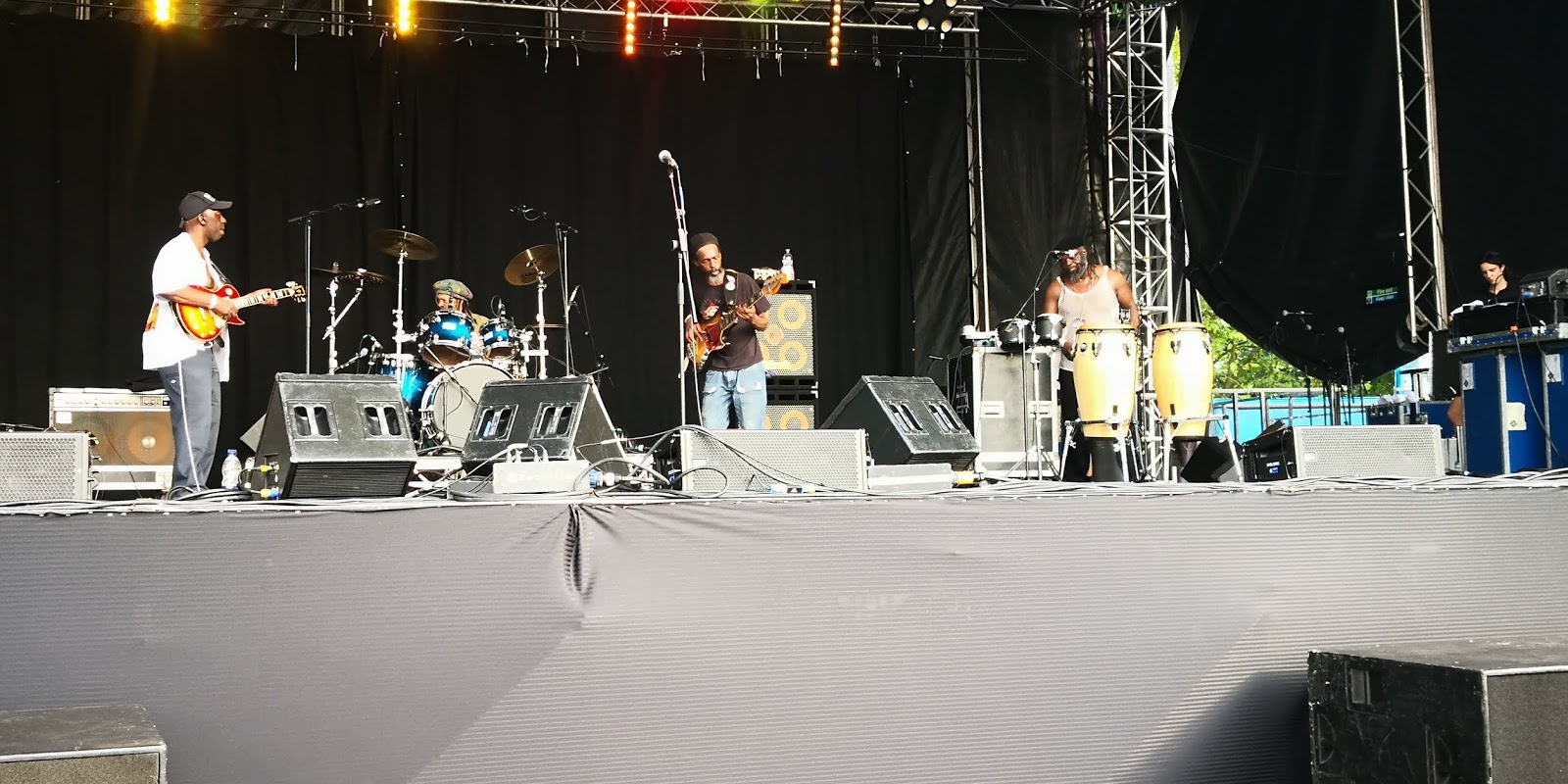


Alas, Afro-Cuban All Stars didn't quite live up the billing. While it was undoubtedly quite a coup for the Barbican to book such a big name for the event there was something missing. Neill suggested that for him it was that he didn't really like Cuban music (at least in relation to Jamaican music) and Pam felt they were too quiet.
I'm more inclined to side with the latter viewpoint. While they were undoubtedly proficient, enthusiastic, and incredibly tight they left me just a little bit cold. It was a shame. Other friends (Mike, Mark, and Eugenie) arrived and we drifted over towards the bar and the dance tent before the first day of the festival reached closure.
We headed into Walthamstow's Mirth, Marvel and Maud for more beers and to watch enthusiastically refreshed punters cut a rug to Tina Moore's Never Gonna Let You Go, DJ Luck & MC Neat's Little Bit of Luck, and Madonna's Vogue. It was nearly 2am by the time I got home. It was one of those nights. There'd only been one really great live band but the day itself had been absolutely delightful.


Sunday would be less about friends (because none of them came, preferring to watch the World Cup or prepare for holidays in Whitstable - I ask you) and more about music. Just as well the music would be great then.
I jumped off the Victoria line at Blackhorse Road for a change (and for the first time ever) and followed the sun baked A503 past some sort of Hindu temple, the birthplace of William Morris, and a vandalised Mercedes-Benz. The queues were slightly less long than the day before and it was even warmer than it had been then too. I had a look around Fellowship Island with its craft stalls and little bars, I watched some kids play in the skate park, and I, once again, let the waft of grilled food fill me with joy.


47Soul were already on stage when I arrived. A group of Palestinians based in London they play a type of music called shamstep which is a warm and generous mix of dance styles du jour and Palestinian folk. They told impassioned stories about government injustice, the Grenfell tower, and the Balfour declaration. They sounded great but they were no match for the absolute star of the festival.
Dona Onete, the 'Queen of Carimbo', from Para state in the Amazonian region of Brazil, may not have put her first record out until she was 73 years old (she's eighty now) but by the time her set had finished she was as much the Queen of Walthamstow as she was of either Para or Carimbo. I wasn't the only one beaming from ear to ear at the joyous sounds that Dona and her band were doling out. That's why she's the header photo in this report.
What a joy it is that elder women, so long marginalised, are now having their voices heard in the world of music. You can add Dona Onete to Calypso Rose, Toto la Momposina, and Shirley Collins on the list of women born in 1940 or before who are finally getting their due. No Meio do Pitiu lightly handles a call and response vocal over a lilting, but urgent, Caribbean rhythm as Dona intones passionately over the top and Jamburana makes a hearty, but not gutbusting, casserole of samba, salsa, and cumbia with even a sprinkling of klezmer on top. It's a winning mix.
Lengthy introductions were given to the songs but as they were in Portuguese I was unable to understand them. They weren't completely in vain however as there were plenty of others there singing along to every word of Dona's. It seems that she'd brought the Brazilians to the yard, alright. As her saxophonist danced around the stage and generally fulfilled the role of hype man, Dona shook her shoulders and grinned the satisfied smile of somebody whose eight decades of life and hard work have finally paid off and then, in a coda to melt the steeliest of hearts, she rose from the chair she'd been perched on all set, did a little shimmy, bowed to the audience and walked off safe in the knowledge that she'd probably got a few thousand more admirers than she'd had half an hour ago. Bravo jovhem senhora.


It seemed like a good time to go for a little stroll around the park and to check the World Cup football scores (France were 1-1 with Croatia in a high scoring final they'd go on to win 4-2, I'd backed Croatia but hey, it seems like, cliche alert, football was the winner after all) before getting some more food.
I'd eyed Shaun's Venezuelan arepa with envy the day before, and had also enjoyed that particular snack in Cartagena during a Colombian sojourn back in 2015, so I headed over to the Venezuelan food stand and got myself a veggie version. Roasted peppers, pico gallo, Llanero cheese, and loads of black beans made for a messy meal but a bloody tasty one. I washed it down with a slightly hoppier Pillars lager from one of the many remarkably fast serving bars.


It filled me up alright and I must confess to feeling slightly bloated during the adorable Fatoumata Diawara's set. Decked out in blue and white the Malian born Ivorian dashed through a greatest hits set of sorts but also included her own tribute to the Afrobeat sound of Fela Kuti and a cover of Stevie Wonder's HIgher Ground which brought some of the more 'experienced' festival goers briefly to their feet. Hey, it was hot! Have I mentioned that?
The light guitar lines of Sowa drifted across the zephyr and I laid back and let them wash over me. When I was younger the idea of putting music on to fall asleep to would've been anathema but no longer, this is the stuff that (sweet) dreams are made of. Later I saw Fatoumata eagerly shaking hands and posing for selfies with young fans. I think I fell ever so slightly in love. Not for the first time that day.
The light guitar lines of Sowa drifted across the zephyr and I laid back and let them wash over me. When I was younger the idea of putting music on to fall asleep to would've been anathema but no longer, this is the stuff that (sweet) dreams are made of. Later I saw Fatoumata eagerly shaking hands and posing for selfies with young fans. I think I fell ever so slightly in love. Not for the first time that day.


Once I'd soaked up some more rays and enjoyed a little dessert of churros'n'chocolate it was time for the last act of the weekend. Seun Kuti was a coup to rival the Afro-Cuban All Stars and, luckily for me, a less disappointing one. The snake-hipped, Yoruba jumpsuit clad, elastic man's voice was in as good nick as his body as he spat out verse after verse of anti-corruption, anti-imperialism infused Afrobeat. A chip off the old block, you can't help thinking his ol' fella Fela would've been mightily proud.
Amazing dance routines from the two female backing vocalists, horn stabs, flickering guitar lines, all added up to a wonderful headline appearance and if Seun lacks some of Fela's originility (or, indeed, song running length) that's no major criticism. In Afrobeat Fela, and Tony Allen, invented one of the most powerful, compelling, and enjoyable genres of music I've yet to discover.
Bad Man Lighter took from the 70s/80s blueprint and pared it down to something more accessible to today's shorter attention spans, though it still weighs in at seven minutes plus, and Struggle Sounds was a lithe funk banger decorated with trilling keyboard flourishes and an old school brass blowout. In a festival that had featured music from Brazil, Cuba, Jamaica, Palestine, and Colombia it was left to the Africans to finish it all off. Seun Anikulapo Kuti was the fire to Fatoumata's ice and African Dreams spread out over an easy nine minutes as if to soundtrack our exalted egress from E17. It may've told a story of African youths losing their souls and sense of self chasing the American dream but it felt more like a comforting hand on the shoulder than a finger wagged in the face.
I went home suntanned, sober, and sated. Fantastic food, marvellous music, and fabulous friends. I can't wait to do it all over again next weekend closer to home in Camberwell and Brixton.


