Sunday, 8 April 2018

Il Stanza Incantata:Modern Works from the Pinacoteca di Brera.

The Estorick Collection has been celebrating its twentieth birthday with a not inconsiderable loan from the Pinacoteca di Brera in Milan, one of the world's greatest collections of modern Italian art. Like most things, it's a mixed bag and the work ranges from fairly straightforward figurative art, via cubist and futurist works (the Estorick's forte really), on to fully fledged abstraction.

Most of it comes from a bequest from Emilio and Maria Jesi and most of it has never been shown outside of Italy before. On donating these works to the Brera in 1976 the collectors dedicated it "to the artists and art lovers of yesterday, today and tomorrow". A demographic most of us would surely find ourselves in.

But is much of the art on show in The Enchanted Room:Modern Works from the Pinacoteca di Brera worth seeing, worth loving? I'd have to give it a resounding 'si'.


Carlo Carra - Rhythms of Objects (1911)

The Piedmontese artist Carlo Carra is one whose works can be seen in the Estorick's permanent collection and if he later developed both more futurist and metaphysical styles of painting then 1911's Rhythms of Objects clearly show the results of his trip to Paris earlier that year with Umberto Boccioni where he was introduced to the cubism of Braque and Picasso.

The work seems to sit on the cusp of both cubism and futurism, mixing the studied stillness of the former with the energetic movement of the latter to produce an effect that had me thinking of stained glass. Carra's Tuscan contemporary Severini had already been a resident of Paris for a lustrum and it was he who introduced Carra and Boccioni to the developing French styles. Perhaps because he'd been away from Italy, Severini's own work seems to be in a more traditionally cubist vein.

Ardengo Soffici, another Tuscan artist, had also been resident in Paris during the 1900s and even though he'd been back in Italy for seven years by the time he painted Watermelon and Liquers, again, you can see the huge debt he owes to the Paris art scene in which he'd been mixing. 


Gino Severini - Le Nord-Sud (1912)


Ardengo Soffici - Watermelon and Liqueurs (1914)


Ottone Rosai - Still Life:The Carpenter's Bench (1914)

Ottone Rosai was a new name to me. Closely associated with Ardengo Soffici, as you can see in The Carpenter's Bench. It's a pleasant, if unremarkable, example of cubist painting though highly atypical of the artist who tended to see himself more in the grand tradition of Honore Daumier, Gustave Courbet, and Paul Cezanne.

If that makes it sound like Rosai was an artist whose name isn't well known because he lived in the shadows of greater artists then a quick Google image search should prove that unfair on him. But it's certainly not an accusation you could level at metaphysical maestro Giorgio de Chirico. His paintings of rubber gloves, empty plazas, long shadows, and strange statues are amongst my favourite things in all art. So it was a pity that his sole contribution to this exhibition was the rather staid, and very disappointing, Le printemps de l'ingenieur. It's got some of the main motifs of his style, skewed perspectives, unusual architecture, etc;, but they've yet to be fully realised. They soon would be and this interesting show would've been a far greater one with just a couple of examples of what de Chirico did next.


Giorgio de Chirico - Le printemps de l'ingenieur (The Engineer's Springtime) (1914)


Carlo Carra - The Metaphysical Muse (1917)

The pittura metafiscia at its pomp is, however, represented by a couple more Carlo Carra pieces. Six years on from Rhythms of Objects Carra's art had changed pretty drastically as, with de Chirico, he sought to create enigmatic and dreamlike paintings that affected us in ways we'd not be able to fully understand. These metaphysical paintings predated the most famous of the surrealist artists by about a decade and its easy to see how the likes of Salvador Dali and Max Ernst could've found inspiration in these faceless mannequins, geometrical shapes, maps, and, that old surrealist favourite, fish!

It's a world away from Umberto Boccioni's divisionist self-portrait of just nine years earlier, yet both these artists were key figures in the futurist scene. Boccioni's work seems to come more from the school of Van Gogh, or perhaps from the pointillism of Georges Seurat and Paul Signac, but the industrial buildings in the background, we're gently reminded, suggest that he'd already developed an interest in celebrating modernity and the industrial city. Key themes, along with speed, violence, youth, and war for the futurists he would soon be one of.

Umberto Boccioni - Self-Portrait (1908)


Carlo Carra - The Enchanted Room (1917)


Umberto Boccioni - Self-Portrait (1908)


Osvaldo Licini - Equilibrium (1934)

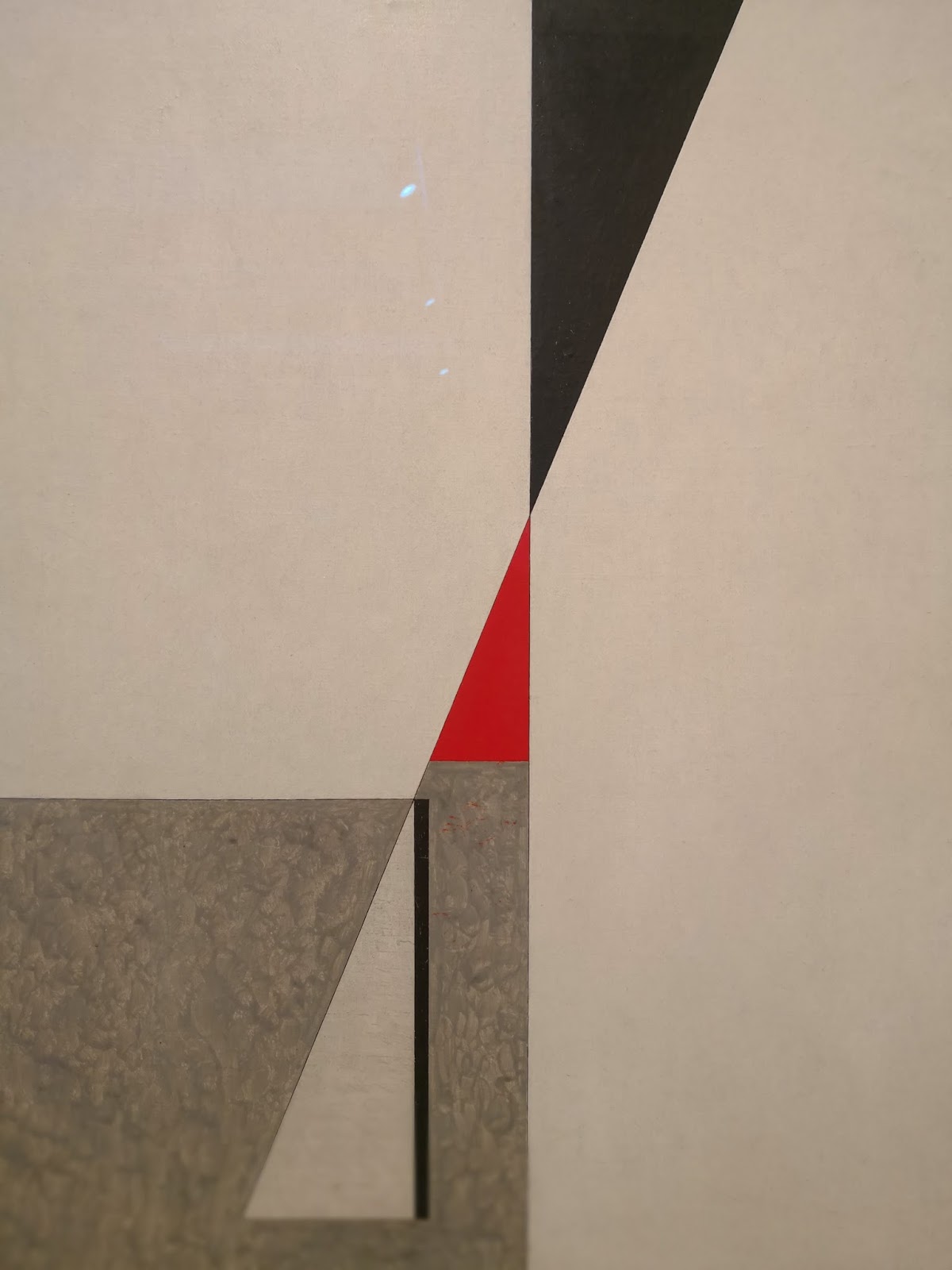
Osvaldo Licini's Equilibrium stands out for a couple of reasons. It's one of the most recent pieces in the show (just 84 years old!) and it's certainly the most purely abstract. Again, Licini was a new name to me. Turns out he'd abandoned figurative painting in 1930 and was now exploring his belief that "geometry can become feeling". I think he's done it rather well. His work would sit rather well alongside that of Ben Nicholson or even Theo van Doesburg. Though it seems likely that Mondrian would baulk at such flashy embellishments as diagonal lines!

Born in Sardinia, Mario Sironi spent his childhood in Rome and after a trip to Germany, brought an expressionist aesthetic with him into the futurist fold. The Truck was painted before his later support, and his provision of decorative works, for Mussolini's fascist regime, and it's easy, at first, to see it as quite the opposite, a rejection of totalitarianism in any form. When you realise it's anything but it's harder to appreciate it. Post-war Sironi's artistic reputation suffered as a result of his overwhelming support for Il Duce and if that's tough on him then tough shit, all you fascists bound to lose.

Anyway, The Lamp's pretty crap even if I can't help holding on to a grudging admiration of The Truck and an even bigger one for the muted muddy Urban Landscape with Chimney.


Mario Sironi - The Truck (1914-15)


Mario Sironi - The Lamp (1919)


Mario Sironi - Urban Landscape with Truck (1919-20)


Mario Sironi - Urban Landscape with Chimney (1930)


Amedeo Modigliani - Portrait of Maise Kisling (1915)

Amedeo Modigliani tried to enlist in the Italian Army during World War I (which was ok, as they were on the right side then) but was refused due to his ill health. He always seemed more a lover than a fighter though. He was all about the love, man. Well, love and multiple terrible addictions and illnesses (he died of tuberculosis in Paris aged just thirty-five). He's certainly the biggest name of any of the artists on show in this exhibition and it was quite a surprise to see a couple of his trademark elongated, or in someway squashed, heads there.

 Head of a Young Woman is said to (probably) portray the English writer Beatrice Hastings who had a tempestuous love affair (do artists ever have love affairs that aren't tempestuous? are any love affairs not tempestuous?) with Modigliani. She lived with him in Montparnasse, was noted for her accounts of bohemian life, and converted to theosophy. Her attempts to defend Helena Blavatsky from charges of fraud and plagiarism has seen her get a bad rep within the skeptics community. In Modigliani's portrait she doesn't look too fussed. Inscrutable and fiery at the same time. The fire burns within. Or maybe on her collar.


Amedeo Modigliani - Head of a Young Woman (1915)


Gino Severini - Large Still Life with Pumpkin (1917)

Massimo Campigli's two works on show are in stark contrast to the industrial grime of Sironi or the bold abstractions of Licini. My friend (and purveyor of Burgess Hill radio's fantastic Sunday night show Out of Limits) Dan asked me why one of the guitarists in Women with Guitar was naked and the other clothed. It wasn't a question I could answer. Perhaps it was some sort of reference to Edouard Manet's Le Dejeuner sur l'herbe some sixty-four years earlier. Perhaps Campigli just liked naked women. Who knows.

Whilst raising obvious questions about the male gaze, it is a rather lovely picture and seems to have something of early Picasso, Fernand Leger, or even Tampara de Lempicka about it. The Garden is equally splendid and seems as if it could've come from an ancient Etruscan or Greek vase or even a cave painting. 


Massimo Campigli - Women with Guitar (1927)


Massimo Campigli - The Garden (1936)


Mario Mafai - Butchered Ox (1930)

Mario Mafai founded, with his wife Antonietta Raphael, the Scuola Romana, a group that, unlike many other art movements of the time, seemed to be founded on friendships (or marriages one assumes) than manifestos. As such it's a surprise to see something so fleshy and blood soaked as a Butchered Ox being made subject matter. There's something of the Renaissance religious painting, a hint at the body of Christ, a flayed Marsyas, but it also predates the celebration, or consideration, of flesh itself that we later see in the work of Lucian Freud and Jenny Saville.


Ardengo Soffici - Santa Cristina (1908)

After all the war, the loving, the death, the sex, and the pushing of boundaries the exhibition fades to grey with a collection of still lifes and landscapes from Giorgio Morandi. Or does it? Morandi's paintings may be still but they're anything but dull. Like William Blake seeing the world in a grain of sand and heaven in a wild flower, it seems Morandi could see eternity in a loose grouping of vases, bottles, and pots.


According to the photohistorian Lamberto Vitali, Morandi's works are "populated not by things but by the ghosts of things" and that seems a pretty apt description. These ordinary household items could be ciphers, they could (as in the work of artists as varied as Paul Nash and Hilma af Klint) represent something more than what they are. But then they could, equally, just be themselves. There's a quiet, contemplative, certainty about Morandi's work that makes it oddly compelling.

Like Cezanne or Monet he became fascinated with subtle variations in hue, tone, and arrangement and like them, too, he beavered away studiously, seemingly utterly sure that what he was on to was something worth sticking with.

It turned it out was. In that respect it was much like the decision of the benefactors of Eric and Salome Estorick's collection to open a permanent gallery in London dedicated to modern Italian art in 1998. Sometimes, if an idea's good it's best to stick at it until everyone else comes round. Why else would I write this blog? ;-)


Giorgio Morandi - Landscape (1916)


Giorgio Morandi - Still Life (1929)


Giorgio Morandi - Still Life (1929)


Saturday, 7 April 2018

A Continuous Becoming or Becoming Tedious? The srcibbles, lines, and numbers of Giorgio Griffa.

"The unfinished work, the object not completed, also means underlying its nature as subject. And it captures an organic aspect of the doing, which never finishes, is never definitive... It is a continuous becoming, from one canvas to the next. Time won't let me finish my works" - Giorgio Griffa, Post Scriptum, 2002.

Yawn! It wasn't because Giorgio Griffa's A Continuous Becoming retrospective at the Camden Arts Centre was boring that I nearly fell asleep when I was reading the press release on a rather comfy seat in their foyer. It was more likely the fact I'd been up since about 0530hrs and had walked over ten miles that day. But it has to be said the show really wasn't that interesting.

Camden Arts Centre is a nice place to visit. It's got a quirky little bookshop, a good cafĂ©, and a reasonably decent sized garden that looked quite inviting on one of the warmest days of the year so far. But that should all be the icing on the cake and the cake itself should be the art that is housed within.

I'd had fairly high hopes for Griffa, an artist I'd previously been unaware of, based on the fact that he had links with the Arte Povera (a movement that I've long admired) and that he lives and works in Turin (which is a beautiful city and one that can really capture the imagination of any artist) and, initially, I thought his numbers, lines, and scribbles looked quite pretty. What could they mean? Would there be a code I could crack? How would his art develop?

 
Tre line con arabesco n.834 (1994)

 
Tre Colori (1998)
 
The best answers I could give would be they meant nothing, there was no code, and the art didn't really develop very much at all. It all got a bit samey and I was glad the exhibition had been free. There's nothing wrong with devoting yourself to one very specific subject and honing your art around that subject. Artists as diverse as Giorgio Morandi, Claude Monet, Bridget Riley, and Paul Cezanne could all be said to have worked in that fashion.
 
But as the careers of those artists went on they, in most cases, seemed to get to the essence of their 'muse', started to really see what it is they were painting, peel away the layers of the onion and uncover some inner truth. It seems like Griffa just carried on grafting. He obviously liked what he was doing and saw no need to change his methods or dig any deeper.
 
Tre Colori does make good use of blues, reds, and pinks to create a pleasant aesthetic but Dall'alto and Obliquo are, well, just a bit dull really. Even if the latter did remind me of the cover of New Order's 'Fine Time'.


Dall'alto (1968)

 
Obliquo (1976)

 
Segni (1969)
 
In his eighties, Griffa's been at it for a while so he probably knows what he's doing and why he's doing it and it probably all makes sense to him but there's very little here for the viewer to latch on to. That doesn't seem very generous. Sometimes I like an artist to give a bit. There's plenty of books about him in the reading room (though most are in Italian which I can't read) and you can even put on headphones to listen to the kind of music (jazz) that Griffa plays when he paints.
 
It must be lovely to spend your senior years tucked away in a studio in Turin listening to jazz and making the art you want. By the time you reach that age you probably deserve it too. But, still, that doesn't mean there's much in it for the viewer. That's as self-indulgent as someone writing a blog about it all, if not as self-aware.


Monocromo (1968)

 
Spugne (1969)
 
There's a lot in the exhibition about how Griffa "transcribes rhythm, sequence and the repetition of minimal gestures", uses something he calls "positive concentration", and how he "nurtures a synergetic relationship between himself, his tools and his materials". It's all so much word salad. They're pleasant enough to look at but positive concentration and synergetic relationships? C'mon!
 
For what it's worth the show follows a rough trajectory around his career. From the sixties when he flirted with minimalism, through the eighties when he claimed some of his work was intended as a homage to arch conceptualist Joseph Beuys, and on to work made as recently as two years ago.
 
Intertwined with the supposed artistic development are two ongoing series. Canone aureo (Golden Number or Golden Ratio) lays claim to all sorts of confusing mathematical stuff from Euclid, pentagrams, pyramids, and the Fibonacci sequence and perhaps offers the closest thing to a Scooby as regards what all these numbers, letters, and marks all mean.
 
Alter Ego is a slightly simpler concept. It's Griffa paying homage to artists he admires. Artists as diverse as Henri Matisse, Yves Klein, Paul Klee, Alighiero Boetti, and Agnes Martin) Paola a Piero is his tribute, if you will, to 15c Late Gothic painter Paolo Uccello and Griffa's near contemporary abstract painter Piero Dorazio. There doesn't seem to be much in common with Uccello's egg tempera renderings of horses or battles (unless those lines represent swords, could be on to something here) and Dorazio worked in much bolder, far more striking, colours.


Paolo e Piero (1982)

 
Canone aureo 498 (Alighiero Boetti) (2015)

 
Canone aureo 860 (2014)

 
Canone aureo 179 (2016)
 
....and so it goes. I walk round the galleries, I take photos, I enjoy the way the sunlight streams through the window onto 1980's Frammenti more than I enjoy the piece itself, and I nearly interrupt a couple having a cheeky little snog in one of the alcoves. I don't hate it. I don't love it. I don't even feel bewildered. Just a little indifferent. So I go home and write about it. Because writing about things you're indifferent about is a really good use of your time, isn't it?
 
Cosi e la vita!

 
Frammenti (1980)

 
Doppio movimento (1997)

 
Canone aureo 874 (Agnes Martin) (2016)


Friday, 6 April 2018

Palace of Sauds Reversed:Welcome to the House of Fundamentalism.

"Saudi Arabia is probably the most corrupt country on the planet and that corruption goes to the very top of the Saudi royal family".


BBC Two's House of Saud:A Family at War was an extensively researched, almost surgically critical, gripping, and absolutely masterful analysis of how the House of Saud have amassed untold wealth and corrupted that country and what that means for both the region and the world. It doesn't let Saudi's international allies (chiefly the UK and the US) off the hook either. It was a truly international crime drama that took in locations as disparate as India, Malaysia, Bulgaria, and Monaco and it was an excellent, important, and, at times, chilling, watch. The fact that the Saudi Arabian government refused to respond to the programme makers and didn't allow filming in their kingdom speaks volumes about how much they hate, and how little they permit, criticism of any kind.

The story begins far away from the yachts, sports cars, and palaces of the Kingdom of Saudi Arabia in snowy Osve in the north of Bosnia and Herzegovinia. Osve has been claimed to operate as a training ground for ISIS and, sure enough, the black jihadi flag of Islamic State flies above the village. Locals have travelled out to Iraq and Syria to fight for ISIS.


The famously tolerant muslims of Bosnia have, historically, worshipped at the 450 year old Ali Pasha Mosque in Sarajevo but in the same city stands a much newer mosque whose imams disseminate a much more 'radical' message. The King Fahd Mosque is Bosnia's largest and is one of 120 mosques in Bosnia that Saudi Arabia have helped fund and build.

During the Bosnian war of the 1990s it's claimed that the Saudi Arabians were diverting charity money donated for Islamic education towards buying weapons and funding the Bosnian mujahideen, foreign Muslim volunteers who fought on the Bosniak side on that conflict. King Salman bin Abdulaziz Al Saud, former King of Saudi Arabia and Head of the House of Saud since 2015, has been implicated in this funding regularly - as well as similar rerouting of money to Afghan fighters.

Now Crown Prince Mohammad bin Salman, King Salman's son, has taken over the reins of power and the Crown Prince has vowed to put an end to terrorist funding but is this just a smokescreen, PR, covering up what is essentially a power grab intended only to result in less freedom for the ordinary people of Saudi Arabia and more power for Saudi's rulers? The evidence given over three hours certainly makes a strong case for this.


But first we're taken on a brief history lesson. It's no surprise that the Kingdom chose to divert billions of dollars of charity money towards 'freedom fighters' when you understand that Saudi Arabia, much like the less successful ISIS, was created as a jihadi project in the first place.

Wahhabism, the doctrine and movement that informs the House of Saud, preaches a return to 7c radical Islam, a return to the times of Muhammad himself, and, as such, has been the petri-dish for both Al-Qaeda and ISIS. Fifteen of the nineteen 9/11 plane hijackers were Saudis and two of the pilots were Bosnians who'd been radicalised in their country's Saudi Arabian sponsored mosques.

While the US bombed Iraq in retaliation, Saudi Arabia escaped any serious international repercussions and back in the Kingdom the death of nearly 3,000 people at the hands of their citizens in a foreign country didn't appear to warrant any reform. In fact it wasn't until Al-Qaeda struck on Saudi soil in 2004, killing 22 people in the oil rich Persian Gulf city of Khobar, that the Saudis started to share intelligence with foreign governments, at the same time introducing some "very very limited" reforms.

Attacks across the globe, of course, continued. India has the world's third largest Muslim population but some of the local interpretations of the religion, Sufism particularly, have not been met with a positive reaction from the Saudi backed ultraconservatives who operate in the subcontinent. The Mumbai attacks of 2008 left over 160 people dead and were carried out by Lashkar-e-Taiba, a Pakistani terror group who've been the beneficiaries of Saudi funding.

Zakir Naik is a prominent Islamic preacher who operates out of Mumbai. He wears a shirt and tie and lectures in English rather than Urdu or Arabic but this shouldn't confuse you into thinking he's a moderate. He's anything but. He's on record as saying that "Every muslim SHOULD be a terrorist" and that message gets out to quite an audience. His television station, ironically named Peace TV, has a global reach of 200,000,000 viewers, he's set up schools, and his 'teachings' have inspired terrorists in London, Glasgow, the US, and Bangladesh.


Naik promotes that view that beating one's wife 'gently' or 'lightly' is permitted. He also says muslims have the right to have sex with their female slaves so he promotes rape as well as wife beating. You'll be unsurprised to learn that his views on homosexuality are equally unpleasant. He believes gay people are sinful and mentally ill due to watching pornography and the only way to deal with them is the death penalty.

Both the Indian and Bangladeshi governments have banned Naik's Peace TV from broadcasting and he has been denied entry to the UK and Canada but Saudi Arabia opted for a different approach, they extended citizenship to Naik thus validating his views for ever larger sections of the Islamic world.

Predictably, India's banning of Peace TV has led to conspiracy theories sprouting up. Many Indian muslims believe that the Hindu nationalists of the Indian government are lying about Naik and other similar 'preachers' in order to discredit them.

So why do the UK (and other Western governments) sit so tight with a Saudi regime that sponsors terrorism in so many different places and ways? Many reasons. One of the most simple to understand is IS's threat to wipe out the House of Saud, to bite the hand that fed them right off essentially. There is also, of course, oil. But a third reason is that as the custodian of the two holy mosques of Mecca and Medina the House of Saud are determined to counter Iran, and Shia's, 'heretical' influence.

When the Syrian uprising started in 2011, Saudi Arabia saw this as a chance to get rid of their mortal enemy Iran's number one ally and proxy, Bashar al-Assad. With 400,000 now dead and one million homeless due to that conflict it's safe to say things didn't go quite that smoothly.


Assad has, quite correctly, been portrayed as a villain in the conflict yet Saudi Arabia's funding of the Islamic groups fighting in Syria has drawn less criticism. Arsenal JSCo, a Bulgarian firm, are known to have built Soviet designed anti-tank weapons and to have sold them to Saudi Arabia. These have turned up on the battlefields of Syria suggesting that the Saudis have been buying arms on the black market.

The programme goes further in saying that, across the Balkans, the Saudi government have spent billions of Euros on weapons that their own forces would not be able to use without contravening international laws. Either they're using them illegally or they're selling them illegally. It seems that the weapons get from Saudi Arabia to Syria via intermediaries operating in Jordan. When Islamic State was at its most potent in 2014 those Saudi weapons (and Saudi cash) started falling into the hands of ISIS. The Saudis pointed the finger at Qatar and continued to deny involvement.

When Crown Prince bin Salman took over as Defence Minister (just a small part of his portfolio) in 2015 the US praised his overtures as regards cutting down on illegal arms deals (Trump made his first foreign trip here, you can see footage of him dancing awkwardly with a load of Saudi princes and their swords) and made funding terrorism punishable by death but neither the money nor the weapons have stopped making their way to extremists around the world. This kind of behaviour may well be, strictly speaking, illegal in Saudi Arabia but many Wahhabis still support extremism and the most vocal, and powerful, of its proponents can be found in the huge Saudi royal family.


Trump's not their only friend in the West. Yemen, 2017:A brutal war personally conducted by Crown Prince bin Salman is being backed by both the UK and the USA. Saudi Arabia says Yemeni Shia rebels are backed by Iran and a proxy sectarian conflict has burned out of control. As ever religion, corruption, and high murder rates go hand in hand.

The same year in Riyadh, in November, five hundred people, including eleven princes, are seized and kept captive in a five star hotel that operates as a very gilded prison. It seems like some of the money that's gone into running that prison/hotel may've come from Malaysia. Certainly money's gone missing from Malaysia.

1MDB (1Malaysia Development Berhad) is a strategic development company wholly owned by the Malaysian government who a lot of people in Kuala Lumpur aren't very happy about. 1MDB's deal with the Saudis begins on a grand yacht stationed in the harbour of Monte Carlo. It belongs to Prince Turki bin Abdullah of the House of Saud and on the yacht we can find Najib Razak, the current Prime Minister of Malaysia, and his family being 'entertained' by Prince Turki.


The entertainment must've been good ($700,000,000 good apparently) because Razak was inspired to invest heavily in a Saudi petrochemical deal that resulted in billions of dollars (or ringgits) of Malay money disappearing and plunging the country in to debt. Razak, himself, was okay though as, at the same time, huge amounts of money started to appear in his account, transferred by Prince Turki. Why did Razak make such an obviously corrupt move?

In the investigation that followed the dodgy deal jets, Monet paintings, and Beverly Hills properties were seized. Money had even been found to have made its way into the funding of Martin Scorsese's Wolf of Wall Street, a film, that, with no little irony, was intended as a satire on rampant capitalism and corruption. The FBI investigations are ongoing and Razak, still in power in Malaysia, denies any wrongdoing.

The House of Saud controls 20% of the planet's oil reserves but the riches this brings in still aren't enough, the greedy princes still want more. A long term corruption investigator is interviewed and he says he has never seen a single transaction with Saudi Arabia that didn't involve massive bribes, and often those bribes come from the UK government.

In fact Whitehall has been Saudi Arabia's most reliable source of illicit funds for fifty years now. If some (certainly not all) were conflicted about offering Saudi Arabia bribes to get their business that appears no longer to be the case. 'Commissions' are now normal practice when securing arms deals and King Abdullah did very well out of this.

Abdullah wanted the UK to supply the weaponry to modernise the Saudi Arabian army but, of course, it came at a cost to the UK. Margaret Thatcher, Tony Blair, Gordon Brown, and David Cameron have all been implicit in deals to pass over millions, billions even, of pounds to the Saudis so that we can get arms deal and they can kill Yemeni people and fund training camps for Islamists so that they can kill us. Sounds harsh? Well, that's how bent (and dangerous) the whole thing is.


People like Ian Foxley who've gotten close to doing something to bring it to the public attention and hopefully stop it have been spied on and threatened with arrest. Some bribes are just too big to fail it seems. When Foxley started to stick his nose in to just exactly what 'procurements' meant on invoices from SA to the UK he was removed from his job and he now works as a cleaner. Whisteblowing may be the morally correct thing to do but it'll very likely cost you your house, your marriage, and your livelihood.

As well as procurements and commissions another euphemism for bribes is 'brought in services' and Peter Austin was the Brit who served as the man who eased the passage for these brought in services, he was crucial in making the system of bribes work. He owns a private island in the Caribbean. An inquiry launched by the Serious Fraud Office in 2012 is ongoing and has so far not charged a single person.

It's a long way from 1960s Saudi Arabia when King Faisal replaced King Saud bin Abdulaziz Al Saud, his brother from one of Ibn Saud's many wives (Ibn Saud had approximately one hundred children, it seems they lost count). Faisal was seen as a honest man who drove around the desert handing out gold coins to the destitute but he held absolute power at a time the petrodollars were starting to flood into the country.

Saudi Arabia hadn't just been behind the west, but about one thousand years behind it. Faisal created ministries for the needed modernisation and installed his brothers as ministry heads where they stayed, in many cases for fifty years, and expanded their own individual power bases. At the Ministry of Defence they knew Prince Sultan bin Abdulaziz Al Saud, Minister of Defense and Aviation from 1963 to 2011, to be the most corrupt of all Saudi princes.


On his watch rake-offs went from 7% to 10% to 15% and UK civil servants warned they'd continue to grow. But with thousands of job in the UK arms industry at stake there was no appetite for restraint. When Michael Heseltine was Secretary of State for Defence he signed off a £43,000,000,000 (43 billion) deal for weaponry with Prince Sultan. As part of that deal the UK promised the Saudis that the rake-off, the corruption, would be kept secret.


Emboldened, and wanting to enjoy the freedoms they don't allow their own citizens, many of these Saudi princes began to arrive in London, the new playground for the international jetset. Amongst those pushing around briefcases full of $100 bills was one Prince Turki bin Nasser Al Saud. At one point it was estimated that Prince Turki was getting through £2,000,000 a month. He owned an estate in LA and even operated a private 747 jet to cart the princess's shopping round in.

He, like Prince Sultan, was getting rake offs from Heseltine's bent deal with BAE. BAE, with the full knowledge and approval of both the British and the Saudi government, were funding Turki's lavish lifestyle. From the £43 billion that Heseltine agreed in this, the Al-Yamamah arms deal, more than £6 billion was in 'commissions'. It's gone down as "the most corrupt transaction in commercial history".


The Saudis paid their bit in oil rather than cash but as the price of oil is not fixed the bloody Bank of England was able to build up a slush fund, again extending into the billions. The Saudi ambassador to the United States, Prince Bandar bin Sultan was given a private jet, in the colours of his favourite American football team the Dallas Cowboys, as a birthday gift. UK taxpayers paid the maintenance costs on it.

Lots more money was disappearing from the vaults of the Bank of England and reappearing in offshore accounts in Switzerland but, as the noose tightened on this outrageous display of greed and corruption, the Saudis played their get out of jail free card. They threatened to, or hinted that they would, withdraw all help on counter terrorism.

Tony Blair personally signed off a letter saying that the investigation into BAE should be abandoned and the enquiry was, indeed, shut down in the UK. The Americans tried to pick up where the Serious Fraud Office left off but the British government refused to share data, claiming it was 'state secrets'. BAE eventually admitted criminal actions and though BAE were fined $400,000,000 nobody ever faced justice for the world's most corrupt transaction. The whistleblower was the only individual to suffer.


In 2001 Prince Bandar suggested that corruption was simply 'human nature' and had begun with Adam and Eve in the Garden of Eden. He said the House of Saud is enriching itself in exactly the same way the House of Windsor once did and it's a fair riposte.

The current richest man in Saudi Arabia, Prince Al-Waleed bin Talal bin Abdulaziz al Saud, owns shares in Facebook and Twitter and was often seen hobnobbing with Michael Jackson before he died. Prince Al-Waleed did very well out of an arms deal with the Dutch firm Ballast Nedam.

In the Riyadh Ritz Carlton crackdown by Crown Prince Mohammed those that found themselves gilded captives included Prince Al-Waleed and both Prince Turkis mentioned above (yes, the names get confusing). Amongst allegations of torture, four hundred bank accounts are frozen. Yet by putting the spotlight on the other princes the Crown Prince has inadvertently turned it, also, on to himself, his huge yacht, his French chateau, and his gold leaf fountain.

Whilst the other princes are finally being made accountable the Crown Prince remains unaccountable. Cynics, or realists, would say this isn't about cracking down on corruption at all. But, just like Putin in Russia, this is a de facto coup by the most corrupt of the corrupt all the time posing as an anti-corruption measure. It's how politics works all over the world now.

There's another way the Saudis are a bit like the current lot in charge of Russia too. A strangely close, if often ambiguous, relationship with Donald Trump. The third episode of House of Saud:A Family at War begins with The Donald awkwardly dancing with a load of rich Saudis.

The king styles himself as the custodian of Islam's two holiest sites, Mecca and Medina. Saud citizens are taught that hypocrisy and unislamic acts are the greatest sins but a former bodyguard of one Saudi prince describes girls, high class prostitutes, being shipped in to serve Saudi princes.

The princes are ashamed and paranoid about this getting out so the girls are paid in the tens of thousands plus given Bulgari and Rolex jewellery and old school Nokia phones (so they can't take any photos, no evidence this ever happened). The girls are also spied on and have to report in as if they had some kind of curfew.

Prince Saud bin Abdulaziz bin Nasser Al Saud is a horny homosexual Saudi prince with extreme temper issues. In 2010 he was caught on CCTV attacking his manservant, Bandar Abdulaziz, in a hotel lift in London. Three weeks later Bandar was found dead in the Prince's hotel room. It came up that Bandar regularly took, and accepted, a beating.


Prince Saud tried, but failed, to take diplomatic immunity. He admitted to the murder but denied a homosexual relationship with Bandar because, in his twisted morality, homosexuality was a greater sin than murder. Prince Saud was found guilty and sentenced to life imprisonment at the Old Bailey. He served three years before a convenient exchange deal saw him return to Saudi Arabia to, supposedly, serve the rest of his time in a Saudi jail. He got away with it, pretty much.

Approximately two thirds of the population of Saudi Arabia are under thirty years old and they're beginning to question just how much power the house of Saud have over the country and what they're doing with it. We hear from Saudi women living in exile in the USA and the UK. Including Dina who, in 2017, when trying to escape an arranged marriage had her passport taken away and was detained in Manila before being sent back to Riyadh where she was kept prisoner in SA by her own family. Eventually she escaped and fled to America. Another, this time nameless, exiled woman says she can't return to SA because if she does her family will force her into slavery.

It's the house of Saud who are allowing this to happen and it's other countries inaction, or complicit behaviour, that allows it too. But now oil prices are starting to drop and the Saudi economy is flatlining change could be afoot. But would it be for the better?

Crown Prince Mohammad launched his Vision 2030 project in an attempt, supposedly, to modernise the Saudi economy. A decree was issued in 2017 giving Saudi women the right to drive, the very last country in the world to do so. Cinemas have opened, women have been allowed to enter sports stadia, and have been permitted to carry out basic administrative tasks without the presence of a male guardian.

Yet still a mandatory dress code exists, women can't leave the country without male permission, and their court testimony is adjudged to be worth only half that of a man. When the Arab Spring saw social media explode in Saudi Arabia it looked, briefly, like the government would not be able to control what their people said. But it soon turned out that the SA government was using an Italian company called Hacking Team to provide mass surveillance on its population by the use of implants in smart phones etc; People ended up in serious trouble for their tweets though unlike in China and Turkey Twitter wasn't shut down.

It's believed the SA government makes uses of propaganda bots to post up to 100,000 tweets per day. It's so prevalent in the country that estimates suggest that at least 50% of Internet users in Saudi Arabia aren't real people and are there only to provide "hashtag poisoning". Pushing real stories down the pecking order by flooding social media with pro-government stories, true or false.

Atheism is considered terrorism in SA law and terrorism is punishable by death. It's a punishment that's carried out pretty often. Up to forty-seven people were executed in a single day including political opponents and a senior Shia cleric, Sheikh Nimr, on trumped up charges.


Crown Prince Mohammad's 'reforms' haven't improved human rights, it's fair to say, but have, potentially, made them worse by creating a raft of new crimes which include 'insulting the King' and contacting Amnesty International. The latter again being considered a terrorist crime and thus punishable, like atheism, by death.

Seventeen year old Mustava was arrested, tortured, forced to sign a confession, and sentenced to death for attending a pro-democracy demonstration and for overseeing a Facebook page on it.

As these mass executions increase under the rule of the Crown Prince, the USA and the UK are inactive, terrified that SA will 'go' to Russia or China. Better to see Saudi Arabia as a 'flawed friend'. If that's sticking your fingers in your ears and pretending not to hear the music then inviting Saudi Arabia on to the UN Human Rights Counsel is absolute insanity.

Saudi Arabia now has the right to veto sanctions or action. They were put on this counsel at the same time as they were advertising for more people to behead their prisoners, often for actions that aren't even considered crimes in most other countries. It completely undermines the counsel, the UN, and the entire concept of human rights.

It's been handy for the house of Saud though who've been able to use it to block investigations into what they're doing in Yemen. Things like bombing a funeral in Sana'a killing 140 people. A drop in the ocean compared to the 10,000 civilians who have already died in Yemen (where both starvation and cholera are also rife) during this hugely under reported conflict so far.

Everywhere you look when it comes to Saudi Arabia there is death. The programme makers had called on some well informed, and high profile, talking heads for this show. From CIA officers and directors and LSE professors through to widows of 9/11 victims and members of Sufi cultural organisations. They'd managed to get hold of stunning, and rare, pictures of the aftermath of those 9/11 attacks and equally disturbing images of caged women being driven around Syria's rubble strewn streets in the back of vans to be used as human shields.

It's odd to hear Donald Trump saying extremism should be driven out and it's even odder to find yourself agreeing with something that comes out of Trump's mouth (even if his hypocrisy knows no bounds, if you don't like extremists don't dance with them) but the evidence presented was overwhelming and it's evidence that none of us will even be surprised (shocked maybe, but not surprised) about. It seems as long as it's got oil, Saudi Arabia and the house of Saud can do whatever it wants. Kill its own people, kill people in neighbouring countries, fund terrorism to kill people in far away countries, and all we do is keep throwing more money in their direction. It really is time to stop it. At the very least we should stop funding Saudi Arabia, stop bribing Saudi Arabia, and stop arming Saudi Arabia.

What a great, if often sickeningly sad and infuriating, programme. The sort of thing the BBC should be doing.


Sunday, 1 April 2018

Mark Dion:To the Birds.

"Artists must resist nostalgia. When we reference the past it is not to evoke the good old days. Our relation to the past is historical, not mythical" - Mark Dion.

Wunderkammers, zebra finches, hunting standards, and a false unicorn horn. If you're the type who can't help peeking into the cabinet of curiosities there's a lot for you at Mark Dion's new show at the Whitechapel Gallery. If, however, you're someone who seeks some kind of narrative to your art viewing experience you may come away disappointed. Or at least confused.

Like anything in life, it's what you make of it and I found it to be a diverting hour or so spent amongst objects both quotidian and quirky. The raison d'etre for Dion's work is his wish to "explore natural history and its institutions including the language and imagery used to identify species, the uncanny quality of natural history museum displays, and nature in popular culture".

He's as much inspired by cinema as he his art movements like Surrealism and Minimalism, and he's just as likely to take from the foreshore of the Thames as he is the rainforests of Guyana. Which all makes for a very mixed bag show. A show that starts with sheds.

 
The Wonder Workshop (2016)
 
Sheds of a sort anyway. A couple of friends of mine used to regularly complain that the biggest cliche of contemporary art was the shed. They genuinely felt they never needed to see another shed in a gallery ever again. Sheds exploding, sheds being turned into boats, sheds just being sheds. 'Shed the shed' they said (or should've). Another friend of mine claims to love very few things more than rusty corrugated iron. Who knew sheds could be so polarising?
 
Of course, strictly speaking, these aren't sheds. They're 'hides', places where twitchers secrete themselves away for hours on end in the hope of catching sight of a gaggle of barnacle geese, a wedge of whooper swans, a colony of avocets, or even a raft of auks. Who gets the job of coining collective nouns for animals? It sounds both cushy and fun. If it pays too I want it. 

 
The Hunting Blinds and Hunting Standards (2005-2008)

 
The Hunting Blinds and Hunting Standards (2005-2008)
 
There are four hides and they take up the bulk of the largest room in the entire show. They're all made of different materials (it's as if there were four little pigs trying to escape some huffy puffy wolf). Some of them look like cold war watchtowers but they've all been given names.
 
Our corrugated iron friend is The Glutton. Below it is The Librarian. It's the only one us visitors were allowed to enter and was kitted out with books, binoculars, and flasks. It looked pretty comfy. Below is the fancily named Dandy-Rococo and The Ruin lives up to its name, lying in a collapsed heap on the floor. Looks like the wolf got to that one.
 
Behind them on a nearby wall are six hunting standards featuring a hare, a deer, a gun, bears, and some kind of fierce looking hog. I didn't spend long looking at them.

 
The Hunting Blinds and Hunting Standards (2005-2008)

 
The Hunting Blinds and Hunting Standards (2005-2008)

 
The Hunting Blinds and Hunting Standards (2005-2008)

 
Costume Bureau (2006)
 
I'd been distracted by these four characters. Four different kinds of naturalists. From right to left we've got On Tropical Nature (Orinoco River Basin, Venezuela), The Great Munich Bug Hunt, Tate Thames Dig (more later), and Roundup (Chicago).

Like the hunting standards they added to the overall experience but were dwarfed both by the sheds and the room's centrepiece:- an aviary, The Library for the Birds of London, in which the visitor can enter and stand amongst eleven pairs of zebra finches (a charm, a trembing, or a trimming for the collective noun fans) as they fly around or perch upon branches. There are books on ornithology and artworks relating to birds piled or peppered around the cage and a nearby sign assured this conscientious vegetarian visitor that the finches were being taken care of.

Dion's created these aviaries for over twenty years now, from Antwerp to Paris to New York, and the reason he does so is to try to get us to think about the way we interact with the animals that are around us every day, all the time. As it's in London perhaps pigeons (or even parakeets) may've been more appropriate. But then think of all the shit the poor gallery staff would have to clean up. Euw!

 
The Library for the Birds of London (2018)

 
The Library for the Birds of London (2018)

 
The Library for the Birds of London (2018)

 
The Library for the Birds of London (2018)
 
I enjoyed my time caged up with the birds but I wasn't quite sure what I was supposed to do while I was there. I took some photos (of course) and then tried to look serious. It seems unlikely a zebra finch would understand the concept of embarrassment or even be able to empathise with each other let alone a visiting creature more than a hundred time their size so when I left I failed to bid a fair adieu. We may be in this cage together, we may all be alive, but what I realised was we don't share all that much really. They don't care about me.
 
A flight of stairs takes you to the more sedate Naturalist's Study (home of the fake unicorn horn). Specially designed wallpaper (animal silhouettes), thick carpets, comfy chairs, yet more tomes both ornithological and artistic in nature, drawings of evolutionary trees that have been spruced up to include the names of influential figures in naturalism like Alfred Russel Wallace and William Beebe.
 
The unicorn horn is included next to a coral tree to show how the real world and the world of the imaginary can, over time, become intertwined. I sat and studiously read for a while before moving on to the Bureau of the Centre for the Study of Surrealism and its Legacy.

 
The Naturalist's Study (2018)

 
The Naturalist's Study (2018)

 
Bureau of the Centre for the Study of Surrealism and its Legacy (2005)
 
You're not allowed in so, like a kid at a candy store, me and my fellow gallery visitors poked our noses up at the glass window and took in the tables, chairs, bookshelves, and assorted objects but to no great avail. It was designed to "make you smile, laugh, shake your head in shock and condemnation, or gasp" but I must confess I did none of those things.
 
I just moved on. The show was all very interesting but I'd have probably benefitted from a personal tour by someone more au courant on affairs curatorial and ornithological than I. It wasn't that I wasn't enjoying it. I was. I just didn't really understand it. I'm a bit thick like that sometimes.

 
Tate Thames Dig (1999)

 
Tate Thames Dig (1999)

 
Tate Thames Dig (1999)
 
The Tate Thames Dig was something I could understand. I've written before about how I'd quite like to go mudlarking on the Thames and I've written often about both London and its primary river so to see the spoils of an archaeological dig on the foreshore at Millbank was most pleasing.
 
Dion and a team of teenage assistants dug no deeper than six inches down in the sand and yet found an astonishing array of material that told a story of London's history and our throwaway culture. A great deal of plastic (Lucozade bottles and the like), some knives, some bullets, a few outdated mobile phones and laptops, clay pipes, oyster shells commemorating 17c visits to local brothels and bear pits. Clearly a socialist in his naturalism Dion has accorded each object equal status. Just as every person has a story to tell so does every object.
 
One has to pass through a curtain into the final darkened room where sits 2015's The Wonder Workshop. Dion was commissioned to create a work for a Venetian palazzo and these wunderkammers were the result. The 'ghosts' of animals and objects that are now either extinct or at least obsolescent have been coated with a luminous paint to create a spectacle for the eyes as much as a question for the mind.
 
In making me think about conservation and curatorial practices, Dion's show had had a minor effect. In giving me a treat for the eyes it had been more successful. There'd been a minor dip in the middle but, on the whole, I'd come away informed, entertained, and ready to learn more. That was enough for a one hour trip and I'm curious to see more of his work in the future.
 
His Wikipedia page also tells me that he shares a birthday with me. Us August 28 folk have to stick together.

 
The Wonder Workshop (2016)

 
The Wonder Workshop (2016)