Friday, 3 November 2017

California Dreamin':A Design for Life.

From the Joshua Tree to the Humboldt Redwood State Park, from Big Sur to Death Valley, along Highway 1 from Los Angeles to San Francisco, from the island prison of Alcatraz to the verdant vineyards of the Napa Valley - no other state, except possibly Texas, presents such a clear image of itself as the Golden one - California.

The streets and bridges of San Francisco, the surfers of Huntington Beach, NWA's Compton, the Hollywood Hills, the beautiful people of Venice Beach, the manicured lawns of Bel Air, and the endless sprawl of San Fernando Valley, all join together, with a little push from the movies and television, to define an utterly iconic space.

Music, too, has done its bit to keep the freak flag of California flying. California Girls, California Dreamin', Hotel California, California Soul, California Uber Alles, California Love, San Francisco (Be Sure To Wear Flowers In Your Hair), Under The Bridge, Welcome To The Jungle, even Sonic Youth and Lydia Lunch's Death Valley '69. It seems safe to say that the neighbouring states of Arizona, Nevada, and Oregon have inspired only a fraction as many songwriters to pick up a guitar or put pen to paper.

So, why, with so much natural (as well as man made) beauty do Californians (both native and naturalised) spend so much time retreating into fantasy worlds? Hollywood, Disney, LSD, and cyberspace. If they weren't invented here they've been perfected or standardised here. The Design Museum in London's Holland Park had curated a show, California:Designing Freedom, that proposed to tell the story of the last fifty or so years of the state's history and how it had become some kind of Mecca for designers and creative types the world over, how it has changed the world we live in, how we express ourselves, how we navigate life, and how we live it. Even how we fall in love.

The show was broken into five loose groups (Tools of Collaboration and Community, Tools of Production and Self-Reliance, Tools of Movement and Escape, Tools of Self-Expression and Rebellion, and Tools of Perception and Self-Fantasy) and it was sometimes difficult to see where one group ended and another began. Understandably there was a huge overlap and if this was initially frustrating, eventually it was liberating, forcing the viewer to impose their own narrative.

For me the story was less about sitting on a beanbag listening to The Grateful Dead or seeing Larry Page's first stool from his Google office and more about how this state of hippies, the open road, skateboards, surfboards, and free festivals morphed into one of tech start-ups, Silicon Valley, AirBnB, Uber, and fitness apps. How, and why, did we get from Easy Rider to the self driving vehicle?


Replica of Captain America Chopper - Ben Hardy, Clifford Vaughs and Peter Fonda (1969)


Waymo 'Firefly' self-driving vehicle - Yoojung Ahn, Jared Gross, Philipp Haban (2014)

Of course, there's no right or wrong answer to that but, as befits the third most extensive state in the Union, there is a journey. In my blog about the V&A's You Say You Want A Revolution? Records and Rebels 1966-1970 exhibition back in February I wrote about how Richard Brautigan, Stewart Brand, and Steve Jobs inspired beatniks to become entrepreneurial and how outsider tech-pioneers like IBM and Hewlett-Packard aimed to create a fairer, more idealistic society by taking the ethos of the hippy and the festival world into the domain of business.

Eventually that dream curdled as many of those involved proved to be equally as venal as those they'd replaced at the summit of the business world. But for a few years California, was indeed, dreaming. The state was experimenting with autonomous communities, conferences and communes provided a testing ground for ideas of what egalitarian, networked societies could look like, and the Homebrew Computer Club (where Steves Job and Wozniak first met) took the idea of digital technology from corporations and put it into the hands of the people.

Though the Homebrew Computer Club may sound a long way from the Day-Glo aesthetics and enthusiastic acid gobbling of Ken Kesey's Merry Pranksters or outlaw motorcycle clubs with names, like Satan's Slaves, designed to shock, they all drew on one thing. A very clear sense of identity. You can see it now in tech giants like Google, Facebook, and Apple. Even the way these titans arrange their business around 'campuses' clearly has its roots in the communes, the hippy dreams, of the sixties. Often their mission statements, Google's Don't be Evil and Twitter's Yours to Discover, are wrapped up in a woolly ill-defined, if well intended, liberalism that, as their tentacles reach further into every aspect of our life, cause the spokespeople for these companies to tie themselves up in ideological knots when trying to defend them. 


Motorcycle Club jacket (1960s-1970s)


Merry Pranksters leader Ken Kesey atop the 'Furthur' (sic) bus - Tad Streshinsky (1966)


Replica Endless Summer surfboard - Hobie (1963)

Many of the sixties start-ups of California seem a world away from the vast sprawling headquarters of the tech behemoths. Hobie Surfboards got going in 1960 when Hobart 'Hobie' Alter used his father's Laguna Beach garage (Disney and Hewlett Packed, as well as many others, also began in small garages) to build a few nine foot balsa wood boards for his friends, the first skateboards started out as wooden boxes, or boards, with roller skate wheels attached to the bottom and slowly developed from there, and Vans (who had opened up in 1966 in Anaheim selling directly to the customer) started out selling shoes for skateboarders before branching out into snowboarding, BMX, and sponsoring the Warped Tour travelling rock festival.


If you weren't into extreme sports you could always enjoy the outdoors, or, indeed, the interior of your own psyche, in a very different way. In front of 30,000 hippies at the Human Be-In in San Francisco's Golden Gate Park in 1967, Timothy Leary popularised the mantra of "Turn on, tune in, drop out" and there were tabs of LSD, depicting the Eye of Horus or scenes from Disney's Fantasia, to help you do this and Jefferson Airplane, The Grateful Dead, Big Brother and the Holding Company, Quicksilver Messenger Service, and Blue Cheer were there to provide the soundtrack to your trip. And it was a trip.


Hosoi Hammerhead skateboard - Christian Hosoi (c.1985)


Vans Era - Tony Alva and Stacy Peralta (1975)


Big Brother and the Holding Company; Avalon Ballroom - Victor Moscoso (1967)


Eye of Horus LSD blotter paper - Designer unknown (1979)

The counterculture of California subversively appropriated industrial and military technologies and put them to use for transforming the self and even society itself. LSD had been used experimentally, and, it has to be said, massively unsuccessfully (tripping soldiers don't really want to fight so much as stare into space), by the CIA before being made illegal in 1966. As acid infused the music of California and elsewhere, it also opened the mind up to new possibilities, and for each mind it damaged many more became switched on by it. Underground newspapers like the San Francisco Oracle enthusiastically wrote about its 'transcendental aspirations'.

You could now have Disneyland or Hollywood in your own mind. But what use a perfect world of freedom and love in your mind if outside in the real world things were not so perfect? Vietnam, Civil Rights, racism, and homophobia were still huge issues across the US and California was, although at times it hardly seemed it, part of the US.

The now world famous Rainbow Flag was created by artist and activist Gilbert Baker for 1978's San Francisco Pride Parade. Each colour stood for something. Pink for sexuality, red for life, orange for healing, yellow for sunlight, green for nature, turquoise for art, indigo for harmony, and violet for the human spirit. Pink and indigo have since been removed and blue has replaced turquoise but the flag still flies proudly, now, much further afield than San Francisco and is often seen as a welcome sign, an indicator of a safe space.


Rainbow Flag - Gilbert Baker (1978)


Protest poster for the police raid of the Black Cat Tavern - PRIDE (Personal Rights in Defense and Education) (1967)


Gay-in poster - Bruce Reifel/Gay Liberation Front (1970)

Eleven years before Baker designed the Rainbow Flag, in February 1967, the gay rights group PRIDE organised a demonstration protesting an LAPD raid of a New Year's Eve celebration in Silverlake, two years before New York's famous Stonewall rebellion this was one of the first gay rights protests in the whole country. Two years later the Los Angeles chapter of the Gay Liberation Front organised a 'Gay-In' at Griffith Park, in that city's Los Feliz district, as a means of increasing the visibility of LA's lesbian and gay population and mobilising the next generation of activists.

As the Gay Liberation Front protested for gay rights, The Black Panthers did for black rights. Emory Douglas, the Black Panther's Minister of Culture as well as one of their chief graphic designers, firmly believed that the Panther's newspaper needed potent images to cut through the high illiteracy rates in deprived communities. With his language of empowerment, resistance, and positive black role models he provided that, and just to make sure people got it each morning he personally distributed newspapers and pasted them directly to neighbourhood walls.


Afro-American Solidarity with the Oppressed People of the World - Emory Douglas (1969)


Everywoman newspaper centrefold - Sheila Levrant de Bretteville (1970)

Sexism, also, was being tackled. While teaching at the California Institute of the Arts in 1970, Sheila Levrant de Bretteville designed a special issue of the feminist newspaper, Everywoman, with a centrefold that celebrated a "give me a C, give me a U, give me an N, give me a T" cheer created by students in her department.

It must've felt like, despite stiff resistance from the establishment and the patriarchy, things were moving forward on all fronts but as the Harvey Weinstein abuse stories continue to trickle out we're beginning to see just how widespread the problem still is. Even something as seemingly solitary as playing computer games has become something of a battleground between sexist 'dinosaurs' and more progressively minded people of both sexes.

Gamergate seems a long way from the idyllic days of the Atari television games. I look back through rose tinted spectacles with joy at the pleasure my Atari brought me. From Indy 500 to Space Invaders and on to Activision's brilliant Skiing and Boxing games all you had to do was shove a cartridge in and play (oh, and get your parents to buy them for you, they weren't cheap). The Atari 2600 (initially called the Atari VCS) was a huge breakthrough in home video systems and sold more than 30,000,000 consoles in the eighties.


Atari 2600 CX2600-A - Ted Dabney and Nolan Bushnell (1980)


Ray Gun, February 1993 - David Carson (1993)

I had hours of fun playing on my Atari (and later my Commodore 64) before going to gigs, buying the NME and Melody Maker, and, let's face it, getting drunk started to take over as my primary leisure pursuits. If I'd lived in America there's a good chance I'd have been buying Ray Gun magazine. With features on Dinosaur Jr, The Flaming Lips, The Shamen, and Shabba Ranks it'd have been right up my boulevard.

Graphic designer David Carson brought the spirit of the subculture to Ray Gun, amongst other magazines, with his hard to read typography and, quite frankly, frustrating use of upside down photographs. A former professional surfer who'd started off working on skateboarding magazines his style came to be known as 'grunge typography' and, alas, it's dated as badly as some of the lesser lights of that scene. Although, rather amusingly, he once set an entire interview with Bryan Ferry in 'dingbats' because he'd found the interview so utterly tedious.

Magazines were fun (and are still, surprisingly, popular) but the interactivity of the Kindle has, understandably, revolutionised publishing. The idea that you could, essentially, carry two hundred books round with you at all times with ease (whilst saving trees at the same time) was so popular that the first production batch sold out in five and a half hours.


Amazon Kindle - Amazon Lab126 (2007)


Cardboard Surfboard - Mike Sheldrake (2017)


Aeron Chair - Don Chadwick and Bill Stumpf (1994)

But even with the increased portability of books and computers (and, of course, combinations of the two) people were still spending more time sat behind desks than ever before. Even if you were downloading open-source surfboards from Mike Sheldrake's website you'd want a comfortable chair to sit on as you did it, lest your arse goes numb.

Don Chadwick and Bill Stumpf's Aeron chair is the most successful ergonomic office chair of all time, one is (by 2016 estimates) produced every seventeen seconds, and the popularity was due to its adjustability, the sustainability of its design (being largely made of recyclable materials and largely able to be further recycled at the end of its life) and the lightness of its breathable mesh 'pellicle' fabric. It's said to fit any body shape (a diagram shows examples including tall thin types with flat spinal curvature, obese types with clef shaped buttocks, and tall preganant female types) but as it freed its user from discomfort it, at the same time, created a new problem by enabling said user to spend even more hours in a sedentary position. 

The design of chairs, both ergonomically and aesthetically, was merely following developments in architectural practices that had been playing out for the last fifty years. From Buckminster Fuller's geodesic domes to Frank Gehry's iconic Walt Disney Concert Hall, architects were questioning orthodoxy and offering new solutions to age old problems, all the time aided by the technological advances that were happening around them.


Walt Disney Concert Hall - Frank Gehry (1989)


Replica of the first Barbie Doll - Mattel (1959)


Building Construction/Geodesic Dome, United States Patent Office no. 2,682,235 - Buckminster Fuller and Chuck Byrne (1951)

If buildings and chairs could be modified, altered, and brought close to perfection then what of the human body? Would the failing, imperfect, and increasingly overweight frames we carry ourselves around in be left behind in the white heat of technology?

The now multinational toy manufacturer Mattel started up a in a garage (obviously) in El Segundo in 1945 producing picture frames and doll's house furniture. Fourteen years into the company's life co-founder Ruth Handler invented the Barbie doll (named for her daughter Barbara) and one quick look at the pins on her suggests she was not designed with accuracy to human anatomy as an important factor.

 With legs like that if she'd been real she'd have given Evelyn Ashford quite a race in the women's 100 metres final at the 1984 Olympics, held that year, famously in Los Angeles. It was the first time I'd ever seen, on tv, people flying around with jetpacks and that, alone, spoke to the modernity of California, not least when viewed from a couch in rural Hampshire.

The urge to run faster, jump higher, explore further, and generally keep the weight off had bitten Los Angeles, had bitten California, and was starting to bite the world. With more people employed in primarily sedentary work and less time spent performing formerly laborious, time consuming, processes due to advanced technology we were in danger of getting seriously unfit. Yet, it was those same computers we looked to for the answers, and they found them too.


1984 LA Olympics Poster - Deborah Sussman (1983)


Google Street View Trekker - Google (2013)


Google Trekker in Liwa Desert in Abu Dhabi, United Arab Emirates - Google (2013)

Bicycles, like the Marin below, used titanium frames and front and rear suspension to make mountain biking (a popular pastime in California since the 1970s) increasingly practical, the Strava GPS could be used to map (and store) your runs. Some even turned their runs into digital 'land art' tracing out the shapes of dinosaurs, bears, Christmas puddings, and, of course, men's cocks as they ran.

If you wanted to view a more accurate, less willy based (talk about the patriarchy), image of where you are or where you're going you could use Google Street View which, thanks to a 19kg camera with 15 lenses, now allows us, for the first time in human history, to view a map the same size as the territory it marks out. Normally mounted on a car Google also made a Street View Trekker which could be used to chart areas inaccessible to motor vehicles. It could be carried on a rucksack or, if for example in the deserts of the Abu Dhabi, on the back of a camel.


Marin Titanium FRS mountain bike - Marin (1993)


Strava GPS doodles - Stephen Lund (2015-present)


Los Angeles 2015 - Syd Mead (1985)

When Ridley Scott adapted Philip K Dick's Do Androids Dream of Electric Sheep? into the dystopian noir thriller of Blade Runner he had to employ visual artist Syd Mead to draw up visions of a future Los Angeles. Now you can simply don a pair of Snap Spectacles and use their built in video camera to post circular format videos directly to your Snapchat social media feed. Or maybe you'd prefer the optical head-mounted display that is Google Glass. Google Glass goes one step further and augments your daily reality by superimposing your field of vision with visual, audio, and location based information. On one hand, it sounds exciting and very much like the future, and on the other, it makes me long to head out on the highway like an easy rider, lock myself in Disneyland's Cinderella Castle, or simply drop an industrial strength supply of blotting paper. As David St Hubbins said you can have "too much fucking perspective".


Snap Spectacles - Spectacles Team (2016)


Google Glass - Janco van der Merwe (2013)

But while we can travel anywhere on our phones, access augmented realities, and sit in chairs ergonomically designed so we don't get sore bums, we can't seem to stop being horrible to each other, particularly to people who look different to us, think differently to us, or love in a different way to us.

With Trump in power, America and the world seem more divided than they have been in generations. Undoubtedly Russian hacking has been pivotal in this (it could even be suggested that Putin's strategy is to sow so much discontent across the West that countries slowly tear themselves apart in scenes not far short of civil wars) but we also need to ask questions of ourselves. What are we doing to stop it? Are we voting for 'strong' and 'powerful' leaders because we believe in them or because algorithms are directing us that way? Is a 'like' on Facebook or an RT on Twitter really enough when the world faces huge, growing, problems of inequality and poverty?
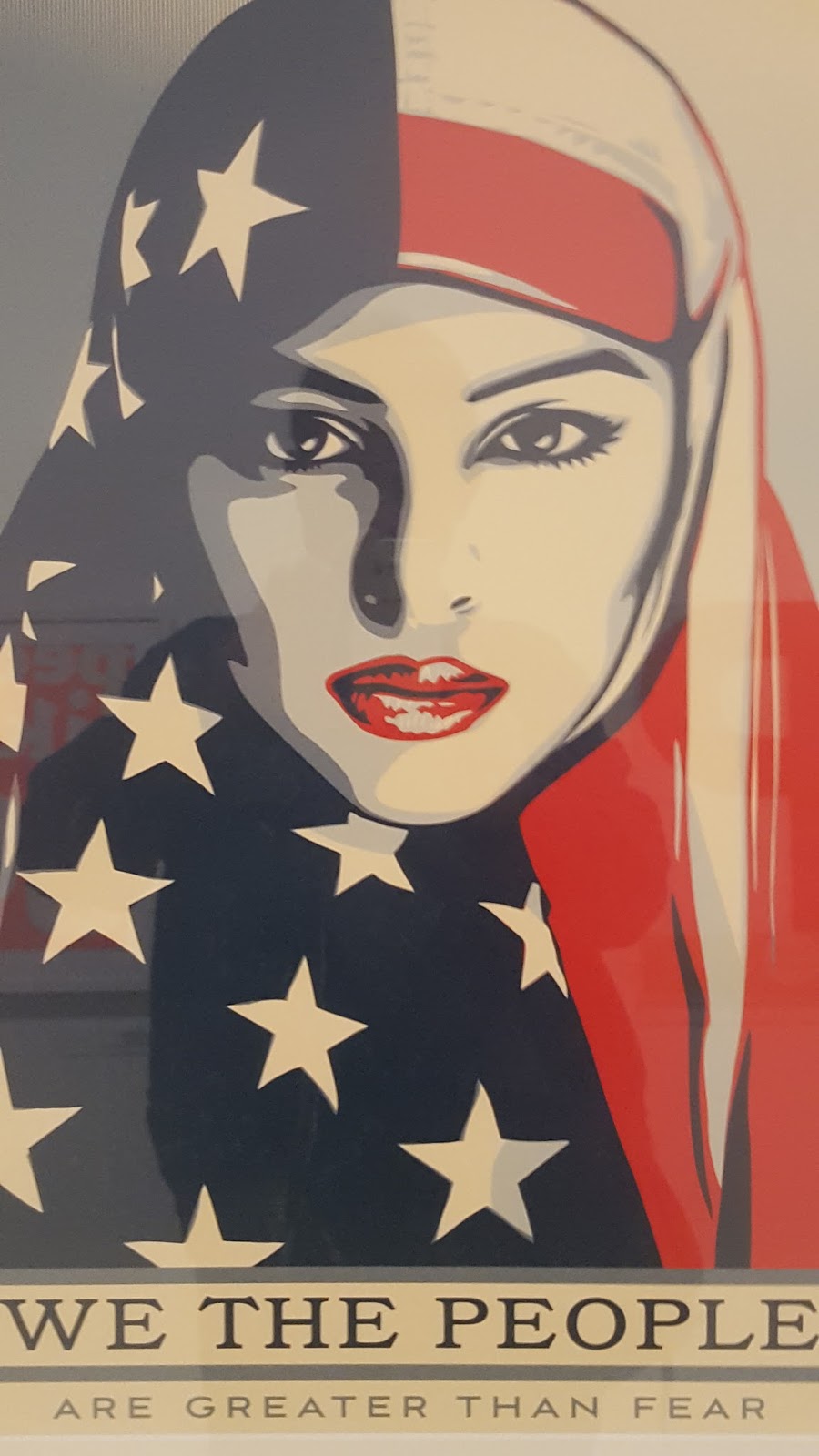

We the People - Shepard Fairey/obeygiant.com and Ridwan Adhami (2016)


Facebook 'Like' icon - Facebook (2016)


Emoji for Apple iPhone - Apple design team (2009-present)


Of course not - and much like when computer technology was able to find an answer to computer technology making us unfit, hopefully the computer technology that we've used to turn as against each other can be rerouted back to its original, idealistic, idea of being used to unify us. It's a big ask for sure but there are positive signs.

Shepard Fairey's We the People series features Native Americans, African Americans, Muslims, and Latinas to protest Trump's misuse of power. It leverages the power of digital distribution by making the posters' print files free to download and distribute. As much as the internet can divide it can also brings us together, it's really up to us how we choose to use it, it's a tool remember, but it has the potential.

It's been a long journey from the Summer of Love and Pong to augmented reality and algorithms, at times it's felt like an interminable trek through the deserts of California itself, and along the way it's thrown up, alongside the emoji, the selfie, and the Kindle, a combination of the good, the bad, and the ugly. But, despite their power, it's still us who are in controls of these tools and it's our decision whether or not to use them to wreak havoc, assert control, or to make the world a better, kinder place for each other.

The hippy dream may've soured a long time ago but some of the ideals of it still ring true. The Californian state motto, nicked from Archimedes, is Eureka, "I find". California has found, and forged, new ways of living, new ways of communicating, new ways of exercising, and new ways of protesting. At a time when America, and therefore the West, is at a very important crossroads it would be a fool who'd bet against California, somehow, again being the state to point the way forward. The leaves may be brown, the sky may be grey, at the moment. But it won't always be that way. Not if we keep California dreamin'.


Publicity still from the film Easy Rider (1969)


Pong - Atari (1972)


Thursday, 2 November 2017

Body and Soul:Instant Karma's (not) gonna get you.

"It's like deja vu, all over again" - Yogi Berra.

The planned speaker for November's Greenwich Skeptics in the Pub event had pulled out at fairly short notice and with no time to book an adequate replacement the affable, articulate, and entertaining host Professor Chris French stepped into the breach with a really rather fantastic talk about the time he spent, nearly two decades back, investigating claims of reincarnation amongst the Druze people of Lebanon.


Either French has a phenomenal memory (and if he has then as founder of the Anomalistic Psychology Research Unit at Goldsmiths he may want to investigate himself) or he'd crammed one hell of a lot of research into a very short time because 'Many happy returns? Investigating reincarnation claims in Lebanon' was thorough, even handed, and had been formed into a coherent, and enjoyable, narrative. He'd even put a couple of jokes in. The talk was an absolute delight from start to finish.

He started with a little bit of history regarding theories of, and belief in, reincarnation over the years. In a recent survey over 25% of UK citizens claimed they believe in reincarnation in one form or another and that figure rises quite markedly elsewhere in the world. Even the hugely revered cosmologist and science communicator Carl Sagan, in his late work The Demon-Haunted World, said that there were a couple of cases of reincarnation that he, as a skeptic and a critical thinker, couldn't (yet) explain. He didn't go so far as to say he believed in reincarnation but he did suggest that he was open to further investigation and that we should follow evidence rather than our own confirmation biases.

There's lots of reason why people may choose to believe in reincarnation. We live in a hugely unjust world where some live in great wealth and others in abject poverty with little chance of improving their lot, few opportunities, and a very strong chance of an early death. It's hardly surprising, given those circumstances, that many would choose to believe this is merely one of many lives they'll experience.

Ideas of what reincarnation is, and how it works, differ from society to society. Some believe in karma (a fairly ugly concept that allows us to believe people living in reduced circumstances or suffering somehow deserve it), some believe you regenerate at the exact moment of death (you know, like Dr Who), some believe you always come back as someone of the same sex, some believe it's possible to come back as someone of a different sex (Dr Who again), and some believe you can come back as an animal. Some even believe you can come back as an inanimate object. Prince Charles was probably joking when, during a particularly cringeworthy bout of phone sex with Camilla Parker Bowles, he suggested he'd like to come back as her tampon. I'd always thought he was a stuck up cunt.


People have suggested the experience of deja vu proves reincarnation is real and it's also been used to explain how child prodigies like Mozart are able to be so talented at such a young age. The suggestion being that they're utilising knowledge and experience picked up during previous existences. Professor French's interest in this subject had become so intense he'd even become a member of the Reincarnation Society so he could study cases with more depth. At £500 per annum membership's not cheap but, hey, you only live once.*

Some people claim spontaneous past life memories but many are brought about using hypnotic regression. Impressive though these accounts appear on the surface some basic digging around usually disproves them fairly easily. For a start there's an unusually large amount of people who claim to have been Henry VIII or Cleopatra in previous lives and considerably less who've been irrelevant peasants who lived and died without making so much as a stain on the page of history.


Supposed historical regressions often prove to be far more ahistorical, Hollywood, versions of events too. People, under regression, have claimed it's the year 50BC which of course is not what that year would've been called at the time, C not having been born yet.

In 1952 the Colorado businessman and amateur hypnotist Morey Bernstein caused something of a sensation when he put housewife Virginia Tighe in a trance that caused her to 'remember' a past life as a 19c Irish washerwoman called Bridey Murphy. She described her childhood in Cork, her move to Belfast after marrying Sean McCarthy, detailed (and accurate) descriptions of the Antrim coastline, and even her own funeral which she'd watched impassively before being reborn in the American Midwest in 1923.

A book, a film, two popular songs, and even a cocktail were launched during the Bridey Murphy craze. People even held 'come as you were' parties. But despite the fact that Tighe had no trace of an Irish accent unless she was under hypnotic regression some doubted both her and Bernstein's claims. Those who examined the case found that Tighe had been brought up by half-Irish parents until the age of three, that an Irish immigrant named Bridie Murphy Corkell lived across the street from Tighe's childhood home in Chicago, and surmised that Tighe was merely dredging up long forgotten childhood memories and not ones from a previous life. It's called cryptomnesia and it's a real thing.


The Bloxham tapes are a set of more than four hundred recordings of past-life hypnotic regression sessions made by the hypnotherapist Arnall Bloxham. During the 1970s they were published episodically in The Sunday Times and perhaps the most noteworthy case was that of one Janet Evans. Evans was a thirty year old Welsh lady who, under hypnotic regression, produced 'evidence' of six previous lives. She'd been Livonia, daughter-in-law of the governor Constantius in Eboracum (York) during the 3rd century. She'd been, in the 12th century (and still in York), Rebecca, wife of a Jewish moneylender. In 1450 she'd been Alison, an Egyptian servant in the French household of Jacques Coeur, a wealthy merchant and financier in Bourges. She'd been one of Catherine of Aragon's ladies in waiting, she'd been a sewing girl named Ann Tasker in 18c London, and she'd been Sister Grace, a Catholic nun living in Des Moines, Iowa, in the early 20th century.

When British skeptic Melvin Harris investigated the case he found that Livonia was based on Louis de Wohl's 1947 novel The Living Wood, that Alison's story has been told in Thomas Costain's 1948 book about the life of Jacques Coeur, The Moneyman, and that Rebecca's story seemed to have been based on a radio play about an anti-Semitic massacre that took place in York in 1190. Not only had Jane Evans remember with astonishing detail all the accurate facts from these books and plays she'd also 'remembered' all the bits the authors had made up and none of the bits the authors had left out. Cryptomnesia again.


Using the DRM (Deese–Roediger–McDermott) technique, French demonstrated how easily a memory could be suggested to a person. You show someone a list of words (for example:snore, bed, tired, pillow, pyjamas, dream) and later on ask them what words were on the list. Most will remember that snore, pillow, and dream appeared and most will know that words like beach, car, and rollercoaster did not appear but if you slip in a word like sleep many will think they saw it on the earlier list. It'd been suggested, implied - but it'd not been there. Unfortunately in a room full of people who regularly attend Skeptical events this demonstration fell a bit flat as most people had seen it before. It was, however, the only thing that did fall flat all night.

In 1998 French, along with a film crew and some less skeptical believers, spent three weeks in Lebanon investigating claims of reincarnation amongst that country's Druze population. The Druze are an esoteric ethnoreligious group that live mainly in the Levant, their largest numbers are in Syria, Lebanon, and Israel, but there is also a significant diaspora in countries like Colombia, the US, and Canada. The most famous Druze are probably Walid Jumblatt (leader of Lebanon's Progressive Socialist Party), Amal Alamuddin (now Clooney, the human rights lawyer and wife of George), and the Detroit born Kemal 'Casey' Kasem, the voice of Shaggy in Scooby Doo no less. Zoiks!


In 1042 the Druze parted company with the Ismaili sect of Shia Islam and from that point on it was decreed that the total number of Druze in the world would remain constant. You couldn't convert, you couldn't leave, and you couldn't, in theory, die. At the moment of death each Druze would be reincarnated immediately. Druze these days, like many who grew up with their beliefs rather than converted to them, are very matter of fact about this. They call it Taqamus, the changing of one's shirt, so relaxed are they about it.

Professor French had looked to interview those who'd turned their back on these beliefs but he'd been unable to find anyone so instead he interviewed those who did believe which, of course, in this community was everyone. The Druze believe that everybody is reincarnated. Druze reincarnate as Druze, Christians as Christians, Muslims as Muslims, and, presumably Skeptics as Skeptics. But how does this square with the utterly empirical fact that the last century has seen a huge, exponential, population growth across the planet?

The honest answer is that it simply doesn't. But, like all religions, facts don't stop people believing in it. That's the very nature of faith, it's what the word means, belief in something without any, or even in the face of overwhelmingly contrary, evidence. Druze don't believe in karma but they do believe that reincarnation is instant, that the exact moment you die you are born anew, but that you can only remember your previous life if you have died a violent, or possibly untimely, death. As a Civil War had raged through Lebanon between 1975 and 1990 claiming 120,000 lives there were plenty of people who'd died both violent and untimely deaths and, thus, plenty of people who claimed to remember their previous life.

The claims of absolute immediacy of reincarnation could be easily tested, you'd think, by a simple check of registers of births and deaths and, as you'd expect, they don't even come close to tallying up but the Druze offer two explanations as to why this is. The first is that many experience an 'unmemorable intermediate life', they may die as a soldier, be born as a sickly baby, die very soon, and then be reborn again. It's a handy workaround but it doesn't really stack up. If this was true Beirut would have an infant mortality rate of about 50%. Thankfully that's more than fifty times higher than the actual rate.

Another theory holds (a bit) more water. Some suggest that the reason the births and deaths don't tally up is that there are Druze being born in countries that refuse to recognise reincarnation (China has a big issue with this due to Buddhism and the Dalai Lama, you have to apply for a certificate to prove you've been reincarnated there) or that there are people born Druze that simply don't know they're Druze. These 'ignorant' members are referred to as juhhal. Some even expouse the belief that there are Druze being born, dying, and being born again ad infinitum all over the universe and therefore it's impossible to keep track of everyone!


Investigations did show that Druze kids could be particularly precocious (taking rifles and engines apart with the skill of much older people) and would often want to meet their 'past life families'. These families would sometimes test, or even try to trick, the kids by showing them false photographs of people that aren't really in the family and false bedrooms where the person they'd once been didn't really sleep.

They didn't tend to trick the kids but neither did the kids seem to recognise real photographs or real bedrooms either. At least not until it'd been heavily suggested to them that these were the actual places. Even then the kids seemed to register a vague recognition rather than anything particularly meaningful. In some cases past life families would disagree with visiting 'reincarnations' because they'd already met someone who'd they believed was, and accepted as, the next incarnation of their departed loved one.

A young child living in terrible poverty, Rabih Abu Dyab, became a compelling test case. Partly because he was utterly adorable but also because of his seemingly wild claims to be the reincarnation of Saad Halawi, an international footballer and successful pop star who'd been killed in the Civil War. Halawi had been known as the Lebanese Kevin Keegan (he even had the bubble perm, although with an 8-0 defeat to Qatar, the Cedars were even less world beaters than the Keegan era England team) and Rabih's mum, somewhat suspiciously in the circumstances, had been a huge fan of his before young Rabih had even been born.


Because it's beneficial to be the reincarnation of a rich, famous, or successful person the likes of Halawi and his family proved to be very popular choices as past life families for those less fortunate. It's not that the wealthier past life family furnished money or lodgings upon their new selves but they would, in a fairly ill defined way, look out for them.

But, other than this vague social support offered by past life families, why would people, with all the evidence stacked against them, go on believing such obvious untruths? Many reasons. It helps to cope with loss and during periods of bereavement people, understandably, employ many different coping mechanisms. Also, the Druze have been a persecuted group during much of their history, even now they're regularly targeted by ISIS, and have often been forced to fight to defend themselves. It's quite handy to believe in reincarnation if you're just about to go in to a battle in which there's a very strong chance you may die. In fact so entwined is the battle against persecution and the belief in reincarnation in the Druze that their war cry is "Tonight, in my mother's womb"!

So it's easy to see why people believe it even if we may sneer at it. But is there any harm in someone choosing to believe it? As long as they're not going round killing other people for not believing it or forcing people to believe it against their will then probably very little. It seems like a load of old cobblers to me but I've been wrong before - and I'm sure I will again. Let's wait and see. Or, more likely, wait and not see. Thanks to Greenwich Skeptics and Chris French for another brilliant evening.


*That's one of Chris's jokes (and a good one too).


Wednesday, 1 November 2017

Faraway, So Close!:The Polaroids of Wim Wenders.

"You can't picture love that you took from me when we were young and the world was free.
Pictures of things as they used to be.
People take pictures of each other
Just to prove that they really existed
Just to prove that they really existed" - People Take Pictures Of Each Other - The Kinks

Wim Wenders is, of course, far more well known as a film director (Wings of Desire, Paris, Texas, and The Million Dollar Hotel to name just three) than a photographer but both clearly involve having an 'eye' and travelling a lot. So it's no surprise that the ease of use and the instant results available with a Polaroid appealed to him.

The Photographers' Gallery was hosting Instant Stories:Wim Wenders' Polaroids, a collection of his personal and previously unseen photographic work taken over the best part of twenty years beginning in the late 1960s. There are over 200 images grouped, vaguely, thematically, and due, perhaps, to the fact that they'd not been taken with a view to being exhibited none of them are dated.

 
New York, First Impressions
 
Some, like the Campbell's soup tins above and the protruding bridge of On A Wing And A Prayer nod to clear influences. Andy Warhol, obvs, in the former - and Whistler (by way of Hokusai and Hiroshige) in the latter. Others appear to have been taken more on the spur of the moment, yet are no less impressive. American Friends, Mean Streets, and Right Or Wrong Moves speak of desolation, loneliness, and the hinterlands of the human condition. They look as if they were taken, respectively, in the US Mid-West, Northern England, and Mitteleuropa (somewhere like Prague or Budapest). Of course there are no labels so I could be completely wrong about that. A lot of this exhibition is about looking rather than reading, interpreting as opposed to being informed.


American Friends

 
Mean Streets

 
A Man Named Dashiell

 
On A Wing And A Prayer

 
Cookie Monster

 
No Man's Land Nor Movies

 
Right Or Wrong Moves

 
Overexposed
 
Wenders claims to have used his Polaroids like a visual notebook during his early days as a film maker and it's possible to see how some of the images he captured could later go on to be adapted for cinema. There's a very filmic quality to snaps like Overexposed and Cookie Monster (and A John Ford Dream speaks for itself). You create your own narrative when you spend enough time with the image.
 
The Polaroids on show feature friends, family members, and cast and crew from Wenders' movies. There are behind the scenes shots, still lives, street photography, landscapes, portraiture. New York and San Francisco feature prominently. As a German in America he views things through the eye of an outsider as so many in that country do. Sometimes it helps us to see things that otherwise we'd  take for granted.

 
Introduction

 
New York, First Impressions

 
A John Ford Dream

 
A John Ford Dream
 
Typeset directly on the wall is a quote from Wenders in which he talks about his process. How, in the beginning, one could only photograph in black and white, how he would stick the pictures under his armpit to keep them warm while they were developing so they could be either overexposed or underexposed, and how he'd wait with "a heartbeat of suspense" for the pictures to come into focus.
 
There's a small film in a curtained off room in the corner of the gallery where you can see a small child's face light up with glee when first faced with the magic of photography and Polaroids in particular. There's another couple of things in the show that somewhat labour the same point and, and maybe this is an age thing, there's also an awful lot of squinting involved.

 
Alice In Instant Wonderland

 
California Dreamin'

 
Golden Gate
 
One interesting point made is how Polaroids once seemed so futuristic they almost seemed like something from science fiction but the passing of time has turned them into slightly kitsch items revered by hipsters and throwbacks everywhere. With the (almost) instant gratification they provided they were, in many ways, precursors to our camera phones. A friend once told me that more photographs are taken every second now than were taken during the entire nineteenth century. If that's true that's not necessarily a bad thing, no need to moan about the modern world, but great as it is to see life refracted through a camera lens sometimes we need to remember to use our eyes as well. A quick glance at Wim Wenders' Polaroids suggests he was more than capable of doing both.
 
Thanks to my friend Vicki for bringing this exhibition to my attention, joining me on a visit, and debriefing over a few glasses in a couple of Fitzrovia's finest old man pubs afterwards. 


Tuesday, 31 October 2017

Frank Bowling and the second wave abstraction

"It seemed that everyone was expecting me to paint some kind of protest art out of postcolonial discussion. For a while I fell for it. I painted a picture called the Martyrdom of Patrice Lumumba" - Frank Bowling.

My recent visit to Tate Modern's Soul of a Nation:Art in the Age of Black Power exhibition was quite an eye opener. Not only did it tell the story of the civil rights struggle in 60s/70s America eloquently, passionately, and prismatically through the art of the era, also it introduced me to a long list of artists I'd hitherto been either only vaguely aware of or completely ignorant of.

One of those artists was the Guyanese Frank Bowling. The two works, Middle Passage and Texas Louise, that'd been included in the Tate show took inspiration from abstract expressionism and Robert Rauschenberg but used those as launch pads to explore notions of identity, rootlessness, and the black experience as and of itself and as part of the wider experience of living in a 20th century dominated by US power.

It's surely no coincidence that Shoreditch's Hales Gallery's Frank Bowling:Fishes, Wishes in Summertime Blue had been programmed to overlap with the Tate blockbuster. In fact the practice of the small commercial galleries following the lead of the big organisations just serves to underline how vital it is that the Tate, the Royal Academy, the National Gallery etc; are braver and more diverse with their programming. Of late the Tate has definitely been leading the way on this front with recent shows devoted to female Turkish abstraction, the under rated Cuban artist Wifredo Lam, and the colourful, figurative Indian artist Bhupen Khakhar.

Many of the artists included in the Soul of a Nation show would be worthy of their own large scale retrospective and, hopefully, one day some of them will receive that. For now though, we've a chance to see what Frank Bowling's been doing in the last few years. The Hales show is small, just one room with eight large canvases on the walls, but is worth half an hour of your time.

 
Iona Miriam's Christmas Visit To & From Brighton (2017)
 
Bowling was born in 1936 in the Cuyuni-Mazuruni region of then British Guiana to a police district paymaster father and a seamstress mother. At the age of 15 he moved to England, completed his education, did his National Service with the Royal Air Force, before giving up early ambitions to become a poet or writer to focus on the visual arts.
 
He studied at the Chelsea School of Art and the Royal College of Art. Fellow students included David Hockney, R.B.Kitaj, Allen Jones, and Derek Boshier. On graduation in 1962 Hockney controversially beat Bowling to the gold medal. Bowling had been relegated to silver because he'd married Paddy Kitchen. Kitchen was staff and Bowling was a student and such liaisons were frowned upon if not, clearly, completely verboten.

 
Stuart's Prediction (2016)

 
Pouring Over 2 Morrison Boys & 2 Maps II (2016)
 
Moving to New York in the mid-sixties saw Bowling and his art blossoming. Moving away from his peers and Francis Bacon inspired figurative painting he, with the encouragement of influential critic and essayist Clement Greenberg, drew upon the art of Jackson Pollock, Mark Rothko, and Barnett Newman but fused their work with his own more personal and political themes, often to great acclaim.
 
Always interested both in the idea of home and the very concept of belonging Bowling's recent work uses generous blues and greens to evoke the imagery of forests and rivers but there's also an element of paint for paint's sake about it. Some of the paint is layered on so thickly that like, for instance Frank Auerbach, it almost demands you touch it. I had a cheeky feel when nobody was looking.

 
Ashton's Swirl I (2016)

 
Little Bird Overhead (2016)
 
The titles of the paintings on show are nothing if not a little abstruse. Many of them refer back to previous work in Bowling's oeuvre (Pouring Over 2 Morrison Boys & 2 Maps II) or even events from his personal life (Iona Miriam's Christmas Visit To & From Brighton) so it's difficult to ascertain any meaning from them. That's less of a problem than you might think as it means you can simply enjoy the work for what it is. Bowling had spoken about the expectations heaped upon him as a black, post-colonial painter and in this exhibition we can see how he's freed himself from the yoke of presumption and allowed his art to reach out in hope to the future.

 
Shadowbalding (2014)

 
Horsing Around (2016)
 

Works like Little Bird Overhead, Shadowbalding, and especially my favourite Collaboration with Ms & Damidge show that Bowling, like Pollock, revels in the physicality of paint and painting and at the age of 81 shows no signs yet of relenting. Often as we reach more advanced ages we find joy in the more simple, quotidian aspects of life. I visited my nan recently and her greatest pleasures now seem to be a smile, a touch, or a kiss. My nan's got twelve years on Bowling but he too has moved on to a different plateau. No longer does he need art to tell a political story. He's been there and done that better than most. Now he's earned the right to paint what he likes and call it what he likes. He's earned the right to celebrate colour for colour's sake and to bathe in the warm glow of both his art and his creation. I'd give him a smile and a hug for that.

 
Collaboration with Ms & Damidge (2016)


Made of Stone.

On Saturday me and a group of friends took a lovely, autumnal walk, around the Hart district of Hampshire. We walked from Hook to Rotherwick and back and as I sat in the beer garden of The Coach and Horses in Rotherwick nursing a very agreeable pint of Red Rye I became distracted by the aesthetic possibilities of a random stone and its shadow playing out against the painted wood of the pub bench in the late afternoon sunshine.

My friends joked that I'd probably get a blog out of it, maybe listen to The Stone Roses while I wrote it, but what they didn't seem to be aware of was (a) I've already written a blog about (much bigger) stones and (b) I had a blog all about stone and what you can do with it lined up anyway. Stone me, stone the crows, let he who is without sin cast the first stone, and any other relevant idioms that contain the word 'stone'.

I'd recently visited the Design Museum in Holland Park and, while I was there, I'd noticed they were hosting a small exhibition, some indoors, some outdoors, called Set in Stone that aimed to represent 'small moments of monumentality that reflect the solidity and permanence of an elemental material". A material that has "followed Humanity's development since the dawn of time". Capital H the curator's own.

Set in Stone, the project, took place over two years and involved twenty-four international architects and designers, each of whom were given complete artistic freedom to explore the potential of Portuguese marble and limestone by making use of both its colour and its texture. Fifty-one works, in total, were created and the best of them, or perhaps just an arbitrary selection, ended up at the Design Museum.

Mancunian Peter Saville is better known as a founder and art director of Factory Records. Most famously he's created iconic record covers for Joy Division, New Order, OMD, Pulp, and Suede but he's also worked with Roxy Music, Wham!, and Gay Dad (if you remember them). His In Memorium looked like it could've featured on one of those radical sleeve designs. Not least Joy Division's Unknown Pleasures. That album's artwork features an image of successive pulses from CP1919 (the first pulsar ever discovered) and In Memorium is a sculptural extrapolation of the same thing. Michael Bracewell has described Saville's work as "the muniments of a crematorium in deep space". I just wanted, like much in this show, to run my hands along its surface. That and look up the word 'muniments' in the dictionary.

 
Peter Saville - In Memorium (2017)

 
Jorge Silva - Pictorama (2017)
 
Two of the exhibits I didn't feel tempted to fondle were Jorge Silva's Pictorama and Sagmeister & Walsh's Don't Look Back. That's because they weren't actually there as such, replaced by an artist's impression of what they would look like. A bit of a swizz really but the exhibition was free.
 
The Alfacinha Silva has been given dozens of awards for the work he's done as Art Director for the Portuguese newspapers Combate and O Independente, he's headed up several magazines (20 Anos, Icon, LER, LX Metropole), and over the last few years he's been teaching Art Direction at the Faculty of Fine Arts in Porto whilst running a blog, Almanaque Silva, dedicated to Portuguese illustration. He's obviously very successful and highly respected in his field. Which makes it a shame that his Pictorama is rather boring, a set of three pieces based on the visual culture of signage and pictograms, it did nothing for me.
 
Marginally more impressive was the effort from New York based duo Stefan Sagmeister and Jessica Walsh. Their CV is even more star studded than Silva's. Past clients have included The Rolling Stones, Jay-Z, Levis, the New York Times, Snapchat, and the Guggenheim Museum and their work has been shown globally from Philadelphia to Prague and from Zurich to Osaka. The six panels of Don't Look Back are intended as a reference to the black screens of the smartphones, televisions, and tablets we spend so much of our life staring into these days. The mention of Charlie Brooker's brilliant Black Mirror in the accompanying leaflet only serves to show just how short, both satirically and aesthetically, Sagmeister & Walsh come up. Shame.    

 
Sagmeister & Walsh - Don't Look Back (2017)

 
Miguel Vieira Baptista - O Peso Da Pedra (2017)
 
Once you get away from the weakly worked through concepts and wall hangings and get to the actual stone itself though everything's rather lovely. Sexy even. Can stone be sexy? Probably not but let's go with it.
 
Miguel Vieira Baptista, born (like Silva) in Lisbon, received his degree from the Glasgow School of Art in 1993. Since then he's been developing projects as a product designer, curating design exhibitions, teaching at ESAD.CR in his native Portugal, and was, in 2013, awarded the Audi Mentorprize in Cologne. O Peso Da Pedra (The Weight of Stone) may look like a top end ashtray but was, apparently, inspired by his research into the construction methods of Roman antiquity.
 
Jasper Morrison's Alpinina looks even more like an ashtray. The Londoner is best known, we're informed, for his work in furniture, lighting, and tableware (like ashtrays perhaps?). He's collaborated with trendy Italian cheese grater, cutlery, and toothpick designers Alessi and had consultancies with South Korean phone/television giants Samsung and Japanese minimalists Muji. It's claimed Alpinina has been designed to give the bowl (or ashtray) the appearance of floating in mid-air even though a three year old child could easily work out it's not. But it looks pleasant. The leaflet provided for the show really goes out on a limb with this work suggesting that "it is a simple piece, meant to be placed on a table, sideboard or kitchen shelf and contain fruit, vegetables or nuts". Gee, thanks guys. It had long been a mystery to me what bowls were used for.


Jasper Morrison - Alpinina (2017)

 
Michael Anastassiades - Forbidden Fruit (2017)
 
Cypriot Michael Anastassiades seems to have provided us with the sculptural equivalent of one of Italian painter Giorgio Morandi's still lifes. In relation to his Forbidden Fruit he has said "No matter how many times a day I decide to consume a fruit, I am always fascinated by the moment when I am about to reveal the inside flesh". Steady on, old boy. The various 'vessels' he's created are easy on the eye but they don't look particularly fruit like and neither did they fill this visitor with erotic thoughts.
 
You have to go outside for that - and that's just where this exhibition took me. Last month I wrote, enthusiastically, about my visit to the Frieze Sculpture Park in Regent's Park and the three works displayed on the patio outside the Design Museum brought back fond memories of that. Unlike the works inside they seemed like they could be put to practical use too. In the case of Paulo David and Eduardo Souto de Moura as chairs and in the case of Elemental's A Thing Not An Object as either somewhere to park one's bicycle or even a urinal, a pissoir.
 
Elemental themselves see it as a slide for children (they'd need to be very small children) and something that offers "speed without the need for physical coordination". A member of the Chilean firm, Alejandro Aravena, has been a recent recipient of the Pritzker Architecture Prize but it has to be said it's the least impressive piece of stone of the three.
 
Paulo David runs his own studio in Funchal, Madeira. It seems likely that the climate there would be more conducive to sitting and relaxing on his Mult, a three piece sculpture that's been designed so that it can be arranged into different formations. The one the curators have gone for seems to suggest two people sitting back to back and not interacting with each other.
 
Which is quite the opposite of Eduardo Souto de Moura's Conversadeira which seems to be made for deeply conversing, possibly even kissing and canoodling, with a friend or lover. You'd get a cold bum sat on that stone surface in the British October weather, and that might dampen your ardour somewhat, but what lovely stone it is. In lieu of having another person there to canoodle with I ran my hands along the smooth and curvaceous surface. I like to think it's what Souto de Moura would've wanted.
 
Conversadeira (Conversation Seat) was the winner for me with Peter Saville and Paulo David taking up podium positions alongside him. I had a fun hour or so looking at stone in new and different ways and, just as my friends had joked, I'm managed to get a blog out of it. Forget blood out of a stone. This is a blog out of a stone and, yes, I did listen to The Stone Roses while I wrote it.


Paulo David - Mult (2017)

 
Elemental - A Thing Not An Object (2016)

 
Eduardo Souto de Moura - Conversadeira (2017)