Wednesday, 11 October 2017

Fahrelnissa Zeid:An Abstract Parrot in the Ottoman court.

"When I am painting, I am always aware of a kind of communion with all living things. I mean with the universe as the sum total of the infinitely varied manifestations of being. I then cease to be myself in order to become part of an impersonal creative process that throws out these paintings much as an erupting volcano throws out rocks and lava" - Fahrelnissa Zeid.

It was another Tate late with my friends Mark and Natalie. I always enjoy these evenings. We normally meet around six in the Turbine Hall, have a little catch up, check some art, then go for a 3x3x3 (three rounds of three pints for three people) and have an even bigger catch up. We talk about the art, of course, but we talk about a lot of other things too.

Last Friday we'd decided to take a look at the Fahrelnissa Zeid exhibition over in the Switch House. Fahrelnissa was an artist none of us had been familiar with before we went in but she was someone we were all fans of by the time we came out. Her life story is pretty spectacular but her art reflects it and certainly doesn't wilt in its shade.


Three Ways of Living (War) (1943)

Born Fahrünissa Şakir in 1901 into an elite Ottoman family on the island of Buyuka in the Sea of Marmara near Istanbul, her life (much like that of her contemporary Wifredo Lam) seemed to run parallel with many of the major political upheavals of the twentieth century whilst, at the same time, reflecting, and riffing on, the art world developments of the era too.

Before even the oldest works in the show, Zeid had witnessed the birth of modern Turkey, she'd married and divorced the novelist Izzet Melih Devrim, had three children (one of whom had died of scarlet fever), travelled to Venice where she was first exposed to European painting, and got married again - this time to Prince Zeid Al-Hussein of Iraq who was appointed Iraqi ambassador to Germany in 1935 when that country was, of course, under the Third Reich.

Living in Berlin she witnessed the rise of Nazism but after the 1938 annexation of Austria the now Princess Fahrelnissa Zeid and her husband moved to Baghdad. The Iraqi capital depressed her so, on the advice of a doctor, she moved to Paris. From there she triangulated between the French capital, Budapest, and Istanbul and it was during these years that her hobby of painting hardened into something more serious.


Three Moments in a Day and a Life (1944)


Third Class Passengers (1943)

There's a room at the start of the Tate's exhibition which looks at the seven key cities she spent her time in. New York, London, Paris, Berlin, Istanbul, Amman, and Baghdad. Budapest doesn't even feature but it's clear from the sheer amount of miles she chalked up that it's a tricky ask to try and get a sense of where she was, either physically or headspace wise, at any given time.

In London she entertained metaphysical maestro Giorgio de Chirico, French-Russian cubist Marc Chagall, as well as Lee Miller and Roland Penrose. Less impressively she took tea with Hitler in Berlin. The year Hitler died, 1945, she had her first show in Istanbul. The work she was making at the time, like Third Class Passengers and Three Moments in a Day and a Life, were huge, full of vibrant colour and detail, and yet intricate and enthralling at the same time. You can spend quite a lot of time looking at them and still keep seeing new things.


Self-Portrait (1944)


Turkish Bath (1943)

She'd occasionally dip into self-portraits but it was with works like Turkish Baths (which borrows from the same inky Cezanne palette as Chris Ofili's recent Weaving Magic at the National Gallery) and, quite bizarrely, Loch Lomond (Zeid visited Scotland on the advice of the Queen Mother) were the ones that entranced me. They're as exquisite as they're exotic, as free as they are formulated.

Zeid spoke of a 'struggle' between figuration and abstraction and in these works you can see her attempts to resolve that potential dichotomy. If Loch Lomond suggests figuration, eventually, won out then other works, like Alice in Wonderland and the fantastically titled Abstract Parrot, make a very different case. Yet they're equally adorable, Abstract Parrot itself almost gives the illusion of stained glass. The work that seems to have dealt with this duality of function most directly is 1947's Fight Against Abstraction. Is that a figurative fist punching through an abstract canvas or an abstract pattern encroaching upon the real world?


Loch Lomond (1948)


Alice in Wonderland (1952)


Abstract Parrot (1948-1949)


Fight Against Abstraction (1947)

Of course it's both. By the fifties her work was starting to resemble huge colourful maps of cities taken from overheard, and for someone who moved around so much perhaps that's hardly surprising. Octopus of Triton is nearly as good a title as Abstract Parrot and it's just as good a painting, My Hell cleverly uses three different colour schemes to suggest the illusion of depth. Zeid was never content repeating herself and she even questioned traditional protocols of art display. She'd hang works on the ceiling so you had to lie down to see them or put them on the ground in front of the door so you'd have no choice but to walk over them if you wanted to visit her gallery.


Arena of the Sun (1954)


Basel Carnival (1953)


Octopus of Triton (1953)


My Hell (1951)


Break of the Atom and Vegetal Life (1962)

In 1958 Zeid and her husband were at their holiday home on the island of Ischia in the Bay of Naples when there was a military coup in Iraq and the entire royal family, and scores of others, were killed. The overthrow of the Hashemite monarchy (which led to a system which remained in place until the death of Saddam Hussein) meant Zeid was no longer a princess. If she'd been in the country it's doubtful she'd have escaped with her life. 

This change of circumstances meant that at the age of 57 she moved in to an apartment in London and cooked her first meal. So enamoured was she by the texture and qualities of chicken bones, clearly something of a revelation to her, she took to painting on them. The finished products were displayed, rotating, inside her house. There's something of the Georgia O'Keeffe about them.


Puncta Imperator (Sea Cave) (1963)


London (The Fireworks) (before 1972)

In later life her abstracts took a more fluid, watery tone - as if the simple struggle between two opposing extremes had been rendered simplistic by the passing of time and all she'd witnessed. These works have a poignant, dreamy, melancholic aspect. London (The Fireworks) has the majesty of one of JMW Turner's epic late canvasses coupled with the quiet contemplation of Whistler's nocturnes. As these are two of my favourite things in all art of course I was impressed. As impressed with these as Natalie was with the portraits Zeid produced in her seventies and eighties and as impressed as we all were with Zeid's entire oeuvre.

How Zeid and her work has been forgotten, or at least marginalised, in the narrative of 20c art history is anyone's guess (though that tea with the Fuhrer can't have helped) but the Tate, in their evolving quest to move away from the male Western narrative, have, again, unearthed another gem. Ellerine saglik. 


Someone From The Past (1980)


Transient Space:A flaneur's fancy.

I was excited when a Facebook friend tagged the owner of Mayfair's Parafin gallery into my update about visiting their Transient Space exhibition. I thought he'd comment on it, maybe offer me a job writing their press releases, a little 'like' at the least. Instead I got nothing.

Which is a pity as it's a rather fantastic gallery and the Hynek Martinec and Justin Mortimer shows I'd seen there, and written about, earlier this year had both been little treasures. I'd kidded myself if I wrote an equally glowing review of Transient Space then I'd finally break through and be noticed by somebody in the art world!

Alas, the show, for the most part, just didn't move me in the same way. There was some good stuff but there wasn't all that much of it. I'd been tempted in, not just by the gallery's track record but, by the premise of the show. That of the flaneur, the man (or woman) of leisure who strolls the city streets almost at random, exploring and making links. As a keen walker, both in city and country, and an art enthusiast too, I'd hoped it would combine these interests and speak to me both directly and passionately.

 
Nathan Coley - Noora (2015)

 
Tim Head - Transient Space 1 (1982)
 
In 1863's The Painter of Modern Life, Charles Baudelaire called upon artists to capture the fleeting nature of modern life by creating 'transient' images. The German Jewish philosopher Walter Benjamin expounded on Baudelaire's idea and came up with the concept of the flaneur. There was a decadence, and a cool detachment, to the flaneur but also, conversely, an earthiness and a willingness to partake in the day to day of city life, all the time keeping one's individuality - a must when confronted with the vast impersonality of modern city life.
 
Parafin are showing the works of six contemporary artists who've all approached urban space and how we relate to it, move around inside it, and how it affects us, from their own personal angles. The Scottish artist Nathan Coley has based his architectural models on photographs of housing blocks that have been partially destroyed by terrorism, war, or UN sanctioned military action. Each model is mounted as if like a placard, as if it could be carried at a demonstration. The destroyed city coming back to haunt itself.
 
The oldest works in the show, by nearly two whole decades, are those of Tim Head. In the early eighties Head would take long walks through London at night taking photographs of anonymous, liminal spaces like empty corridors, lobbies, the foyers of hotels, and underground car parks. He's mirrored them horizontally to give them a kind of sci-fi effect and, one assumes, make us look again at environments we take so easily for granted as we pass through them. Head studied at the University of Newcastle upon Tyne alongside Bryan Ferry and, as with Ferry's Roxy Music, there's something in Head's work that makes the mundane spectacular. I'd go so far as to say as he'd have probably been even better off if he'd not gone for the sci-fi effect. These spaces, when devoid of human life, can be eerie and other worldly enough anyway.

 
Abigail Reynolds - St Paul's 1975/1926 (2013)
 
Abigail Reynolds is a collagist and film maker based in Cornwall. Her series The Universal Now uses cut and paste techniques to juxtapose images of buildings from old books to show how they looked, and how they've changed, during five, twenty, or fifty year time periods. She's specialised in London landmarks like Cleopatra's Needle, Battersea Power Station, Buckingham Palace, the Albert Hall, St. Paul's, and Trafalgar Square. It's a simple trick but like many simple tricks it's a neat one.

 
Nathan Coley - Ruth (2015)
Nathan Coley - Rima (2015)

 
Mike Ballard - No Omega (2017)
 
Mike Ballard, in his pleasant paintings (and in his far more impressive sculptural work), aims to 'bring our attention to the visual noise that influences a fundamental experience of the everyday urban environment'. Riffing on the gap between public and private spaces, and influenced by Duchamp's idea of the readymade, Ballard uses building site hoardings, spray paint, and toner to bring something of the outside of the city into the confines of the gallery.
 
Melanie Manchot's three part film Tracer takes an even more direct route. I love her films when there's not much happening but when the parcour runners appear and start jumping all over everything I'm left cold. I get the point that they're upgrading the flaneur's passive engagement with the city into something more active and more now but it doesn't half look like showing off for the sake of it. Slow down and take stuff in from time to time, why don't you? 


Melanie Manchot - Tracer (2013)

 
Mike Ballard - Sentry (2016)
Mike Ballard - Superstrasse (2016)

 
Keith Coventry - Ontological Painting (1999)
 

Keith Coventry is probably the most well known artist in the show and, on first sight, it's hard to work out what he's doing here. This is just abstract painting isn't it, and not particularly inspiring abstract painting? There's only one work by him so it's hard to get a feel for what he's trying to do simply by looking. The free A4 leaflet you can grab at the door helps here (but that does leave you wondering that if the art needs to be explained is it, perhaps, failing in its role as art - and if that's the case then why bother writing so many bloody blogs about it?).

His Ontological Paintings are inspired by the orientation maps you see at the entrances to housing estates, often with You Are Here arrows written on them, but he's removed any useful geographical information and moved all the blocks around to suggest confusion and alienation. While that certainly makes it pertinent to a show about us small humans and how life in the large city affects us, it doesn't mean it either offers us any particularly filling food for thought or is worth pondering for any great amount of time.

I like to think Charles Baudelaire, and even more so Walter Benjamin, would have popped in to this show as they chanced upon it, enjoyed it, and continued walking off into the city unsure of where they'd end but certain that, at some point, they'd see, or encounter, something that would make some kind of sense of what they'd seen here. Everything's about making connections and links. This show was a link but what, one day, it'll be linked to is still yet to be ascertained. That's the joy, the wonderful and frightening joy, of life in the city. At least for me.

 
Mike Ballard - Fly Wonder (2017)

 
Tim Head - Terminal Space 3 (Vanishing Point) (1982)

 
Tim Head - Transient Space 3 (1982)

 
Abigail Reynolds - Buckingham Palace 1977/1982 (2010)

 
Melanie Manchot - Tracer (2013)


Tuesday, 10 October 2017

Kings of the Wild Frontier.

Levison Wood is an affable and curious mid-thirties ex-forces guy who's been bitten, pretty seriously, by both the travel and the walking bug. I'd enjoyed his Channel 4 programmes in which he walked the entire length of the Nile and from Mexico, across Central America, to Colombia so I was pleased to see he was back on another adventure. This time he was going From Russia To Iran:Crossing Wild Frontiers and even though I was becoming familiar with him, views (of which he witnesses many) are always 'phenomenal', 'mind-blowing', 'stunning', or 'insane', that familiarity was yet to breed anything even close to contempt.

Jealousy maybe. I'd love for someone to pay me to go on a lengthy expedition and make a television series, or write a book, about it as I go. The gout's pretty much cleared up now so if anyone wants to start a Kickstarter page for me feel free. It'll get me out of the country for a bit! Although there are certain situations Levison (let's call him Lev like his friends do) gets himself into I wouldn't fancy quite so much. Mainly the ones involving angry guard dogs, terrifying chasms, and men with massive guns.

The fact he started this trek in a Russian military helicopter suggested there'd be plenty of the latter in his Caucusus constitutional. The Caucusus is where East meets West, where democracies meet dictatorships, and, in the Russian part, where the presence of one Vladimir Putin looms very large indeed.

Lev's helicopter can't land until it's cleared Putin's holiday home but when it finally does he hops in a cab with a taxi driver whose adherence to the Russian Orthodox Church is so strict he doesn't like cameras, cars (despite driving one), or even civilization. He does like the local lezginka music though and blasts it out for the entirety of their journey.

Lev's first walking buddy, the first of many, Rashid is, fortunately, not so extreme in his outlook although he does introduce Lev to a banya, a traditional Russian bath that's taken in the buff and involves getting smacked around your naked body with a load of oak leaves. If that's not painful enough banyas can reach ninety degrees centigrade (194F).

Suitably 'refreshed' Lev and Rashid depart the town of Mezmay and head into the mountains. A 94 year old man tells the British visitor he prefers goats to women before our explorers hitch a lift (is this cheating? I thought this was supposed to be a walk?) with Valeri who takes them to a gorgeous, deserted lake to go, unsuccessfully, fishing for trout.

They meet up with Andrey, decked out in his finest Cossack uniform, who invites them in for a noisy, 70% vodka fuelled, Sunday lunch. Tradition states guests cannot turn down a drink so as endless toasts are made, Cossack songs are heartily sung, spoons are played. and women get up to dance Lev gets a bit pissed. What was I saying about wanting his job?

Although it might not be that much fun to approach Ingushetia, one of Russia's wildest frontiers, with a stinking hangover. Islamist bombs have gone off in the area recently and it's unlikely the majority Muslim population would appreciate the smell of booze anyway.


After an hour of questioning they're let in on the condition that they are chaperoned by a government official whose teeth are all gold. He drives them past amazing five hundred year old towers in the hills and they visit ancient tombs full of the bones of old warriors as Ingush mountain men pass by in their traditional garb.

Next it's a sacred Sufi ceremony, a Zikr, in the town of Nazran. It's being held in the memory of a recently deceased boy and the aim is to dance and chant until one's soul is subsumed by, and in, Allah. It certainly seems a preferable way to express your religious beliefs than driving a car into a random group of people and killing them.

The next day they're offered a lift from the mayor of Nazran and it's one of those lifts that appears to be non-optional. They're driven to the edge of town from where they'll set off for the even more daunting, and infamous, republic of Chechnya. Chechnya's capital Grozny was once known as 'the most destroyed city on Earth' but in the last decade or so Putin has invested millions in rebuilding it and he's personally installed, as leader,  the 'hard man' Ramzan Kadyrov.


Kadyrov won a highly suspicious 98% of the vote in the most recent elections and he's even been accused of murdering his opponents. There's been rumours of gay people being rounded up and even taken to death camps. Kadyrov's terrifying response when questioned about this was that it hadn't happened and it wouldn't be possible because homosexuals simply don't exist in Chechnya.

Kadyrov is also the owner of local football team FC Akhmat Grozny (formerly Terek Grozny FC) and he seems to have an absolute iron grip on the republic. Locals sing his praises but we can never be sure how much they mean it or how much they have to. Certainly his brand of macho behaviour, in truth something hardly specific to this part of the world, has trickled down. There may be a seemingly innocent kebab festival going on in Grozny's central square but it's not long before the locals are driving their cars around dangerously, firing semi-automatics into the air, and staging mock kidnappings for old time's sake.

Across the border from Chechnya is the equally notorious Dagestan, a place the British Foreign Office warns people not to visit under any circumstances whatsoever. The fact that the border guy is wearing a balaclava doesn't bode well and neither do the tales of rebel/terrorist (depending on your point of view) hideouts in the mountains they're passing through. The first town Lev and Rashid reach is the rather forlorn looking Andi. There's nowhere to stay so they head on to the marginally more promising Gagatli where they're stopped by police.

Fears for the worst are, fortunately, unfounded as the local cops give Lev and Rashid a room for the night and a plate of nettle dumplings to fill their empty stomachs. Hopefully the meal will have warmed them up a bit too as it's -5 and snowy as they head deeper into Dagestan to an army base from where the Russians fight the Islamist insurgency.

Imam Shamil was a leader of anti-Russian resistance in the 19th century Caucasian war that resulted in the annexation of much of this region and a visit to the site of his surrender finds it unchanged for over half a century. There are 1950s bars of soap, a newspaper from Stalin's time, ink bottles, and some local spirits still waiting to be drunk.


Horses are taken over the steppe, and into the valley, with a bear hunter following for protection. After Andi, Gagatli, and Balkhar the city of Derbent, Russia's southernmost, looks huge. It's one of the oldest continually inhabited cities on Earth and it's been an Islamic city since the eighth century but that doesn't seem to be stopping the locals spending their Saturday morning getting smashed on home made Cognac.


Crossing from Dagestan (and Russia) into Azerbaijan, Lev has to say goodbye to Rashid before meeting up with a new guide, Namin. Namin is an ex-soldier who seems to lack any fear whatsoever. He hangs from tall buildings, unsupported, by just his hands and then repeats the trick from an already dicey looking rope bridge using just one hand. So it's quite a surprise when he engages Lev in conversation about Azerbaijan's recent performances in Eurovision as they make the one hundred mile walk from Quba to the capital city, Baku.


Along they way they look in at Khinalug where locals say, to Turkish disagreement, that Noah's Ark came to rest. Khinalug is so high up in the mountains supplies are difficult so they fuel the place using bricks of shit. It's quite a contrast to booming Baku, a city dripping with oil money and oil itself. So much oil, in fact, that Lev, bollock naked again, takes a bath in it. If you like looking at ex-soldier's bums this is the show for you.


Marco Polo, as far back as the 13th century, had written about Azeri oil baths and they're said to cure all manner of ills including skin conditions and impotence. They certainly look pretty odd but as Lev says, trying to convince himself, "if it smells bad, tastes bad, and looks bad then it's probably good for you".


From the oil baths of Baku to the mud volcanoes, hundreds of 'em, of the Gobustan desert, an area known as the burning mountains. They say the mud keeps the sun off so Lev and Namin apply it, fairly liberally, to their bodies. But it turns out to be none too comfy and they soon wash it off again.

It can't be that comfortable, either, sleeping in the desert being circled by wild dogs with horses also at large. In Lahic, Lev sees coins that predate the life of Christ and there's a mummified 150 year old cat nailed to a wall in one shop. Apparently, the owners loved it so much they couldn't bear to part with it. At Shaki market there's a decapitated cow's head stuck on a tree.

If that's grisly it's as nothing to the war over the disputed region of Nagorno-Karabkh. Azerbaijan's been fighting with Armenia over the mountainous and densely forested area since 1988 and over 30,000 people have been killed.

If a trip to a 'fairy castle', Parigala, where once, legend has it, a princess fled to so she wouldn't have to marry Genghis Khan, sounds less daunting it proves not to be so. The view, of course, is stunning but the three hour haul by rope to the top it takes to get there makes it debatable if it was worth the effort. I was glad I got to watch it on telly instead. The Castle of the Beautiful Woman could equally be called The Castle of the Knackered Men.


As we leave Azerbaijan for Georgia, Lev says goodbye to crazy Namin and catches up with new guide, but old friend, Lasha. The ancient Greeks thought Georgia so beautiful they described it as a paradise on Earth. Lev and Lasha soon join a group of  Georgian shepherds migrating to higher pastures. The Georgians claim they invented wine eight thousand years ago and they still export up to 50,000,000 bottles of it a year. But, judging by the state of one of the shepherds they keep some for themselves. He's so twatted that when attempting to kiss one of his own sheep it pisses all over him. He doesn't seem to mind.

Georgia proves to still be as beautiful as those ancient Greeks said. Compared to a lot of that part of the world it's mostly peaceful too but the Pankisi Gorge has become a recruiting ground for ISIS. We meet women who are speaking out against radicalisation. Including Laila whose two sons went to Syria to fight for ISIS. She went there and, remarkably, was allowed to meet with one son. She tried to persuade him to return to Georgia with his brother. He refused and, soon after, predictably, both he and his brother were dead.

For all their horrific intentions ISIS have yet to chalk up a death rate comparable to that of Ioseb Jughashvili. Or Stalin as he became much better known. The man who's estimated to be responsible for the deaths of 26,000,000 was born in Gori, eastern Georgia, where there's still a memorial to him.


A less gruesome, but equally bewildering, Georgian sight can be found in the village of Katshki. There, atop a limestone pillar, sits the ruins of a 1,200 year old church which has, for the last two decades, been home to the hermit monk Maxim Qavtaradze. Lev and Lasha hope to visit both the monk and his home but rumour has it the last visitor had to pray for four days before being allowed entry.


Maxim's in a good mood when they arrive though so, once he's finished his mobile phone call (!), he lets them clamber up the ladder to see his humble abode. It's not as humble as when he first moved in, back in 1995, and had to sleep in a fridge but it's still pretty basic and hasn't got a bathroom. Maxim the monk's not bothered though. He firmly attests that 'pure' people don't smell so he has no need for washing.

Nearby Chiatura once provided 60% of the world's manganese (an element essential to iron and steel production) but now 50% of the city are unemployed and in Georgia you don't get a penny out of the government if you're not working. It says something of the generosity, and perhaps the propensity towards alcoholism, that a penniless local miner offers to share his homebrew with Lev and Lasha.

Khertvisi is a place Lev has visited before. He remembers being asleep on a bench before being woken by a man called Gotcha and taken for a three day bender on the local cha-cha (a kind of Georgian grappa). Gotcha's still in Khertvisi so Lev enjoys an emotional reunion in which Gotcha tells him "if I knew you were coming I'd have slaughtered a sheep" - surely a title Eileen Barton's songwriters must've at least toyed with?


As usual, at the border, it's time to say goodbye to one guide and hello to the next. Lasha hands over to photojournalist Anush as Lev reaches Armenia. It's quiet, windswept, full of mountains, and seen as a place where the persecuted Yazidis enjoy freedom of religion and non-interference in their culture. Many of them work herding sheep but the twelve hour days are tough, repetitive, and boring. It's one thing to be passing through enjoying phenomenal scenery but it's quite another to have to put those sort of shifts in day after day after day.

The reason Lev's taken such a circuitous route, through Georgia, from Azerbaijan to Armenia is that he can't cross between the two disputatious nations directly. Nagorno-Karabakh, despite a supposed ceasefire, is still officially off limits too but Lev and Anush decide to have a look anyway. Of course they do.


Despite the Nagorno-Karabakh war supposedly ending in 1994 with a decisive Armenian victory there are clearly still huge, unresolved, issues in the region and the clashes in 2016 were the worst since '94. Lev and Anush find remains of military vehicles, burnt out buildings, and other simply reduced to ruins. A small child leads them to the top of the hill from where they can look down at the Azeri trenches and positions. The calm is necessarily eerie.

The edge of the conflict zone is also the edge of the Caucusus itself and from here we drop into the Iranian plateau. As a guide Anush is replaced by Reza and this seems to be far easier than the hassle Lev had obtaining a visa to visit Iran. It's not an easy country to visit but, by all accounts, it's a worthwhile one. A 'captivating' one as we hear Lev say on the slightly overlong recaps that introduce each of the four shows in this series.

Reza, like Lev, is an explorer and the Iranian government don't seem to like the idea of the two of them doing too much unsanctioned exploring so they're provided with a camera shy guide who shadows, from a short distance, their every move in the Islamic Republic.

Lake Urmia isn't the lake it used to be. The damming that has been necessary to make post-revolution Iran self-sufficient foodwise) has seen the lake shrink to a tenth of its original size. It's now more of an endless salt plain and, as with India's Little Rann of Kutch, locals are there farming and collecting, essentially, that salt.


Tabriz was one of the largest trading centres on the Silk Road and, unlike Lake Urmia, it's still a pretty impressive sight. It has a huge covered market with seven kilometres worth of shops inside but, after Lev's blown a fortune on some rugs (how much are the BBC paying him?), it's time to head on through the plateau and up in to the Alborz mountains, and even further up a very wet, and massively dangerous looking, gorge to Alamut, or Assassin's, Castle. A four hour climb, the former mountain fortress of the 12c Nizari Ismaila state stands in ruins but is being redeveloped by the Iranian government as a tourist attraction.


Its proximity to Tehran has, no doubt, been a factor in this decision. Tehran, with a population of 15,000,000 is vast, and it's a difficult place to get one's head around it seems. On one hand murals denounce US imperialism on what seems to be half of the city's available walls. On the other the large black market trades only in US dollars as the local rial is too unstable. The renowned hospitality too, belies their animosity towards a nation they probably know very little about. It's instructive to see that some Iranians hate the Americans in exactly the same way that some Americans hate Iranians. Because they've been told to. This is the sad state of world affairs and with Trump in Washington and Ali Khamenei as Supreme Leader of Iran it seems unlikely that much will change for the better soon.


With all the stresses of the world the best we can do is try and look after ourselves (and those we love) so it's off to do some zurkhaneh. Zurkhaneh is a martial art that dates back to the times of the Persian warriors and Lev calls it a mix of yoga, cross-fit, power lifting, and zumba all in one. He's pretty much completed a walk of several thousand miles but it still looks like the zurkhaneh session has taken something out of him, so it might be a while (or never) before I build up to that.

The last bit of exercise, at least on this trip, for him is a walk, in 35 degree heat, to the Caspian Sea where he, and Reza, of course, jump in. I love the idea of finishing a long walk by wading into the water as if to cleanse off all the blisters and aches and to become rejuvenated. The blisters will heal but the memories will remain. Watching Levison Wood walk these ridiculously long distances, meet these fascinating people, and dabble, somewhat amateurishly but enthusiastically and curiously, into the history and politics of the places he passes through gives me itchy feet to match my intrigued mind. Good on him for doing it. Looking forward to the next one and if he needs a mate he can let me know and I'll start training!


Giovanni da Rimini:Apostles of the Adriatic.

Room 1 of the National Gallery in London was showing one of their more recent acquisitions, if one of the oldest paintings in the gallery. Giovanna da Rimini's Scenes from the Lives of the Virgin and other Saints dates from over seven hundred years ago. It's so old it's not even certain if it should be considered a proto-Renaissance work or not and da Rimini is so obscure he's not even got a Wikipedia page devoted to him. I mean, that really is obscure.

So it's probably a bit daft to attempt to write a blog about my trip there but then I can be as daft as I am curious and I'm usually very curious. I'm curious about Italian art, history, and geography and as I knew pretty much next to nothing about the city of Rimini, the region of Emilia-Romagna, or the culture of that area I thought it'd be a learning curve for me. So this one's pretty much for me. Don't feel you have to read it. I'm sure you won't.

 
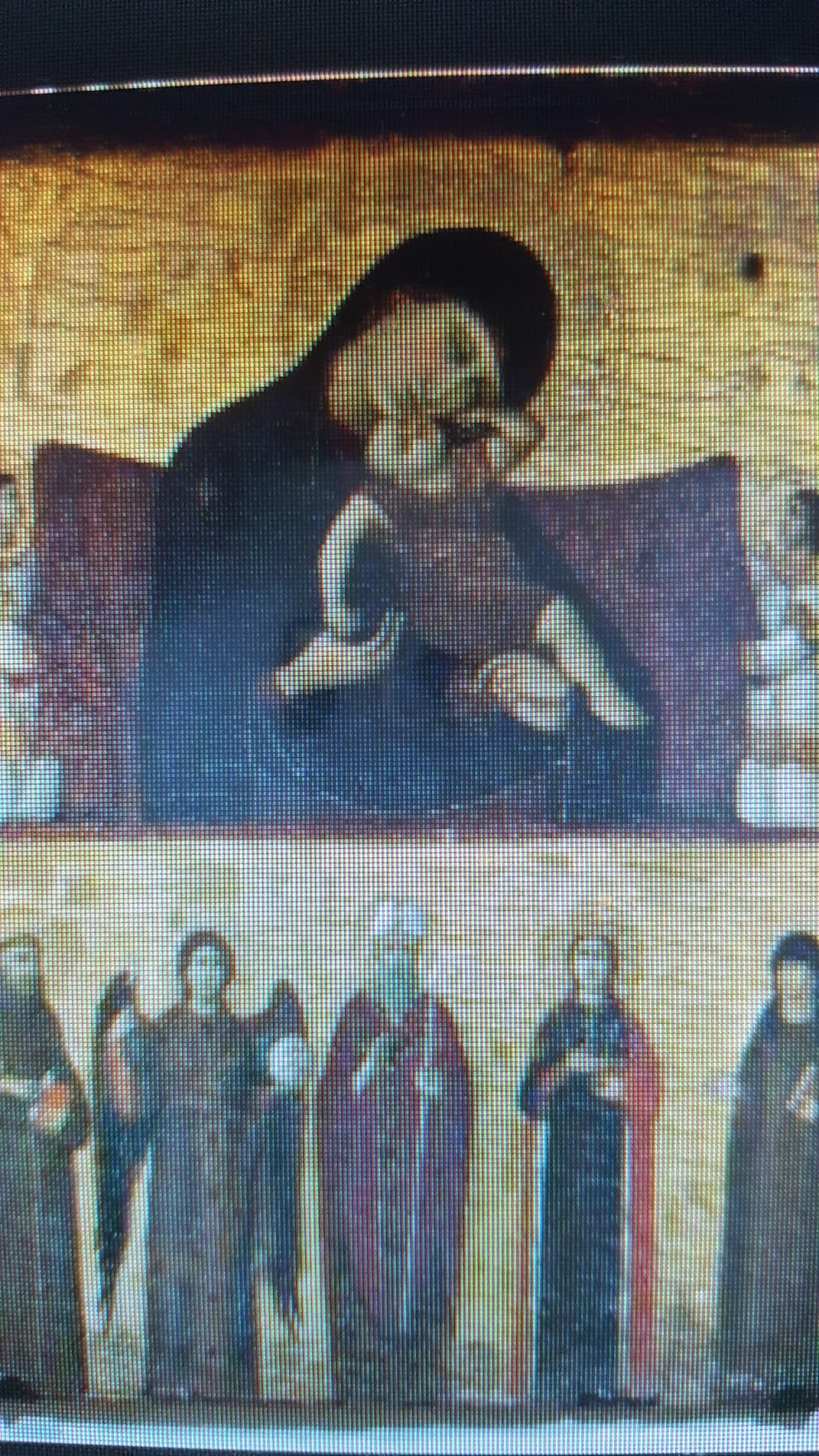
Giovanni da Rimini - Virgin and Child with Five Saints (1300-1305)
 
From my visit I found out that in the early fourteenth century Rimini served as an important trade centre between western Europe and the Byzantine Empire. These two competing forces came together across the Adriatic to create a specifically Riminesi art but following a series of earthquakes most of the art has now been lost.
 
Not much is known of da Rimini but most accounts report that he produced several large painted crosses for northern Italian churches but was better known for the small paintings he produced for spiritual contemplation. The three works here, all rendered lovingly in egg tempera on wood, fit that description perfectly. In Virgin and Child with Five Saints we see Jesus and Mary touching in many places, all the better to instruct followers of the strong emotional connection between the two of them. It's a nice work but do Christians, either then or now, really need reminding that mothers and their children have strong emotional connections? Funny lot, religious people.
 
The key work, Scenes from the Lives of the Virgin and other Saints, doesn't particularly stand out amongst the supplementary pieces. It's neither better nor worse. It's just newer to this particular gallery. It depicts St John the Evangelist being received into heaven, the Coronation of the Virgin, St Catherine of Alexandria preaching to the philosophers, and one of St Francis and St John the Baptist, two of the undoubted star names of the sanctified firmament. Good solid biblical stories that clearly bear repeating - time and time again.

 
Giovanni da Rimini - Scenes from the Lives of the Virgin and other Saints (1300-1305)

 
Giovanna da Rimini - Scenes from the Life of Christ (1300-1305)
 
The reverses of both these works, and that of Scenes from the Life of Christ, have been painted to imitate, or give the illusion of, precious stones. It's not said if that's something da Rimini picked up off of Giotto but it does seem clear that Giotti spent time in Rimini in the late 13th century where he became a great influence on the local artists.
 
When I first started taking an interest in art history Giotto di Bondone's name kept cropping up. I didn't know who he was but I took counsel in wiser friends and found out that whilst undoubtedly an important artist his greatest stroke of luck came when Giorgio Vasari, in 1550, wrote his hugely influential book of art history and art criticism. Lives of the Most Excellent Painters, Sculptors, and Architects plotted a course through Italian painting from Cimabue to Bronzino and described our man Giotto as being the artist who made the decisive break with the then dominant Byzantine style and as initiating "the great art of painting as we know it today, introducing the technique of drawing accurately from life, which had been neglected for more than two hundred years".

 
Giotto - Pentecost (1310-1318)
 
Looking at Giotto, or indeed da Rimini's work, through modern eyes it's hard to take Vasari seriously but, of course, this was hundreds of years ago. Many of the advances we take for granted now were yet to happen. Many materials and techniques now firmly established were yet to develop. I try to look at these works with unsullied eyes, to appreciate the shock of the old, but I'm not sure I can deceive myself any more than I could kid myself that the stories told in the Bible sound even remotely believable

I don't doubt Giovanni da Rimini and Giotto meant it when they made their paintings but, as I looked at two ivory panels from Constantinople and a parchment by Neri da Rimini, it soon became apparent that this was, for me at least, a dry academic exercise of learning rather than something I could attach any great personal passion to. The passion of the Christ, it would seem, is not a passion I can share.

A couple of works by Francesco da Rimini and a surprisingly modern, and colourful, Giovanni Baronzio nativity scene completed the exhibition. I'd learnt something but I'd not felt a great deal. Perhaps I should one day read that Vasari book to gain a greater understanding of the art of this era and why it's held in such high esteem. I'll certainly learn more than any of you who've soldiered through to the end of this blog will have done by doing so.

 
Francesco da Rimini - The Crucifixion/Noli me Tangere (1330-1339)

Francesco da Rimini - The Vision of the Blessed Clare of Rimini (1331-1340)

 
Giovanni Baronzio - The Nativity and the Adoration of the Magi (1375-1400)