Friday, 3 February 2017

A Cable Street constitutional.

Sometimes when the rest of the TADS aren't available Shep & I (the D and the S of the TADS) allow ourselves a little non-affiliated walk. We go off book. We may visit more pubs than normal. We might not have an Indian. Shep might not request a Bangla.

We'd spoken for a while about hanging one around Cable Street (where a motley band of communists, socialists, dock workers, Jews, and anarchists fought a battle with the Metropolitan Police who were protecting a walk by Oswald Mosley's fascists in 1936) and what with us both being off work on an unseasonably mild Monday in January it seemed the time was right.


I met Shep in the usual spot. On the mezzanine of Waterloo station, looking out at the big clock, and drinking a cup of tea from Benugo. We soon headed out on to Waterloo Road, swung a left into The Cut, and along Union Street until we reached Borough High Street. London Bridge seemed to appear very quickly. We looked down a grey and still river to Southwark Bridge and passed across into the City proper.


We paused for a quick look at the Tower of London. I remembered a visit I'm made there in 2000. I'd enjoyed the historical tour and the architecture but felt aggrieved at having to pay to look at the Queen's jewellery. Something I'd already paid for through no choice of my own.

It got my political back up just in time for entering Cable Street proper. I try not to use Wetherspoon's too much these days after founder Tim Martin's backing of Brexit but I really needed the bog so we stopped for a soft drink in The Goodman's Field, a less grim than normal branch on Mansell Street. From here we cut a block south and picked up Cable Street itself.


The DLR runs parallel to the north and a cycle superhighway passes along it now but the smattering of blue plagues tell of quite a colourful history. We passed the former homes of lightweight boxer Jack 'Kid' Berg and the British-Jewish doctor Captain Hannah Billig who, due to her efforts during wartime, became known as The Angel of Cable Street.


We also had a brief glance inside the restored Wilton's Music Hall. They were preparing for a show that evening so we weren't permitted a longer look. The bar had a very appealing wild west feel though. Surely a good pit stop for a future East End walk?

The best site of all is the Cable Street Mural. Painted in the style of the Mexican muralists by Dave Binnington Savage, Paul Butler, Ray Walker, and Desmond Rochfort between 1979 and 1983 to commemorate the 1936 battle. It combines fisheye perspective and the influence of Goya to show the confrontation between anti-fascist campaigners and mounted police. Sadly it seemed more topical than ever. It was not to be the last anti-police thing we'd see on our walk. As you'll surely spot as/if you read on.


We passed by Shadwell station, Shep gave some spare change to a very unwell looking young man on the street, and we came out in Limehouse on Commercial Road. Frank's Café seemed to be calling us in. I had my favourite yellow meal of cheese omelette'n'chips and then, suitably refreshed, we continued down past Limehouse Town Hall with a brief stop to have a look around the graveyard of St.Anne's.


A textbook alcoholic sat swigging from a bottle on a bench in the churchyard. I'm not criticising him. I've not been far off that a few times. I've written about the mysterious pyramid in the grounds of Hawksmoor's church before but I struggled to recount the details to Shep as we considered it further.

From here we dropped south to the top of the Isle of Dogs. Round the Museum of Docklands, across the floating bridge, past the skyscrapers of Canary Wharf and out on to the Blackwall Basin.


This side of the Isle of Dogs was unchartered territory for me. We passed by the barges moored both in Blackwall Basin and Poplar Dock and from Preston's Road took a turn into Coldharbour. The Gun on Coldharbour is a pub I'd seen recommended several times. Described as a "lively" docker's pub it'd clearly undergone some serious gentrification. Most of it was given over to diners but we secured a pint by the roaring fire in the rear room looking out across the Thames to the gasholders on the Greenwich peninsula and the Millennium Dome. It felt quite decadent drinking on a Monday lunchtime.


Tempting though it was to get stuck in for a session we dragged ourselves away. Marsh Wall took us across the uppermost boundaries of Cubitt Town and Millwall, sculptures poked out of the river, builders hurried about, and cranes dominated the skyline.


We turned into Narrow Street on Limehouse and had another pint in The Grapes. Sir Ian McKellen, I believe, is the proprietor. There were a couple of loud thespy types in enquiring as to his whereabouts. They were informed he'd be in for the quiz later but as that was still four hours away we continued. Only to another pub. Of course. This time The Prospect of Whitby in Wapping, the only pub I know with a noose hanging outside. Clearly not one to misbehave in.


Starting to get dark now we carried along to St.Katharine Docks and had yet another pint in The Dickens Inn. On weekends and during summer a packed touristy mock coaching inn but on a Monday in January something of a local. The news was on. Donald Trump had been being a cunt again. Hard to remember which particular cuntish thing he'd done as it was four whole days ago now and he's obviously done loads of cunty things since. Shep's assessment of his Facebook feed if converted into Basic would read something like this:-

10 PRINT "DONALD TRUMP IS A CUNT"
20 GOTO 10


Over Tower Bridge we went. Loosened up by a few pints and letting loose a volley of expletives we were now jolly enough to be singing Clap Your Hands Say Yeah and Half Man Half Biscuit songs as we continued down Tower Bridge Road, into New Kent Road, and up Waterloo Road to the Duke of Sussex for one last pint. Another pub with a roaring fire and another that's seen serious refurbishment since my last visit. It'd been a good walk and when I got home and ran the stats through www.mapometer.com it revealed we'd covered over 20k. At 1 pint every 4k I think we'd earnt it. To the next one (both walk and pint).


James Ensor:Intrigue and entrails in Ostend.

James Ensor may not have travelled much physically but in his mind he went to some very strange places indeed. His work runs the spectrum from fairly traditional landscapes and impressionist pieces through to Hieronymus Bosch inspired grotesques and political satire to the sort of thing I'd have doodled in the back of my Social Studies book in the early eighties.

The Royal Academy's recent James Ensor:Intrique was a fascinating look at an artist who'd hitherto only been on my periphery. It'd been curated by another Belgian artist Luc Tuymans who'd taken the liberty of including a few of his own works in the show. And why not? He's a well-known, well-respected artist in his own right. But, at the RA, it was Ensor who stole all the plaudits and it's Ensor who I'm concentrating on here.

Born in 1860 in the coastal city of Ostend to an English father and a Flemish mother Ensor's upbringing was, that old cliché, a tale of contrasts. On one hand Ostend was becoming the 'Queen of Belgian beaches', playing host to the masked Dead Rat Ball, and was frequented by King Leopold I, the first king of Belgium. A grisly result of the constant development was the accompanying disinterment of mass graves from centuries past. Many of them victims of the Siege of Ostend during the Eighty Years' War when Holland sought independence from Spanish rule. The warm, busy summers contrasted with the bleak, desolate winters and Ensor's work echoes this duality.

His mother and aunt ran a shop selling curios, seaside souvenirs, chinoiseries, and masks. Again these would come to populate, inform, and exoticise his work. Not that this was particularly apparent in nascent works like Bourgeois Salon (1880) and Adam and Eve expelled from Paradise (1889), both below. The former borrows the colours of the Impressionists and the Post-impressionists, even verging on Fauvism, whilst the latter nods to the sun bleached experimentalism of late era Turner who'd died earlier that century.


Ensor left school at sixteen and went to study at the Academie royale des Beaux-Arts de Belgique in Brussels for three years. He achieved little success and felt badly treated and misunderstood by his tutors. Disillusioned by the strictures and formalities of the establishment he co-founded a group called Les Vingt (Les XX) in 1883 and they invited big name artists like Cezanne, Monet, Seurat, and Pissarro to exhibit alongside the emerging Belgian talent.

Despite this opening up possibilities of travel for Ensor he determined to remain independent and chose to stay in Ostend for the rest of his life with only occasional brief trips to England, France, and Holland.


The exhibition jumps about a bit chronologically so it's tricky to keep track with Ensor's development. Therefore it's probably best enjoyed as an overview of his career rather than a full retrospective. In fact the show concentrates only on the first half of Ensor's life as by the early 1900s he was focusing his energies on composing music and playing the penny whistle and harmonium.

Even though they weren't appreciated at the time (though the Belgian establishment later relented and, after relinquishing his British citizenship, Ensor received the title of Baron from King Albert I) there's still a lot to enjoy in works like Calvary (1886) and 1905's Comical Meal, both above. Ensor's use of masks is highly prevalent and, in fact, the Symbolist poet and Ensor's biographer Emile Verhaeren referred to him as 'the painter of masks'.

Devils Thrashing Angels And Archangels (1888, below) shows Ensor really cutting loose and letting his imagination run free. Peculiar Insects, from the same year, and Bad Doctors (1895) adopt a biting satire way ahead of their time. It's almost as if Ensor is utterly disgusted by all humanity. Witness the grim reaper overseeing an horrific surgery scene in which a 'doctor' pulls entrails (or are they sausages?) from a patient's gut!


1887's The Pisser shows a top hatted gentleman urinating. Presumably over the art world. It almost seems to come from a different artist to the one that, twenty years later, painted Chinoiseries with its (trademark) masks, vases, bright yellows, and melancholy blues.


1896's Flowers and Vegetables could almost be an old master. Although one imbued with the restless spirit of Van Gogh. The year before Ensor made Entry of Christ into Brussels. Considered his most famous work and a precursor to the Expressionism of Max Beckmann and Emil Nolde it reminds me also of the famous Mexican murals of Diego Rivera or David Siqueiros.


The dead bodies Ensor had witnessed as a youth reappeared in Skeletons Fighting for the Body of a Hanged Man (1891) and Skeletons in Fancy Dress (1898). Sometimes the animated bone men would represent Ensor himself. Sometimes not. Sometimes they appear to be offering a narrative, a critique, of societal mores. Other times they seem to be little more than decoration.


Seemingly ever restless, at the same time, he was painting traditional, if slightly disturbing, still lifes like 1892's The Skate - a skilful rendering of a typical North Sea catch. It's about as realistic looking as Fall of the Rebel Angels (1889) isn't. Again we see touches of Van Gogh and, dare I say it, signs of a slightly disturbed mind.


Dangerous Cooks (1896) seems to pass comment on the food preparation business in much the same way as medical practitioners had been previously lampooned but, switching tack yet again, Baths at Ostend (1890) depicts a naïve, though warm and tender, portrait of an innocent day's bathing. This is a work that, like much of Ensor's output, really needs to be seen up close and in situ. There's so much detail that a representation really doesn't do it justice.


Only a year after his leisurely and light-hearted Baths at Ostend Ensor was painting Skeletons fighting over a Pickled Herring (1891). Bold in colour. Brash in subject matter. It's no better, or worse, than a very early work like 1876's Bathing Hut but seems to come from a completely different place. If you triangulate those two works with 1884's Rooftops of Ostend (below Bathing Hut) you get some idea of just how much James Ensor was able to travel around within the confines of just one city and just one mind.

It'd been an education for me and one I'm very grateful for Kathy for getting me into for free.


Thursday, 2 February 2017

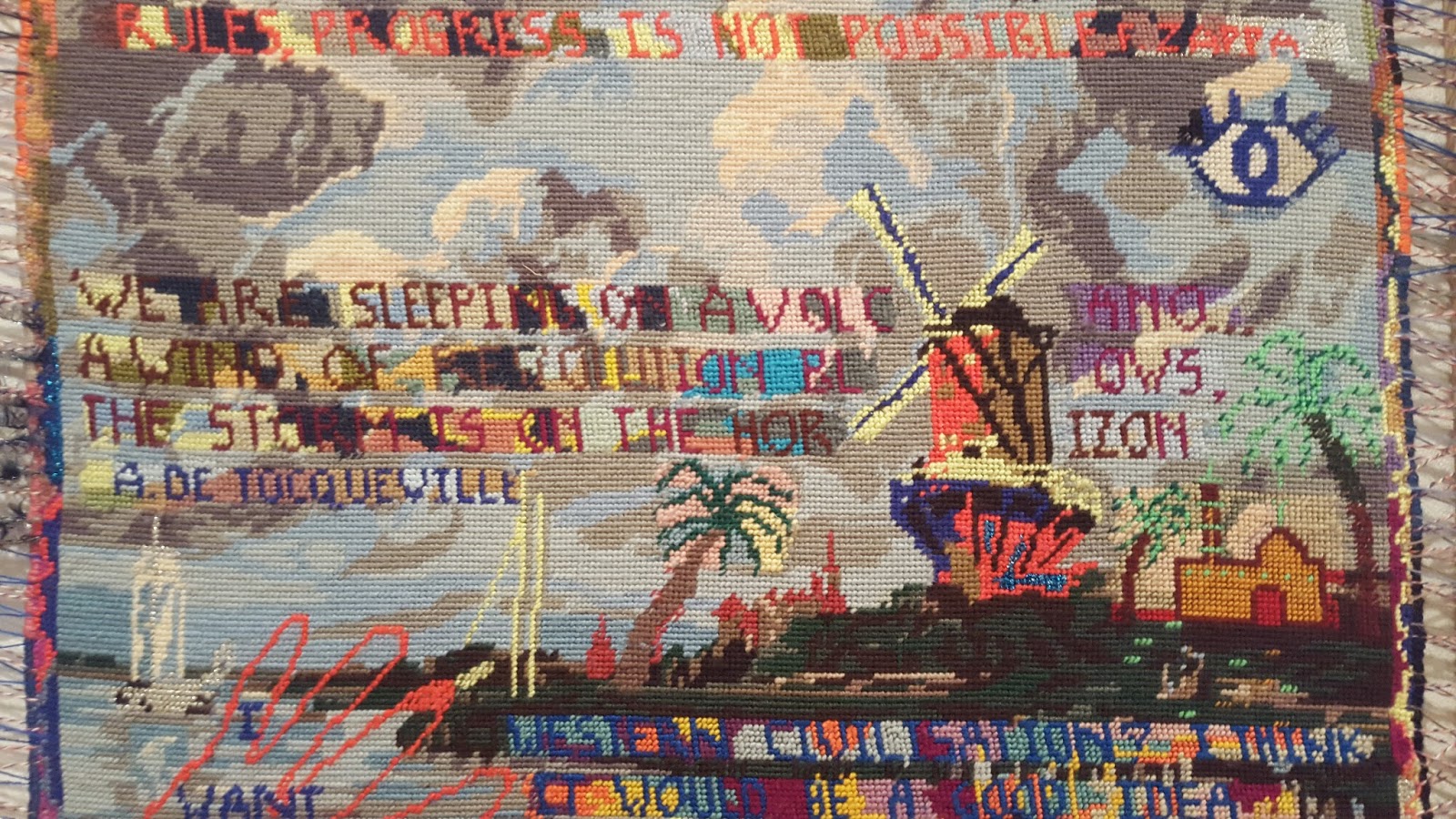
Sylvia Franquet:reMembering.

Don't laugh at me for going to an exhibition of needlepoint. I wouldn't even begin to pretend I know the first thing about the medium. So bear with me as I go on a steep learning curve. Hopefully you'll enjoy the photos I've taken if not the words I've contributed.


As well as the form being new to me so was the gallery. So was the artist. Sylvie Franquet, for it was she, was actually present when I visited. I think that's the first time it's ever happened to me. She was on hand to answer people's questions and generally chat about her work. This hands on approach certainly made me even more conducive to what were pretty eye catching pieces already.

Sylvie was born in Belgium and read Arabic and Islamic studies in the universities of both Ghent and Cairo. She's spent much of her life immersed in the world of Mediterranean culture and has written extensively on the Middle East. These studies inform both her tapestries and her dolls. There seems to me to be a huge amount of labour involved in creating these works and, in that respect, the works are as much about process as anything else.


Being a fan I particularly warmed to her Bowie tribute. But although Franquet occasionally works with pop culture on the whole she prefers to base her images on more canonical works, overlaying them with found words from poets and thinkers she admires and even text messages from friends. Rofl!


Sometimes it's hard to make out the text but the images are never less than intriguing. You could spend a lot of time with each one and keep finding new things to consider. An influence she's cited is Giacomo Leopardi's Zibaldone da Pensiere. Leopardi was a radical Italian thinker of the early nineteenth century. Franquet likes his "dense collaboration of thoughts, ephemera and philosophies" and you can see quite clearly how she's employed a similar approach.


Of course needlepoint has, for generations, been considered women's work. Franquet claims a fascination for this inheritance. In her repurposing and reimagining of artworks created by men into this traditional female way of working there is a quiet feminism in her work. In some ways a world away from the more cutting edge female artists that preceded her. In others standing in solidarity with them.

As well as the needlepoint works Franquet has made a rather large series of 'Wayward Sisters'. Small cloth dolls emblazoned with slogans both inspirational, interesting, and, in some cases, a bit cringeworthy. Cicero rubs shoulders with William Blake and Marcel Duchamp.


Some of them would look a bit scary if you were to enter the room in the dark. Alongside the Wayward Sisters stand three Poupees (mannequins). Franquet has sewn life-size fabric sculptures, pattern-cut from her own body and 'tattooed' in a similar graffiti to the tapestries. They look like vandalised showroom dummies but they represent repositories of memory, stories, and myth. I didn't like them as much as the tapestries.

Franquet's work has featured in Vogue and Elle and her art was included in the More Material exhibition in New York curated by Duro Olowu. There's obviously a lot of interest in this kind of art (or, if you'd prefer, craft) and, on the most part, it's not covered in the traditional art media. At least the elements of it that I subscribe to. It was an education for me and although I wasn't completely sure about all of it I think I've got the taste for some more. The October Gallery in Bloomsbury was quite a find too - and talking of taste there's a small vegetarian/vegan restaurant in the same building that may well be worth sampling when and if I'm back in the gallery.


Wednesday, 1 February 2017

Richard Wilson:Stealing Space.

"I need that initial thing from the real world because I've always been concerned with the way you can alter someone's perception, knock their view off kilter. And to do that I need to start with something we think we understand" - Richard Wilson, 2005.

So far so much word salad, so much artist talk. In many ways Richard Wilson's Stealing Space at the Annely Juda Fine Art gallery near Bond Street confirms every gripe about the pretentiousness and pointlessness of contemporary art. There seems to have been, for quite some time, a lot of talk about a piece's 'relationship' with its environment and Wilson's oversized wooden sculptures seem, intentionally, to have a dysfunctional one with their space.


I'm not saying that's a bad thing. They're pleasant enough to peruse for a while. Ponder them and then move on. I didn't feel a great deal of emotion, or any really, but they were interesting enough to look at.

I've a soft spot for Richard Wilson though as his works are among the first contemporary art I ever went to see. His 20:50 was the highlight of an exhibition I saw at the old Saatchi Gallery in St.John's Wood. It's the room partly filled with highly reflective sump oil which gave the illusion of a room turned upside down. It was visually sensational and had a rather lovely aroma too. It was one of the first times it really clicked to me that there was something in this malarkey. That the setting, the materials, the experience were all key components in how you viewed a work. Not just what it represented but what it actually was.


Wilson's never really topped that work. Either in my eyes or the view of many proper art critics. Even his Slipstream sculpture at Heathrow Airport's Terminal 2, despite no doubt being seen by many more people, lives in the shadow of 20:50. The wooden sculptures at Annely Juda stand higher, in places, than the gallery's architectural beams. It seems as if they're trying to break out of their constraints in the way that an artist tries to forge new works without letting go of their past. Despite his continued success perhaps Wilson feels this particularly keenly.


Some seem to take the negative forms of a Rachel Whiteread sculpture. Not least Block of Dering (the leading photo in this piece) that reconfigures the façade of the gallery into something more cube like and more cubist. Even the gallery's signage is included. Preparatory sketches nearby shed light on the process if not the inspiration. Another room features the forms of inverted furniture. Wilson seems to be making the everyday look, in some way, 'other'. An admirable achievement and one he's, partially, succeeded in.


His boat sculptures, like Slice of Reality, invite us to have another look at our everyday surroundings. Well, if you live on a boat that is. I actually prefer these to his more abstracted works. There's something about seeing an inversion, or even a slight tweak, to the familiar that is aesthetically both satisfying and discomfiting at the same time. A cognitive dissonance that I can actually enjoy.

Like the circular portion carved out of the architectural model of a hotel façade we're asked to consider something we've seen many times before from a different angle or perspective. There's plenty of chin stroking, a small helping of pseudy bollocks, but also a rather delightful diversion that won't cost you a penny or detain you for very long at all. Worth a look.