Thursday, 18 August 2016

The Sky Needle and the damage done.


I woke at 2, and again at 5, in a room festooned with books about algebra, chemistry, and fluid mechanics. I'm building up a profile of my host David without actually meeting him (yet). Trainers in the hall are the only evidence he's even been in his own apartment. Luli was keeping herself occupied so I had the run of the place. But no breakfast. Airbnb should probably just be airb.

The first person I saw on my first full day in Seattle was a man walking down the street telling no one in particular, quite loudly, about the 'zombie mafia'. The black lady with the giant red mohawk paid him no mind and the 20 or so elderly Chinese ladies waiting patiently outside a food bank clearly had weightier concerns.

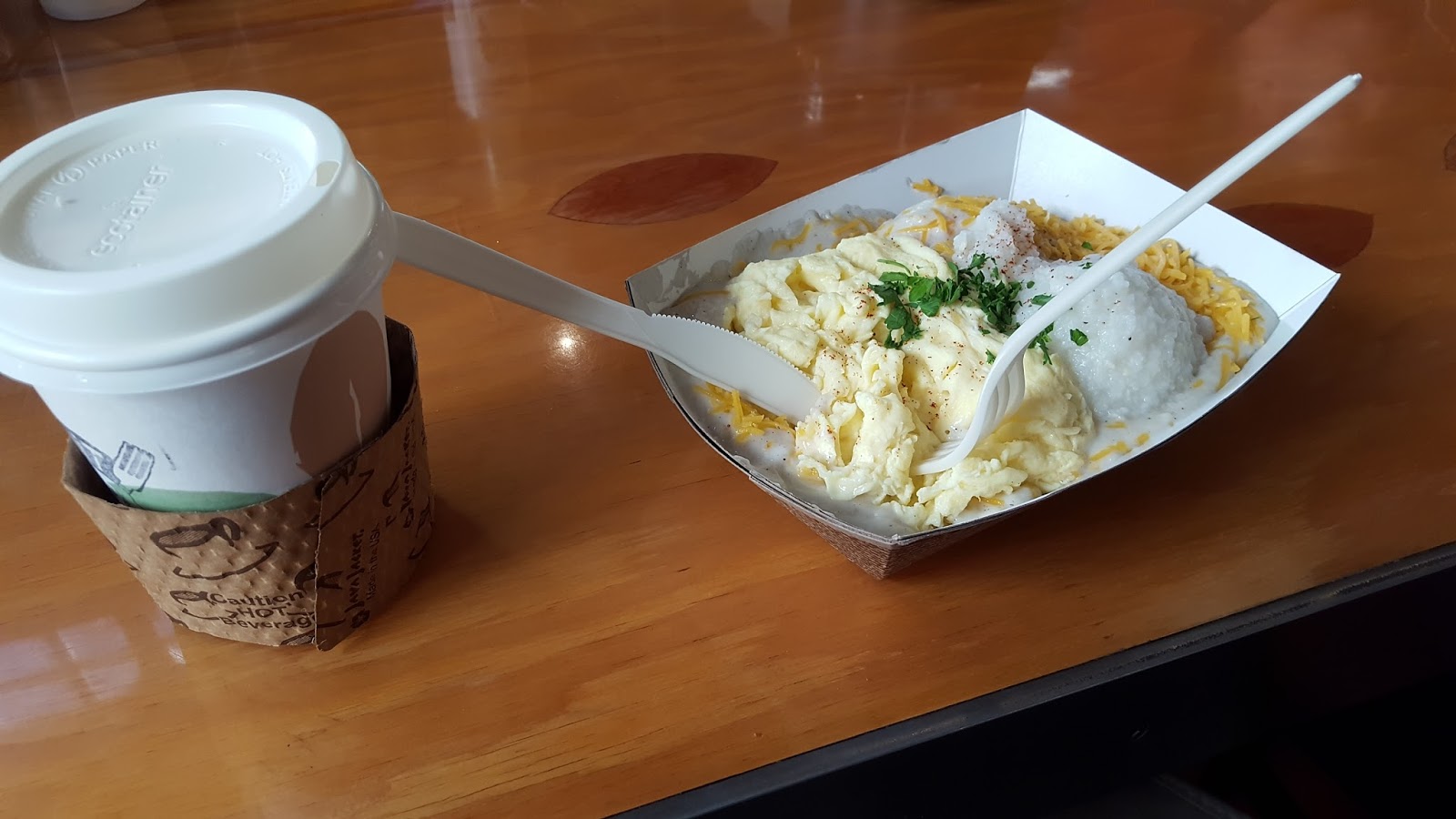
I'm fortunate that I wasn't breaking my fast in such a fashion. I'd been tempted into a branch of, the crudely monikered, Biscuit Bitch on the corner of Cherry & 3rd.

I went for a Gritty Scrambled Cheesy Bitch (Vegetarian Bitch). They may be over using a certain word. It was biscuits & gravy smothered in grits, scrambled egg, and cheese. Washed it down with a 12oz cup of Seattle Fog (Earl Grey with a 'splash' of vanilla) and listened to Aaliyah's 'Try Again'.

It tasted better than it looks. At least once I'd added some Frank's Red Hot original cayenne pepper sauce. I was set up for the day.


Past skyscrapers trimmed with Art Deco flourishes I walked. Up to Pike Place Market and its brass pig (an actual piggy bank donated by a local ice cream firm) and it's gum wall. Which is literally a wall thickly plastered with smelly bubblegum.


At the market you can buy jumbo Alaska king crabs, Himalayan pink salt, rendered duck fat, snickerdoodles, Polish kielbasa sausages, rambutans, mangosteens, and 'wife cakes'! I simply enjoyed the sights and sounds of a city going about its business.


I met again with Gareth and Bec. We visited the Seattle Art Museum. It was fantastic. Combining the styles of Tate Modern, the V&A, and the National Gallery all under one roof in its collection.

It was lovingly, and intelligently, curated. It was sensitively lit. Even the air con was set right. Bec, who works in a gallery herself, thought it one of the most beautiful museums she'd ever seen. I agreed.

After a rather extensive preamble by a friendly member of staff we found ourselves in a room full of minimalist works. I was taken with the juxtaposition between Norman Zammit's 'Yellow' and Robert Irwin's 'Pillar' below.


The artworks crossed international boundaries and spanned centuries. I saw works by Warhol, Rauschenberg, Ellswoth Kelly, Rothko, De Kooning, Agnes Martin, Barnett Newman, Pollock, Jasper Johns, Beckmann, E.L.Kirchner, Josef Albers, Robert Delaunay, Thomas Eakins, Van Dyck, Murillo, Cranach the Elder, Monet, and Matisse.

The UK was represented by the impressive young painter Lynette Yiadom-Boakye. I'd enjoyed her show at the Serpentine a while back and felt proud to see her work in such exalted company.

One of the neat curatorial tricks the SAM liked to pull was playing sculptures off against paintings. To the mutual benefit of each. Here we see Anthony Caro's Veduggio Stay posing in front of Kenneth Noland's Vista.


I was equally impressed by these two Philip Guston paintings flanking a Cy Twombly bust. None of which were titled.


There's a large ethnographic section. Nuxalk masks, Japanese Edo period kettles, gold llama figures from the Andes, and 14c altarpieces from Siena share equal billing with Dervish begging bowls, Iranian ceramic mihrab tiles, Egyptian faience Hathors, Greek vases, a taxidermied cat, John Cage videos, and a cedar Horus.


It's great that the native American button robes, above, can sit in the same collection as Whitfield Lovell's comparatively recent Walkin' Blues and Kane Quaye's Ghanaian Mercedes coffin, both below.


So if you visit Seattle visit the Art Museum but also take a stroll along the waterfront to the Olympic Sculpture Park too. Especially if it's a sunny August day. Which it was. Pay only passing heed to the segway tours and get your outdoor art on.


The red painted metal of Alexander Calder's The Eagle plays off nicely against the bright blue sky.


I wasn't tired yet but it would've been rude not to take up Ginny Rufner's Mary's Invitation - A Place to Regard Beauty (2014).


Richard Serra's monumental, rusty, Wake is probably the highlight but find time for smaller pleasures too. Such as Louis Nevelson's Sky Landscape I.


A stroll uphill takes you to the Seattle Center. Home, most famously, of the iconic Sky Needle but also Frank Gehry's Experience Music Project, intersected by a monorail (oh, yes), a Claes Oldenberg sculpture, and various concession stalls and child friendly activities.


We sat in the sun eating veggie frankfurters. Talking Heads and Santigold played over the PA while kids played on the slide. It was, again, a joy to be alive.

Bec wasn't up for a trip up the Sky Needle so me and Gareth debated the relative merits of splurging $27 on such a brief experience.

So glad we decided to go up. Should've been a no brainer on such a clear day. The retro futuristic gold lift zips you up to the top in no time and the views stretch as far as Canada.

Once again we marvelled at how green the area was and how many lakes were dotted around. A seaplane landed in Lake Union. A helicopter hovered amongst the skyscrapers and, all the while, Mount Rainier stood defiantly in silent contemplation of our fleeting human follies.


Gareth and I wandered back to Pike Place and met Bec for a couple of jars and a chat about Snoopy and flea circuses in Kells.

We ended the night in Ian's Pizza by the Slice up on Capitol Hill. My odd hipstery meal being a mac'n'cheese pizza and a can of PBR. Sadly no PBRR&B soundtracked my slurping.

We'd walked the best part of 20k and I'd had a brilliant first full day of my West coast adventure. Thanks to Gareth and Bec and here's to many more.


Wednesday, 17 August 2016

Ringway to Sea-Tac.

My alarm went off at 0220hrs. The silliest of silly'o'clocks. Even more so if you consider it was 1820 the previous day at my destination and I was to be awake 27 hours straight. Of course it's easier to drag yourself out of bed for a holiday than it is for work so by 3am I was making small talk with an Iranian taxi driver as we glid through the London streets in the near dead of night.

A cup of tea and a pain au chocolat in Caffe Nero, Heathrow T4, later I was on a KLM flight to Amsterdam. The enormous bump about five minutes after take off scared me but the Brazilian girl next to me looked unperturbed and, more importantly, so did the cabin crew. But it was nice to touch down in Schiphol and take advantage of their free WiFi.

On my Delta flight to Seattle I lucked out. There was a spare seat next to me so I moved over to the window hoping for views of Iceland, Greenland, and Canada.

There's something about flying that seems to make me extra emotional and I must confess I had a little cry reading about a guy whose mum died in a car crash when he was a lad and whose previously loving father became an abusive drunk. The guy followed in his father's footsteps and eventually ended up being jailed for life by the Old Bailey. He'd changed his ways but it sounded like a long and painful 'journey' that had, no doubt, damaged untold numbers of people. All because he thought that was how a 'man' should act. The older I get the more I realise you don't have to be 'hard'. It's OK to be a cissy.

My actual journey was long but not at all painful. Patches of England revealed themselves in the wispy cloud gaps. A river. A stadium. A conurbation. A beautiful patchwork of yellow and green fields. The oblivious crazy paving of olde Albion wishing this traveller adieu. It really does look beautiful from eight miles high.

As we flew over the more rugged, but equally awesome, Western Isles of Scotland the cabin crew offered drinks. I broke the habit of a lifetime and washed my pretzels and peanuts down with a Coke and not a red wine.

There was tortellini'n'turbulence, coffee, crackers'n'cheese. Then an orange coloured mousse. Delta Airlines were spoiling me with FOUR desserts. I assumed, judgementally, that this was just the way Americans ate now. But I was informed by the lady serving I got extra because I'm a 'nice person'. All I'd done is say please and thankyou and occasionally smile but maybe even that level of common courtesy is rare now? Either way I felt a warm glow of pride and you can't take that from me.

I didn't see much of Iceland or Greenland because of cloud cover but the Canadian landscape was dramatic. Barren. Icy. Mountains. Mountains. More mountains.

As we descended the skyline of Seattle, with Mt.Rainier standing snow capped and proud in the distance, I felt a chill of excitement and anticipation shoot up my back. Maybe some altitudinous over emotion, sure, but also genuine joy to be embarking on a new adventure and discovering new places.


I took the Link Light Rail into Seattle proper. I worked those ticket machines like an old hand but I wasn't so bright on the train itself when I missed my stop at Westlake.

Never mind, I could improvise. I got off at the next one. Capitol Hill. A university district with lots of rainbow flags and a statue of Jimi Hendrix. The sun was beating down. It felt good to be alive and even better to be on holiday.


To get my bearings I popped into a Starbucks. Normally a sign of lack of imagination but as they're a Seattle firm I'll cut myself some slack. The service was great. The coffee was crap.

Turned out I wasn't far at all from the First Hill area where I'd booked my airbnb. I walked it. I got confused by the US system of street numbering and bewildered by lock boxes. I asked a man for directions who turned out to be visiting from Idaho.

But I got there. The apartment was lovely. David wasn't there to meet me but his dog Luli was. She was lovely. She followed me round the place as I checked out his vinyl (or vinyls, I'm not fussed) and the views from the balcony.

Earth, Wind, & Fire and James Brown shared space with more classic rock tropes next to the record player and the vista was of Seattle's tallest building. The dark monolithic 73 storey tall Columbia Center. Nearly 1,000 feet high it's the second loftiest edifice this side of the Mississippi.


I freshened up and descended the steep hill down to the waterfront. The weather still glorious. Clapboard huts dished out clams, crabs, oysters, and the like. You could take a boat ride across the Puget Sound. You could ride a ferris wheel. You could just sit and relax.


Predictably I plumped for the latter option and, even more predictably, I found a bar to do it in! Clams - no! Seattle Beer Co? Yes!

I've no idea, but I should've asked, what a 'growler' is so I took a small glass of Red Hook ESB and watched the world go by.


At Kells Irish Bar off the bustling Pike Place Market I chatted briefly to Rory the bartender. To the strains of 'Hills of Connemara' he explained why orcas no longer visit Elliott Bay (the boats play havoc with their echolocation) and recommended crab joints. I didn't have the heart to tell him I was a veggie! He said he came from Belfast but his accent told a different story.

I finally caught up with my friends Gareth and Rebecca in the Alibi Room down the road for a couple of Northern Brewing Lagers. The Rough Guide to The USA describes the Alibi as 'swanky'. That'd not be my preferred adjective but it was absolutely fine and great to catch up and hear of their experiences in Portland and Vancouver.

Wandering around looking for food we came across a plaza with couples dancing to Jolene. It was sweet and not necessarily what you'd imagine from the city that gave us Nirvana, Mudhoney, and The Screaming Trees.

We didn't stay long. We were hungry. We'll hopefully be more imaginative later in the trip but we tried veggiegrill. A vegan fast food chain with possibly the friendliest service I've ever encountered. The food was none too shabby'n'all.

I ate the Santa Fe Crispy Chickin' and washed it down with a Scuttlebutt blonde. It was then time to walk back up that hill.

When I arrived back on Cherry Street both David and Luli had turned in. It wasn't even 10pm Pacific Standard Time but I wasn't far behind them. Tomorrow is a new day and there's exploring to be done.


Wednesday, 3 August 2016

To Hellenikon and beyond.

The BBC's recent Who Were The Greeks two parter with Dr Michael Scott as our guide was one of the most informative and interesting things I'd ever watched about the ancient Greeks, their customs, their history, and more. He showed us both how the Greeks lived and what they have given us. Quite a lot you'll not be surprised to learn.

Beginning in 490BC overlooking the plain of Marathon where 10,000 Greek soldiers defeated a Persian army twice, maybe three times, its size. The Greeks had created democracy, architecture, and philosophy and all that had been at stake.

After their victory their general Militiades traveled to Olympia to make offerings to the Gods. He dedicated his helmet to Zeus (fnarr, fnarr) and a Persian helmet too. A spoil of war. John Stuart Mill, an old favourite of mine, once claimed the battle of Marathon to be a more important historical event in English history than even the Battle of Hastings. Such is our debt to the ancient Greeks.


Greece, at the time, was not the unified country it is now. It was a series of poleis (city states) that represented groups of people rather than cities as we'd recognise them. It was a patchwork, a mosaic, divided by mountain ranges and, of course, sea. These poleis formed alliances. Like a precursor to the EU they felt, and were, stronger together and peace, of sorts, prevailed over this previously bellicose region.

An indication of this bellicosity was pankration, a combat sport with scarcely any rules, which was used to train Greek soldiers to fight to the death even after being divested of all their weapons.

In Sparta things were seriously tough. At the age of six boys were taken from their families and whipped for minor offences as they trained to become perfect warriors. Blood cropped up a lot. In battle they wore red cloaks to hide any blood they may have shed. They ate disgusting tasting broth which consisted of pig's blood mixed with vinegar. A tough food for tough men. And tough women too.

The Athenians looked down at Spartan women for joining in with the fighting and flashing their thighs. In Athens the men were often naked whilst women tended to remain clothed but in Sparta men and women were more equal both on the field of battle and in their nudity.

Not everything in ancient Greece would appear so enlightened to our modern morals. Parents of weak Spartan children were ordered to carry their frail offspring to Mount Taygetos and leave them there to die. Cold blooded old times. Again. This happened all over the country. Even in Athens. Some say 10% of daughters were simply left to die. Infanticide and eugenics thriving in the cradle of democracy.


Osteologists studied the skeletons of 450 babies in a well from the second century BC and found that dogs were buried along with the kids. Sacrifices and bribes to the Gods too. And what a lot of Gods there were. So many they were described as being like clothes that had spilled out from an over filled drawer that nobody felt compelled to tidy.

Yet, paradoxically, alongside this belief in the supernatural the Greeks took to science and medicine. Dr Scott visits Epidaurus on the Peloponnese to study stelae dealing with the dichotomy between the rational and the irrational. The stelae tell fantastic stories of pregnancies that lasted a lustrum and new born babies that could pretty much walk out of the womb.


It was mostly faith healing bullshit, the crap that persists to this day, but they did make some genuine medical breakthroughs. A terrifying case of scalpels and knives, anyone fancy an anal speculum insertion?, testify to the efficiency of ancient Greek surgical instruments.

But, yet, offerings to the Gods remained. Which seems a bit of an insult to the surgeons themselves. Quite often these offerings took the form of the body part that had been healed and, more often than not it seems, that body part was a man's cock. They weren't shy about such things because everyone in the gym was bollock naked anyway. In fact the world gymnasium, Greek of course, essentially means naked room.

Unsurprisingly all that naked man-on-man wrestling action led to a very open ended view of sexuality. They thought sex was good for women as it kept their wombs from drying out and, er, wandering around the body! Athenian laws demanded husbands have sex with their wives at least three times a month. Anal wasn't allowed with one's wife but high class hookers, lower level prostitutes in brothels, and live in lovers could provide bum fun.

Young men were expected to have sexual relations with adolescent boys. It was considered an exalted and important form of love. Greek vases show priapic older men fiddling with younger boys willies. These relationships had to end when the boy reached puberty. The man had to be married by the age of 35, anyway, or face a fine.


As touched on earlier, it was different for women. Male statues were naked. Females clothed. Much like the actual men and women. Girls were married off aged 13 and were expected to be virgins.

A form of body fascism operated too. People deemed ugly were shunned. Plutarch metaphorically claiming that those who lived with a lame man would end up limping also.

So sexual mores were very different. As was the culture of drinking. Symposia drinking parties for the beautiful and clever weren't exactly relaxed affairs. They consisted of a series of behavioural tests. For example drinking wine whilst reclining which was not so easy out of one of those wide brimmed vessels they used at the time.


The 'eye' appears. Not to ward off evil as believed by modern day gullible cretins but to remind Greeks that society was watching them. There were cleansing rituals and libations to the Gods. Plato wrote of one famous symposium in which the expected argument and debate about love was ruined when Socrates' other half turned up pissed. Bad form apparently. No preloading in the Hellenic social scene.

If you opted out of society (or symposia, much the same thing it seems) you were simply denounced as an 'idiot'. The literal translation being 'private person' but the meaning of the word changed for a reason.

With all this sex and booze it seems surprising that they ever got much else done but in the centre of modern Athens there lies an unremarkable pile of rocks. This was The Assembly. The birthplace of all democracies everywhere. It wasn't like Westminster where elected representatives speak for, or against, us. Every citizen had a right to attend.

As well as, potentially, having to represent yourself in parliament you may have to do so in law also. There were no lawyers. If you wanted to try a case you had to do it yourself.

Pottery shards called ostraka gave us the word ostracism. You wrote, on your ostraka, the name of someone you wanted expelled from Athens for a decade. Like a Big Brother eviction night vote those whose names came up the most were out on their ear. Hundreds of ostraka were found carrying the name of Themistocles. Vote rigging was suspected. Even the earliest of democracies was bent.

Another word we took from the Greeks is bureaucracy. They loved it. Laws, contracts, scrutiny lists etc; Red tape gave way to more red tape and so on.

But how did they pay for all of this? Simple. Slavery. Slaves were either spoils of war or brought from overseas. At the height of ancient Greece there were ten slaves for each citizen. Athens also made money from silver mining but it was, of course, slaves who worked those mines. Some slaves were comparatively well treated and educated. Plutarch, always one for a controversial soundbite, said he'd rather be a slave in Athens than the king of some poxy island.


Slave testimony was only permitted in court if they'd been tortured. Slaves being seen as natural liars who could clearly only speak the truth when forced too. Starvation and flogging of slaves was common and, naturally, slaves had no business whatsoever denying the sexual demands of their masters.

In spite of all this some still prospered. One slave, Pasion, from the fourth century BC, had begun his bondage working in the Piraeus port district of Athens. He was bought by bankers and his work was so good they granted him his freedom. He became bank manager and, eventually, bank owner. A very very rich man indeed by this point he donated triremes and shields to the state. Eventually he was awarded citizenship and was considered the richest man in all Athens.

Athens had become the central and most dominant state. Yet the alliances, on the whole, held. Herodotus, father of history with his 'common blood, common language, common shrines and rituals, common customs' line, explained how the 1000+ city states (there was no Greece as such) gelled across the Levantine region.

Perhaps the greatest bonding exercise took place once every four years in Olympia. I think you can probably guess what that was. The Olympic Games only lasted for five days back then. There were running races, javelin, chariot races, and horse races as you'd expect. The boxing and wrestling was so competitive that people actually died.

The sport was seen as an act or worship but the main focus was outside the stadium. At the Temple of Zeus, God of all Gods, whose honour the games were held in, a great procession took place at the climax of the Games. It led to the altar of Zeus where 100 oxen were sacrificed.


Across Olympia historians have discovered helmets and shields. They tell of the many years of warring Greek states. The Olympics were war by any other means and, on top of that, there was no sanitation. Wags of the time claimed slaves were punished by being sent to the Olympic Games. And you thought having to watch dressage was bad.

After the wars with the Persians Pericles decided to rebuild the Parthenon and to build the original statue of liberty, Athena herself. Statuary show noble Greeks fighting brutal centaurs. The buildings and statues were brightly coloured. That's something seemingly anathema to our tastes these days but if we can't bear to look at it we should at least consider the story these colours tell.

The gypsum came from Northern Greece. The realgar from the Caucuses. The ochre from Cyprus. Cinnabar was imported from Spain and, most notoriously of all, Afghanistan provided the lapis lazuli.

It was the result of a network. Athens was a hub of commerce for the ancient world. A city of cushions, carpets, spices, and fish. And people. People with ideas. Aristotle came from Stagira in Macedonia. Herodotus from Halicarnassus in modern day Turkey. They were the Metics. Not citizens. Nor slaves. But they could live and work in Athens. What a great advert for integration.

Certainly it helped aid the wellspring of ideas. Socrates claimed the unexamined life was not worth living. Plato, his pupil, grappled with such evergreen posers as what makes an ideal individual and what makes an ideal state? They even coined the word philosophia. Love of wisdom. Which gives me carte blanche to describe myself as a philosopher. I don't need to be wise myself. I simply need to love wisdom - and I do'n'all.


The Richard Dawkins of his time it seemed that average Athenians found Socrates an insufferable know-it-all. Worse still he was always skint. This didn't stop him pointing out the moral weaknessesof others. Nor did his contention that nobody really knew anything anyway.

Such was the antipathy towards Socrates that in 399BC he was imprisoned for corrupting the youth by questioning the existence of the Gods. He was sentenced to death (and atheists are supposed to be the unreasonable ones).

The fictional dramas of the theatre were surely preferable to the horrific treatment of one of the city's finest minds. Yet theatre was not mere entertainment. It emerged in Athens as a drama contest and spread out as far as Sicily. Two forms emerged. Tragedy and comedy.

On tragedy Aristotle coined the term catharsis. Dealing with extreme emotions within the controlled environment of the theatre gave the audience better skills, coping methods, to deal with the shit that real life was to throw at them.

Comedy was equally influential. Its tropes of hookers with hearts of gold, young men falling guilelessly in love, and slaves who are cleverer than their masters set a template for much of our most enduring culture to this day. The masks look a bit silly now but the influence is utterly undeniable.

All these great ideas but what helped them to spread so far can be found by looking at two men. King Philip II of Macedon and his son Alexander the Great. Under Philip Macedon had become a power to rival Athens. Philip's ambition was to be leader of all the Greeks. The Macedons traced their lineage back to Heracles.

After Philip was assassinated Alexander famously built an empire that spread as far as India. He spread Greek culture but he assimilated it with the cultures he met along the way. He wore Persian clothes. His officers took Persian wives. Cities were built in Egypt. His name, undoubtedly, lives on and not just in the darts commentary of Sid Waddell.

In the 2nd century BC Greece was taken over by an expanding Roman empire. Augustus was the emperor. Romans saw the Greeks as militarily weak but artistically supreme. They honoured the empire they defeated and replaced. When Hadrian became emperor he completed the Temple of Zeus.


The Romans not only promoted Greek culture. They shaped its legacy. The shaping continues to this day. Dr Scott shaped a lot of it in my mind during two hours in which he managed to cram in a lot of history but never made it feel like a boring history lesson.

I hope, in this blog, to convey some of both Dr Scott's enthusiasm and some of the Greek love of wisdom for wisdom's sake. If I've failed you can write my name on an ostraka or something.

Monday, 1 August 2016

Trinacria.

It was a balmy Sunday and the British Musem was very busy. Its garden even more so. It almost seemed a shame to leave that garden and head up the circular stairway to the upper gallery but I'd been meaning to get along to their Sicily:culture and conquest exhibition for a while and whilst I was there, and tickets were available, I was taking my chance.

Much as I'd love to visit Sicily (I hear the walking's good) I never have and I don't know a great deal about the place. I was looking forward to finding out. I'd have probably been able to guess it was the biggest island in the Mediterranean and you only need to look at a map to see how its central location must've made it an important trading post. The roughly triangular shape of the island gave it its old name of Trinacria which translates to 'three promontories'

The exhibition focuses, chiefly, on two eras of the island's history. Firstly under Greek rule. The Greeks arrived in 734BC and mixed with the Phoenicians, who were already there, establishing the city of Naxos on the East coast.

The other period under the telescope is from over 1800 years later. In 1091AD Norman mercenaries from France conquered Sicily from its Arab rulers. The Arabs were not the only rulers of Sicily between the Greek and Norman era. The Romans and Byzantines had their time in the sun too.

The economic success of the island was due to its dark fertile soil fed by ash and lava from Etna. One of the world's most active volcanoes.


There's a brief outline of Sicily before the Greeks. Before the Phoenicians arrived from the Levant even. The history's sketchy though. Archaeologists have found evidence of pre-Phoenician culture but biased, and clearly prone to telling the legend rather than the truth, Greek historians claimed the earliest inhabitants were the Cyclopes and Laestrygonians. Giant cannibals from Homer's Odyssey.

In the Odyssey Scylla and Charybdis terrorised Odysseus' crew in a narrow sea channel, perhaps the Straits of Messina which divides Sicily from mainland Italy. The Cylops Islands off the coast of Eastern Sicily are named after the rocks the one eyed giant Polyphemus threw at Odysseus' escaping ship.

There were real people living there too. Sicani from Iberia. Elymians from Troy. Sicels from Italy. The visitor can squeeze through the crowds to look at basins, cups etc; from over 4000 years ago.


Further legend claims Hades' abduction of the fertility goddess Persephone took place near Enna. A selection of offerings made to Persephone and her mother, Demeter, are presented to illustrate this. This isn't one of them (no photos allowed) but it is a representation of Persephone.


Away from the realms of mythical beings things were equally fractious. There were frequent disputes between Greeks, Phoenicians, and the locals. An Athenian attempt to invade the wealthy city of Syracuse in 414BC was thwarted and the returning Carthaginians vengefully destroyed many major Greek cities on the island.

Around 396BC the tyrant Dionysios I of Syracuse defeated Carthage and assured his city's Sicilian supremacy. This was possibly the peak of Sicily's cultural kudos. The tragedian Aeschylus and the philospher (to many THE philosopher) Plato both traveled to the island. Archimedes was born there. Eureka!


Greek temples built in the Doric order were among the world's largest. The Sicilians performed well in the Olympics particularly the chariot racing. Poems were commissioned in honour of their greatest athletes and recited to crowds back in Sicily.

It was the Romans who built the theatre in Taormina, below, in the AD 100s. Centuries later the German writer Goethe said "never did any audience, in any theatre, have such a spectacle". Rome had taken over in 241BC making Sicily the first province of the new Roman empire. The aforementioned fertility of its land led to it being known as 'Rome's granary'.


The thread of the story goes a bit awry at this point and we catch up again in 535AD when the Byzantines reclaim Sicily from the Goths. I knew the Goths had sacked Rome but, from this, it sounds like they sacked the whole Roman empire. Other reports suggest the Visigoths were unable get across the Straits of Messina. I don't know. I wasn't there.

Either way they were soon (if you consider nearly 400 years a mere blip) giving way to more new arrivals. In the AD 900s Islam arrived in Sicily. Qu'rans were printed. Mosques were built. Christians and Jews were allowed to continue practicing their religion as long as they paid their Muslim conquerors a jizya (tax). Taxing people for their religious beliefs probably wouldn't work out very well now but it doesn't seem any worse than giving churches tax exemptions.

The Arabs brought irrigation upgrades, oranges, rice, sugar, and cotton and then in about 1000AD many Normans, Christian descendants of the Vikings, left France for Southern Italy. Eventually this new influx became the most powerful group on the island. Count Roger de Hauteville founded a dynasty but one that reigned over Sicily for one century only.

The fragile but tolerant multi-religious island spawned new art and architecture. The Norman palace in Palermo and the Church of San Giovanni degli Eremiti, below, being two stunning examples of the Norman-Arab-Byzantine fusion style.


Tolerance slipped though under the reigns of Roger's descendants, Roger II, William I, and William II. Christianity took hold and Byzantine Greeks and Muslims became marginalised.

In what's a hopefully a lesson we can still learn from this was the beginning of the end for Sicily as a world power. Having once been one of the most progressive courts in Europe by the time of Renaissance, a couple of centuries later, it was no longer a major player either politically or culturally. Sicily fell under the realm of the Swabian kings from Germany and was, of course, eventually to become Italy's southernmost region. 

I enjoyed the exhibition. I'd recommend, if you have even a passing interest in world history, a quick visit. You can see all the artefacts that I've hardly mentioned here and when you're finished it's a very short walk to Sicilian Avenue in Bloomsbury. It's one of London's first pedestrianised shopping areas and although the architecture could be said to be vaguely Italian looking it's not particularly Sicilian.

I'd have my doubts, too, about the authenticity of the quattro formaggi pizza and even the Birra Moretti I scoffed and quaffed during my visit to the Spaghetti House afterwards. But I sat outside so I felt like I was on holiday and that was good enough for me. The real Sicily will have to wait.