Wednesday, 23 November 2016

Danny Lyon:Eating right on the dirt.

"The use of the camera has always been for me a tool of investigation, a reason to travel, to not mind my own business, and often to get into trouble" - Danny Lyon.

If you've got a spare £5,000-£6,750 you could always pop down to Beetles + Huxley on Swallow Street, Piccadilly and avail yourself of a Danny Lyon silver gelatin print. If, like most people, that's not an option you can visit the same place and look at them for free.

That's the option I took. I think it was the right one. It's a nice little spot if you're interested in photography. Either as art or documentary or, ideally, both. They've books by the likes of Steve McCurry, Sebastiao Salgado, Eve Arnold, Derek Ridgers, and Raymond Depardon.

These are piled neatly on tables and shelves in the middle of the room whilst the walls are festooned with the aforementioned prints of Lyon. Born in Brooklyn, 1942 to a German dad and Russian mum. His father Ernst had fled from the Nazis to the US in 1933. It's strange to think we're in danger of being in a place where Americans will be fleeing to Germany to escape the neo-Nazis (or alt-right as they're choosing to style themselves at the moment).

Lyon studied history and philosophy at the University of Chicago and, during summer break, he hitched to Cairo in the southern corner of Illinois, near the border with Kentucky, where he joined marches and protests with the SNCC (Student Non-Violent Co-Ordinating Committee). Politicised he spent the next two years travelling around the South taking photos of events relating to the Civil Rights Movements of the time. His aims were twofold. Firstly he sought to change people's minds. But he also sold his photos to raise funds for the cause.

In the 1963 print below we can witness his colleague, SNCC photographer, Clifford Vaughs being arrested in Cambridge, Maryland. Vaughs, who died earlier this year, was a civil rights activist who'd made a documentary 'What Will the Harvest Be?' about the Black Power movement that was aired on ABC TV. In it he interviewed both Martin Luther King Jr and Stokely Carmichael. It's Carmichael you can just make out, in the foreground of the shot, pulling Vaughs' leg from the National Guardsmen.


Clifford A. 'Soney' Vaughs had another string to his bow. He built motorcycles and, in fact, designed the two choppers that you can see Peter Fonda and Dennis Hopper use in the film Easy Rider. Vaughs and Lyon must've found a lot to talk about because Lyon become hugely interested in the biker subculture and, in what was to become known as the New Journalism, embedded himself with his subjects. He joined the Chicago Outlaws in 1963 and remained a member until 1967. Whilst immersed with his biker gang he sought to erode the incorrect demonisation of their lifestyle and subculture by presenting photos of them going about their ordinary business. Which, of course, mostly involved riding, fixing, and posing on motorbikes.


The pull of the open road could hardly be better illustrated than in 1963's On the Road to Yazoo City, Mississippi whilst the shot of a man named Cal in Elkhorn, Wisconsin taken four years later makes fantastic use of the bike's wing mirror.

Below you can see Clubhouse During the Columbus Run, Dayton, Ohio (1966) and an untitled work from the same year. The dry ice effect makes these knights of the road look like they're auditioning for a Cormac McCarthy adaptation.


The feeling of comradeship, the sense of the wind in your hair, and the excitement of 55hp between your thighs is caught brilliantly by Lyon's 1963 Route 12, Wisconsin. In terms of career linearity it's appropriate that the bikers are racing off into the distance because in 1967 Lyon found a new theme.

He'd been at a rodeo in Huntsville, Texas when he got talking to some prisoners. His intrigue was pricked and an idea for a new series came. Surprisingly the Texas Department of Corrections not only co-operated but gave him unchecked access for fourteen months spanning '67 and '68.

The Texan prison system was terrifyingly outdated at that time. It was based on a format that had been created during the days of slavery and prisoners were segregated on grounds of colour and guards and prison staff were treated as no less than Gods!

Lyon sought to capture the brutality, the latent (and the very real) threat of violence, the boredom, and the inhumanity of the penal system. This he did with no little aplomb. 1968's Meal Line sees a group of men in single file ascend stairs for what, one would assume, would be one of the day's highlights. Other ways to lift the boredom would be to play dominoes or, er, have a shower.


Other shots show shakedowns, visits, men lifting weights and contents of newly arrived prisoner's wallets. It's necessarily dull stuff but beautifully shot and humanises those incarcerated. Gandhi said 'the true measure of a society can be found in how it treats its most vulnerable members' and though some of these men will have, though some probably won't have, committed the vilest of crimes they're still human beings. They still deserve their dignity.


What comes across in this short, but rewarding, tour of Lyon's work is just that. Dignity. Lyon aimed not to sneer but to understand. It's an idea as old as time, not some modern woolly liberal concept as those on the far right would have you believe, and one we'd do well to cling on to in the uncertain years ahead.

Tuesday, 22 November 2016

Fleapit revisited:Arrival

I'm not normally the first to rush down to the cinema to check out science fiction films but I'd heard very good things about Arrival and had also really enjoyed its director Denis Villeneuve's Sicario so I thought it'd probably be worth a couple of hours of my time. It most certainly was.

As Amy Adams sips red wine, staring out at a beautiful lake, in her immaculately decorated Frank Lloyd Wright style home it's hard to imagine we're in for a gung-ho, action packed, shoot 'em up - and indeed we're not. This is a far more cerebral affair that takes in themes of communication, global geopolitics, the linearity (or not) of our existence, and the Sapir-Whorf hypothesis. In case, like me, you're not sure what that is it's the concept that the structure of the language you speak affects your cognition or world view.

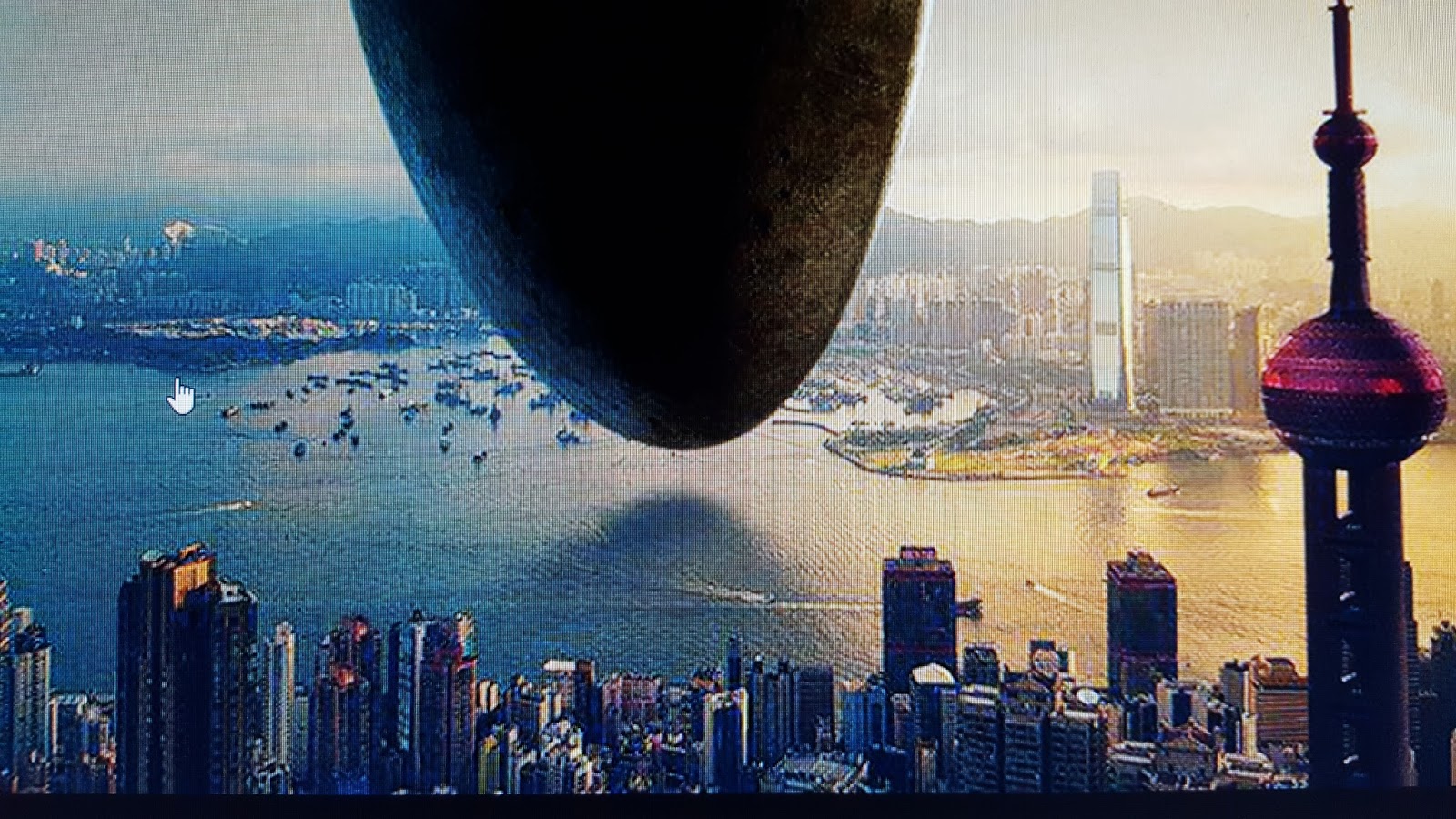
So it's not Independence Day. Even though the enormous alien pods that arrive, and hover over, various Earthly destinations are, in places, reminiscent of the spaceships in that movie. They've also something of the 2001 monolith about them. In fact whilst a highly original film (based on Ted Chiang's The Story of Your Life) there are plenty of nods and winks for aficionados to look out for. Close Encounters, ET, The Day the Earth Stood Still, War of the Worlds, and even Lost in Translation.


Amy Adams is excellent as a linguistic expert who's pulled from a lesson teaching the roots of the Portuguese language by Forest Whitaker's Colonel Weber to work on a top secret mission trying to decipher the messages being received from the pods and whatever it is that lurks inside of them.

She's taken to a verdant Montana valley where she's teamed up with Jeremy Renner's Ian Donnelly. He's a military astrophysicist and, in a welcome change, he very much plays second fiddle to Adams's Louise Banks. Her backstory is fleshed out with the use of flashbacks and heartbreaking interludes of her formerly idyllic life where clearly something went wrong (though not wrong enough for her to lose her stunning house). Renner's character is given no such breadth and, good though he is, has to be content with the role of foil, sidekick, and will-they/won't-they love interest.


Forest Whitaker's great - but then he usually is. His weathered features excellently conveying a seen-it-all listlessness completely at odds with his character's power. He walks a fine line in reconciling those (like Adams and Renner) who wish to take time to learn to communicate with the visitors and the more faceless, militaristic voices of both the US and other nations that are being visited.

This is where the film tries to have its cake and eat it. Whilst wholly commending its message of working together as people, and countries, towards a common goal the film then rather disappointingly, if potentially accurately, lays the blame for the more bellicose responses on the door of the usual suspects.


To be fair, and to avoid spoilers, it makes a good save on this front. Even if it didn't it certainly wouldn't have ruined a suspenseful and intriguing piece of storytelling. There's very few action sequences (more puzzle solving than anything) but the special fx hold up well. Even if the shots of the world's news anchors with their 'Breaking News' flashes is fast becoming the modern equivalent of those once ubiquitous spinning newspapers.

It's beautifully shot at all times, wonderfully acted, particularly by Amy Adams who is rarely off the screen, and it makes you think a bit, makes you do some work. Villeneuve seems to have the knack of effortlessly straddling the thankfully/hopefully fading line between blockbuster and art-house. Which is just as well as he's remaking Blade Runner next!


Sunday, 20 November 2016

Toy:Clouds that cover the sun.

It's become a yearly, or six monthly, pleasure, to visit Brighton for a night out with Toby and Darren. We saw Cate Le Bon doing her own rather splendid thing in the summer and this time we had tickets for local lads made good Toy and their homecoming gig at the Haunt down by the pier.

I was no expert on the band but I'd heard, and enjoyed, several of their tracks on YouTube and elsewhere. I had slight reservations about them as I do about many psychedelic revivalists. I'm ambivalent about shoegazing, too, and they certainly have elements of that. Krautrock, however, I'm a big fan of and in the drumming of Charlie Salvidge there's certainly traces of Neu. For this he's forgiven for having the haircut of an East German footballer from the early eighties.


I'd arrived in Brighton late afternoon and after a quick, and tasty, pint downstairs in The Pond pub we moved upstairs to the Sing Tong Thai. I had holy basil tofu with egg fried rice. It was the first Thai food I'd had for ages and, onions aside (I'm no fan), it was delicious and had exactly the right level of spiciness. It's a pity I've only discovered this place now as it's due to close in January and I'm unlikely to be in Brighton again before then.

We couldn't glean any information on who'd be supporting Toy or what time the bands would be on so we arrived early, about eight, to find we'd missed most of JC Flowers' set. Which was a pity because the two and half songs we heard sounded highly promising. Darren was so impressed he bought the album on leaving the venue. He managed to resist splashing out £20 on a limited edition Toy 7"!


The oddly named JC Flowers were a studious, vaguely gothic, looking bunch. Guitarist Noel Anderson perched on a chair facing away from the audience making Issie Spurgeon undoubtedly the focus of attention. Her voice haunting and intricate. I'd make comparisons to Liz Fraser of The Cocteau Twins but that's probably crazily high praise. Either way they seem like an interesting prospect and I'm certainly curious to hear what they do in the future and to have a listen to the album next time I'm round Darren's place.


Watching Toy reminded me of countless gigs I'd attended in the late eighties and early nineties, usually in The Boston Arms or The Electric Ballroom. Blokes in black t-shirts making a glorious racket with their guitars whilst the whole thing remains underpinned with a fey sensibility and an aloof, though unthreatening, demeanour.

Charlie Salvidge and bassist Maxim 'Panda' Barron would probably not be permitted on those stages with those haircuts in those days. Barron divided me and my friends. Whilst I'd not want to sport his hairstyle I was actually quite enamoured with his stage antics, mane shaking, and bass hero theatrics.


It both complimented, and stood in counterpoint, to vocalist/guitarist Tom Dougall's more studied cool. A cool of the indie school. On some songs, most specifically, I'm Still Believing from new album Clear Shot, he carries the air, and the voice, of a young Stephen Pastel.

Where they forge ahead of other contemporaries mining C86 and late sixties rock for inspiration is, as mentioned earlier, in the incorporation of a drum style ripped from the Klaus Dinger textbook. It propels their better songs, Motoring for example, with a juicy, impatient urgency.

Max Oscarnold, who replaced Alejandra Diaz in the band last year, also adds Another Dimension to their sound. Not so much in terms of tunes but in texture. His whirrs and clicks giving a band that could sound a little retro a more forward looking feel.

The band didn't seem too happy with the sound throughout the gig. They were constantly asking the engineer to turn the vocals up and, though I didn't notice any problems, I wondered if this meant they were perhaps a tad below par. There were a few songs that dragged a bit and I came out having witnessed a good, rather than a great, gig. Which was a pity as they've got all the elements, the sound, the looks, the attitude in place. I'm fairly confident they'll raise their games and write some more absolute killer tunes in the future. I'd love for them to make their fourth album their classic.


The gig finished at 10 so The Haunt could clear up the crushed up cans of Red Stripe and host an eighties revival night. Having lived through that decade I felt no need to stick around. We retired to the nearby Cricketers pub for a nightcap before turning in. A highly satisfying evening.

Thanks to Darren for picking up the tab on the meal and for Toby, Cheryl, Saffron, and Estelle for putting us up and for the posh chocolate spread on toast for breakfast. Another great trip to Brighton.

Sunday, 13 November 2016

Theatre night:Every Day I Wake Up Hopeful.

Full disclosure. John Patrick Higgins is my friend. We grew up in the same area. We spent many, too many, nights in the pub together. I went to his wedding. I hadn't seen him for over four years but I was certainly looking forward to reacquainting myself with him when I attended the second night of his Every Day I Wake Up Hopeful at the Leicester Square Theatre last night.

So I may not be entirely impartial. But I'll certainly try. I was never gonna write a puff piece but I was worried that if it was shit I'd be in an awkward place. But what if it wasn't just good but great. Then I'd be jealous of the bastard and not for the first time either. The git's even looking handsome, in an elder statesman kind of way, these days. See below for evidence. Of sorts.


He made a very wise decision in getting Irish stand-up Christian Talbot to deliver his words. Christian may've tripped up over a few of them but, that aside, his delivery was as on point as anyone could've hoped for. He effortlessly embodied John's, and my, and many of ours, mixture of despair and eternal, often unfounded, positivity.

Almost every twist of the monologue sought both to solve, and dissolve, the duality of our very human condition. That of being part of the human race and yet, somehow, always feeling apart from it. I laughed. I nearly cried. I heard echoes of many of my friends in John's words and Christian's delivery. In fact I looked around the room and saw those very same friends sat there undoubtedly feeling the very same thing.

So it works if you know the author and you warm to the actor. But would it work if you didn't? My friends Pam and Kathy came along. They don't know John from Adam but they both told me they'd been impressed. Even mentioning they'd paid big bucks to see major West End shows that hadn't had half the impact this did.


Impact it certainly had. Like anything it took me a few minutes to warm to the theme. But when Christian started pouring the wine out and pouring out his memories and heart I felt like I was in a room with a troubled, but engaging, friend. Fuck it. I WAS in a room with a troubled, but engaging, friend. Meditations on suicide, cancer, and alcoholism struck notes so close to home I nearly rang my mum. If I couldn't identify with eating chicken nuggets or hating football I could very much identify with the all too human condition, the mix of clarity and utter bewilderment at what life can become, that rang out throughout the entirety of the hour.

And it was humanity that rang out the loudest. Despite some pretty near the damned knuckle pontifications this was a dance with the devil that for every flirtation with the dark side always remembered that, in the words of dearly departed Leonard Cohen, 'there is a crack in everything that's how the light goes in'.

So, yeah, I was jealous of John but more than that I was proud of him. About 25 years ago I wrote a review of his band in which I described him as a 'rag doll Morrissey'. He's never let me forget that. So I'll bastardise one last Morrissey line for him. I love it when my friends become successful.

TADS #8:Walthamstow Marshes (or Itchycoo Park in the November Rain).

Before we'd even started our last TADS walk of 2016 I'd decreed that it'd been our best year of walking ever - and it had been. Despite the shitstorm of Brexit and Trump. Despite the deaths of Bowie, Prince, and Leonard Cohen. Despite the endless lurch towards right wing idiocy. Despite everything we had each other and we had these Saturdays to live for.

In St Albans we'd learnt what a lustrum was. In Henley-on-Thames we'd gazed out at the expansive blue of the Thames. We'd seen animals more accustomed to the African savannah in Woburn Safari Park. The South Downs Way was so good, and so wet, we spread it out over two days. The same thing applied to our visit to Royal Tunbridge Wells. I can't say, in all honesty, we were ending the season in style but we were ending the season traditionally. Walking round one of London's less glamorous areas in the drizzle. That's how we roll. In the November rain at least.

I was up bright and early and I took the Overground to Dalston Junction and walked to Hackney Central. Pam and Kathy were on good time but Shep, Adam, and Teresa were suffering, in Shep's oft-repeated word, a major 'ballache' on the train. Adam was winding Shep up with the idea that I was sinking a Kronenbourg in the pub as they sat outside West Byfleet. If he'd said Doom Bar Shep may have exploded.


For some reason Kathy was lugging around a complimentary candle from John Lewis so we took a pew in Oslo and once we'd all gathered our baggage and thoughts we began the walk proper. It's worth noting here that only Pam and Teresa took alcohol (in the form of rather delicious looking glasses of red wine) at this juncture.

We headed down Mare Street past the Hackney Empire (where I'd once seen Danny Baker present a variety show) and the Ocean (now a 'Spoons but once the site of fondly remembered Calexico and Asian Dub Foundation gigs). The town hall looked spiffing - even in the rain - and we cut a right, not the one the book recommended, and headed into London Fields.


London Fields is famous for its heated lido but today that wasn't an option. Broadway Market was bustling. Full of tasty goodies. Pie'n'mash in Cooke's was considered and then rejected because we were running to a tight schedule. Pity. We must do another trip one day but if you think Charles Bukowski runs a tight ship then you haven't met me.


It was after Broadway Market we picked up the water. Slipping on to the  Regent's Canal (a branch of the mighty Grand Union) we got an eye full of gasholders and we loved it. Well, I did. Narrowboats were rendered with loving care and paint and named after mums, daughters, and lovers. They always get me.


The canal weaved it's way through luxury flats, oddball art fantasia, Mosul inspired pumpkins, bridges, and tunnels. Coots, moorhens, and Canada geese came out to play. We all came out to cruise about in Itchycoo Park. Itchycoo Park, of course, being Victoria, Vicky, Park where some of us had attended Field Day, ran 5k races, and got generally leathered in the past.


It seemed odd to see canalside cottages that looked like they belonged in the marginalia of the home counties rather than the urban dystopia of Hackney. But it felt right. The artworks, as we moved further East, got weirder, odder, and more pretentious. It wasn't long before the London, once Olympic, stadium came into sight. Pam and I had taken a guided walk here in the summer and knew a little of the area. I'd revised the history of the walk using this here blog and bored my fellow walkers with facts I'd genned up on. They're lucky I didn't fill them in with details of Pedro Obiang's transfer from Sampdoria.


It was here the Hertford Union, which had been the Regent's earlier, turned into the River Lee Navigation. Neither a river nor a canal but in some ways both and clearly less gentrified than where we'd come from. It was a long stretch and the drizzle and grey continued. Relentless. The umpteen football pitches of Hackney Marshes sat, spookily, unused, in the dank fog. The changing rooms looked a likely setting for a ghost story.


From there we headed into Walthamstow Marshes. Through subways seemingly architecturally designed for mugging and, past the sewage treatment plant, into the 'Stow itself. The market spread on for an infinity. Luckily they weren't taking it down. The atonal clang of dismantled market stalls creates, in my head, a noise akin to the torture of chipmunks. I don't like that.

We, and by we I mean BOOK, had earmarked The Nag's Head in Walthamstow Village for a jar but the walkers were wet, tired, and, in some cases, pissed off. So we chose a closer option. The Victoria. Victoria had seen better days but wasn't without charm. Discreet and seedy but somehow just right. On entry I half expected some stripper to be strutting her stuff on the green baize as men popped pound coins in to a pint pot. In reality the baize saw pool only. A man sat on his own and watched Wales play Argentina in the rugby. My round of six drinks was about £20 and they all went down pretty sharpish.

We took the Victoria line to Finsbury Park, swapped to Piccadilly to Leicester Square, and met Rob, Damon, Darren, Cheryl, and Stocksy in the Tom Cribb before visiting Woodlands Indian Veg for a curry. Shep never got his bangla and I, for some weird reason, had a cheddar cheese'n'jalapeno dosa which wasn't very Indian at all.

The crack was good and it was going to get better. The vast majority of us were off to the theatre but that's a whole different blog. We only had a little time to reflect on the TADS walking season and my reflection was that it'd been a bright bright light in a year full of shite. It'll be a pity to leave it until March but I, for one, cannot wait to start again. I thank everyone who's joined us on these walks for making a dark world a lighter place.

Friday, 11 November 2016

Fleapit revisited:Tear the Roof Off - The Untold Story of Parliament Funkadelic

There have been so many members of Parliament/Funkadelic, so many offshoot bands, so many alter egos, so many egos even that to tell their story in its entirety you'd probably need to stretch it out over a couple of box sets. It's something to suggest to Netflix or HBO.

So props to Bobby J Brown for trying to condense it down to an hour's length. Ideal for that Friday night BBC4 music documentary slot but enjoying a brief cinema run as part of London's Doc'n'Roll film festival. Brown has worked more as an actor than a director in the past. He'd appeared in The Wire and also in John Water's Pecker. A great pedigree but other than the city of Baltimore it's hard to see much in common or much that would lead him to the funk.

Tear The Roof Off starts off as a fairly conventional documentary. Telling the story of how George Clinton and his childhood friends in Plainfield, New Jersey form a doo-wop group called The Parliaments. They travel to Detroit to get signed to Motown and then cheat on Motown by having a huge hit in 1967 with (I Wanna) Testify on Revilot Records. It's the first example of George Clinton taking over as bandleader and svengali.


After that the chronology goes a bit haywire. It's not adequately explained how these besuited smart young men mutate into the freak show that becomes the p-funk organisation. Nor how their doo-wop sound becomes more soulful and ever funkier before eventually morphing into the ultimate in funk rock experiences.

The music you hear throughout the film is, of course, absolutely excellent.The run of albums Funkadelic put out throughout the seventies stands shoulder to shoulder with anybody else. Not just in funk but in all music. From 1970's self titled debut, via Maggot Brain, America Eats Its Young, Cosmic Slop and on to 1978's One Nation Under A Groove they forged a sound, an image, and an ethos that was like nothing that had gone before. Or, indeed, since.


They went a step further by inventing their own mythology. Populated by characters like Sir Nose D'Voidoffunk, Rumpofsteelskin, and Starchild. The latter of these worked for Dr.Funkenstein, the intergalactic master of outer space Funk. Funk was spelt with a capital F as it's the source of all creative energy on Earth. Sir Nose, being too cool to dance, intended to place humanity into the Zone of Zero Funkativity but Starchild is on hand with his Bop Gun to achieve Funkentelechy for all humanity and everyone, even Sir Nose, starts dancing.

With all this going on, and words like supergroovalisticprosifunkstication, thumpasorus, and trombipulation being bandied about you won't be surprised to hear drugs were involved - and lots of them. Ludicrously large amounts. At one point Clinton, who by now was running the whole show, was paying band members in drugs. You may've wanted money but drugs were what you got.


It's here where the story, unsurprisingly, turns a darker corner. Addictions destroy, and even end, lives. The girls (and in many cases they are girls, not women) recruited for the band are treated abysmally, bordering on abuse in some cases and in one example crossing right over that border.

Clinton becomes a dictator. Pocketing royalties and keeping his bandmates hooked on drugs while living it up in his lakeside mansion in Michigan. While they were so high you couldn't get over it some of his behaviour was so low you couldn't get under it. How the fuck he managed to preside over such a huge rotating line up of musicians, many of them hopelessly addicted, while maintaining a gargantuan habit himself is a wonder of nature.

Perhaps due to Clinton not coming out of this well he's not there to represent himself. Bootsy Collins is another glaring omission. But the makers of the film have been able to secure interviews with vital musicians like trombonist Fred Wesley, drummer Jerome 'Bigfoot' Brailey, guitarist DeWayne 'Blackbyrd' McKnight and bassist Cordell 'Boogie' Mosson who died in 2013 giving us an idea how long this film's been in the can.

The talking heads interviews with these guys and the vintage live footage are easily the best parts of the films and luckily there's plenty of that. The seemingly endless anecdotes are in turns insightful and hilarious. Occasionally both. The historical reenactments fare less well. They look a bit daft and in a film where a man appears on stage wearing a nappy, another runs around the street wearing a fox mask, and George Clinton exits the mothership with his dick out behind bemused guest Sly Stone that's saying something.


For somebody who was new to the band, the mythology, and Afrofuturism as a whole the film may be a bit confusing, potentially alienating. For someone who's been an admirer of the band for decades like my cinema date Tony there's very little new for them. For someone like me, I own four or five albums and have been meaning to get a few more, it's pitched just about right.

If you're in the former two camps I can recommend the film to you. If you're with me in camp three then I'd say it's close to a must see. You could wait for it to show up on BBC4 but as another friend, Ian, said "you need to see the Mothership on the big screen" - and you do too.