Sunday, 24 February 2019

The London LOOP. Part XIV:Chigwell to Harold Wood (Essexual Healing).

I didn't expect to be eating alfresco in February, I didn't expect some of my fellow walkers to be worried about sunburn this time of the year, I didn't expect to see croci flowering on the Essex hillsides before the clocks go forward, and I didn't expect to be eating my end of walk meal nearly fifteen miles from where the actual walk ended - but these are the mysteries and surprises often throw up on the epic walk, now nearly completed, they call the London LOOP.

It had been a pretty emotional couple of weeks. I had been preoccupied (and greatly concerned) by the health concerns of one of my oldest (and closest) friends as well as those of a dear and much loved family member, I'd been worried about my own, increasingly penurious, existence and my own health, I'd been drinking too much, I'd been eating crap, I'd been upset by the continuing (and deepening) catastrophe of Brexit and the far right fervour it's given way too, and I'd been sleeping abysmally.


So, to put it mildly, I was looking forward to getting the ol' walking boots on again, catching up with friends, and hitting (for the fourteenth time - not including aborted attempts) the LOOP. I was so excited I was up before 5am which gave me plenty of time for Cornflakes and chores before making the relatively quick (if involving FOUR changes) journey to Chigwell, bumping into Pam at Woodford along the way.

On arriving in Chigwell we briefly kidded ourselves we'd actually beat Shep to the start of the walk. Of course, we hadn't. We soon received a WhatsApp message informing us that him and his workmate Tom (a firm Liverpool FC fan and one from the area too) were having a coffee in the nearby Village Deli. A place Marvin Gaye would surely have described as "hot just like an oven".


We picked them up and headed off up Chigwell High Road, past apartments that looked as if they should be facing out to the beach, past increasingly large houses (ones that didn't so much boast of taste or architectural prestige, but cold hard cash), and up to St Mary's, described as "a typical rural Essex church" with a "weather-boarded belfry" and "a broach spire". Most amusing to us was the fact that the rector was a Reverend Ben King. Please turn to page 444 in your psalm books and join me in a recital of "Stand By Me".


Just across from the church stands what used to be the Kings Head pub. A fairly large timber-framed building that seems to lean precariously into the road. It's where, when Chigwell used to lay deep in the forest, the Verderer's Court used to meet but it now houses a top end and, I think, Turkish eaterie called Sheesh.

The next building of note was the brick schoolhouse founded and endowed by one Samuel Harsnett in 1629. Harsnett, once the area's vicar, made it to Archbishop of York and that's perhaps not a surprise when you consider pious, or pompous, statements such as this one describing his conditions for future occupancy of the schoolhouse. The occupant should be "neither papist nor puritan .... no tippler, haunter of alehouses or puffer of tobacco, but apt to teach and severe in punishment".


That ruled all four of us out so, instead, we dipped through a hedge, crossed Vicarage Lane, and climbed up into the Essex fields along farm tracks and beside hedges. The sun was high in the sky and was illuminating vistas more spectacular than you'd have thought possible on the outskirts of Chigwell. It really was a beautiful day for it. One of those days where conversation and laughter flow easily and wrong turns don't matter much because nobody is in much of a rush.

We rambled along Pudding Lane (seeing the first of the day's more irregular signs), passed by a waterworks, and came out on Chapel Lane where the yellow brick chapel had been described in our trusty tome as 'charming'. That's allowing a fair bit of artistic license but it was pleasant enough. In a municipal kind of fashion.


As well as unorthodox signage another feature of the day's walk became damaged signage (some tipped into nearby ditches, others defaced, and some simply no longer there) and peculiar gates and stiles. Though none as odd as the one Tom recalled Shep opening with his chin during an outing by one of their other walking groups. One we tend not to talk about on here. Lol!

We read a little history about Hainault Forest. How it never found local defenders like its neighbour Epping and, after Parliament gave its consent in 1858 over 100,000 trees were felled and the land drained and fenced, how it is now a shadow of its former self and, thus, much much less famous than Epping.

It still seemed a pleasant enough area though. We ambled over Chigwell Row Recreation Ground with its swings, roundabouts, and tennis courts and took in the view of the Victorian church and the boarded up Maypole pub before crossing the busy A1112 Romford Road and dipping between two 'squeeze-posts' (see!) and through a kissing gate into Hainault Forest County Park. Where we got lost. Not for the last time. It's part of the LOOP experience. There's no point complaining - and none of us do/did.


Once we were back on track, cutting through some felled trees and overgrown shrub, Hainault Forest Country Park proved a delight. Shep, unlike the rest of us, was unimpressed with Woodhenge but he was cheered up, as he always is, with the sight of an impressive amount of waterfowl on the lake. There were swans (upping), coots, moorhens, mallards, tufted ducks (misidentified by me as pochards), and geese. Hundreds of geese. Making quite a noise. One Shep thought sounded like Tom and his mates in the pub before a Liverpool game.


The lake, and the birds, were beautiful but, perhaps, better still was being able to sit outside the Global Cafe (a surprisingly diverse menu, though Tom was unlucky with his orders, for a parkside cafe) for our brunch/lunch/whatever you want to call it. I had cheesy chips and a veggie hot dog (not proper hot dog sausages but plenty of tomato sauce from an impressively stocked condiment corner sorted that out) while I sipped a cappuccino. Children kicked balls. Birds flew overhead. All felt well with the world.

It took us a short while to get back on track and there was no sign of the advertised Millennium Beacon (the book is getting old and some things aren't as they're described) but the sun was only getting brighter and the great expanse of the country park made for an impressive sight. After a few forested hills we opened out into a golf course (as regular a feature on the LOOP as it on some TADS walks) and took an overgrown path through the Mile Plantation (that seemed to almost involve hurdles at one point) to avoid being struck by the errant balls of a wannabee Sam Snead.
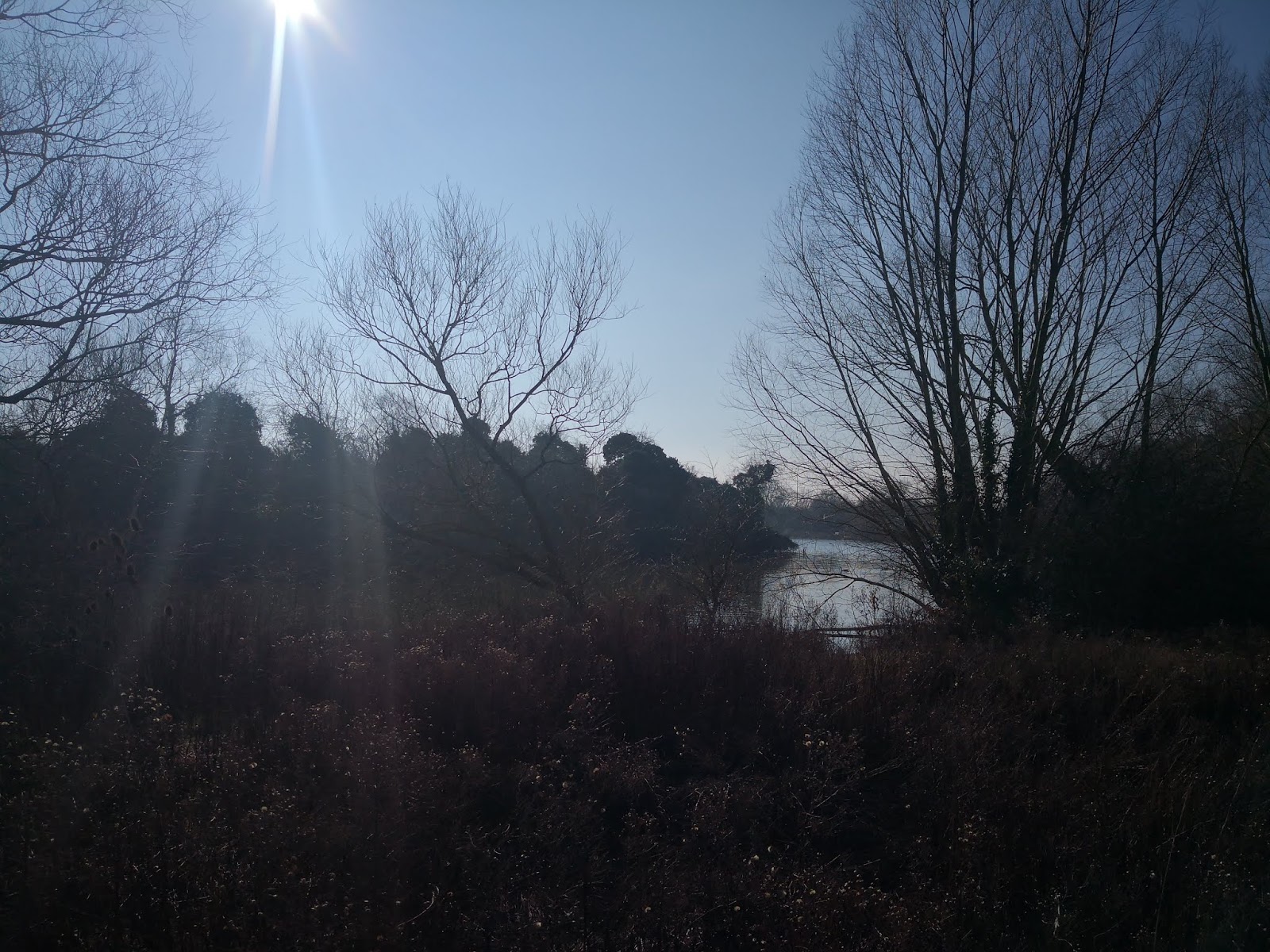


Once we came out from beneath the canopy we were afforded views of Havering Country Park and, beyond, a Romford tower block reminding us that we're not so far from civilisation after all. If Romford can be called civilisation, that is!

Children rode horses along muddy bridleways and farm equipment sat idly on its weekend break as we trudged along a difficult path, occasionally stopping to look back at the hazy views of the London skyline. So hazy was it that if you squinted you could kid yourself you were in LA.


After a reasonably stiff climb, one that had me regretting the donning of my winter coat, we turned right into a broad avenue where soon we were flanked by giant sequoia. I didn't even know we had these in Britain but, apparently, Havering Country Park has England's second largest collection.

Also known as redwoods, or wellingtonia, they became 'fashionable' (can trees be fashionable? guess so) after the Californian Gold Rush and these were planted here not long after to make for an impressive entrance to the no longer there mansion of Havering Park. These trees are about 150 years old and they're still pretty huge but to see how big they've grown in California then you should check the photos recounting the trip Simon and I made back in 2016 on this little blog here.


The wellingtonia lined avenue brought us out past an old church (where I think I may once have been best man at a wedding), an unlikely burger van, and expansive views across the Roding Valley to the pretty Essex village of Havering-atte-Bower. One that looks like it should be far more rural than the Romford outpost it really is.

On the village green we took a look at the stocks and the whipping post but these days the worst punishment you can get is a pint of Courage Best at The Royal Oak pub. According to Shep and Tom, anyway. They took theirs back and got a Moretti like me. Pam took a Guinness. The landlady and her friend had, it seemed, the best idea. They sipped cups of tea and ate buttery toast as France beat Scotland in the Six Nations on the television.

On a sunny day like this I'd been looking forward to a summer ale (they didn't have any, lager sufficed) and a beer garden (they didn't have one, we sat inside) and, for such a pretty village, the pub was underwhelming. We laughed at how much their Charles II (behind a fruit machine) looked like David Mitchell, perhaps working through some ideas for a pilot of Upstart Crow.


On leaving the pub we noticed a car (bearing the numberplate G666WAR, Satan's War?) had crashed outside while we'd been resting our legs and we took a little snicket round the back of the garages, sadly no discarded porn - the internet is destroying British culture, and continued through various fields full of almost stationary horses and past some iron gateposts (not quite as 'magnificent' as described by Sharp & Saunders) that once graced the entrance to Pyrgo Park.

As ever, there was some GPS (and map) consultation to keep us on track and we even met a fellow London LOOP walker (an anti-clockwise one) who we briefly exchanged rambling anecdotes with before dipping down into Paternoster Row, a peculiar collection of heavily fenced properties, ramshackle cottages, and static caravans.

This lead us down a slip road and to The Bear pub on Noak Hill. Famous, you can discover, for once having real bears in cages there. Something for the kids to play with it while you drink. There's no bears there now - and, again, very little ale. Or even decent lagers. It looked nice outside but, truth be told, it was a bit tatty within. Not unpleasant but hardly a place to settle in. I had a Carlsberg, there was more rugby on TV, that says it all. Essex pubs, at least so far, don't seem to do ale. Or character.


It was starting to get dark when we left and we wandered into a field of heavily antlered, and twilit, deer. Right in front of suburban homes. Not sure I've ever seen deer in such an unlikely environment before.

They watched as we passed by and as the skies darkened our pace got brisker. Eager now to reach our final destination. The last hour was a pretty straightforward schlep along a pathetic brook, crossing various roads, skirting brutalist playgrounds (thanks, Pam), and traversing Dagnam Park Drive, Central Park, and Paines Brook Play Area before, quite suddenly, reaching Harold Wood.


The (King) Harold pub did not look good. It was as brightly lit as a fast food takeaway joint and as we pondered our next move we were approached by a local lady, out in her slippers, who told us it was horrible and that a kid had died there recently (something confirmed by a brief Google). She went on to tell us there were no nice pubs in the area and that the only Indian restaurant was awful too (though Bombay Palace smelt good to me). She said not to go to Romford on a Saturday night because that was terrible too. It's fair to say she didn't work for the Harold Wood tourist board.

There was a bus replacement service so we hopped a bus to Newbury Park, took the Central Line to Liverpool Street (a journey so dull I ended up talking about biros), and all got off there. Pam, who was struggling to stay awake after a White Denim gig on Friday night and a stressful week/month/several years of work, said goodbye and headed off to Shepherds Bush for a night of Ukrainian music and Tom, Shep, and myself wandered circuitously towards Brick Lane. We had a pint in the Pride of Spitalfields and then I had chana masala, tarka daal, pilau rice, and a chapati (washed down with a nice cold Cobra) in the Brick Lane Brasserie. As with most places on Brick Lane it was serviceable, it was decent, but it was not outstanding. Shep and Tom had never eaten on Brick Lane before so I thought I'd give them the full tourist experience and they weren't let down there.

Legs tired, belly full, they left for Aldgate East and, eventually, Waterloo and I headed to Whitechapel to catch the Overground to Honor Oak Park. When I got home I'd walked nearly 37,000 steps and I was in bed before midnight (which is far from always the case on the LOOP). The day may have been a long one but, for me, it had been both a good, and a much needed, one. The title of this blog, Essexual Healing - I ask you, may be corny but sometimes in life the corny things are what matter. Friendship, laughter, countryside, and more condiments than you could ever wish to consume.

Next time it's the final stage of the LOOP. The book claims it's thirteen and a quarter miles from Harold Wood to Purfleet but we're psyching ourselves up for many more. Maybe we'll even find an Essex pub that serves decent ale. In the meantime, TADS resumes in a fortnight for a stroll from Gomshall to Dorking and it'll be great to see as many old (and new) faces as possible. Last year's season end walk got messy but, this time - at least in March, we're gonna do it clean (know what I mean?). See you soon.


Thursday, 7 February 2019

That's the Spirit:Dr Romany Reagan's Partial Guide to Spiritualism.

"A fool sees not the same tree as a wise man sees" - William Blake.

Dr Romany Reagan's talk at this week's Greenwich Skeptics in the Pub, The Victorian Seance:From the Occult to the Gin Parlour, was a densely packed, if not complete - that'd be near impossible, history of the heyday of Spiritualism, how it rose, and how, for the most part, it fell. It took in a cast list of characters that stretched from William Blake to Emanuel Swedenborg to Aleister Crowley and it covered themes as seemingly disparate as drunkenness, Americanness, and female liberation.

Although, as Dr Reagan was keen to point out, those last three things are not as disparate as they may seem. She claimed she managed to cover all three in just one person. Which was a little unfair on herself, she wasn't drunk (though the red wine she was sipping did look good) and she'd obviously been able to hold it together long enough to receive a doctorate from Royal Holloway in "performing heritage with a focus on community engagement", curate a series of four audio walks for Abney Park cemetery, and to put this quite long presentation together.

One that took us, initially, back to a time of Thomas Edison and an age of great scientific discoveries. Discoveries that transformed lives by harnessing previously unseen energies like electricity. These things seemed almost magical and led to wild speculation of what might be possible. Once Charles Darwin had comprehensively disproved creationism, some felt the ideas of Spiritualism provided solace, filled, if you must, the God-shaped hole.

The basic tenet behind Spiritualism was that spirits of those who'd passed away could communicate with the dead via mediums. It differed from mesmerism because that was a theory that claimed there was an invisible nature force that allowed communication between all living things (human, animal, and even vegetable) whereas Spiritualism was about contact with the dead.


The most famous early practitioners of Spiritualism were the Fox sisters, Maggie and Kate, who lived in upstate New York. In 1848 (when they were both teenagers) they found they were able to make weird noises by clicking the joints of their feet and, for a prank, fooled their mum into thinking there was a ghost in the house.

This trick proved to be so effective, or the locals were so gullible, that soon visitors were coming to the house just to witness these siblings who, it soon became believed, could bring messages from the dead. Maggie and Kate's older sister, Leah, started to smell money and soon she was working her sisters for commercial gain and the concept of Spiritualism started to take hold as copyists sprung up in the states of New York and Massachusetts. 

Over in the UK, the US was still viewed, contests Dr Reagan, as an inferior copy of the mother country and its new craze of Spiritualism, therefore, could only be an inferior version of whatever belief was popular in Britain at the time. Women, too (in Dr Reagan's not particularly controversial view), were also viewed as inferior versions of men. As most of the Spiritualist mediums were female it meant the whole thing, to the British establishment at the time, reeked of inferiority. 

The idea began to be promoted that Spiritualism had fostered insanity in America (certainly women were being incarcerated in lunatic asylums) and there was a fear that this madness may cross the Atlantic and arrive in London. Instead, London saw the rise of an 'intellectual' Spiritualism inspired by Swedenborg take hold. One that harked back to the writings of William Blake and Rosicrucianism. 


Although both Blake's art and his poetry are so fantastical they could be open to a wide array of interpretations, the gist that the British Spiritualists took was that Blake, when he wasn't banging on about 'psychogeomancy' and 'mysticism', saw the world as a sensual place, a place experienced as much in the mind as in the body. He believed what happened in your mind WAS reality. He said "what seems to be - is" and that "a fool sees not the same tree as a wise man sees".

The philosopher and novelist Colin Wilson, in his studies of Blake, claimed that occultism, in general, regarded women as evil and even believed that women had had too much power over the last 1,800 years! The perceived faults of women were that they thought intuitively rather than logically and that they can't see long term. Men suffered by being unable to see short term. It's all Men are from Mars, Women are from Venus stuff and, frankly, it's bollocks.

The Marquis de Sade and Aleister Crowley rallied against the idea that the female need for security was, somehow, stifling male creativity. Not just creativity but the kind of rampant individualism that is doing so much to damage the social fabric now (it's probably no coincidence that the New Thought movement, which was followed by a young Donald Trump, should crop up). Whilst Spiritualism was, on one hand, all about social improvement this was completely undermined by its drive towards an individualism that thrived on the distrust of others.


There were further dualities at play and dichotomies unresolved within the Spiritualist world too. How did the misogynistic beliefs of Crowley and de Sade square with the campaigning for female rights? How could a movement that claimed to be about social improvement harbour so many drug and alcohol abusers?

It was the women who got the most shit over this, society being what it was (and, for the most part, still is). It was said that some of them "tipped bottles as often as they tipped tables" but some context is needed. In 1875, which went down at the time as "the most drunken year on record", being pissed out of your head on gin for most of the day was not uncommon. As it had been in London, if we're to believe Hogarth's Gin Lane, for well over a century.


While some Spiritualists railed against the use and abuse of alcohol (especially in the hands of delicate women), others, including the Fox sisters, took to it with, at first, gusto and then, latterly, with some shame. Young female Spiritualists who'd been on the sauce were said to be allowing unmarried men to fondle them and dance with them.

It all sounds like terrifically good fun but the drinking didn't stop when the fun stopped. Kate Fox died in 1892 aged 55 and her sister Maggie a year later aged sixty. Both of them deeply damaged by cocaine and alcohol abuse. Although their father had been an alcoholic there is also the suggestion that the stressful lives they led as public figures, forebears of a new movement, exacerbated the problem, as did the constant exposure to boozy seance parties.

In many ways it seems as if the Spiritualists were the rock stars of their day. They offered entertainment, salvation, and hope to their followers but themselves suffered lives of solitude, boredom, pressure - all things that would make drinking oneself into oblivion a tempting proposition. It's worth noting that most of the Spiritualists were of working class stock. Something that wasn't necessarily the case for those that promoted Spiritualist events. The rich knew where the money was.

Towards the end of her life, Maggie Fox denounced Spiritualism, saying it had been a fraud all along and that she felt guilty to have been one of its original perpetrators - though she couldn't know how far an innocent prank on her mother would go. The Spiritualists who had taken the baton on from her and ran with it said she couldn't be trusted. She was a mentally ill drug addict and therefore not dependable in the slightest.

As if to prove them right, she later retracted her denunciation. The motivation for this remains unknown but it didn't really matter. Spiritualism had moved far away from the Fox sisters clicking their joints and was now big business. They'd become a footnote in their own movement and they were both buried in pauper's graves in New York.

Within thirty years or so the game was up for most Spiritualists. So many mediums had been exposed as frauds that the public just weren't susceptible anymore. Of course, new fakes and phonies came along to fill the void. Eventually people like Derek Acorah and Uri Geller. These people, too, are constantly being debunked but like weeds in your garden, new strains keep reappearing. It seems the public don't mind a bit of woo if it makes them feel comfortable or if it reinforces what they already believe but that woo needs to be ever changing. 


Dr Reagan's talk didn't really draw any conclusions on why that is or even if that's a good or bad thing but it was, despite going over some ground that had been covered at previous Skeptics and Fortean events, an interesting and worthwhile hour of my time and the illustrations of phrenology heads and the coda in the Q&A about a 1990s seance in Clerkenwell's House of Detention (a place I'd love to visit) were very much in the spirit of the evening. An evening in which I neither drank spirits nor conversed with any.


Wednesday, 6 February 2019

Shirley Collins:Repent, Repent.

"So repent, repent sweet England for dreadful days draw near" - Shirley Collins.


A lot has happened since Shirley Collins played the Barbican back in February 2017. Both politically and personally. While that gig had the air of a celebration (I described it at the time as "a bit like an episode of This Is Your Life") with special guests, a fuller band, and all the pomp and circumstance the Barbican infers, last week at the Roundhouse saw a much more low-key performance. While it, perhaps, wasn't quite as memorable evening, it was, it's probably fair to say, a more honest, more folkier event.

Of course, there's always the possibility that my slightly lukewarm appraisal of this major talent and her fantastic songs is tempered by the fact that my evening was fueled by nothing more powerful than chocolate ice cream! Apart from the tasty halloumi burger and fries in the delightful Camden branch of Mildreds where I met my gig companions Mark and Dane beforehand.

It was the first time Shirley had appeared at the Roundhouse since a performance with Deep Purple and The Edgar Broughton Band fifty years ago, Shirley delighted in telling of the bemused faces of many of the heavy rock fans in the audience faced with Shirley, and her sister Dolly's, rendering of a selection of folk favourites.


Well, a lot may have changed in two years - but in fifty it seems not so much. Because this gig was, of course, an evening's rendering of folk favourites. After Rattle of the Stovepipe's introductory set of old American tunes, spoon playing, and musicianship so proficient it belies the slightly befuddled expressions of the slightly elderly gentleman playing it, it was time for Shirley, her compere Pip Barnes, Ossian Brown and his hurdy-gurdy, Ian Kearey, Dave Arthur, and Steve Coooper (the latter two both members of the aforesaid Rattle of the Stovepipe) to take the stage...


...and it's that hurdy-gurdy that we first hear. Setting a mounrful tone that will last for the next hour or so on The Split Ash Tree, we're led through a set of tunes from Lodestar and elsewhere in Shirley's career but it's noticeable that, at eighty-three years of age, she's delegating occasional vocals to some of the guys in the band this time.

It's understandable, I'd probably rather be tucked up in bed with a cup of cocoa should I reach that age, but it does rather suggest her return to live music may not last much longer. That's a real pity because when Shirley does sing, as in the broken hearted Pretty Polly or the sparse Death and the Lady's tale of a "poor distressed maid", a "tombstone", and the "cold earthen clay", she's still in fine voice. In fact, any weakness in the voice proves, oddly, to be a strength. These are songs that have been lived and felt and, therefore, it needs a voice that has lived and felt to do them justice.


When Glen Redman comes on stage to do some very energetic, almost aggressive, morris dancing and Shirley blows him a little kiss, it's a sweet moment but, in some ways, it's a reminder that the Shirley Collins live experience has been downsized. At the Roundhouse we were treated to an entire morris (and a molly) team.

Last week's gig worked better during the occasions Shirley and the band stuck to the songs. Songs like Barbara Allen which are very much Shirley's meat and drink. Haunting reflections of love lost and, yes, lovers lost. Lost to war, lost to rivals, and, yes, lost to death. If there was a little something missing from this performance it didn't need to be covered up (and it rarely was - witness Shirley, at one point, forgetting her words and having a sweet laugh about it) but instead made a focal point. The Barbican gig may have been a great one, this was merely a very good one. That's enough sometimes.


Thanks to Mark for sorting the tickets for this gig and to him and Dane for the company. Was nice to bump into Rachel as well.

The Age of Consent:Myles Jackman's Fist of Fun.

"Age verification sucks but you can now watch fisting and watersports" - Myles Jackman.

Over the years I've heard (and said) quite a few alarming things at London Skeptics in the Pub but Myles Jackman's sign off to his talk, The Obscenity Lawyer:What's the Truth Behind Age Verification? was right up there. Luckily, it was very much in context with his excellent, enlightening, and humorous forty five minute speech. One that had my eyes watering in places. For a variety of different reasons.

Recent political developments meant the talk began with something of a proviso. Last Thursday, parliament voted to change the law on age verification for the Internet so instead of the talk now being just about age verification, Myles was going to extend it to include some background on obscenity law and how it works. I'd seen him talk about obscenity law before and knew that he was both incredibly knowledgeable about it and that his delivery came with a side order of dark humour. Which seems appropriate considering some of the subject matter.

Myles Jackman does not look like your typical lawyer. He looks more like a roadie for Grinderman with his Batman t-shirt, customised Doc Martens, and unkempt beard - and he peppers his delivery with smutty asides and swearing to highly amusing effect. Even when a pissed Polish guy in the audience asked him a question in Polish he batted him off with both charm and imperturbability.

He began the evening by explaining that criminal offences relating to obscenity come under two distinct categories. Possession and distribution. If you own some illegal pornography you're committing a possession offence and if you send it to anyone else you're committing a distribution offence. But what is obscenity? How is it defined?


It's been a grey area ever since the publication of Lady Chatterley's Lover in 1928 and it's not getting any clearer now. Obscenity is defined as something that is either depraved or corrupt. Images that, if seen, could actually corrupt the viewer or send them into a spiral of depravity. Which sounds like fun. But it proves to be something of a movable feast, very dependent on modern standards.

The old list (up until last week) of depraved, corrupt, obscene, and therefore illegal pornography included sexual acts with animals, realistic portrayals of rape, fisting, urine drinking, dismemberment or graphic mutilation, torture with 'instruments' (I don't think they mean forcing a flute up someone's bumhole), certain types of bondage, and hardcore sadomasochism.

Although, as Myles was quick to point out, it doesn't include CIA waterboarding or ISIS throwing LGBTQ+ people to their deaths from towers. Those things are more acceptable to share because they're just violence, rather than sexual violence. So even obviously faked violent sexual acts can get you into more trouble than actual deadly violence. In terms of sharing videos, at least.

Jackman seems quite eager to talk about what he describes as his "two favourites" - fisting and water sports. He points out that the law accepts that both vaginal and anal fisting is legal (four fingers, apparently, isn't fisting - that's the rule of thumb) but representation of it, or distribution of images of it, is (or was) illegal. It's kind of the obverse of the old Doug Stanhope observation that prostitution is illegal in the USA except if somebody is filming it. You can pay people to have sex to make pornography but not for personal pleasure.


Now, fisting and pissing on each other have joined the old permitted list of acts like oral sex, wanking, anal sex, vaginal sex, and mild bondage. There's a general consensus among libertarians that if it's legal to do it, it should be legal to share images of it - providing there is consent from all parties and that they're old enough to consent. Which is covered in law anyway.

But, often, confusion arises. A man in North Wales, one of Myles Jackman's clients, was arrested for making a pornographic film of a tiger having sex with a woman. On closer inspection it became obvious that it was actually a man 'wearing' a tiger skin rug. Something that's certainly odd - but something that wouldn't look very much like a real tiger. 'Necrobabes' videos, too, have caused people problems - even though these were proven to be faked, and very obviously faked.


Now, some of these kinks are undoubtedly unpleasant ones to have (Myles Jackman urged everyone present not to, under any circumstances, Google BME Pain Olympics) but if it's just people acting (even acting dead) should they be illegal? What about Twink pornography? Twink is the gay equivalent of Barely Legal, youngish looking guys but ones that are actually above the age of consent.

Cartoon pornography can be illegal if it involves a child so, in theory, you could draw a stick man with his badly drawn willy out next to a smaller figure and get your collar felt. The way round it, Jackman claimed, was to say the smaller figure was Tyrone Lannister from Game of Thrones and not an actual child. Then you're in the clear.


After digressions into simulated rape porn, QUILFs, how the description "filthy, loathsome, and lewd" sounded like a great album title, and the news that most of Myles's clients work in IT (they tend to think they can hide their porn - they can't), we came to the news that now harm caused during the making of grot needs to be at ABH levels to be illegal. Needles and mild cutting are now fine and, a rectal surgeon had been to able to confirm to Myles, anal fisting is unlikely to cause long term harm (though he did add the caveat that a shotgun up the arse is dangerous).

As anyone who's looked at porn (most of you I expect) will know it's not difficult to get around current age verification. You just click on a box and you're in (if you'll pardon the expressions) but now, with the more liberal approach to more hardcore pornography, age verification is to be tightened up (again, pardon the expression). But that's not without problems. Lots of them.

In a world of multiple content providers, multiple ISPs, blocking orders, VPNs, and proxies it seems like it will be pretty easy, if you're determined enough, to get around any new age verification software. Look at the catastrophic shitshow that is Brexit and ask yourself if you really believe this Tory government will be able to put anything workable in place.

PornHub (a large internet porn provider, so I'm told) have estimated that between 20,000,000 and 25,000,000 UK citizens will sign up to their services within the first month of the law changes. That's a lot of wankers and a lot of wanking. Imagine all that energy being put to use elsewhere!

There are also concerns that age verification software on porn could be a taster for other online transgressions and perceived transgressions, so there are worries about personal liberties. Personal privacy too. Once the proposed age verification measures are in place (many of them outsourced, of course) this could act as a huge data mine. You may be annoyed that Facebook knows your voting intentions but PornHub and xHamster will have a very clear image of your sexual inclinations and proclivities.

The law has been passed and will be rubber stamped this month. It's expected to come into play in April but it's not even remotely fit for purpose, it's totally unworkable, and it will have an effect on freedom of speech - but it's unsure what that effect will be as yet.

It seems to me while we're concerned about the age of consent we must be careful not to forget that we live in, and always have (and always will), an age of context. In Australia, one of their plans to stop child porn being disseminated was using an algorithm that looked for small breasts. So, if small boobs (on grown women) were your thing you could be investigated as a potential paedophile.


Another amusing example of the grey areas regarding legality (and in the Q&A, Myles offered people the chance to play a little game called "Is my porn legal now? - one in which he proudly declared not only is his personal favourite porn legal but he had been responsible for legalising it) involved picking mushrooms in a Royal Park. That act is illegal so if a film featured a consensual couple fisting each other and then pissing on each other's faces that would be perfectly fine unless, in the background, someone was seen picking mushrooms in Hyde Park. That act would render it illegal pornography!

It's a fascinating area and it must be a fascinating, if often disturbing, job that Myles does. Luckily he was able to share stories with us without breaching any laws. I learnt, I laughed, and, somewhat oddly, I listened to Prefab Sprout's When Love Breaks Down before Myles took the stage. Another great evening from London Skeptics in the Pub.