Monday, 20 June 2016

Offa's Dyke day 10:When I Get To The Border.

It wasn't the fault of The Royal Oak hotel in Welshpool. I slept well in their big comfy bed. They popped a copy of The Guardian under my door at 7am as requested and the buffet breakfast was bounteous.


No, the problem was all mine. After breakfast I returned to bed and listened to the cars hiss by my window. I felt lethargic and demotivated, a little sad even. You're not supposed to feel like that on the first day of your holiday. Then it hit me. I was massively dehydrated. I'd taken beer the night before and had a cuppa with breakfast but no water for about 18hrs. That's not like me. I normally guzzle the stuff.


So I got my pack on and headed out. It was raining. It was pissing down. Almost immediately I took a wrong turn out of Welshpool. Through a housing estate and to a dead end.

Returning to the very busy A483, no pavements and lorries speeding by, I saw a sign saying I was 16 miles from Oswestry - and I was taking the scenic route.


Finally I picked up the path proper. Good to catch up, Offa. It followed a particularly meandering and picturesque stretch of the Severn with occasional detours along the Montgomery canal.


I saw rabbits, a speedy hare, lots of sheep as usual, and nearly as many cows. Lambs micturated in tribute as I passed them. I witnessed both bovine and ovine excrement. One cow, clearly the GG Allin of the livestock world, stood right in front of me as if to afford me a medical view of shit coming out of her arse.

There was shit everywhere - and flies feasting on it. I don't think I stood in any. The view from above was better. The sun had come out.


Cows appear to have two different approaches to intruders on their patch. Most slowly amble out of your way. Some of them stand in your path and stare you down. Make you change your path. That gives you the willies. They're big fuckers. I don't think there were any bulls but I removed my red jacket just in case. One snorted at me. I had a quick check. I've never been so relieved to see an udder.


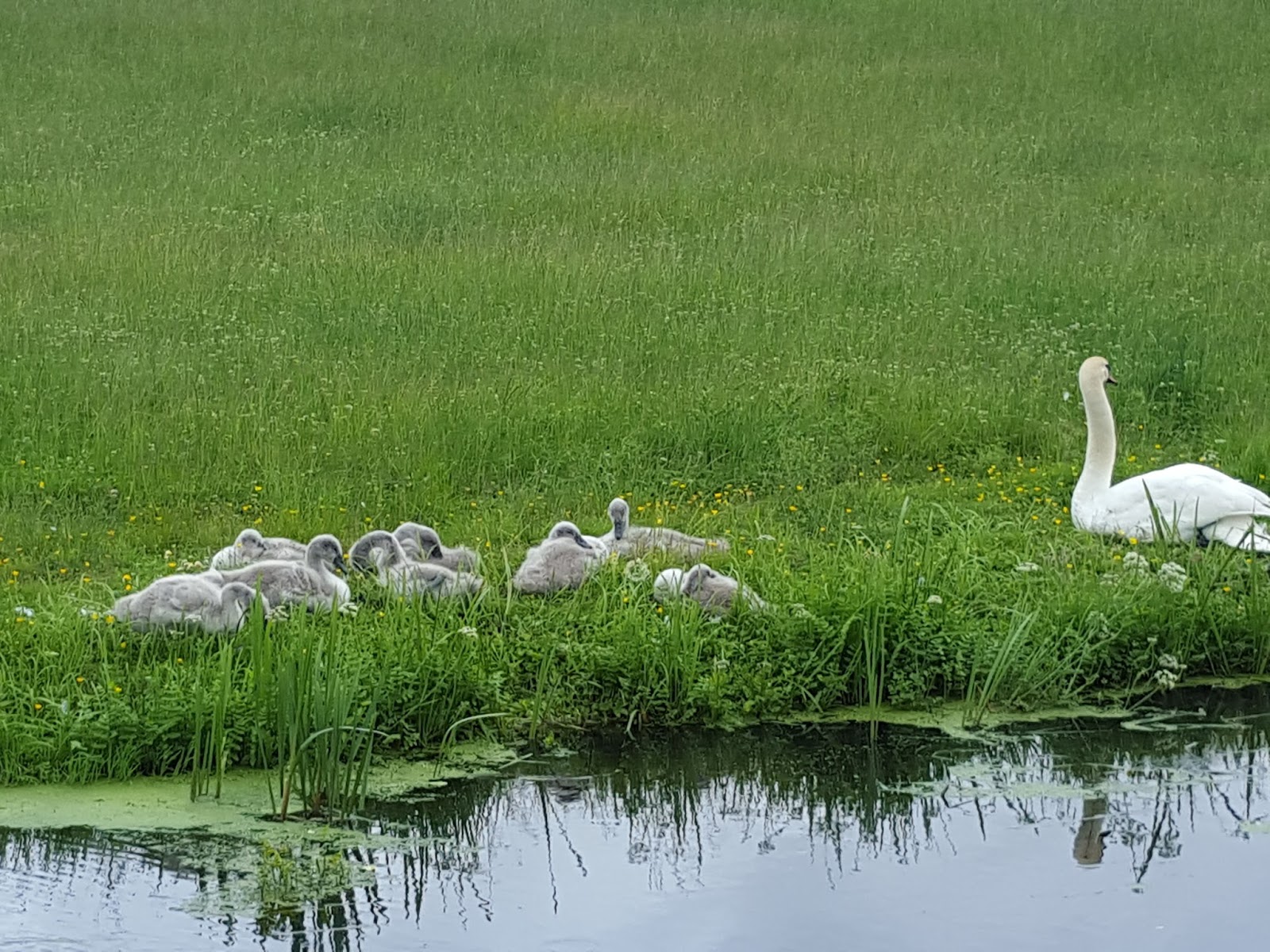
The wildlife highlight of the day wasn't the cows or sheep. Nor even the hare. The unidentified green insect was good but, for cuteness alone, the pen, cob, and eight cygnets chilling out canalside take the plaudits. Awww.


Kissing gate followed kissing gate followed kissing gate. The Powis Arms, walkers and dogs welcome, looked enticing but it was 11:45 and it's not a 'Spoons.

I walked a few miles in the shadow of the imposing Breidden Hill. Topped by Rodney's Pillar.


Just before 2 I reached Four Crosses. A small village but the biggest place I'd seen since Welshpool - and it had a pub. The Golden Lion. Ale it said. Food it said. CLOSED it said. Bloody typical.


A sign said 4 miles to Llanymynech, a place I knew nothing of, so I took it. Back on the Montgomery canal I crossed a stunning aqueduct over a wide Severn tributary. It was awesome.


I arrived in Llanymynech about 3, mums were on the school run, and with my squelchy wet socks starting to blister my tootsies I thought it'd do for an overnight stop.

Oswestry was another 2-3 hours on foot and off route to boot. I grabbed a pint of Stonehouse brewery Station bitter (2013 National Beer competition award winner) in The Cross Keys and enquired about a room. They had one. I took it.

In the bar I chatted to a lady who'd done Offa's Dyke twice, once in each direction, with her six year old son. It made me realise how doable it is and what a wuss I can be.


Llanymynech straddles the English/Welsh border. In fact one side of the high street is in England and the other in Wales. Back when Montgomeryshire was dry, we're talking booze of course, on Sundays thirsty Welsh drinkers simply crossed the road to wet their whistles.

Lions to the east. Dragons to the west. It seemed an apt spot to hole up and watch the England and Wales Euro games. The tasty pint of Three Tuns pale ale in The Dolphin confirmed it.

Tomorrow it's back on the Dyke.  For now it's supporting the country I live in and the one that gave me my name. C'mon England. C'mon Wales.


Sunday, 19 June 2016

Walking backwards to Florence

The V&A's Botticelli Reimagined exhibition begins with brief excerpts from Terence Young's 1962 Dr No and Terry Gilliam's 1980 Adventures of Baron Munchausen.

Both films contain nods to Florentine Renaissance artist Sandro Botticelli's Venus and it's a cute way to begin a backwards journey to 15th century Tuscany and the era of Botticelli himself.

The slightly self-satisfied conceit is that it's a show about what has been done to Botticelli since his death in 1510 as much as it is one about what he did in his lifetime.

Botticelli's a good artist to do this with as, unlike Raphael and Michelangelo for example, he was pretty much forgotten for 300 years before the Pre-Raphaelites began the process of reinstating him to the canon.

So we start with modern riffs on his style. A rather boring Bill Viola installation inspired by his Story of Nastagio degli Onesti, a Jeff Koons album cover for Lady Gaga's Artpop, and a Dolce & Gabbana trouser suit utilising the Birth of Venus.


There are car wheels, coins, Rineke Dijkstra beach photos, and Tomoko Nagao's parody with its pointed digs at consumer culture.


David Lachapelle's Rebirth of Venus isn't shy about repositioning Venus's shell for maximum erotic mileage and even Warhol adapted Botticelli to his own ends. His legacy was nothing if not versatile.


If Lachapelle doesn't do it for you see how you feel about Joel Peter-Witkin's God of Earth & Heaven, Los Angeles. Yes, that's a dick.


Yin Xin made Venus Asian. Cindy Sherman donned false nose and lactating breasts. Alain Jacquet incorporated the Shell logo and Robert Rauschenberg's tribute was more figurative than we'd expect from the artist.


Bob Dylan's Sad Eyed Lady of the Lowlands plays as you take in ORLAN's striptease, Edward Baird's seaside surrealism, Wadsworthian, Venus, and Magritte's Ready Made Bouquet.


Magritte, with tongue possibly firmly planted in cheek, said he preferred the postcard to the actual painting. Dali gave Venus a fish head. Of course he did.

The soundtrack to the rooms devoted the Pre-Raphaelite rediscovery comes courtesy of Debussy whose Printemps was inspired by Botticelli's Primavera.

Alongside the many copies and book illustrations by the likes of Aubrey Beardsley, Gustave Moreau, John Ruskin, Ingres, and Degas we can see film of Isadora Duncan dancing. Inspired, she claimed, by days (days!) spent in the Uffizi staring at Primavera.

The paintings include Walter Crane's gauzy Renaissance of Venus (1877), Dante Gabriel Rossetti's earnest Day Dream (1880), Ingres' classicist La Source (1820-1856 - it took him 36 years?), and Edward Burne-Jones' watery Luna (1872-1875).


A William Morris tapestry and an Ettore Ximenes sculpture usher you to the final third of the show. Renaissance Florence itself. One for the purists.

Botticelli was the son of a modest tanner. Many of his commissions were for the 'powerful' Medici family. After the Dominican friar Savonarola (imagine a Tuscan Da'esh, slightly less obsessed with death) and his rampant religious revivalism gained ascendancy in Florence Botticelli revised his style. Coward. This possibly contributed to the loss of his reputation.

Few works are definitively attributed to him but there's some in the V&A. Portrait of  Lady known as Smeralda Bandinelli (1470-1475) was owned by megafan Rossetti. Burne-Jones had The Annunciation with Raphael & Tobias. Prince Johann II of Liechtenstein gave The Virgin and Child with Two Angels (circa 1490) to the Academy of Fine Arts in Vienna for study purposes. Good lad. The tondo (Italian translation:round) form is always satisfying. Let's hope the Viennese students appreciated it.


The only signed and dated work is 1500's Mystic Nativity. It dates from the Savonarola era and includes cryptic references probably alluding to the religious upheavals of the time and the expulsion of the Medici from Florence.


If you can read Latin you can read Vasari's thoughts on Botticelli. If you can understand Italian you can listen to Dante's Divine Comedy. I can do neither so best to exit with his mythological masterpiece Pallas and the Centaur and, after all those fake Venuses, the real thing. The Botticelli Venus. She's got it. Yeah, baby, she's got it.


Play out classical, I've never felt better in my life (Oh, Vienna).

Classical music has never affected me on the same gut level as pop, rock, reggae, hip-hop, soul, funk, and many other 'popular' genres. I've never been offended by it. I've enjoyed it often. But, on the whole, it's been on a more academic level than, say, New Order or Eek-A-Mouse.

So I was interested to watch Revolution and Romance:Musical Masters of the 19th Century on BBC4 recently. I expected to learn stuff from it. For it to be an 'improving' experience. I didn't expect it to be quite so much fun as it was.

A lot of that is down to presenter Suzy Klein. She clearly knows her stuff and can play a bit too. She doesn't bombard the viewer with technical information but focuses on telling the story. Always ready with a humorous or telling anecdote and a game girl too. Witness her pulling faces, barking like a dog, getting the crisps in, and getting excited over making her first recording. She's got nice hair too. I think, as the series progressed I fell a little bit in love with her!

We begin in Vienna, then capital of the Habsburg empire, at Beethoven's funeral in 1827. Less than 40 years earlier Mozart had died unlamented in the same city but by the time Ludwig Van passed on he was a 'celebrity'. Suzy's bought enough tat from Viennese shops to prove it.


Whilst Mozart had been buried in a common grave the obsession with Beethoven was such that the day of his funeral was declared a national holiday and a gravedigger was offered money to cut his head off so someone could have it for keeps. As an ornament I guess! What had happened between 1791 and 1827?

The French Revolution had unleashed a spirit of democracy across Europe. Aristocractic privilege was waning (although it's still bloody here even now) and it was becoming possible to succeed on the basis of merit and talent. How novel!

In 1803 Beethoven had written Eroica celebrating the heroic Napoleon. It opened with a thunderclap as if to say "Shut up. Listen" before going on to celebrate ol' Boney's achievements. Beethoven was later disgusted when Napoleon declared himself emperor and took on the trappings of those the revolution had removed. So much so that he withdrew his dedication. Suzy claims this as a turning point in the history of music. It now had a meaning beyond pure entertainment, beyond serving wealthy patrons.

Middle class audiences (not the poor, not yet) could attend Theater an der Wien enabling Beethoven further freedom from the elite. Liberty to make musical, rather than commercial, decisions. On a freezing December night in 1808 he staged FOUR hours of music which included his monumental fifth symphony. He was full of confidence. His music was bold. We're used to it now but placing yourself two centuries back you can imagine 'the shock of the new'.

The new bourgeois class (it hadn't become an insult at this point) of Vienna wanted more. Schubert , who died aged just 31, gave them it. He'd grown up in a building with 16 other families. He was nicknamed The Little Mushroom and wore his glasses in bed. A great musical eccentric who, in his short life, wrote more than 600 songs.


While Beethoven dealt with grand ideals Schubert looked at the messy business of what it is to be alive, to live, to love. His salon recitals became places of subversion and debate. They were like pop up gigs. Most of his songs even lasted about three minutes.

After the fall of Napoleon there'd been a clampdown on political expression in Vienna. Schubert was targeted by the cops. Music had become powerful. Composers were being compared to the likes of Goethe and Byron.

Berlioz, over in Paris, was the the wildest romantic musician of this wild romantic age. When on holiday in Italy he heard a girlfriend of his was being unfaithful. He boarded a carriage with a gun and some strychnine with the intention of killing her, her lover, and finally himself. On the way, however, he got distracted and went to Nice to write an overture. As you do.

He had more luck with a later love. So smitten was he by British Shakespearean actress Harriet Smithson that he went on a four year long stalking campaign. She eventually formed the basis of his Symphonie Fantastique. A story that included the murder of Harriet and Berlioz's execution. All of which took place entirely in Berlioz's head. In real life, instead of notifying the authorities, she married him. Well played, Hector, with your silly Donald Trump hair.


Composer's currency was on the rise. Performers too. None more so than Niccolo Paganini, the Keith Richards of his day, whacking out the South Bank Show theme tune on his violin at breakneck pace. The speed metal of the romantic era. People thought he was in league with, or even that he actually was, the devil. He was happy to play up to this. Refusing to remove his shoes in public to encourage the belief that he had cloven hooves. Another rumour circulated that he'd murdered his wife and used her intestines to string his fiddle. He wasn't just mad, bad, and dangerous to know. He could play a bit too. Ricochet bowing. Fast bowing. He had an armoury of tics and moves. People fainted at his gigs. It all made him a very rich man indeed.

Giaochino Rossini was richer still. The Croesus of the Adriatic was more famous than any of the others too. At the age of 36 he retired and lived the life of a glutton for forty years. He had the body to prove it. He was one of those lucky bastards who can knock things out in a trice. It took him only three weeks to write The Barber of Seville and he wrote 39 operas in his short working life. He boasted he could set a laundry bill to music.

Music had become such big business by the mid-nineteenth century that theatres would pay audience members to laugh (that smug knowing NFT laugh), weep, or blow kisses.

A backlash to this commercialisation came in the form of Robert Schumann who, hypocritically, used the gains of his more famous wife Clara's celebrity piano recitals to fund his broadsides against celebrity culture. He was also a music journo and attacked both banality and virtuosity. He hated Rossini. Imagine if he met Simon Cowell?

He doesn't sound a lot of fun to be around and, indeed, his marriage was described as 'tricky'. Nevertheless the Schumanns knocked out 7 kids. Secretly he wanted to be a star like his wife. So desperate was he he'd plunge his hands into the abdomens of freshly slaughtered animals which he believed would improve his playing. Not sure why. It didn't work and, worse still, the mercury he was taking for his syphilis was killing him.

For the first time ever, though certainly not the last, musicians agonised as to whether they could be both successful and critically acclaimed. Liszt succeeded on both counts. In fact the 1840s saw Lisztomania. It was a real thing. Girls went crazy. Ripping his hankies and stashing his used cigar butts in their cleavages. No doubt fantasising about giving Franz a titwank.


He was to piano what Paganini was to violin. He'd have two pianos on stage and, most nights, one of them would end up smashed up. This afforded a positive symbiotic relationship between Liszt and the piano manufacturers. Steinway wanted him as much as he needed a constant supply of joannas. An early example of product placement.

Liszt went on a European tour where he played more than 1,000 gigs. Like a rock star he had groupies and he took full advantage of them too. In 1857, in Weimar, at the inauguration of a monument to Goethe and Schiller, he set Goethe's Faust to music. It was audacious. Like Radiohead releasing Kid A or something.

Back in France La Marseillaise had become the national anthem of the new French republic. The song had started in Strasbourg, been popularised in Marseille, and had, in Paris, become a rabble rousing revolutionary anthem. It still has power to this day as evinced by its singing at Wembley when France visited for a kick about after last year's Paris attacks.

It seems odd that a national anthem can be seen as a precursor to the protest music of Woody Guthrie and Bob Dylan but even opera flirted with sedition in those heady days. Grand Opera dealt with this by, ostensibly, focusing on historical themes. Daniel Auber's La muette de portici, based on an uprising against Spanish rule that happened in 17th century Naples, inspired the Belgian revolution of 1830 which overthrew Dutch rule.

In the same year the Poles rose against Russian occupation. It was brutally crushed. Frederic Chopin, a sympathiser but a non-revolutionary himself, fled the repressive Russian regime, moved to Paris, and never saw Poland again. He kept with him a small jar of Polish earth. Using mazurkas and polonaises, traditional Polish forms, he gave a Polish kick, swagger, snap, and pulse to the expatriate Polish community. Galvanising and embodying feelings of loneliness, displacement, and (yes) patriotism.

Chopin was buried in Paris but his heart was removed and taken to Warsaw where it was pickled in cognac and buried in an urn. Schumann, as we've established a difficult critic to please, once said Chopin's musical pieces were 'cannons buried in flowers'.

Elsewhere in Europe Germany and Italy were marching towards unification. Carl von Weber wrote a German, pointedly not French or Italian, opera Der Freischutz inspired by Hansel and Gretel and Rumpelstiltskin. This use of folk tales to tell supernatural stories came in the wake of Mary Shelley's Frankenstein. His use of a diminished 7th invented the classic spooky horror chord.

He was an inspiration to the retrospectively problematic genius Richard Wagner who, in 1848, gave up a prestigious job in Dresden to help spearhead an anti-royalist uprising. So far, so good. He manned the barricades. He even made hand grenades. Unsurprisingly this attracted the attention of the authorities so he fled to Switzerland.


He spent 12 years in exile. Nietzsche, Kant, and Hegel fuelled his desire for a socialist utopia but he chose to put down the sword and pick up his composer's pen. He would redeem humanity in Bayreuth. A small town in Upper Bavaria. Specifically in the Festspielhaus. You had to be made of pretty stern stuff to attend. Performances lasted six hours. You sat on hard seats in hot summers and popping out for a pee was frowned upon. People even died there.

But Wagner turned it round. The once wanted exile was, by 1876, shaking the hand of Wilhelm I, the first German emperor. Wagner had lived to see Germany 'born'. On the plus side he was a veggie. On the downside, and it's a very big downside, he was a virulent anti-semite who, after his death, inspired Hitler.

Verdi did similar for Italy. Minus the protofascism, thankfully. Verdi's music was more mournful, less rousing, than Wagner's. Perhaps because his breakthrough opera Nabucco came from a place of deep personal tragedy. Strange then that it should be transformed into an anthem for Italian unification.

The revolution it helped inspire failed, for now, but Verdi's career flourished. La Traviata and Rigoletto dealt with a form of social realism where Wagner had spoken of Gods and monsters. Verdi got minted on the back of it. It also helped that Viva Verdi could be read both as a wish for long life for Giuseppe and as a ringing endorsement of Victor Emmanuel II, the first king of united Italy.

In the 3rd episode Suzy guides us through the technological developments of the age. The Paris World Fair of 1889 had 35,000,000 visitors from around the globe. All that remains of it now is the Eiffel Tower but at the time you could hear music from France itself, Russia, America, Finland, and Norway. But also Javanese gamelan and Vietnamese traditional music.

The gamelan transfixed spectators so that, according to contemporary reports, their ice creams would melt. Once Debussy had wiped vanilla off his shirt he set about changing his entire style so inspired was he by the gamelan. He incorported arabesques and melodies to create musical 'pagodas'. His piano approximated the interlocking of the Javanese gongs. His music broke free from Richard Wagner's overbearing power. They represented softer subjects. For example a deer walking in the forest. There was no melody whatsoever yet it was beautiful. A sort of early form of ambient music?


Music was awakening to the world of modernity. The industrial revolution had provided the transport infrastructure that enabled much larger audiences to attend concerts. Venues, like the Royal Albert Hall, were built to cater for these huge crowds. So awestruck was Queen Victoria on the opening night of the Albert Hall that she couldn't deliver a word of her introductory speech. That night the audience were treated to On Shore And Sea by Arthur Sullivan. Friend and partner of Gilbert.

What Eiffel was to towers and Brunel was to bridges Adolphe Sax was to instrumentation. The Belgian moved to Paris in 1841 and when he arrived in the French capital he was so poor he had to sleep in a shed. He'd already cheated death several times after swallowing a pin, getting burnt in a bonfire, and drinking sulphuric acid.

His saxophone (I guess you saw that coming?) combined elements of brass and wind, flute and trombone, and was seen as an orchestra in one instrument. A very complicated instrument too. It was made, very precisely, of over 800 components. The instrument makers of Paris hated it. They stole his workers, burnt down his factory, and tried to have him assassinated - twice!

Still he prevailed and in 1846 he validated his genius by winning, of all things, a battle of the bands contest which, remarkably, 20,000 people turned up to watch.

The most futurist invention however was Thomas Edison's phonograph. It must've been mindblowing to hear recorded sound for the first time ever. People at the time thought it was a trick. Perhaps involving a ventriloquist. Opera singers were worried they'd be put out of work.

Wider concerns were that society, modern society, was sliding into moral decline. Exacerbated by the opening of the Moulin Rouge. Seedy and glitzy, though tame looking these days, it was said that the Can Can could lead to lunacy and moral degeneracy. Eyebrows were even raised by the waltz. Couples getting that close together was bad enough but the fact it occasionally aroused amorous passions was simply too much for some.

Music and dancing came to be seen as corrupting practices. Particularly, of course, for women. The poor little petals were seen to have nerves too fragile to deal with the maelstrom of emotions that music could stir up. It was even said to have a dangerously adverse effect on the menstrual cycle. Women spent years in asylums, were tortured even, because it was said they'd been driven insane by exposure to too much music.

Despite all this nonsense music gained in popularity. Mass produced and affordable pianos helped this. More and more homes had one. Bad news for the 17,000 elephants slaughtered each year to make the ivory keys.

In 1878 Gustav Mahler moved to Vienna to create music reflecting this modern age. The now. Not the then. Vienna had changed from Mozart to Beethoven and had changed again. There was radical architecture, electric trams, Freudian analysis, cinemas even. These were the things reflected in Mahler's music. Whereas a Beethoven symphony was a journey, often from darkness into light, Mahler's were finely layered collages. Ethereal and dreamlike.

A world away from Richard Strauss who, in 1896, wrote his philosophical and monumental Also Sprach Zarathustra. It was epic in scale and it pushed the orchestra to it's very limits. It used about 100 musicians.

Ten years later no musicians at all were required when 10,000 people turned up to the Albert Hall in London to hear a phonograph. Things were to change again. We'd entered the 20th century and never again would composers have such fame or power. Their legacy though, as this wonderful programme shows, lives on.

So, yes, I did learn something after all. Thankyou.

Wednesday, 15 June 2016

Offa's Dyke days 1-9:Up The Hill And Down The Slope.

Offa was an 8th century Mercian king who, for some unknown reason, built a massive dyke between his kingdom and that of the neighbouring Welsh. It probably had something to do with defence but no-one seems to really know. This, eventually, became the de facto border between England and Wales. It's still there in some in places. Not in others.

What is there, however, is Offa's Dyke Path. A 176 mile hike stretching from Chepstow on the Severn estuary to Prestatyn on Liverpool Bay. With a faint nod to my dual heritage I decided, in 2013, that I'd walk the length of the bloody thing.

I was ludicrously optimistic about how many miles I'd cover in a day. With a heavy rucksack on. Going up and down hills that can't be far off mountains. It became apparent almost immediately that I wasn't going to complete this trek in one trip so I promised to myself I'd keep coming back until I finished it.

The 2013 trip saw me walk from Chepstow to Hay-on-wye. I stayed overnight in St.Briavel's, Monmouth, Pandy, and finally Hay itself. The Wye valley was stunning. The views of Tintern Abbey equally breathtaking. I walked an extra few miles as I got lost leaving Monmouth. I criss-crossed the England Wales border countless times. Much of the time I didn't even know if I was in England or Wales. At Pandy I stayed in a room full of bunk beds that were usually occupied by visiting Scottish loggers.


The owner of the pub (and the digs) warned me the next stretch would be tough. He kindly made me a packed lunch and asked me to phone him when I reached Hay. I thought he was being over dramatic. He wasn't.

I walked up and up until I reached the ridge of the Black Mountains. It was the start of April but it had been a cold winter and spring wasn't proving to be much warmer. I'd seen animal carcasses pecked away by starving birds and I'd seen snow topped mountains on the horizon.


Now I was getting into the snow itself. Totally inappropriately attired I forced my freezing hands into my pockets and trudged along the ridge. For about five hours. The landscape looked almost lunar. I could see walkers in front of me and others behind me. Sometimes we'd pass and exchange brief pleasantries.


Finally I started to descend. This was not easy. It was very slippery under foot. I gingerly placed my feet where I thought they'd be safest. But, eventually, I fell. I've joked to friends since that I'd slid down Lord Hereford's Knob and it wasn't fun. Actually the Knob was nearby and I'd slid a very small distance down Hay Bluff. Just enough to graze my hands and scare the shit out of me.

That was enough for the first visit. I didn't want to be on the news being rescued while people at home tutted. I'd come back in better weather next time. Which, last year, I did. Starting off in Hay I made it all the way to Welshpool. Overnight stays in Kington, Knighton, Clun, and Montgomery along the way. As well as a night in Welshpool itself and, just for fun, stays in Hereford and Aberystwyth bookending the trip.


The place I stayed in in Knighton appeared to be a pub. A pub with no lights on and a few male clientele. It served no breakfast and was run by a very strange lady. When I got to Clun I was told it may've been a brothel!

Then again when I got to Clun I slept in a caravan in someone's back garden. The B&B was full of people cycling Land's End to John O'Groats. It's on the route as I'd already discovered when I met a young lady doing a 90 day walk between those two places. Pissed all over my little stroll. We walked together for a few hours and the time passed quicker with some company.


It can get a little lonely walking on your own for hours on end. I sing to myself. I think about the past. I think about the future. I make plans. Many of which are completely ignored on return to normality.

On arriving at a destination I grab a pint, sort out some accommodation, and get myself some food. I'm normally pretty knackered so, after another pint or two, it's off to bed. Be that in a caravan, a potential whorehouse, or some rather nice hotels. Like the ones in Monmouth, Chepstow, or the almost toytown like Montgomery.


I see far more animals than people. Sheep mainly. The sound of bleating accompanies me through forests, fields, and meadows. One of them even chased me. I got a funny look from a goose and some of the cows looked like they could easily turn should I make a wrong move. The badgers were no hassle though. They were all dead.

Most of the few people I meet are friendly enough. Friendlier than dead badgers anyway. Only the grumpy B&B owner in Hay who pretty much slammed the door in my face, presumably because I had bloody hands and was covered in dirt and snow, was rude. Oftentimes folk will offer me a lift (which frustratingly I have to refuse) or help me out with directions. I get lost a lot.

It's been exhausting and even stressful at times. The rucksack hurts after a while. But it's also been highly rewarding. I'm going back again very soon. I'll start at Welshpool where I finished last time. Again with the intention of reaching Prestatyn. As you can see below I've already passed the halfway mark. I can do this. Surely. There's a pint in Prestatyn with my name on.


Tuesday, 14 June 2016

Square heads, round tables.

I was over at the Frankenstein place. Not the castle overlooking Darmstadt in Germany but the Science Museum in South Kensington. My friend Kathy had kindly invited me to an illustrated lecture on the history, myth, and continuing popularity of Mary Shelley's Frankenstein whose first draft was written 200 years ago in 1816.

So I sacrificed a night of watching Ireland play Sweden and Italy beat Belgium in Euro 2016 for an evening in the IMAX with Sir Christopher Frayling as my host. He was giving an illustrated lecture and there was to be a round table panel discussion afterwards.

We got a Night at the Museum vibe wandering through the almost empty galleries of old space hardware and Stephenson's Rocket. It set the scene nicely. Frayling, too, seemed a good fit. He was clearly very passionate about the book and had made television programmes about it in the past. Clips of which were interspersed with his talk.

A minor quibble was that the whole thing felt a touch too academic. Witness members of the audience scrawling in notebooks like eager students. Observe, also, Frayling's odd forays into the realm of absent minded professor. It's possible he spoke a little too long about the genesis of the book and cut into time he could've been expanding on other themes or chatting to his guests.

The story, nevertheless, was fascinating. Eighteen year old Mary Godwin had eloped to Switzerland with Percy Shelley, eight years her senior and already with a wife back home, and they'd set up home on the banks of Lake Geneva along with Byron, a man whose attitudes were sexist even by the standards of the early 19th century, Mary's stepsister Claire Clairmont, and Byron's physician Dr John William Polidori who went on to write the first published modern vampire story.


1816 was seen as the year without a summer. The weather was shit, basically. Geneva was a walled city and each night the gates closed at 10pm. This gave our party little chance to go out on the town. Percy and Mary refused to smoke as they felt that aided the slave trade. They were also strict vegetarians. Television hadn't been invented so those long, gloomy, Swiss evenings were spent amusing, and scaring, each other by telling competitively macabre stories.

Each night Mary was asked if she'd come up with one yet. Each night she deferred until one evening she told them the story of Dr Frankenstein and his monomaniacal attempt to create life from its raw materials. The others were blown away and soon she was fleshing it out, adding the story of the creature, and working through to its conclusion. Percy helped. That'd be called mansplaining now.


Frankenstein (the book) was a combination of many things happening at the time. A storm as perfect as those that battered their Alpine windows. Elements of Erasmus Darwin's proto evolutionary theories, a nod to Greek mythology in the form of the Titan Prometheus, a debt to John Milton's 17th century blank verse poem Paradise Lost, and possibly some influence from Neuchatel's eerie automatons who, still to this day, will knock out a tune or draw a picture for you.


After several drafts the book was published and became one of those overnight successes that take years. Soon West End plays were taking liberties with the story. They were nothing as to what Hollywood would do with it.

We all picture Frankenstein's monster (no longer a creature but a monster) as the bolt-necked, block-headed Boris Karloff (who was born just down the road from me, outside a doctor's surgery as I found out to my concern when visiting the quack once) but initial drawings showed a romantic lank-haired hunk with a six pack. He looked like one of the Chippendales.


Frayling suggested the popular image of the monster had been cribbed from a Goya artwork (below) which seems reasonable enough. Others suggested the inspiration was from medical books showing severely disfigured humans. Either way, if you're wearing a 'Frankenstein' mask at Hallowe'en it won't be one of Robert De Niro in Kenneth Branagh's under rated 1994 film.


Henry Fuseli's The Nightmare (1781) also became a template for later illustrated versions of the book. Skulls and other signifiers started placing the book in the realm of the gothic horror. Having initially been seen as early science fiction. Later on it became a warning against monomania, a precursor of feminist literature, and many other things to many other people.


That Mary Shelley nee Godwin was able to write a classic in a year of such misery, and at an age when most scholars these days struggle with simply studying the book, is amazing. Percy's wife Harriet drowned herself in the Serpentine. The similarly youthful Claire Clairmont fell pregnant to Byron who proved a useless father, promising to take care of baby Allegra but actually placing her in a Catholic convent where she died five years later. Mary's half-sister Fanny also committed suicide using the method du jour of overdosing on laudanum.

Stories nearly as remarkable as those told in the book. Which, as the lives of those involved in it disintegrated, developed a life of its own. In 1927 Fritz Lang's Metropolis expanded on the themes of revivification and reanimation. Later the Karloff film came out. We were even shown a clip of Bride of Frankenstein. Something Mary Shelley hadn't mentioned at all and something that made the age old mistake of mixing up the monster with the scientist.


On the subject of which Frayling explained that he'd visited a school and asked the kids to draw a scientist. They'd all gone down the 'mad scientist' route. Einstein hair, thick glasses, bubbling test tubes, white coats, and, somewhat bizarrely, Mr Men shoes. He posited the theory that it was the Frankenstein movie mania that started all this.

There was a brief postscript about Frankenstein foods, test tube babies, and other scientific breakthroughs that have, more often than not, shocked the public before he called on Kim Newman (journalist, critic, writer, eccentric dresser), Dr Alice Roberts (anatomist, tv presenter, and owner of a fine Bristol accent), and Ben Russell (the Science Museum's own robot expert).

The chat was all too brief. Dr Roberts suggested any creature would now be built using 3d printers and stem cell research. Ben Russell spoke a little about uncanny valley. The concept where the human psyche likes androids up to the point they start to look too much like us at which juncture we get repulsed by them. Kim wrestled with the untapped potential of Claire Clairmont's story and wondered aloud if there was a book in it for him.

It was just getting going when proceedings were called to a close. I got the impression the panellists, and Frayling in particular, could've chatted all things Frankenstein all night long. He said if there was one day in the history of the cultural world he could go back to he wouldn't revisit Michelangelo painting one of his masterpieces, nor witness JMW Turner tied to the mast of a boat in his dotage gaining inspiration for one of his seascapes, but instead time travel to the shores of Lake Geneva on that night in 1816 and witness Mary Shelley make literary history. He made quite a compelling case for it. Perhaps I should read the book now?