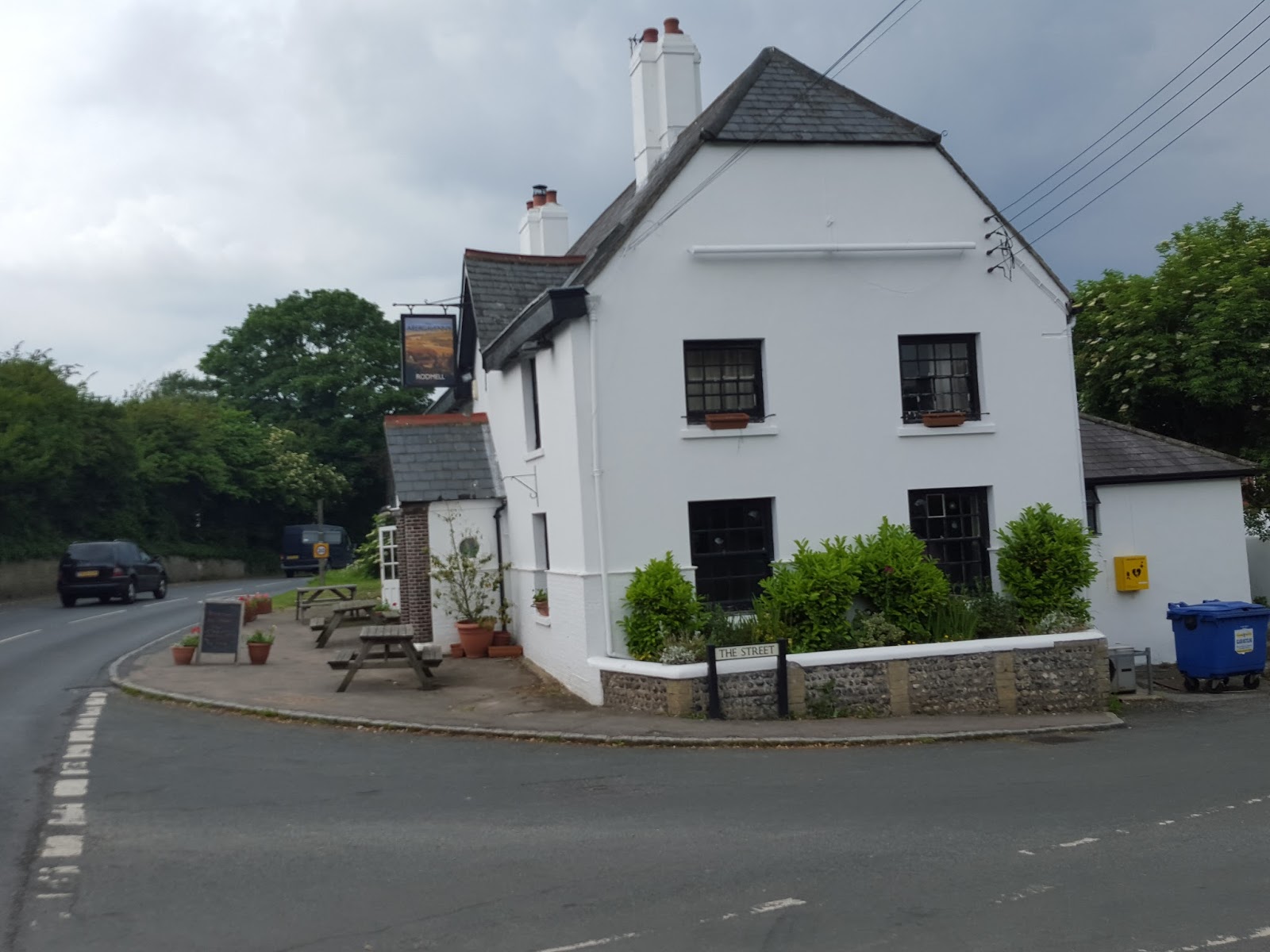
The first attempt at a two day TADS walk may not have seen the walkers reach their destination but it didn't feel like a complete failure. There was laughter. There were sights. There was ale and there is expectancy that the rest of the walk will be completed sooner rather than later.
It's a pity the inclement weather brought an abrupt end to proceedings but it seemed pointless to soldier on past the point of enjoyment. Getting out of breath trudging up a hill is one thing. Pouring water out of your shoe like it's a jug quite another.
It had all started so promisingly too. Reduced in numbers (both of people and genders) to just myself, Shep, and Adam we stopped for a panini and a toastie in Lewes' station award-winning Runaway Cafe. These simple requests took at least four staff, and a great deal of panic, to deal with. But they tasted good and they set us up nicely for the first little stretch out of Lewes.
We were moving so fast we barely had time to register the remains of the Cluniac St Pancras Priory. Under concrete tunnel and over kissing gate we marched. Soon we were in the village of Itford before finally reaching the South Downs Way itself.
Cyclists and several other walkers passed us by but we soon took a detour into Rodmell. Not to see Virginia Woolf's former dwelling Monk's House but to stop for a pint of Harvey's in the beer garden of the delightful Abergavenny Arms.
Dodging, by our own volition, a two pint mistake we headed on to Southease, past the Saxon church, and eventally crossing the Ouse (where, in 1941, Virginia Woolf drowned herself), a railway track, and the busy A26.
From here we started a steep ascent to the ridge of the downs. To the north Mount Caburn stood proud. To the south Newhaven, a town Shep reported unfavourably on, came into clear view. In both directions you could make out the meander of the Ouse. The water, bizarrely, flowing upstream. Is it a tidal thing!?
It was a 10k stretch along the ridge of the downs. Cyclists passed us who'd started 5am that morning in Winchester. We passed cows, sheep, dead rabbits, and the Bronze Age barrows where the Beaker Folk buried their dead. It was a glorious undulating stretch and, mild chafing aside, all was well with the world as we breathed the clean fresh air of the hilltops.
After numerous false peaks we eventually started our descent into Alfriston. The loose gravel on the path proving something of a challenge. I watched Adam skid about but keep his footing. I was less fortunate. I went 'for a burton' and ended up with some minor grazes to my hand and a slightly bigger dent to my pride.
Alfriston is a picturesque village that styles itself as the Eastern gateway to the South Downs and would appear to have a problem with nimbyism. Forget the EU referendum. Forget ISIS. The big story there is the campaign to keep traffic lights out of Alfriston. Didn't realise improved traffic calming measures could cause such concern.
The pubs were nice though. We firstly tried a couple of Hopheads in The George Inn. Adam and I ate there too. Puy lentils with halloumi, shaved asparagus and sun dried tomatoes.
Later we popped over to The Star (directly across the road). There was a wedding reception going on but we nursed another Harvey's and watched England and Russia play out a predictable 1-1 draw in their first game of Euro 2016. Shep, who'd steered clear of the 'poncey' food in The George, had a cheese sandwich. It looked pretty good though - and so it should've been for the price.
We'd booked ourselves a night in Flint Barns, a hotel-cum-vineyard on the outskirts of Alfriston. A jolly fat man from Seaford Cabs drove us out there. We had bunkbeds! The room slept 8 but there were only 3 of us. I slept pretty bloody well.
In the morning we had a chance to look around Flint Barns. What a gorgeous spot. A good place to go to read books, play board games, and sample the local wine. We contented ourselves with a hearty breakfast. Vegetarian sausages, hash browns, fried mushrooms, scrambled egg, and toast. But no beans. Why no beans? Shep, clearly having gotten over the previous evening's aversion to haute cuisine, risked a spiced plum. He didn't like it though.
Breakfast finished we packed our things and set off with the aim of hitting Eastborne some time between 3 and 4. The skies opened up. At first we laughed it off. I optimistically spotted breaks in the cloud on the horizon. Blue threatened to appear in the firmament.
It was a bit of a schlep back into Alfriston before we could even get started on part 2 of the walk. Between the Church of St Andrews (known as the Cathedral of the Downs) and the 14th century Alfriston Clergy House we picked up the course of the Cuckmere river.
It wasn't much of a river. More a brook. More a ditch. I felt like I'd be able to wring more water out of my sodden jeans than was in the Cuckmere. The path was overgrown. There were stinging nettles everywhere. Our clothes were covered in pollen. The weather wasn't improving any time soon. This really was the day the rain came down.
The three of us looked at each other, remembered we'd come here to have some kind of fun, had a quick vote and decided to knock it on the head and come back another time.
Back in Alfriston we took tea and cake (coffee cake for me, lemon and blueberry for Adam) in The Apiary Cafe. So soaked were we we kindly untied the cushions from the chairs before we sat down. When we left there were puddles where we'd sat. Even though we'd all gamely controlled our bladders.
We took the bus to Polegate and, there, picked up trains back to London and Basingstoke. South Downs Way - you have won a battle but the TADS army will win the war. We'll be back.
Sunday, 12 June 2016
Friday, 10 June 2016
I am a camera.
I'd left it fairly late to get along to Tate Modern's 'Performing for the Camera' exhibition but on the Friday before it closed I finally got down there. The concept behind it is that it examines the relationship between photography and performance. Works made by artists who use the camera as a tool to produce their own performative images. From serious works of art to snapshots. To be honest it didn't fill me with confidence but some of the names involved were ones I liked so I gave it a go.
First up we're introduced to artists who've used their own bodies as props. Charles Ray employs a plank of wood to precariously prop himself up. To what ends it's not clear. Aaron Siskind, more interestingly, fakes levitation. Yves Klein (who knew he was a photographer?) does similar with 1960's Leap Into The Void, below.
Although it looks death defying Klein actually had a team of helpers waiting to catch him in a tarpaulin. Klein being involved it's not long before we're shown photos of naked ladies smearing paint all over themselves. Naked ladies and....judo!
There's more boobs, willies and bums too, in Yayoi Kusama's 1968 'happenings'. Her use of polka dot already in place back then. Though, maybe thankfully in this instance, they're less colourful than her later work.
Although credited to Kusama and Klein these photos were mainly taken by Harry Shunk and James Kender, underrated mainstays of the Paris art scene from 1958 to 1973.
Other performance related shots show Minoru Hirata's capturing of the 1970 protests against the Fukuoka World Fair, Marta Minujin (c/o Shunk & Kender again) and her discarded mattresses burning on the streets of Paris, Dan Graham's NYC cityscapes, and some stills from Babette Mangolte's dance events - which you'd probably need to have been at to really appreciate. Or maybe not.
The spectral shapes, lit by Robert Rauschenberg, of Merce Cunningham's choreographed routines fare better. Taken, of course, by Shunk & Kender, they evoke some of the spirit of Man Ray. The dancers certainly seem to have had their Ready Brek.
Gaspar-Felix Toucharon, known as Nadar, didn't wait for a happening or performance to photograph. He staged them purely for this reason. His pierrots are predictably irritating. Sarah Bernhardt kitted up as a character from MacBeth marginally more interesting.
Equally pretentious, though aesthetically more pleasing, are Eikoh Hosoe's contributions. Hosoe and the dancer Tatsumi Hijikata travelled to a northern Japanese village and improvised a series inspired by the legend of a malevolent demon that haunts the countryside.
There's lots of dancing, lots of jumping, more tits (obvs), and some really rather beautiful edgeland photography. Halfway through the exhibition before you see, naked bodies aside, a photo that's actually enjoyable to look at!
Luckily things pick up. The next room alone features Man Ray's Erotique Voilee (1933) and Warhol's Grace Being Painted By Keith (1986). The former showing Meret Oppenheim supposedly evoking the unconscious. The latter Keith Haring making use of an unusual canvas.
People, mostly women, being smeared in paint is something of a leitmotif of this exhibition. Being injected in the eye whilst your head is completely bandaged up less so. But that's the Vienna Actionists for you. Rudolf Schwarzkogler's 3rd Action still has the power to disturb 40 years on.
Erwin Wurm's photos of Claudia Schiffer fixing an orange between her legs certainly stand as a contrast. So much so that poor old Ai Weiwei has dropped his Han dynasty urn.
Ai's action was seen as powerfully provocative in China although it's the action, rather than the photo, that is the real artwork.
Less so in the case of Central African Republic's Samuel Fosso. A highlight for me is his 2008 African Spirits series. They're all him in various guises, mostly of a civil rights bent. The way he manipulates character and takes on multiple roles is genuinely thought provoking.
Cindy Sherman, too, employs 'dress up' creating imaginary publicity shots for non-existent films. Fosso and Sherman both escape themselves and, simultaneously, become themselves. Marcel Duchamp's take on this was to invent a female alter ego and get his mate Man Ray round to take a few snaps.
Andy Warhol and Jeff Koons were others who were happy to use their own image in their art. They brought a flash of colour to proceedings and, in Koons' case particularly, lots of scantily clad women. He even married a porn star. Touched by the hand of Cicciolina.
The rampant objectification of women Koons so readily enjoyed was called in to question by both Lynda Benglis, who posed herself naked wearing a giant prosthetic cock, and VALIE EXPORT who, in 1969's Action Pants:Genital Panic (yes, really) walked into a cinema wearing these crotchless jeans.
Feminists were split over this (is the exploitation of one's own body the same as having one's own body exploited etc; etc;?) as they were over Hannah Wilke's willingness to pose nude. On her own terms and with vague political statements accompanying the end results.
Linder of Ludus took a different route. In a series taken by Christine Birrer she obscures her face using various materials.
Martin Parr doesn't cover his face but stares out at you in full gormless technicolour! His intentionally retouched Autoportraits no doubt making points about banality and uniformity of culture. I liked them when I first saw them but I've grown weary.
In Ekaterina Swiss artist Romain Mader explores Ukrainian 'mail-order bride tourism'. Ekaterina is a made up city so, pleasant though the photos are, it's hard to see the point.
Much the same could be said of many of the works here:- a Japanese man in his bath with a pan on his head, an intensive study of Kant's Critique of Pure Reason, a 100 year old plane tree. All distracting enough but none of them really adding a great deal to the end product.
There's further Ukrainian pretending from Boris Mikhailov. Known more for his grim Russian street portraiture his Crimean Snobbism series from 1982 sees Mikhailov and his wife enjoying a 'holiday'. A fake one. In the way that Soviet citizens were forced to live fake lives. It looks a little clunky now but this show works best when it follows a political narrative.
The biggest pretender here, though, is Amalia Ulman whose Excellences and Performances series of Instagrams from 2014 told the untrue, but only too believable, story of an innocent blonde who moved to LA, got a drug habit, kicked it, before finally discovering healthy living. It's a great spoof of motivational posts and posters and created a lively, and no doubt overheated, debate.
So, overall it was good but it wasn't great. I saw more breasts in a couple of hours than I've probably seen for years. They balanced this out by telling, or half-telling, a story about feminism. It may've worked better if they'd simply done a show explaining how women have moved from in front to behind the camera. How they've taken control of their own images and how far there still is to go on that score. It's possible that the remit for this show was a little too large. A good effort nonetheless.
They say the camera never lies? You'll leave the Tate thinking it hardly ever tells the truth.
Thursday, 9 June 2016
A factory in the desert
It's not often at a gig that every person you make eye contact with is grinning from ear to ear. But last night in Camden's Forge that was just what happened. The responsibility lay squarely with Bombino and his band and the electrifying music they conjured up out of seemingly workaday instruments. Every smiling face seemed to be saying "Yes. This is happening. We're sharing a moment". But what was that moment?
Omara 'Bombino' Moctar was born in Agadez, Niger 36 years ago. Military issues in that country saw two of his band members killed and Bombino himself flee to Burkina Faso. So he's got a back story that Catfish and the Bottlemen probably don't have. He's also got a guitar technique that knocks the cream of the current indie crop into a cocked hat.
He's a man very much on top of his game. If he hadn't been singing in Tamasheq then he'd have been playing to a much bigger venue. Of that I'm sure. It's to ours, the audiences, advantage that he's playing the homely Forge. A venue where one can eat a sit down meal whilst watching the band.
I was in a good mood anyway. It was a beautiful sunny day. I was having a catch up with my great friend Paola. We'd had delicious Mexican food in the new Tottenham Court Road branch of DF. I'd washed mine down with a couple of glasses of horchata. We'd wandered slowly up the Hampstead Road, admiring the art deco Carreras cigar factory along the way, on the way to a Camden Town that felt ready for the weekend, ready for summer, ready for Bombino.
It'd been Paola's idea to go to this gig. I have, for many years, been a big fan of African music but my tastes have tended to lie in western and southern Africa. I'd been able to 'appreciate' northern African and Tuareg music if not always truly love it, really feel it.
So I wasn't totally sure if I'd enjoy Bombino. Doubts were put aside almost immediately. Moctar and his band started off seated. Guitar, bass, conga, and calabash drum. You've got to love a calabash! The fact the bassist was wearing what were essentially orange pyjamas, a straw hat, and thick gloves, and yet still looked cool as fuck was a good sign. Better still was that even the opening salvo of acoustic tracks still rocked pretty hard.
Moctar's surprisingly sweet voice stands as a counter to Tinariwen's Ibrahim Ag-Alhabib's more stentorian vocal technique. It also belies his facial vocabulary of tics and grimaces. Not only can he play a bit. He can outgurn many of your more traditional guitar heroes.
Not being versed in Tamasheq he could, for all I know, have been singing about the slashing of the Sunday bus service from Agadez to Niamey. It mattered little. The unveiling of a Tuareg flag later on in the show suggested, perhaps, a political stance.
Influences came, of course, from his desert blues peers and forebears. There's hints of Ali Farka Toure and a nod to the circular grooves of Tinariwen themselves. But also from much wider sources. You'd be hard pressed not to notice his debt to Hendrix but did I really spot a hat tipped in the direction of Phil Lynott, even the odd mannerism borrowed from Springsteen?
The band have been working with Dave Longstreth of The Dirty Projectors so these Western influences shouldn't come as a surprise. What's more interesting still is that they don't simply mix blues and rock but chuck in elements of reggae. Tuareggae they call it. There's even times when, if you close your eyes, you could be witnessing a particularly noisy section of a My Bloody Valentine or Sonic Youth gig. If those bands allowed their rhythm section to keep a bottom end of bass fuelled groove.
It's a boring cliche of 'world' music gigs that the audience consists of old white blokes stroking their beards and though there were one or two that'd fit that description Bombino's crowd was a much more mixed affair. Good to see a crowd inside a London venue as diverse as the crowd outside a London venue for once.
So the United Colours of Benetton swayed, they linked arms, they just about started moshing. Moctar always ready to up the tempo if things started flagging. Which they rarely did. Always ready to unleash another blistering guitar attack though never veering off into the wanky world of self-indulgent solos. Always ably backed by powerhouse drumming and fluid slinky basslines. Something for your body and something for your head.
Will Bombino disappear up the arse of blues craftsmanship or will they continue to find newer, appreciative, audiences and carry on expanding their sound outwards? Who knows? But judging by the young women dancing at the front as if they were at the sort of club night I'd be far too old to go to now I'd suggest the latter.
Thanks to Paola for inviting me to such an auspicious, entertaining, and, let's hope, historical evening. Thanks to Bombino and the boys for making me smile.
Tuesday, 7 June 2016
The bottleneck of cognition.
The first Monday of the month meant another visit to Camden for London Skeptics in the Pub. It was a gorgeous day so I stopped off for some art (Bosco Sodi) in the West End, wandered up through Regent's Park, had an incredibly greasy quesadilla in Camden Market, topped that off with a 99 ice cream, and still arrived in The Monarch Bar in plenty of time.
The talk was Skeptics - The Next Generation and it was being hosted by Daisy Christodoulou. Daisy is perhaps most famous for captaining the eventual winners Warwick in University Challenge 2007. After a spell as a secondary school teacher she's now head of education research at Ark. Ark works in the areas of education, health, and child protection. She's also written a book, that some have called controversial, with the title Seven Myths about Education.
It was that, and her thoughts on where we're going wrong with education at the moment, she was there to talk about.
"The more you learn, the easier it is to learn more" the mantra would appear to be but unlike a lazy motivational Facebook poster she was prepared to put a little flesh on the bones of it. Although she spoke less about the specifics of her ideas than I'd expected, hoped, it was still fascinating stuff from start to finish. Not sure I agreed with it all. But that's not really the point.
She started off by explaining the difference between working memory and long term memory. Working memory is the stuff you need to do what you're doing when you're doing it. To write this blog I don't need to know the capital of Chile is Santiago but if someone burst into the room now and asked me that question I'd be able to answer it. I'd be retrieving that from my long term memory.
Your working memory holds between about three and seven things at any one time. To demonstrate this she showed a list of seemingly random numbers and asked people to recall the sequence. Nobody managed more than five. Q.E.D.
Working memory, when not required, makes its way down into your long term memory. Or, at least, some of it does. This is what Daisy called the bottleneck of cognition. Some things stay. Some don't.
This led her to the crux of her, potentially contentious, argument. That knowledge is made of memory and skills of knowledge. If we assume this to be true then there can be no binary opposition between skills and knowledge thus rendering the long running debate within teaching as to whether or not to focus education on learning 'things' or training children up in 'transferable' skills.
She felt there was a trend, in the 21st century, to shun knowledge based learning as antiquated. It's on the Internet. You can look it up. That kind of thing.
But without basic knowledge you won't have the skill to even look things up correctly. Your Internet usage will be directed towards David Beckham selling you a watch you don't need, conspiracy theories or, in very extreme cases, believing Boris Johnson has your best interests at heart.
Instead of reading highly educational and entertaining blogs like this one you could find yourself driving down the electronic superhighway without a map and only a faulty satnav for company.
A notorious example of this is the Pacific Northwest tree octopus. This arboreal cephalopod is quite clearly an Internet hoax but in school Internet literacy classes huge numbers of students were fooled by it. The reason being the website devoted to it looked official, it had citations, and quotes, and all that.
Obviously it seems daft to believe in such a thing (even though it sounds great) but another point Daisy made was that we tend to underestimate other adults whilst overestimating children. They haven't been round as long as us. They don't know as many things. They can be quite gullible. Another case, she said, for a focus on more fact based learning.
Troubles she highlighted included what cognitive scientist Steven Pinker calls the curse of knowledge. If you know a lot about a subject you tend to speak to people as if they do too. Partly, perhaps, because you don't want to appear patronising. She cited instruction manuals in old video recorders as a perfect example of this.
She spoke a lot about how the knowledge taught, schemas was her preferred term, would enable children, as they grow up, to think for themselves and make decisions in the future. This, for me, had worrying shades of Nicky Morgan and the current Tory government's, so far, botched attempts at full academisation of the school system. But I believe Daisy was talking about providing children with sound scientific and rational thought processes whereas Gove and his gang probably see children, as they do all humanity, simply as machines for creating wealth.
There was, a little disappointingly, little in the way of firm ideas of how all this would be put into practise. Daisy acknowledged that too much repetition of facts could be boring for children and put them off learning. She appreciated the need to entertain as well as educate and I'm pretty confident she doesn't want to go back to the days of kids singing the times tables in lessons. Unless that still happens!? I don't know. It's a long time since I was in a school. I'm pretty sure they don't hit children with sticks any more though. That's what they used to do when I went.
I was particularly intrigued when Daisy compared the current state of education to that of 19th century medicine. That makes it sound horribly anachronistic but, again, that wasn't her point. John Snow's proof that cholera was a water borne infection, and was not transmitted by 'miasma', was a defining moment in giving medicine a scientific footing.
Before that it had been divided between pseudoscientists, who still lurk in dark corners (like The Daily Mail) preying on the weak, and those of a more rational bent. Education, she proposed, could go this way in the next 20-30 years. Too late, perhaps, for your kids?
Again, I wasn't totally sure about this but her argument was certainly compelling. It sounds better than training children up to be whatever their class and wealth has predestined for them. But it still doesn't seem perfect. At the very least though there's another passionate advocate for putting children's needs first in education. You may not agree with all she says but you'd find it hard to come away arguing she had any kind of political agenda.
Strolling back to Kentish Town West underground through the crisp dusk air I thought how a summer evening can lift the oppression of the day. I thought too how an enlightening exchange of ideas can lift the spirits and if Daisy's intellectual journey has carried her this far since her meeting with Paxman just how far she may eventually go. Good on her. I hope she continues to develop ideas and one day many more children are inspired to follow her. Or, better still, question her.
Sunday, 5 June 2016
Ghosts of old Antwerp
It's a pure coincidence that Britain's oldest public art gallery is a short walk from where I live. I can stroll past the, suddenly popular, brutalist tower blocks of Dawson Heights, grab a Maltesers ice cream, wander leisurely through Dulwich Park, and be there in just over half-an-hour. On a day as sunny as the one I chose to pop down to see their Rubens' Ghost exhibition it was something of a small delight.
John Soane's 1817 edifice houses not only a gallery but a cafe, educational areas, and occasionally shows films. I saw Woody Allen's Manhattan there some years back. They had cheese from a local cheesemonger on hand. It's got a splendid little garden surrounding it too.
The gallery founders, Noel Desenfans and Sir Francis Bourgeois, put together quite a collection of old masters. There's really nothing modern there at all. We'll ignore, for today, the likes of Velazquez, Murillo, Reni, Veronese, and many other notables to concentrate on their renowned library of Dutch and Flemish masters.
Their Major Discoveries season has already focused on Van Dyck and has both Dou and Rembrandt to come. For now, however, Rubens takes centre stage. The curators have used historical and technical research to reveal new findings.
The centrepiece is an x-ray (ghosts, geddit?, not sure I do) of his Venus, Mars and Cupid. A work that stands in the gallery anyway. The painting shows Venus feeding her son Cupid, giving him a right ol' spray to be fair, while Mars, the father, looks on.
The x-ray reveals that the position of Cupid's head was changed at some point. As were the dimensions of the background red curtain. Whoop-di-fucking-doo! This is hardly fascinating stuff and certainly not worth the gallery's £7 entrance fee. The gallery is rather steep, anyway, as when attending temporary exhibitions you have to pay full entrance fee.
Fortunately they've fleshed out their meagre discoveries with another nine Rubens originals so it wasn't a complete mistake to leave the ice creams and sunshine of the park behind.
Hagar in the Desert, from the 1630s, shows a servant of Abraham. The servant with whom he had his son Ishmael. It seems odd that shagging your servants would set you up as the patriarch of three major religions. So it goes. The model for Hagar is rumoured to be Rubens' beloved second wife Helene Fourment. He painted her often. I imagine she was grateful that, on most occasions, he chose to do so more flatteringly than this.
There's further biblical balderdash with Saint Barbara Fleeing from her Father, below. It's a preparatory sketch for an Antwerp ceiling decoration. Telling the story of Barbara who was imprisoned in a tower to deter potential suitors. On her escape her father killed her! I suppose at least she was the one sanctified.
The Miracle of the Blessed Ignatius of Loyola is another preparatory sketch. This time for an altarpiece for a Genoese Jesuit church. It was created as part of a campaign to accelerate his (Ignatius's, not Rubens') canonisation. If you'd like to see St Francis Xavier evicted from the Society of Jesus call us at the end of this programme.
Hey, Venus again! In Venus Lamenting Adonis the latter lies slain by a boar, having ignored Venus's warning not to join the hunt. Never really had much sympathy for huntsmen myself. It is, yet again, a preparatory sketch. For a much larger work in Jerusalem's Israel Museum. It looks back to the pieta and, to these amateur eyes, forward to the work of Cezanne.
The Three Graces were Venus's handmaidens. Seen as personifications of beauty and certainly giving a good idea of the etymology of the adjective Rubenesque. I'm not sure what level of appreciation Sir Mix-A-Lot had for seventeenth century baroque altarpieces but I think it's safe to say he would approve. We all know he can not lie.
Elsewhere we witness Katherine Manners (no, me neither) in her slashed 'virago' sleeves, Romulus (legendary founder of Rome) celebrating his victory over King Acron, and modelli (oil sketches) demonstrating the Italian influence on Rubens work.
It's probably fair to say it's all a bit old and dry. But then so am I. It's an interesting gallery if you like 'real' art but for those of you wanting something a bit more taxing you may come away disappointed.
Staving off, a little, my sense of let down was another coincidence. I arrived the day they were hosting a free architectural historical tour of the building. I'd been in the crypt before but it was interesting to learn it was intentionally free of any Christian symbolism. I didn't know the temporary exhibition space used to be alms houses. I did know that Sir Giles Gilbert Scott based the design of his classic red telephone box on John Soane's grave in St Pancras. But I didn't know they'd also been influenced by the shape of the funerary decoration atop the mausoleum.
It was an interesting tour and it was an okay exhibition. But there'll be better ones.
Subscribe to:
Posts (Atom)